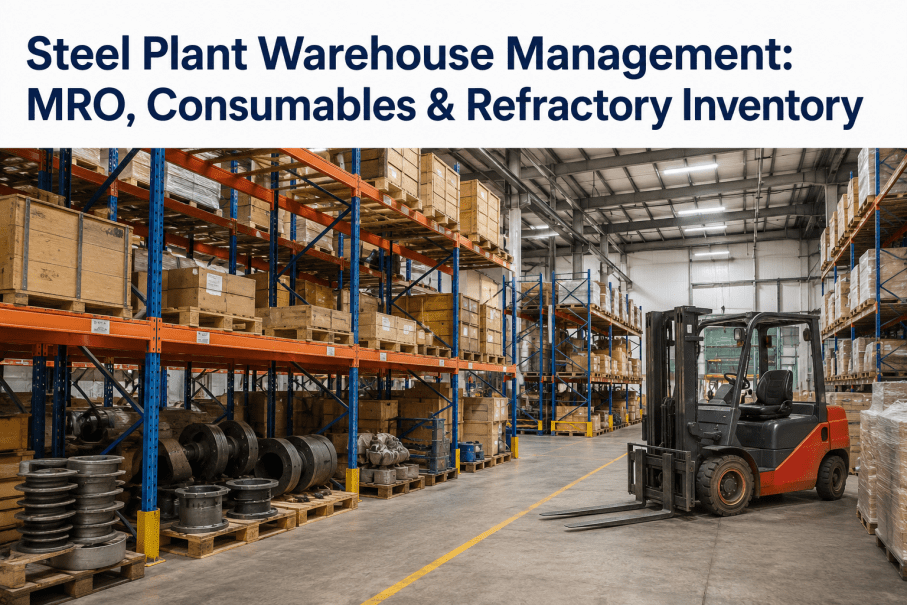
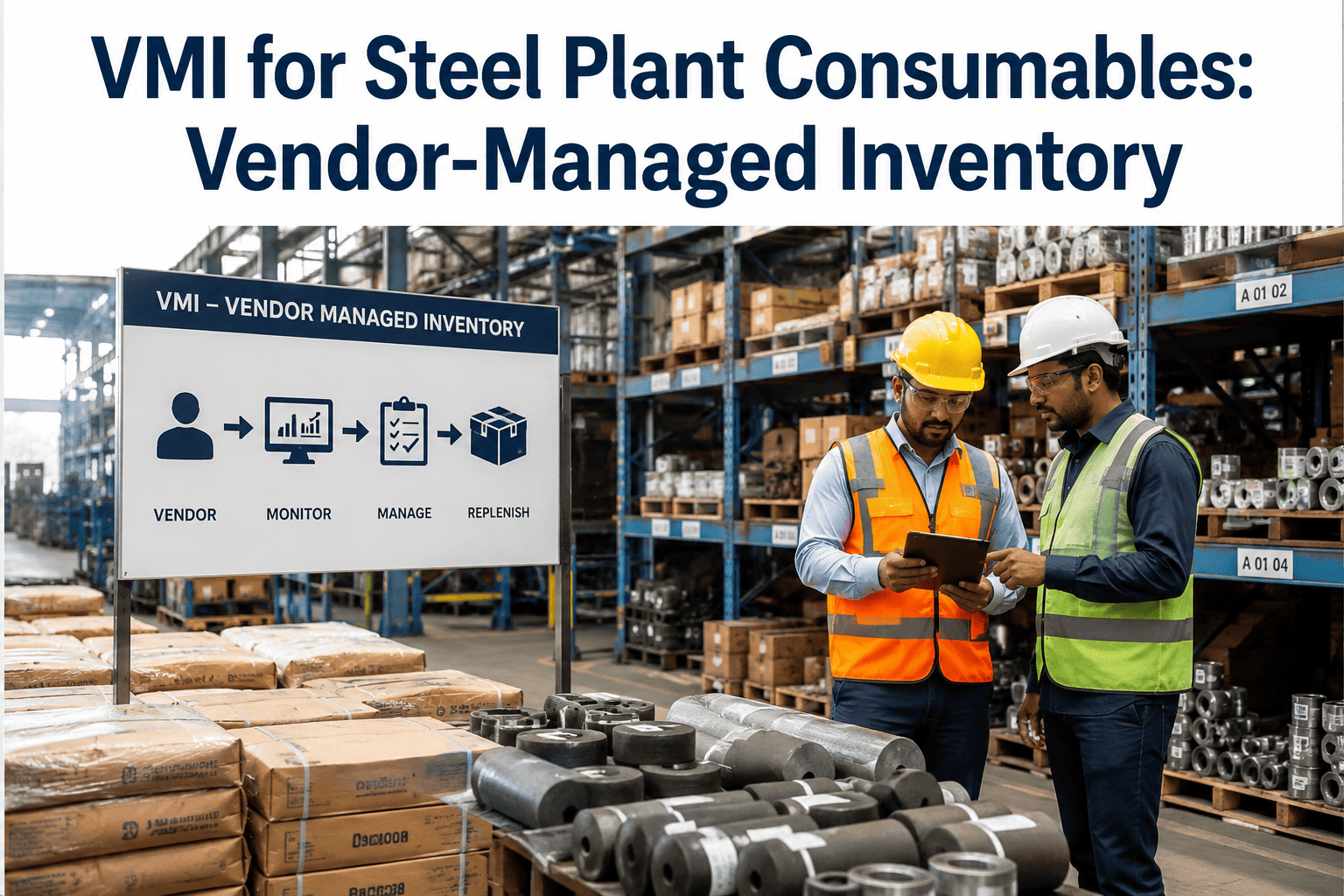
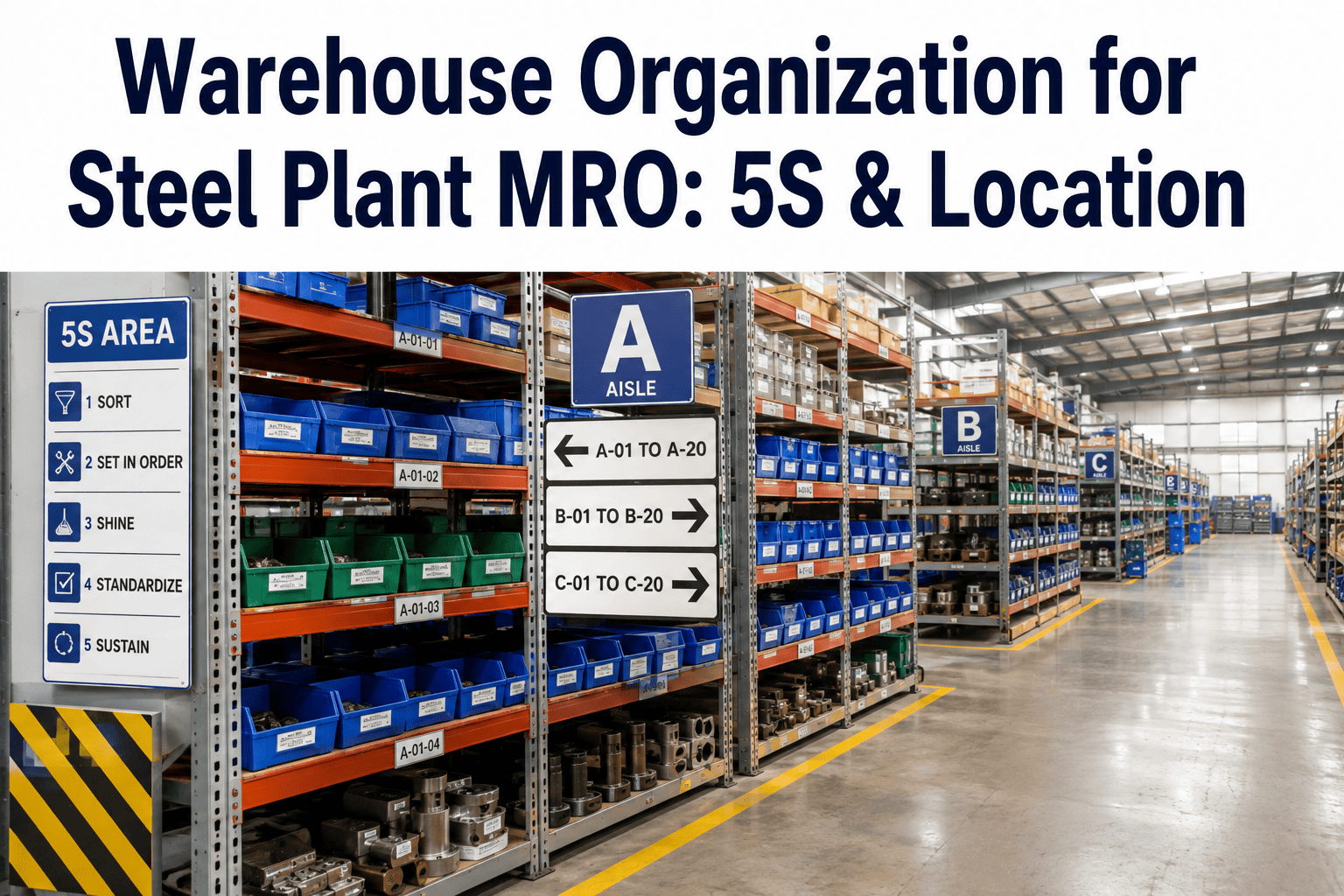
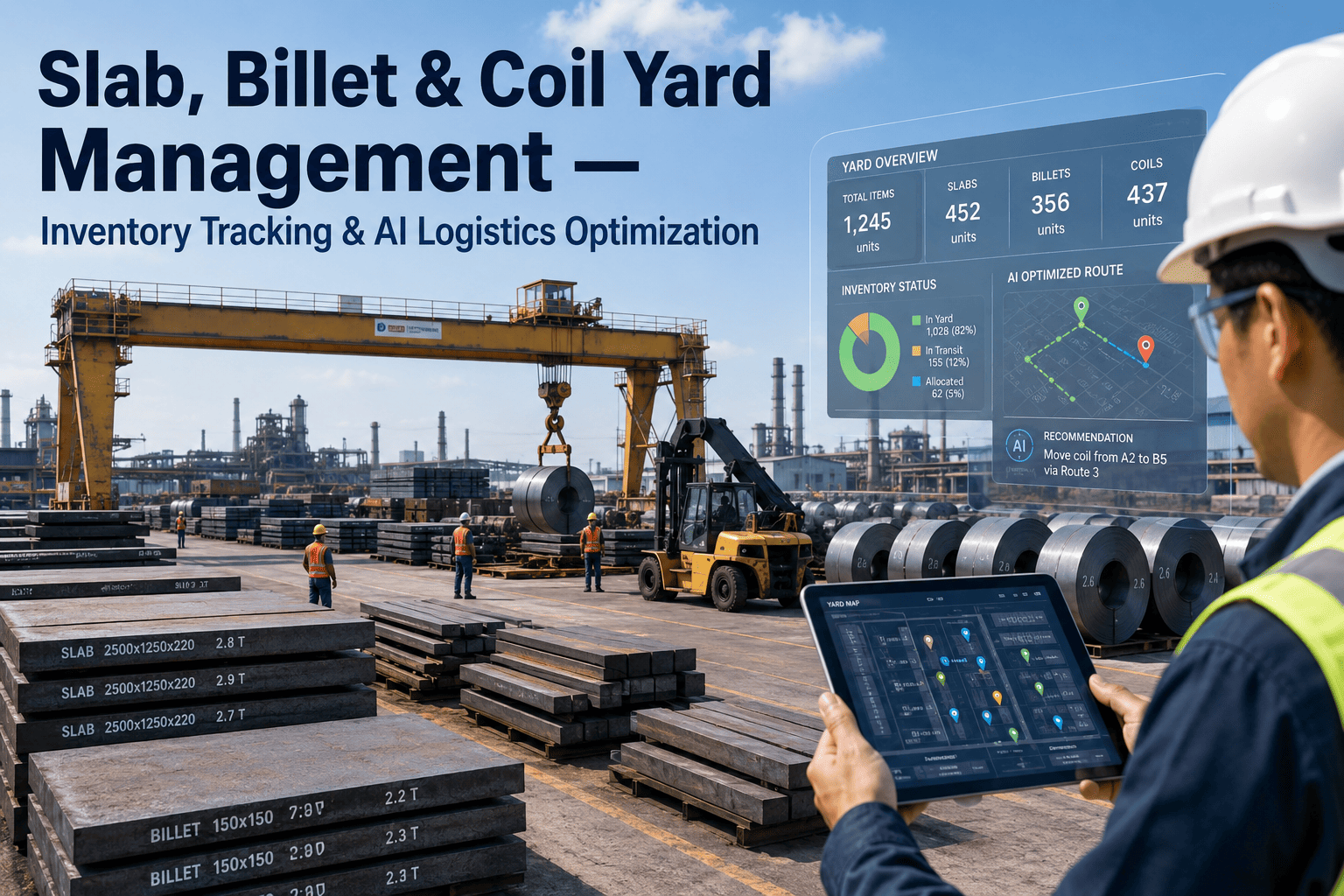
Steel plants run on materials as much as they run on metal. Every tonne of steel produced depends on a precise choreography of MRO parts, refractory linings, electrodes, fluxes, and consumable supplies moving from warehouse to production floor without delay. When that choreography breaks down — a critical spare not found, a refractory brick batch misidentified, a consumable run-out discovered mid-heat — the cost is immediate unplanned downtime, safety exposure, and restarting a furnace that costs $12,000 per hour to run idle. Steel plant warehouse management is not a back-office function. It is a production-critical discipline, and the plants treating it as one are building a measurable competitive advantage.
The Warehouse Gap in Steel Operations
Most steel plant downtime traces back to material availability failures — not equipment failures. The warehouse is the first domino.
23%
of unplanned downtime linked to MRO stockouts
$40K+
average cost per furnace stoppage event
30–40%
of warehouse stock is excess or obsolete in manual systems
The challenge is structural. A mid-size integrated steel plant carries 15,000 to 50,000 active SKUs across MRO spares, refractory materials, electrodes, lubricants, cutting consumables, and safety stock. Managing that inventory with spreadsheets, paper requisitions, and tribal knowledge is not a workflow problem — it is a risk management failure waiting to express itself as a production loss. This article maps exactly what a digitized steel plant warehouse system must cover, how it integrates with production, and what measurable outcomes quality and operations leaders should hold it accountable to. If your plant is evaluating platforms, book a live demo scoped to your warehouse layout.
The Four Inventory Categories That Drive Steel Plant Warehouse Complexity
Consolidating steel plant warehouse management into a single system requires understanding that the inventory is not homogeneous. Four distinct material categories have different velocity, criticality, lead time, and handling requirements — and a good warehouse management system must treat them differently while maintaining a single searchable record.
01
MRO Spares
Bearings, seals, motors, gearboxes, belts, and electrical components. These are low-velocity, high-criticality items. A single missing bearing can stop a rolling mill. Managed by min/max reorder logic tied to equipment criticality ratings and failure history.
High CriticalityLong Lead TimeEquipment-Linked
02
Refractory Materials
Bricks, castables, mortars, and monolithics used in EAF, ladle, tundish, and blast furnace linings. Batch-tracked by campaign and heat number. Consumes by zone and must be reconciled against lining condition reports and remaining life estimates.
Batch TrackedCampaign-LinkedZone Specific
03
Consumables
Electrodes, oxygen lances, tuyeres, fluxes, alloys, and slag formers. High-velocity items consumed predictably per heat. Forecasting against the production schedule is the key control — stockouts here stop the heat, overstock ties up capital in perishable materials.
High VelocitySchedule-LinkedPerishable
04
Safety & Indirect Supplies
PPE, maintenance tools, office and lab supplies, and janitorial materials. Managed separately from production-critical stock. Controlled by department budgets and issue-by-person tracking rather than equipment or production linkage.
Low CriticalityBudget-ControlledHigh SKU Count
The reason most steel plants struggle with warehouse accuracy is that these four categories require different data models but are often lumped into a single undifferentiated stock list. A proper warehouse management implementation assigns criticality tiers, reorder logic, and tracking depth by category — not by alphabetical order or part number series.
Barcode-Driven Issue and Receipt: Eliminating the Paper Trail
Every warehouse transaction that goes through a paper form or manual spreadsheet entry creates a latency window between physical reality and the system record. In a steel plant moving hundreds of material transactions per shift, that window compounds into significant stock discrepancies, phantom shortages, and over-purchase orders placed to cover uncertainty. Barcode scanning at every receipt and issue point closes that window to near-zero.
Digitized Material Flow: Receipt to Issue
1
Purchase Order Receipt
Goods arrive at the gate. Storekeeper scans supplier barcode or QR label. System matches against open PO, flags quantity and quality deviations, and logs receipt timestamp and GRN automatically.
2
Bin Location Assignment
System suggests optimal bin based on material type, ABC classification, and current occupancy. Storekeeper confirms or overrides. Location printed on barcode label — scanned to confirm putaway completion.
3
Material Requisition
Maintenance or production team raises digital MR against a work order or heat number. Approval workflow triggers storekeeper pick notification. No paper, no phone calls, no ambiguity on quantity or specification.
4
Pick and Issue
Storekeeper picks from directed bin location, scans item barcode and quantity. System deducts from inventory in real time, records issue against work order or cost center, and updates reorder triggers if stock falls below minimum.
5
Audit Trail Closure
Every transaction — receipt, putaway, issue, return, scrap, transfer — is time-stamped, user-stamped, and linked to the originating document. Audit-ready ledger available at any point without manual reconciliation.
Want to see barcode-driven issue and receipt running on a steel plant warehouse layout? Schedule a live platform walkthrough and bring your current transaction volume and SKU count to the conversation.
Refractory Inventory Tracking: The Most Overlooked Warehouse Problem in Steel
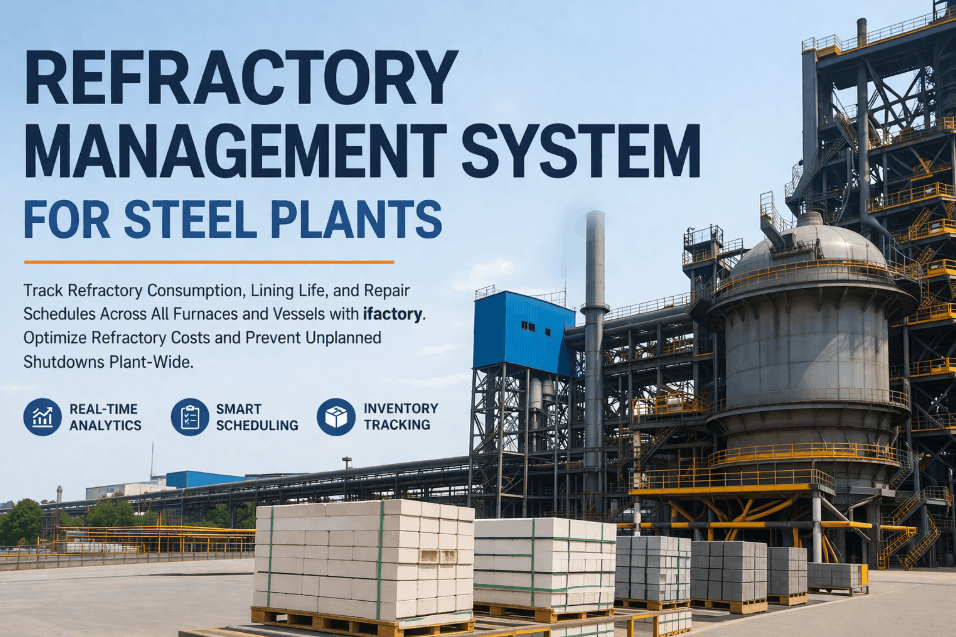
Refractory materials are the most technically complex inventory category in a steel plant warehouse — and the most frequently mismanaged. Unlike MRO spares with discrete part numbers or consumables tracked by weight or count, refractories move through the plant in campaigns linked to specific vessels, zones, and heat counts. Managing them on a generic stock ledger destroys the traceability that maintenance and engineering teams need to optimize lining performance and campaign life.
Taphole clay by daily tap count; major reline by campaign plan
Proper refractory tracking links warehouse stock records to vessel inspection data, heat logs, and campaign management — not just a generic stock count.
The practical payoff of proper refractory inventory tracking is two-sided. On the cost side, you eliminate emergency procurement of refractory materials at spot prices because the planned reline date was not visible in the warehouse system. On the quality side, you maintain complete traceability when a heat quality issue is investigated — confirming whether the lining was within specification or approaching end-of-life during the affected heats.
Digitize Your Refractory and MRO Warehouse in One Platform
iFactory's Warehouse Module connects refractory batch tracking, MRO min/max reordering, barcode-based issue/receipt, and vendor management into a single system — overlaid on your existing ERP without rip-and-replace. See your plant's inventory structure on the platform in a live demo.
Consumables Forecasting: Aligning Warehouse Stock to the Production Schedule
Consumable materials — electrodes, oxygen, fluxes, alloys, and slag formers — are the fastest-moving and most schedule-sensitive category in a steel plant warehouse. Unlike MRO spares that sit until needed, consumables burn down predictably with every heat. The forecasting problem is not complex in theory: multiply heats planned by consumption rate per heat per grade, add a safety buffer, compare against current stock, and trigger procurement. In practice, without system integration, this calculation does not happen until someone physically counts the electrode bay and finds a two-day stock with a three-day lead time.
Manual Approach
Reactive Replenishment
Driven by visual inspection and operator memory
Stock checked by walking the warehouse floor
Reorder triggered only after visual shortage spotted
No linkage between production schedule and stock planning
Emergency orders placed at 15–30% price premium
Outcome:Stockouts and emergency freight cost $80K–$400K/year
vs
Forecasting Gap
Digital Approach
Schedule-Driven Forecasting
Consumption predicted from the production plan, not the warehouse floor
Consumption modeled per heat, per grade, per furnace profile
Reorder triggered automatically when projected run-out hits lead time window
Production schedule changes propagate to procurement immediately
All orders placed on planned timelines at negotiated contract prices
Outcome:18–25% reduction in consumable procurement cost within 12 months
Curious how your current consumables procurement cost compares to schedule-driven forecasting benchmarks? Book a 30-minute warehouse intelligence demo and bring your current electrode and flux spend to the conversation.
Stock Count, Audit Readiness, and Inventory Accuracy: The Compliance Layer
Steel plant warehouses face audit scrutiny from multiple directions simultaneously: internal financial audits requiring accurate inventory valuation, ISO 9001 quality audits requiring material traceability from receipt to use, and safety audits requiring controlled issuance of hazardous materials like oxygen lances, cutting gases, and certain fluxes. Meeting all three with a paper-based or spreadsheet system requires an enormous manual reconciliation effort before every audit cycle — and still produces findings. A digitized warehouse eliminates the pre-audit scramble by maintaining a continuously accurate, audit-ready ledger as a byproduct of normal operations.
Warehouse Audit Readiness: Digital vs. Manual
Manual System
Digital System
Financial inventory valuation
Quarterly physical count, 3–5 days effort
Real-time running valuation; spot count anytime
Material traceability (ISO 9001)
Paper GRNs and issue slips; manual lookup
Barcode-linked audit trail from receipt to work order
Hazardous material control
Signature registers; hard to cross-reference
Digital issue approval + user identity logged at scan
Cycle count execution
Full physical count; operations disrupted
ABC-stratified rolling cycle counts; no shutdown needed
Dead stock / obsolete inventory
Discovered at annual count; capital locked for years
Automated zero-movement flag at 90/180/365 days
Vendor performance documentation
Manual quality rejection logs; inconsistent
Rejection logged at GRN; vendor scorecard auto-populated
The inventory accuracy benchmark for a well-run digital warehouse is 98%+ perpetual inventory accuracy — meaning the system record matches the physical count within 2% at any given moment without a formal count cycle. Plants running manual systems typically land at 85–92% perpetual accuracy, and the 8–15% gap is where emergency orders, phantom shortages, and duplicate stock accumulate.
Expert Perspective
"The steel plant warehouse is the last operational function to get digitized — and the one with the highest hidden cost when it isn't. Every unplanned heat stop that traces back to a missing electrode or a mislocated refractory batch is a warehouse data problem dressed up as a production problem. When you put barcode discipline on every transaction, connect the stock record to the production schedule, and give maintenance a real-time view of what's in the store, you stop firefighting and start planning. That shift alone — from reactive to planned material flow — is worth more than most capital equipment investments a plant will make in a given year."
— Steel Plant Operations & Inventory Management, Industry 4.0 Best Practice
98%+
perpetual inventory accuracy in digitized steel warehouses
18–25%
consumable procurement cost reduction with schedule-linked forecasting
4–8 wk
typical deployment window from integration to live barcode scanning
Conclusion: The Warehouse as a Production Asset
For decades, the steel plant warehouse was treated as a cost center to be minimized — staffed lightly, digitized last, and measured only by whether parts were available when someone needed them. The plants outperforming on OEE, refractory campaign life, and procurement cost have reframed that equation. They treat the warehouse as a production asset: a system that, when properly instrumented with barcode scanning, schedule-linked forecasting, refractory batch tracking, and real-time audit trails, actively protects uptime and reduces material cost. iFactory's Warehouse Module deploys over your existing ERP infrastructure — first live transactions within days, full inventory accuracy benchmarking within the first quarter. The remaining question is whether your plant captures that value in the next budget cycle or continues absorbing the cost of a warehouse system that was never designed for the demands placed on it.
Make Your Warehouse a Competitive Advantage, Not a Risk Factor
iFactory deploys barcode-based issue/receipt, refractory batch tracking, consumables forecasting, and audit-ready inventory ledgers over your existing systems — no rip-and-replace, live transactions within days. Get a free warehouse readiness assessment scoped to your steel plant's material categories and SKU count.
What is steel plant warehouse management and why is it different from standard inventory management?
Steel plant warehouse management covers four distinct material categories — MRO spares, refractory materials, consumables, and indirect supplies — each with different tracking depth, lead times, and production criticality. Unlike general inventory management, steel plant warehousing requires vessel-linked refractory batch tracking, schedule-driven consumable forecasting, equipment-linked MRO criticality tiers, and heat-number traceability for audit and quality purposes. A standard inventory system that treats all SKUs identically fails to surface the right signals for the right category at the right time.
How does barcode scanning improve inventory accuracy in a steel plant warehouse?
Barcode scanning eliminates the transaction latency that creates discrepancies between physical stock and system records. Every receipt, putaway, issue, return, and transfer is logged at the moment it occurs — time-stamped, user-stamped, and linked to the originating PO, work order, or heat number. Plants running barcode-based warehouse systems consistently achieve 98%+ perpetual inventory accuracy versus the 85–92% typical of manual systems, and the difference shows up as fewer emergency orders, fewer phantom shortages, and cleaner audit cycles with no pre-audit reconciliation effort.
What does refractory inventory tracking require beyond standard stock management?
Refractory materials require batch-level tracking linked to specific vessels, zones, and campaigns — not just a generic quantity-on-hand count. Each material type (bricks, castables, gunning mix, taphole clay) has a different consumption pattern tied to heat counts, sequence numbers, or campaign life targets. A proper refractory tracking system connects warehouse stock records to vessel inspection data, lining condition reports, and heat logs so that procurement is planned against remaining campaign life rather than triggered by visual shortage in the brick bay. This traceability is also required when investigating quality deviations that may be linked to lining condition.
How does a digital warehouse system reduce consumable procurement costs in a steel plant?
Schedule-driven consumable forecasting links warehouse reorder logic to the production plan rather than to physical observation. The system models electrode, flux, oxygen, and alloy consumption per heat by grade, calculates projected run-out dates against current stock, and triggers purchase orders when the run-out date falls within the supplier lead time window. All orders are placed on planned timelines at contract prices rather than as emergency spot purchases at 15–30% premium. Plants implementing this approach typically report 18–25% reductions in consumable procurement cost within the first 12 months, primarily from eliminating emergency freight and premium pricing events.
Does implementing a digital warehouse management system require replacing the existing ERP or SCADA infrastructure?
No. Modern warehouse management platforms like iFactory's Warehouse Module are explicitly designed to overlay existing ERP, CMMS, and SCADA infrastructure via standard integration protocols — REST APIs, OPC-UA, Modbus, and direct database connectors for systems like SAP, Oracle, and Microsoft Dynamics. The warehouse module consumes and writes back to the existing system of record rather than replacing it. Most steel plant deployments reach live barcode scanning transactions within 4–8 weeks and full inventory accuracy benchmarking within the first quarter, without any shutdown or infrastructure replacement.