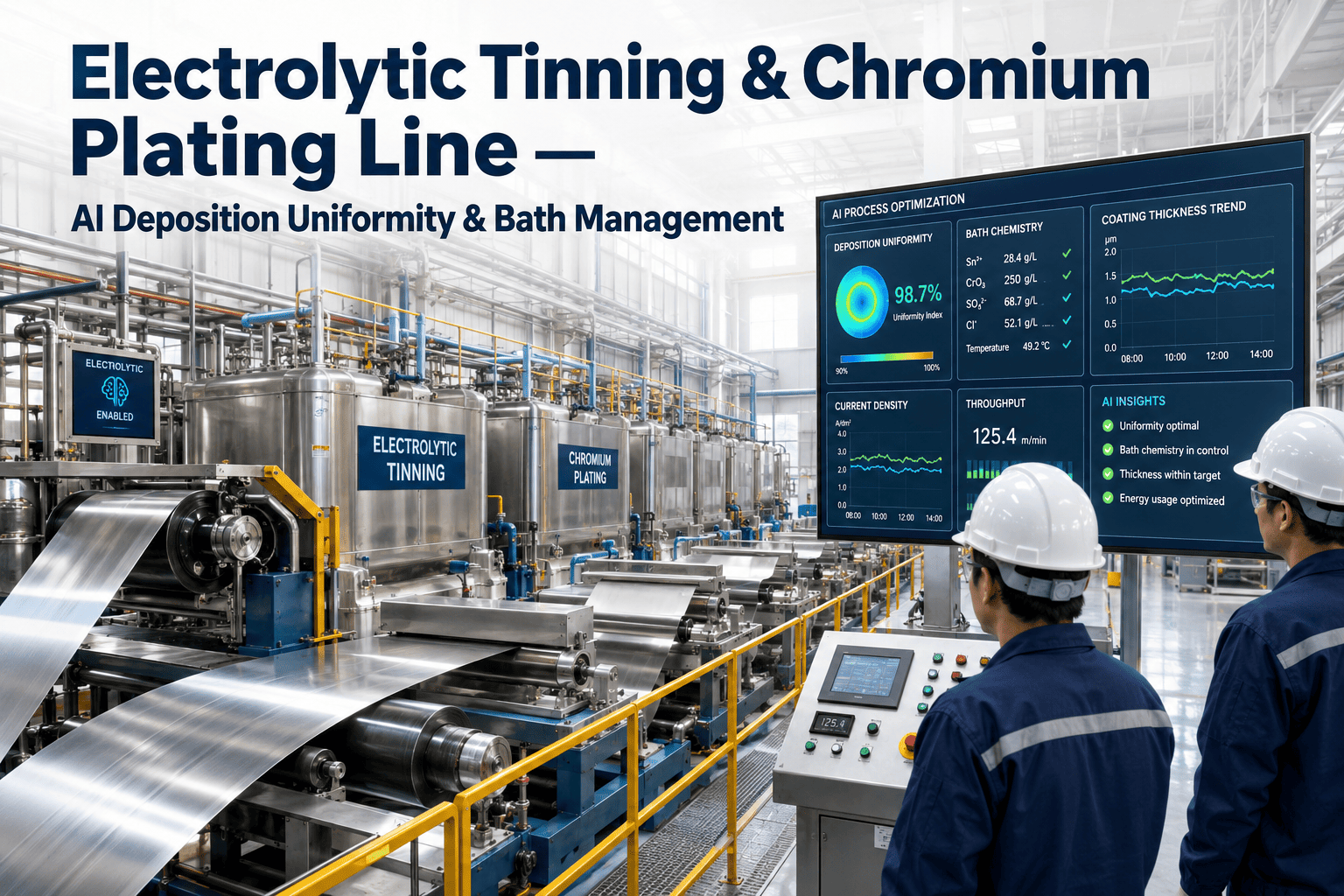
In the high-stakes environment of cold rolling and finishing, electrolytic tinning and chromium plating lines represent the final frontier of quality assurance for packaging steel and industrial coatings. These processes demand microscopic precision: a deviation of just 0.1 microns in coating thickness can compromise food preservation, corrosion resistance, or downstream forming operations. Traditional reliance on periodic lab samples and manual bath titration leaves manufacturers blind to real-time shifts in deposition efficiency, bath chemistry, and strip speed dynamics. This gap creates millions in scrap, rework, and warranty claims annually. iFactory’s AI-driven platform ingests thousands of data points per second from line sensors, bath analyzers, and thickness gauges to predict coating weight variations before they become defects. By fusing multivariate process signals with machine learning models trained on years of historical production data, our system enables maintenance and quality teams to proactively adjust current density, strip tension, and additive feed rates. The result is a 30% reduction in coating weight variability, 25% lower bath chemical consumption, and a significant decrease in unplanned line stoppages. For plant managers and maintenance directors aiming to maximize OEE and minimize total cost of ownership, this capability is transformative. Book a Demo to see how iFactory can elevate your plating line performance.
Optimize Your Plating Line Today
Achieve zero-defect coating with AI-driven bath management and deposition control.
Schedule your personalized demo now.
Why Electrolytic Tinning and Chromium Plating Demand AI Precision
Electrolytic tinning applies a thin layer of tin to steel strip for corrosion resistance in food cans, while chromium plating provides a hard, wear-resistant surface for industrial components. Both processes are highly sensitive to bath chemistry (tin or chromium ion concentration, pH, temperature), current density distribution, strip speed, and anode condition. Even minor fluctuations cause coating weight non-uniformity, pinholes, or poor adhesion. Traditional control methods rely on periodic sampling and manual adjustments, introducing latency that allows defects to propagate across hundreds of meters of strip. AI models trained on real-time sensor data can predict coating weight with 95% accuracy, enabling closed-loop control of rectifiers and additive pumps. This reduces the need for costly over-coating and minimizes environmental waste from bath chemicals.
Real-Time Bath Chemistry Monitoring
Continuous analysis of tin/chromium ion concentration, pH, and conductivity using inline spectrometers and ion-selective electrodes. AI correlates these parameters with coating quality to predict drift before defects occur.
Strip Speed & Tension Optimization
Machine learning models adjust strip speed and tension dynamically to maintain uniform deposition, compensating for variations in incoming strip surface condition and line vibrations.
Anode Wear & Current Density Mapping
Predictive algorithms detect uneven anode wear and redistribute current density across the plating cell, ensuring consistent coating thickness across the full strip width.
Defect Prediction & Root Cause Analysis
Historical defect data combined with real-time process signals enables early warning of pinholes, streaks, or adhesion failures, with automated root cause identification.
How AI Transforms Deposition Uniformity
Deposition uniformity is the holy grail of electrolytic plating. iFactory’s AI platform uses a hybrid approach combining physics-based models and neural networks. The physics model simulates electrochemical reactions and mass transport, while the neural network learns from actual production data to correct model inaccuracies. This digital twin of the plating line runs in real-time, predicting coating weight at every point across the strip. When the twin detects a deviation, it automatically adjusts rectifier voltage, anode gap, or additive flow rate. In a recent deployment at a major packaging steel mill, this system reduced coating weight variability from ±15% to ±3%, directly saving $2.3M annually in tin metal costs alone. The same approach applies to chromium plating, where hardness and wear resistance are tightly linked to bath chemistry and current density.
Implementation Roadmap: From Assessment to Autonomous Control
1. Process Audit & Sensor Integration
iFactory engineers assess existing line instrumentation and install additional sensors for bath chemistry, strip speed, current density, and coating weight. Data is streamed to the cloud edge gateway.
2. Digital Twin Calibration
Historical production data and defect logs are used to train the AI model. The digital twin is calibrated against real coating weight measurements from X-ray gauges and lab samples.
3. Closed-Loop Control Activation
AI recommendations are first presented to operators as advisory. After validation, the system is granted authority to adjust rectifiers, pumps, and strip drives in real-time.
4. Continuous Learning & Optimization
The model continuously retrains on new data, adapting to bath aging, anode wear, and seasonal changes in raw material quality. Monthly performance reviews identify further optimization opportunities.
Ready for Zero-Defect Plating?
Leverage AI to eliminate coating defects and reduce chemical waste.
Book a demo to see iFactory in action on your line.
AI-Driven vs. Traditional Plating Line Management
| Aspect | Traditional Approach | AI-Driven Approach (iFactory) |
|---|---|---|
| Bath Chemistry Control | Manual sampling every 4-8 hours; lag in corrective action | Continuous inline monitoring with predictive drift alerts |
| Coating Weight Uniformity | ±15% variability; frequent over-coating to meet specs | ±3% variability; precise deposition reduces metal use |
| Defect Detection | Post-production inspection; scrap and rework costs high | Real-time prediction; defects prevented before they occur |
| Chemical Consumption | Excess additives to compensate for drift | Optimized dosing based on actual bath demand |
| Operator Intervention | Reactive; high cognitive load | Proactive; AI handles routine adjustments |
Advanced Analytics: Predicting Coating Weight from Multivariate Signals
iFactory’s AI models analyze over 200 variables simultaneously, including bath temperature, current density profile, strip speed, strip temperature, anode gap, and additive concentration. Using a gradient-boosted regression model, the system predicts coating weight at each strip position with a mean absolute error of less than 0.05 g/m². The model also identifies the root cause of deviations: for example, a sudden drop in coating weight on the edge of the strip may indicate uneven anode wear or a misaligned strip guide. Operators receive an alert with the likely cause and recommended action, reducing troubleshooting time from hours to minutes. This level of granularity was previously impossible with manual analysis.
Bath Management: The Key to Consistent Quality
Bath chemistry is the lifeblood of electrolytic plating. Tin and chromium ion concentrations must be maintained within tight windows: for tinning, typically 20-40 g/L Sn²⁺, and for chromium, 150-300 g/L CrO₃. pH, temperature, and conductivity also directly affect deposition rate and morphology. iFactory integrates with inline titration systems and ion-selective electrodes to monitor these parameters every 30 seconds. AI models predict when a parameter will drift outside the control limit, triggering automatic dosing of additives or adjustment of current density. This closed-loop bath management reduces chemical consumption by 25% and extends bath life by 40%, lowering both operational costs and environmental impact.
Case Study: Packaging Steel Mill Achieves 30% Coating Uniformity Improvement
A leading packaging steel producer in Europe faced persistent coating weight non-uniformity on their electrolytic tinning line, resulting in 8% scrap and frequent customer complaints. After implementing iFactory’s AI platform, the mill achieved a 30% reduction in coating weight variability within three months. Bath chemical consumption dropped by 22%, and unplanned line stoppages due to quality issues decreased by 40%. The payback period was less than six months. The plant maintenance director noted that the system’s ability to predict anode wear and schedule proactive maintenance eliminated two major line stoppages per quarter.
Frequently Asked Questions
How does AI improve coating weight uniformity in electrolytic tinning?
AI models analyze real-time data from bath chemistry sensors, current density monitors, and strip speed encoders to predict coating weight at every point across the strip. When the model detects an impending deviation, it automatically adjusts rectifier voltage, anode gap, or additive flow rate to maintain uniformity. This closed-loop control reduces variability from ±15% to ±3%, ensuring consistent quality for food packaging applications. Book a Demo to learn more.
What sensors are needed for AI bath management?
iFactory integrates with existing inline sensors such as ion-selective electrodes, pH meters, conductivity probes, and temperature transmitters. For lines without these sensors, we provide retrofittable modules that install directly into the bath circulation loop. Data is collected every 30 seconds and streamed to the AI platform via a secure edge gateway. No additional IT infrastructure is required. Contact our support team for a detailed sensor compatibility list.
Can the AI system handle different strip widths and thicknesses?
Yes. The AI model is trained on historical data covering the full product mix, including varying strip widths (600-1800 mm) and thicknesses (0.15-0.5 mm). It automatically adjusts current density distribution and strip speed based on the specific product being run. The digital twin simulates the plating process for each product type, ensuring optimal coating uniformity across all dimensions. Book a Demo to see a live simulation.
How long does it take to deploy iFactory on a chromium plating line?
Typical deployment takes 8-12 weeks from initial audit to closed-loop control. The first 2 weeks involve sensor integration and data streaming setup. Weeks 3-6 are dedicated to model training and digital twin calibration using historical and live data. Weeks 7-8 involve operator training and advisory mode validation. Full autonomous control is activated in week 9 after performance benchmarks are met. Book a Demo for a detailed project plan.
What is the ROI for AI-driven plating line optimization?
ROI varies by line configuration and current performance, but typical payback is 6-12 months. Savings come from reduced tin/chromium metal consumption (15-25%), lower chemical usage (20-30%), decreased scrap and rework (30-50%), and fewer unplanned stoppages. Additionally, improved coating quality reduces customer complaints and warranty claims. iFactory provides a detailed ROI analysis during the discovery phase. Contact support to start your ROI assessment.
Transform Your Plating Line with AI
Achieve zero-defect coating, reduce chemical waste, and boost OEE.
Schedule your personalized demo today.