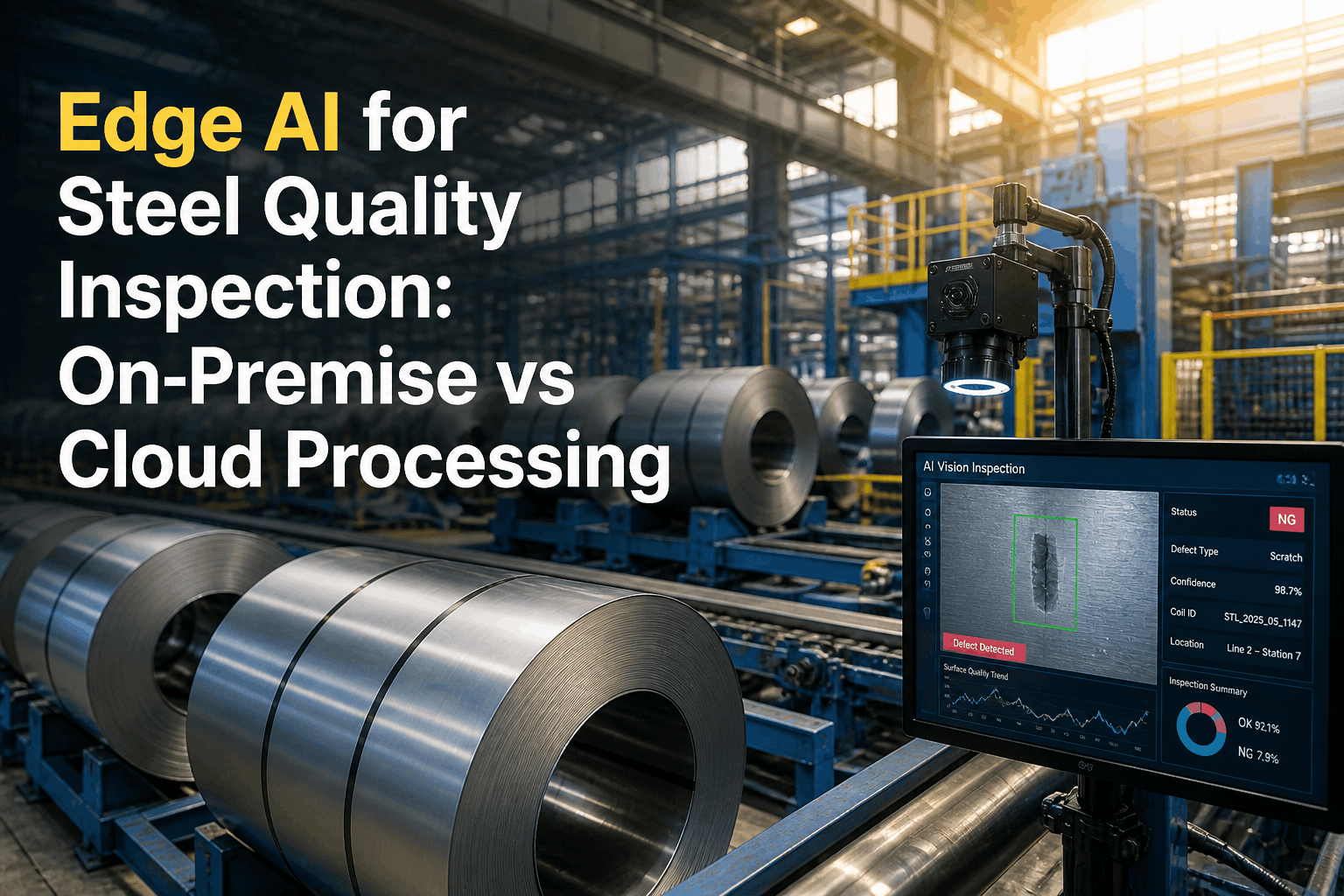
A rolling mill decision that depends on a cloud round-trip has already lost the millisecond window it needed to matter, because network latency, however small, is still too slow for a safety interlock or a real-time quality reject decision on a moving line. Steel plants that tried routing AI inference through the cloud generally ran into this wall quickly, either accepting delayed decisions or building workarounds that defeated the purpose of real-time AI in the first place. NVIDIA IGX changes that calculus by putting a safety-certified, GPU-accelerated computer directly on the plant floor, close enough to the sensors and actuators that inference happens in milliseconds, not round trips. iFactory builds its plant AI on this on-prem architecture, and you can see how it maps to your existing Level 1/2 systems by visiting this scheduling link.
Millisecond Decisions Can't Wait for a Cloud Round Trip
iFactory's on-prem AI architecture runs on NVIDIA IGX directly on your plant floor, delivering safety-certified, low-latency inference that cloud AI structurally cannot match.
The Latency Problem Cloud Architecture Cannot Solve
Cloud AI works well for batch analytics and reporting, but a plant floor decision tied to a moving process cannot tolerate the round-trip time a cloud call introduces, no matter how fast the connection.
- Round-trip latency measured in tens to hundreds of milliseconds
- Dependent on network uptime and bandwidth
- Data leaves the plant network by default
- Inference latency in single-digit milliseconds
- Runs independent of external network availability
- Data and models stay inside the plant's own network
How On-Prem AI Sits Alongside Your Existing Automation Layers
NVIDIA IGX does not replace your control systems. It adds an inference layer that sits close to Level 1 and Level 2, reading sensor data directly and returning decisions fast enough to act on in real time.
Real-Time Decisions Need a Real-Time Architecture
Safety interlocks and quality rejects on a moving line can't wait on a network call. iFactory's IGX-based architecture puts inference exactly where the decision needs to happen.
Three Reasons NVIDIA IGX Fits Industrial AI Better Than General Edge Hardware
Functional Safety Certification
IGX is built with industrial functional safety in mind, which matters when AI output feeds directly into a safety-relevant decision on the plant floor.
GPU Performance for Vision and Sensor Models
Steel plant AI use cases like vision-based safety monitoring and vibration analysis need real GPU throughput, not a stripped-down edge chip.
Air-Gapped Deployment Support
Plants with strict OT network isolation requirements can run IGX fully disconnected from external networks while still getting full model performance.
Cloud, Edge, and On-Prem Compared for Plant Floor AI
| Architecture | Typical Latency | Network Dependency | Best Fit |
|---|---|---|---|
| Cloud AI | Tens to hundreds of ms | Requires stable internet | Batch analytics, reporting |
| General Edge Device | Low, but limited compute | Local, but limited GPU power | Lightweight inference tasks |
| NVIDIA IGX On-Prem | Single-digit ms | Independent of external network | Safety-relevant, real-time plant AI |
Steel Plant AI Use Cases That Genuinely Need On-Prem Inference
Not every AI use case needs single-digit millisecond latency, but the ones below typically do, which is why they are the most common first deployments on IGX-based architecture.
Vision-Based Safety Monitoring
Detecting a worker entering a restricted zone near moving equipment needs a decision fast enough to trigger a stop before contact occurs.
Real-Time Quality Rejects
Surface defect detection on a moving line needs an inference result before the material passes the inspection point.
Vibration-Based Equipment Protection
Catching a bearing failure signature in time to trigger a protective shutdown depends on processing vibration data locally, not after a network delay.
Questions Digital Leads Ask About On-Prem AI Architecture
Does on-prem AI mean we lose the benefits of cloud-based analytics and dashboards?
How does IGX integrate with our existing PLCs, SCADA, and historian systems?
Can this run in a fully air-gapped plant network with no external internet access?
What is the typical timeline and effort to deploy IGX hardware in an existing plant?
Can IGX hardware support multiple AI use cases at once, or does each need its own unit?
Build Your Plant AI on an Architecture That Actually Fits the Floor
See how iFactory's NVIDIA IGX-based on-prem architecture delivers safety-certified, real-time AI without depending on a cloud connection.