Steel plants cannot afford milliseconds of latency — when a continuous caster detects a breakout signature, when a blast furnace tuyere shows thermal anomaly, when a rolling mill encounters gauge deviation, the corrective decision must happen in real time, not after a round-trip to the cloud. Cloud-based AI works for trend analysis and reporting, but it cannot run real-time closed-loop control at sub-50ms response, cannot operate during WAN outages, and cannot meet the air-gapped security requirements that steel plants with government or defence supply mandates must maintain. iFactory's Edge AI and On-Premise Deployment platform puts the full power of industrial AI — anomaly detection, digital twin simulation, predictive maintenance inference, and LLM-powered maintenance assistance — directly on GPU edge servers inside your plant boundary, with zero dependency on internet connectivity for real-time operations.
Edge AI for Steel Plant Analytics: On-Premise Deployment & Real-Time Analytics
Sub-50ms AI inference, air-gapped security, on-premise LLM for maintenance, and zero-cloud-dependency operations — iFactory Edge AI runs entirely inside your plant boundary.
Edge AI vs Cloud AI — Why Steel Plants Need Both, But Edge First
Cloud AI is powerful for batch analytics, model training, and dashboards. But cloud-first AI creates critical gaps in the real-time operations of a steel plant. Schedule an edge AI readiness assessment to map which of your use cases need sub-100ms response and which tolerate cloud latency.
iFactory Edge AI Hardware Stack — What Goes Inside Your Plant
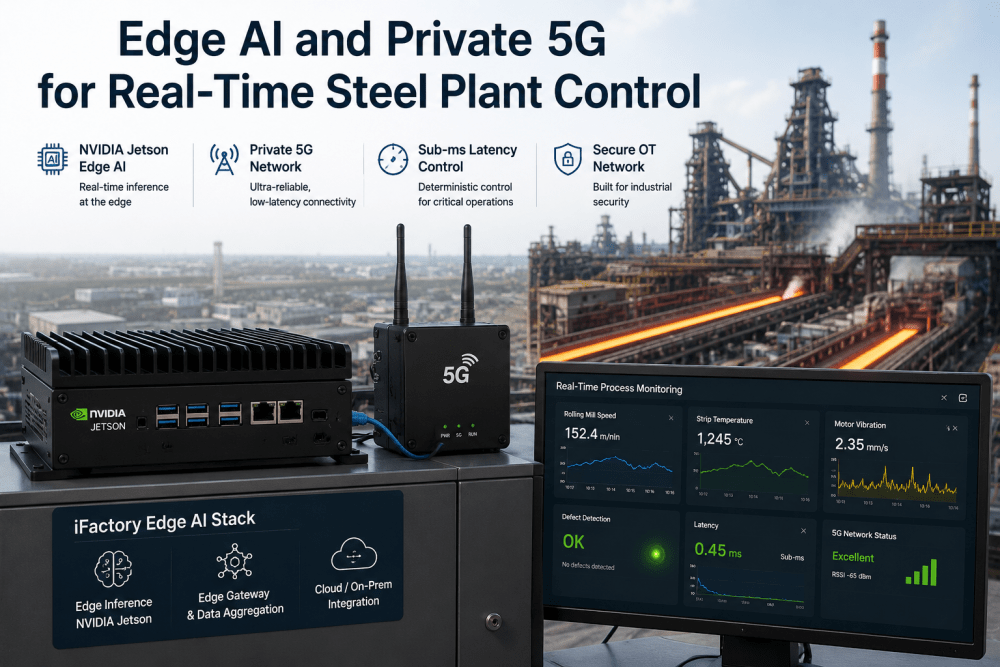
The iFactory edge deployment is purpose-built for industrial environments — fanless servers rated for high-EMI, high-vibration, and high-temperature operation, with GPU acceleration for real-time AI inference across all sensor streams simultaneously. Talk to our edge deployment team about the right hardware configuration for your plant's scale and use cases.
Six Steel Plant Use Cases That Require Edge AI — Not Cloud
Each of these use cases has a response requirement that makes cloud AI physically impossible — either the latency window is smaller than network round-trip time, or the security requirement prohibits data leaving the plant boundary.
Mould heat flux AI monitors 200+ thermocouples simultaneously. Breakout signature detected and slab withdrawal stopped in under 10ms — cloud round-trip is 200ms. Edge only.
Thermal camera AI at tuyere level detects burn-through signatures from pixel-level temperature patterns. Blast air isolation triggered in 30ms — a cloud decision arrives too late.
Hydraulic gap control AI processes X-ray gauge measurement and adjusts AGC cylinder position in under 2ms. Cloud AI cannot participate in this control loop at any WAN speed.
Plants supplying armour plate, naval steel, or aerospace grades face government mandates prohibiting production data from leaving the plant boundary. Edge AI is not optional — it is the compliance requirement.
CO/H₂S sensor arrays feed edge AI that activates plant-wide ventilation and initiates evacuation protocols within 5 seconds of threshold breach — cloud latency is not acceptable for life safety.
Llama 3 running on the plant-level edge server answers maintenance technician questions in natural language — equipment manuals, fault histories, spare part numbers — with zero data leaving the plant.
Edge AI vs Cloud AI — Latency Comparison by Steel Use Case
The numbers make the case. Every use case below has a maximum tolerable response time — defined by the physics of the process. Edge AI meets every requirement. Cloud AI fails every real-time requirement.
| Use Case | Max Tolerable | Edge AI | Cloud AI | Verdict |
|---|---|---|---|---|
| Caster breakout stop | 10ms | 8ms | 280ms | Edge Only |
| Mill AGC gauge control | 2ms | 1.6ms | 210ms | Edge Only |
| Tuyere burn-through alert | 30ms | 22ms | 260ms | Edge Only |
| Vibration anomaly detection | 100ms | 48ms | 240ms | Edge Only |
| Energy demand prediction | 15 min | Fine | Fine | Either Works |
Air-Gapped Security Architecture — How iFactory Keeps Steel Plant Data Inside the Plant
Steel plants handling defence steel, government infrastructure contracts, or sensitive IP face strict cybersecurity mandates. iFactory's edge deployment is architected from the ground up for air-gapped operation — with zero data leaving the plant boundary unless explicitly enabled by the plant operator.
Zero-Trust Network Design
All edge nodes operate on isolated industrial LAN — no internet route by default. Sensor data never crosses plant firewall boundary. External access only via air-gapped terminals with audit logging.
IEC 62443 OT Security
iFactory deployment follows IEC 62443 industrial cybersecurity standard — zone and conduit architecture, firmware signature verification, and encrypted communications between all edge nodes via mTLS.
ISO 27001 Data Governance
All data classification, access control, retention, and audit trail policies configured to ISO 27001 — with role-based access control per user, per plant zone, and per data type enforced at edge server level.
72-Hour Local Buffer — Resilience
All sensor data is buffered locally for 72 hours at full resolution on NVMe storage. AI models, alerts, and closed-loop control continue operating without interruption regardless of WAN status.
Role-Based Access Control
Operator, supervisor, engineer, and administrator roles with granular permissions — who can see which data, which models, which alerts, and which configuration parameters. Full audit trail per user.
DSCI & CERT-In Compliance
iFactory edge deployment documentation and audit controls aligned to DSCI framework and CERT-In guidelines for critical information infrastructure — covering Indian steel plants under national security mandate.
Edge AI Deployment Roadmap — From First Server to Full-Plant AI Coverage
A full steel plant edge AI deployment follows a structured 4-phase programme — delivering measurable value from Week 6, not Month 18. iFactory's deployment team handles hardware, network integration, model calibration, and SAP connection in parallel workstreams.
Edge server installation, OT network configuration, OPC-UA bridge setup, PLC/SCADA data connection, SAP PM RFC interface test. Hardware rated and commissioned per IEC 62443.
Vibration anomaly, thermal trending, and energy anomaly models deployed and calibrated. First real-time alerts firing. Baseline established per asset for anomaly scoring.
Caster breakout, tuyere failure, and mill gauge control AI models deployed to edge with closed-loop PLC integration. Response latency verified at commissioning. Air-gap mode tested.
Llama 3 / Mistral fine-tuned on plant manuals and SAP history, deployed on plant server. All remaining AI models live. Security audit completed. Full plant AI coverage confirmed.
What a Head of Digital Operations Said
Our first cloud AI vendor told us the 350ms round-trip latency was acceptable. I asked them to stand in front of a caster that had just had a breakout and explain why 350ms was acceptable. We switched to iFactory Edge AI — the caster breakout model now responds in 8ms and the system has prevented three breakout events in 14 months. That is approximately ₹22 crore of avoided cost.
Frequently Asked Questions
What happens to the AI analytics when the WAN connection goes down?
Absolutely nothing changes for real-time operations. Edge AI runs entirely on plant-level hardware — anomaly detection, closed-loop control, and maintenance alerts continue without interruption. Cloud dashboards go offline but plant operations are unaffected.
Which on-premise LLM does iFactory deploy for maintenance assistance?
iFactory supports Llama 3 8B/70B, Mistral 7B, and Phi-3 Medium — quantized to 4-bit or 8-bit precision for inference on A100 GPU hardware. The model is fine-tuned on your plant's maintenance manuals, SAP PM history, and equipment documentation during deployment.
How long does a full edge AI deployment take for a 3–5 MTPA plant?
Hardware installation and network integration: 2–3 weeks. First AI models live (vibration anomaly, thermal trending): Week 4–6. Full plant coverage with all models active: Week 10–14. On-premise LLM fine-tuning and deployment: Week 8–12.
Can iFactory edge AI connect to existing Siemens, ABB, or Honeywell PLC systems?
Yes — via OPC-UA, Modbus TCP, Profinet, and HART adapters. No PLC replacement required. iFactory reads existing process variables and writes back control outputs through the same protocol interfaces your SCADA already uses.
Deploy Edge AI Inside Your Plant — Zero Cloud Dependency
Demo built around your latency requirements, use cases, and security constraints.