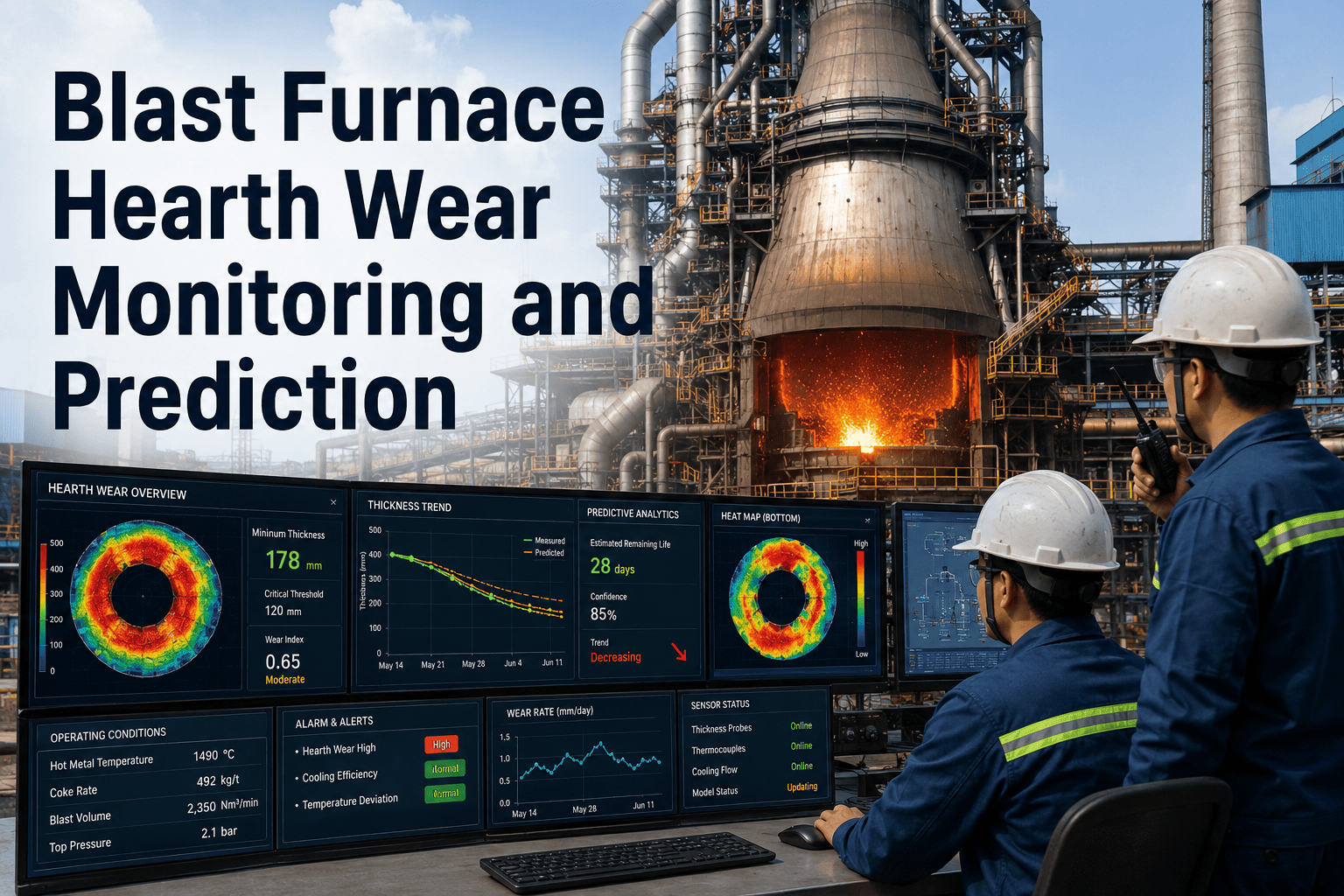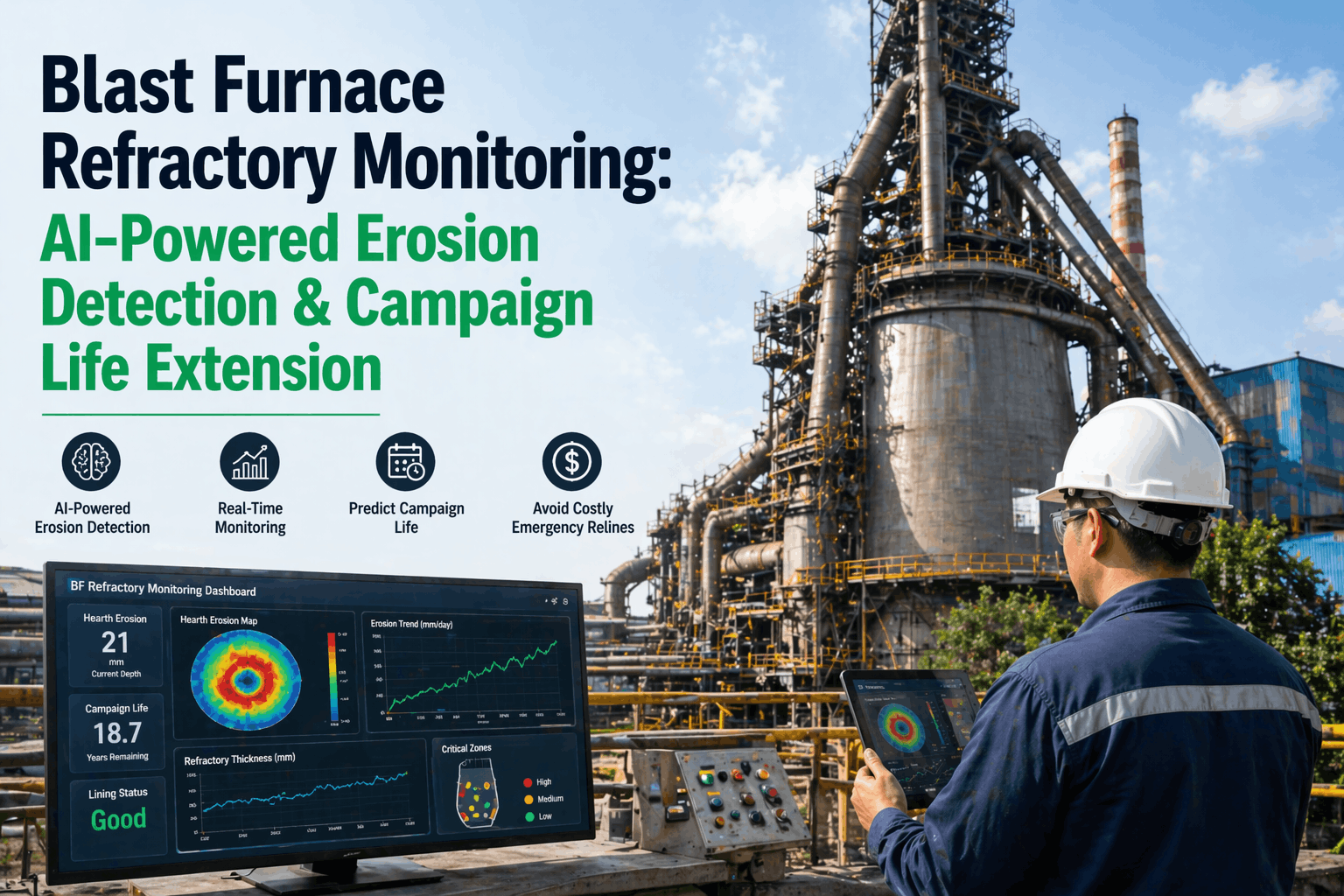
Refractory linings are the invisible armor protecting every furnace, ladle, converter, and kiln in heavy industry — withstanding temperatures exceeding 1700°C while containing molten metal, corrosive slag, and extreme thermal cycling. When refractory fails without warning, the consequences are catastrophic: molten steel breakouts that destroy equipment, injure workers, halt production for weeks, and cost millions in emergency relining and lost output. Yet most plants still monitor refractory condition through periodic visual inspections and scheduled shutdowns — missing the gradual degradation that leads to sudden, catastrophic failure. In 2026, AI-powered continuous refractory monitoring is transforming furnace management — predicting lining wear in real time, optimizing reline schedules, and preventing breakouts before they happen. iFactory's AI platform brings this transformation to your facility. Book a free consultation and discover how AI refractory monitoring extends furnace life and eliminates breakout risk.
Refractory Lining Monitoring with AI: Extending Furnace Life and Preventing Breakouts
Monitor. Predict. Protect.
A single refractory breakout can cost $2–10 million in direct damage, production loss, and emergency repairs — not counting the catastrophic safety risk of molten metal escaping containment. AI-powered continuous monitoring uses embedded thermocouples, thermal imaging, acoustic emission sensors, and machine learning to track lining wear in real time, predict remaining life with 95%+ accuracy, and alert operators weeks before critical thickness thresholds are reached. This guide covers how it works, what it costs, and why leading steel, cement, and glass plants are deploying it now.
Refractory Breakout Event
With AI-Optimized Campaigns
Accuracy With AI Models
Why Refractory Failures Are So Dangerous — And So Expensive
Refractory linings degrade invisibly under extreme heat, chemical attack, and mechanical stress. Here is what happens when monitoring fails.
How AI-Powered Refractory Monitoring Works
From embedded sensors to predictive lining life models — a continuous monitoring system that replaces guesswork with data-driven certainty.
Multi-Point Thermal and Structural Sensing
Embedded thermocouples at multiple depths through the refractory wall measure thermal gradients continuously. External infrared thermal cameras scan shell temperatures across the entire vessel surface. Fiber optic distributed temperature sensing (DTS) provides continuous linear monitoring along critical zones. Acoustic emission sensors detect micro-cracking and spalling events invisible to thermal methods.
Cross-Sensor Correlation and Heat Flux Mapping
The AI platform fuses data from all sensor types into a unified 3D thermal model of the vessel lining. Heat flux calculations at every monitoring point reveal the effective remaining thickness — accounting for material conductivity changes, coating buildup, and infiltration effects that single-sensor approaches miss entirely.
Remaining Lining Life and Wear Rate Forecasting
Machine learning models trained on historical campaign data, process parameters (temperature, slag chemistry, tapping frequency), and real-time sensor trends predict remaining lining life for each zone of the vessel. Wear rate acceleration is detected weeks before critical thresholds — giving operations teams time to plan interventions without emergency shutdowns.
Tiered Alerting With CMMS Work Order Integration
Three-tier alert system: Advisory (watch zone — accelerated wear detected), Warning (plan reline — approaching minimum safe thickness), and Critical (immediate action — breakout risk imminent). Each tier automatically generates the appropriate CMMS work order — from scheduling a planned reline to triggering emergency response protocols.
Campaign Life Extension and Reline Planning
AI recommends optimal reline timing by balancing remaining lining life against production schedules, refractory material availability, and maintenance crew capacity. Hot repairs and gunning can be targeted to specific degraded zones rather than full relines — extending campaign life by 20–30% while reducing refractory material consumption.
Continuous Model Improvement Across Campaigns
Every reline event provides ground-truth data — actual remaining thickness versus AI predictions, wear pattern validation, and material performance under specific operating conditions. Models retrain continuously, improving accuracy campaign over campaign and building a proprietary knowledge base specific to your vessels and operating practices.
Refractory Monitoring Across Furnace Types and Industries
Every vessel containing extreme heat needs refractory monitoring. Here is where AI monitoring delivers the highest impact across steel, cement, glass, and non-ferrous metals.
| Vessel Type | Industry | Lining Temp | Key Failure Modes | Monitoring Priority |
|---|---|---|---|---|
| Blast Furnace Hearth | Steel (BF-BOF) | 1500–1600°C | Carbon erosion, salamander buildup | Critical |
| BOF Converter | Steel (BF-BOF) | 1650–1700°C | Slag erosion, thermal spalling | Critical |
| Electric Arc Furnace | Steel (EAF) | 1600–1800°C | Hot spot formation, electrode erosion zone | Critical |
| Steel Ladle | Steel (All) | 1550–1650°C | Slag line erosion, glaze cracking | Critical |
| Tundish | Steel (Continuous Casting) | 1500–1550°C | Impact zone wear, stopper erosion | High |
| Rotary Cement Kiln | Cement | 1400–1500°C | Coating loss, ring formation, shell hot spots | Critical |
| Glass Melting Furnace | Glass | 1500–1650°C | Crown drip, throat erosion, bottom wear | Critical |
| Copper Smelting Furnace | Non-Ferrous | 1200–1350°C | Matte penetration, tuyere zone wear | High |
Our engineers will prioritize your vessel fleet by risk and ROI in a free 30-minute assessment.
What Your Refractory Monitoring System Must Deliver
Effective AI refractory monitoring goes far beyond temperature alarms. These four capabilities transform monitoring from reactive hot spot detection into proactive lining lifecycle management.
Real-Time Lining Thickness Estimation
Inverse heat transfer calculations using thermocouple arrays and shell temperature data produce continuous remaining-thickness maps across the entire vessel. Operators see a live 3D visualization of lining condition — no shutdown or invasive measurement required. Thickness estimates validated to within 10–15mm accuracy against post-campaign measurements.
Predictive Campaign Planning
AI models project when each zone of the vessel will reach minimum safe thickness under current operating conditions — then simulate how changes in production rate, slag chemistry, or tapping frequency would extend or shorten remaining life. Maintenance planners get a dynamic reline window rather than a fixed calendar date.
Hot Spot Detection and Breakout Prevention
Thermal cameras and shell temperature sensors detect localized hot spots indicating accelerated lining loss. When a hot spot develops, the system calculates estimated time to breakout, alerts operators with severity classification, and triggers CMMS work orders for emergency gunning, cooling water adjustment, or production rate reduction to stabilize the affected zone.
Refractory Material Performance Analytics
Track how different refractory brands, grades, and installation methods perform under your specific operating conditions. Compare campaign life by material supplier, correlate wear rates with process variables, and build data-driven specifications for procurement — eliminating subjective material selection and negotiating from a position of verified performance data.
Need these capabilities for your furnace fleet? Book a free demo and see real-time lining monitoring configured for your vessel types.
Traditional Refractory Management vs. AI-Powered Continuous Monitoring
Refractory Monitoring ROI — The Numbers That Matter
Plants deploying AI refractory monitoring are seeing measurable returns across safety, uptime, material costs, and furnace campaign life.
| Metric | Without AI Monitoring | With AI Monitoring | Improvement |
|---|---|---|---|
| Breakout Incidents | 1–3 per year (high-risk vessels) | Near zero | 95%+ prevention |
| Campaign Life | Baseline | 20–30% longer | 30% extension |
| Refractory Material Cost | Baseline | 15–25% lower | 25% savings |
| Unplanned Reline Downtime | 72+ hours per event | Planned: 24–36 hours | 50% shorter |
| Hot Spot Detection Time | Hours to days (walk-around) | <5 minutes (continuous) | 99% faster |
| Lining Thickness Accuracy | Unknown between shutdowns | Continuous, 10–15mm precision | Real-time visibility |
Our engineers will calculate the ROI specific to your furnace fleet in a free assessment.
Implementation Roadmap — From Audit to Autonomous Monitoring
A typical refractory monitoring deployment runs 8–16 weeks depending on the number of vessels and existing sensor infrastructure.
| Phase | Focus | Timeline | Key Deliverables | Impact |
|---|---|---|---|---|
| 01 Audit | Vessel fleet assessment, sensor gap analysis | 1–2 weeks | Risk-ranked vessel map, sensor plan | Prioritized fleet |
| 02 Design | Sensor placement, thermal model configuration | 2–3 weeks | Monitoring architecture, integration spec | Engineered solution |
| 03 Install | Thermocouple embedding, camera deployment | 2–4 weeks | Live sensor network during reline window | Data collection starts |
| 04 Calibrate | AI model training, baseline establishment | 1–3 weeks | Calibrated thermal models, alert thresholds | Accurate predictions |
| 05 Validate | Parallel monitoring, accuracy verification | 1–2 campaigns | Verified predictions vs actual wear | Proven accuracy |
| 06 Optimize | Campaign extension, material analytics | Ongoing | Reline optimization, supplier benchmarking | Continuous ROI |
Refractory Components and Parameters Monitored
Refractory Monitoring With AI — Key Questions Answered
How does AI predict remaining refractory lining life?
AI models combine real-time thermocouple data (thermal gradients through the wall), external shell temperature scans, acoustic emission signals (micro-cracking), and process parameters (temperature, slag chemistry, heat count) to calculate effective remaining thickness using inverse heat transfer methods. Historical campaign data trains the model to recognize wear acceleration patterns — predicting when each zone will reach minimum safe thickness with 95%+ accuracy after the first calibration campaign.
Can sensors survive inside furnace refractory at 1700°C?
Thermocouples are embedded at specific depths within the refractory wall — not at the hot face. Type K and Type S thermocouples in ceramic protection tubes operate reliably at the temperatures they experience within the wall (typically 400–1200°C depending on depth). External monitoring via infrared cameras and shell-mounted sensors avoids direct hot-face exposure entirely. Fiber optic DTS cables are rated for continuous operation at temperatures encountered in the outer wall zones. See sensor placement strategies in a live demo.
Do we need to shut down the furnace to install monitoring?
Embedded thermocouples are installed during a planned reline — adding minimal time to the reline schedule (typically 4–8 hours). External thermal cameras, shell temperature sensors, and fiber optic cables are installed while the vessel is operating with no production interruption. For vessels approaching their next planned reline, the full sensor suite can be installed in a single coordinated campaign.
How does this integrate with our existing CMMS?
The platform integrates with all major CMMS and EAM systems via REST APIs. When monitoring detects accelerated wear, a tiered alert triggers the appropriate CMMS response — advisory watch orders for trending issues, planned reline work orders when approaching threshold, and emergency work orders when critical risk is detected. Parts pre-staging for refractory materials is automated based on predicted reline windows.
What accuracy can we expect for thickness predictions?
After initial calibration against a post-campaign measurement (first reline after installation), AI thickness predictions typically achieve 10–15mm accuracy for working lining remaining thickness. Accuracy improves with each subsequent campaign as the model accumulates more ground-truth data. For vessels with dense thermocouple arrays, accuracy can reach 5–10mm in well-characterized zones. Discuss accuracy targets for your vessels.
What ROI can we expect from refractory monitoring?
The three primary ROI drivers are: breakout prevention (avoiding $2–10M per incident), campaign extension (20–30% longer life reduces reline frequency and material costs by 15–25%), and planned versus emergency downtime (50% shorter outages). A single prevented breakout typically pays for the entire monitoring system across all vessels for 5–10 years. Most plants see full ROI within the first campaign cycle. Get a custom ROI calculation for your vessel fleet.
Can this monitor cement kilns and glass furnaces too?
Yes. While the core technology is the same, AI models are configured specifically for each vessel type. Cement kiln monitoring focuses on coating stability, ring formation detection, and shell hot spot prevention. Glass furnace monitoring addresses crown refractory drip, throat erosion, and bottom wear patterns. The platform supports multi-industry deployment across steel, cement, glass, non-ferrous metals, and petrochemical applications from a single dashboard.
Ready to Extend Furnace Life and Eliminate Breakout Risk?
Every furnace operating without continuous refractory monitoring is one thermal cycle closer to a breakout you cannot predict. Join steel, cement, and glass manufacturers who have extended campaign life by 30%, prevented 95% of breakout incidents, and saved millions in refractory material costs. Let our refractory engineers show you exactly how — in a free, no-obligation 30-minute assessment tailored to your vessel fleet.