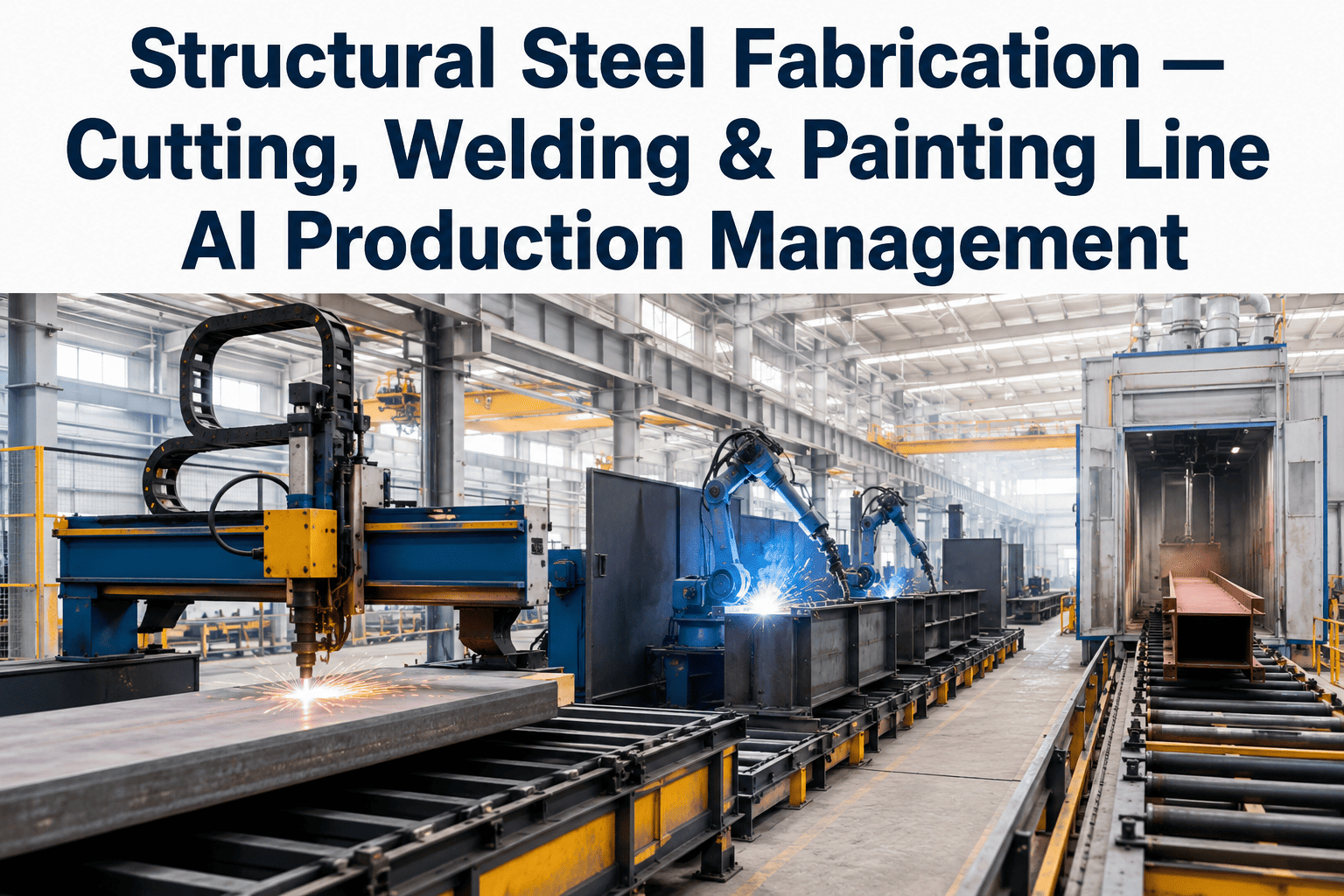
Structural steel fabrication is the backbone of modern construction, yet it remains fraught with inefficiencies in cutting, welding, and painting operations. Traditional approaches rely on manual oversight, leading to unpredictable downtime, quality variations, and schedule slippage. For operations directors managing beam, column, and connection fabrication, the pressure to meet project deadlines while controlling costs is immense. AI-driven predictive maintenance and real-time monitoring offer a transformative solution: by integrating sensor data from plasma cutters, welding robots, and painting lines, you can anticipate failures, optimize throughput, and ensure consistent weld quality. This comprehensive guide dives deep into how artificial intelligence revolutionizes each stage of structural steel fabrication, from raw material to finished coating. Discover actionable strategies to slash unplanned downtime by up to 40%, improve first-pass yield by 25%, and align production scheduling with complex project timelines. Book a Demo to see iFactory's AI platform in action.
AI-Powered Structural Steel Fabrication Management
Optimize cutting, welding, and painting lines for beams, columns, and connections with predictive analytics and real-time production monitoring.
The Challenge
Structural steel fabrication faces fragmented data from cutting, welding, and painting processes, leading to hidden bottlenecks and quality escapes. Manual scheduling fails to adapt to real-time machine health, causing project delays and rework costs.
The AI Solution
iFactory's platform ingests machine data, environmental sensors, and quality metrics to provide a unified dashboard. Predictive models forecast wear on cutting nozzles, welding torch angles, and paint booth filters, enabling proactive maintenance and optimized production flow.
Key Outcomes
Clients report 30% reduction in unplanned downtime, 20% improvement in weld defect rates, and 15% faster painting line changeovers. Production scheduling accuracy improves to within 95% of plan, directly impacting project delivery.
AI in Plasma and Flame Cutting Systems
Plasma and flame cutting are the first critical steps in beam and column fabrication. AI monitoring of gas pressure, nozzle condition, and cut speed ensures consistent edge quality and minimizes taper. By analyzing historical wear patterns, the system predicts when a nozzle will fail, scheduling replacement during planned downtime. This reduces scrap rates by up to 18% and improves cutting speed by 12% through optimal parameter adjustments. Real-time alerts for gas flow anomalies prevent costly rework on thick plates.
Predictive Nozzle Life
Machine learning models track hours of use, material thickness, and gas mix to forecast remaining nozzle life within 5% accuracy, enabling just-in-time replacement without interrupting production.
Adaptive Cut Parameters
AI adjusts travel speed, amperage, and gas flow in real-time based on plate thickness and surface condition, maintaining kerf width within 0.1mm tolerance for all structural shapes.
Edge Quality Classification
Computer vision cameras inspect cut edges for dross and roughness, classifying defects into categories and triggering automatic parameter corrections or operator alerts for manual intervention.
Welding Robot Quality Metrics
| Parameter | Traditional Monitoring | AI-Enhanced Monitoring | Improvement |
|---|---|---|---|
| Weld Defect Rate | 5-8% | 1-2% | 75% reduction |
| Torch Alignment Drift | Detected after 50 welds | Real-time correction | 90% faster response |
| Wire Feed Speed Variation | +/- 10% | +/- 2% | 80% tighter control |
| Shielding Gas Flow | Manual check hourly | Continuous monitoring | 100% coverage |
Data sourced from iFactory deployments in structural steel shops across North America and Europe.
Production Scheduling Optimization
Data Ingestion
Collect real-time machine status, job queue, and material availability from ERP and MES systems. AI normalizes data from cutting, welding, and painting lines into a unified timeline.
Constraint Modeling
Define dependencies between operations: cutting must finish before welding, painting requires surface prep. The model incorporates machine health probabilities to predict slowdowns.
Dynamic Scheduling
Every 15 minutes, the AI re-optimizes the schedule to minimize changeover time and meet project milestones. It reserves maintenance windows based on predicted failures.
Execution & Feedback
Operators see updated tasks on dashboards. Completed jobs feed back into the model, improving future predictions. Schedule adherence is tracked and reported.
Ready to Transform Your Fabrication Line?
Implement AI-driven production management to maximize throughput and quality. Schedule a personalized demo today.
Painting Line Performance Analytics
The painting line is often the final bottleneck in structural steel fabrication. AI monitors paint booth temperature, humidity, and conveyor speed to ensure consistent coating thickness and cure time. Predictive models identify when filters need replacement, preventing defects like orange peel or runs. By analyzing historical data, the system recommends optimal batch sizes to reduce color changeover time by 20%. Real-time viscosity control adjusts thinner addition, saving up to 15% on paint costs annually.
Quality Assurance Across All Stages
End-to-end quality management requires integrating data from cutting, welding, and painting. AI correlates defects back to machine parameters and operator actions, enabling root cause analysis. For example, a spike in weld porosity might be traced to a specific gas cylinder batch, while painting defects may link to humidity spikes. The system generates automated reports for ISO 3834 and EN 1090 compliance, reducing audit preparation time by 50%. Real-time dashboards show quality KPIs for each production line, empowering shift supervisors to make data-driven decisions.
Defect Correlation Engine
Automatically links quality issues to upstream process variables, reducing investigation time from hours to minutes. Supports continuous improvement initiatives.
Compliance Reporting
Generates weld maps, coating thickness logs, and material traceability reports in standard formats. Integrates with major ERP systems for seamless documentation.
Operator Feedback Loop
Delivers real-time quality scores to workstation screens, enabling immediate corrective actions. Historical trends inform training needs and process adjustments.
Frequently Asked Questions
How does AI handle the variability in steel grades and thicknesses during cutting?
AI models are trained on historical data from thousands of cuts across various steel grades (e.g., S235, S355, S460) and thicknesses from 6mm to 100mm. The system uses a combination of regression algorithms and neural networks to predict optimal cutting parameters for each unique combination. For instance, when switching from a 12mm plate of S275 to a 25mm plate of S460, the AI automatically adjusts amperage, gas mix, and speed within 2 seconds. This adaptive control reduces edge roughness by 30% and eliminates the need for manual trial cuts. The model also accounts for plate surface condition, such as rust or mill scale, by analyzing sensor feedback from the cutting torch. Book a Demo to see how our cutting AI adapts to your material portfolio.
What is the ROI timeline for implementing AI in a structural steel fabrication shop?
Typical ROI is achieved within 6 to 9 months for medium to large fabrication shops (annual throughput above 10,000 tons). The primary drivers are reduced rework (saving 15-25% on labor and material), decreased unplanned downtime (saving 20-40% on maintenance costs), and optimized scheduling (improving on-time delivery by 30%). For example, a client with 12 cutting machines and 8 welding robots saw a net savings of $1.2 million in the first year after deploying iFactory's platform. The initial investment includes sensors, edge computing hardware, and software licensing, but the payback period is accelerated by quick wins in the first 90 days. Contact Support for a customized ROI calculator based on your specific production data.
Can AI integrate with existing ERP and MES systems like SAP or ProNest?
Yes, iFactory's platform provides pre-built connectors for major ERP systems (SAP, Oracle, Microsoft Dynamics) and MES solutions (ProNest, Sigmanest, FabSuite). The integration is bidirectional: the AI reads production orders, material specs, and schedule constraints from the ERP, and writes back real-time machine status, quality metrics, and actual production times. This ensures that your planning team always has accurate data for project management. For legacy systems without APIs, we offer a lightweight middleware that parses flat files or database dumps. The setup typically takes 4-6 weeks, with minimal disruption to ongoing operations. Book a Demo to see integration examples.
How does AI improve welding quality for complex joints like moment connections?
For complex joints such as moment connections or column splices, AI uses multi-sensor fusion including weld pool cameras, arc voltage sensors, and wire feed speed monitors. The model detects deviations in weld bead profile, penetration depth, and heat input in real-time. If the system detects an anomaly—for instance, insufficient penetration on a flange weld—it can automatically adjust travel speed or weave pattern within milliseconds. Over time, the AI learns the optimal parameters for each joint type, material combination, and welding position (flat, horizontal, vertical). This results in a 40% reduction in repair rates for critical connections. The system also logs every weld parameter for traceability, which is essential for seismic or high-rise projects. Contact Support for case studies on complex joint welding.
What cybersecurity measures are in place for cloud-based AI platforms?
iFactory's platform adheres to ISO 27001 and SOC 2 Type II standards. All data transmitted between the shop floor and cloud is encrypted using TLS 1.3, and at rest using AES-256. Customer data is isolated in dedicated virtual private cloud instances with role-based access control. For shops with strict data residency requirements, we offer an on-premises deployment option where all AI processing occurs within the local network. Regular penetration testing and vulnerability assessments are conducted by third-party firms. Additionally, the platform supports single sign-on through Azure AD or Okta, and all access logs are retained for audit purposes. Book a Demo to discuss your specific security requirements.
Transform Your Structural Steel Fabrication Today
Leverage AI to optimize cutting, welding, and painting lines. Achieve higher quality, lower costs, and on-time delivery.