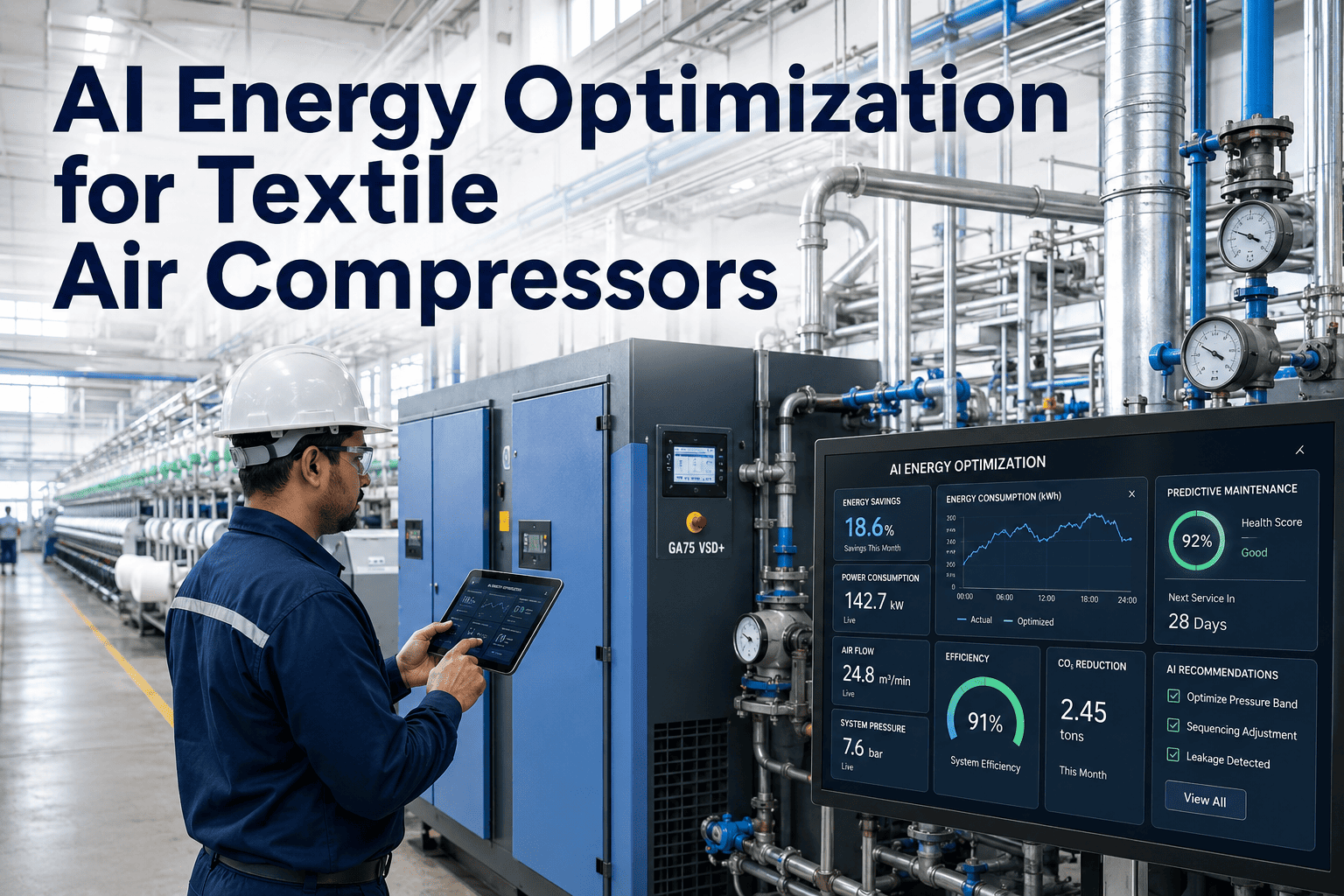
Air-jet looms are the single largest consumer of compressed air on most weaving floors, pulling a majority of the shed's total air demand through picks that fire thousands of times a minute across every running machine. Because that demand is so constant, mills tend to run system pressure high "just to be safe," which quietly inflates the compressor's energy draw around the clock. iFactory's AI watches pressure, flow, and compressor load specifically against your loom demand pattern and finds the exact point where pressure can drop without a single pick misfiring, and you can book a demo to see that number calculated for your own weaving floor.
Air-Jet Looms Consume 60 to 80 Percent of a Weaving Shed's Compressed Air — Most Sheds Still Run Pressure Blind
iFactory's AI matches compressor output to real loom demand and finds the safe pressure floor for your specific fabric and loom mix, converting one of the largest energy line items on a weaving floor into a controlled, monitored cost.
What Every Extra Bar of Pressure Actually Costs You Over a Year
Reducing discharge pressure from 7.5 bar to 6.0 bar on a weaving compressed air system typically delivers a measurable energy saving on that load alone, because compressor energy consumption rises steadily with discharge pressure even when actual demand stays flat.
Every 2 psi, or roughly 0.14 bar, of unnecessary discharge pressure adds close to 1 percent to compressor energy consumption, which is why the drop from 7.5 to 6.0 bar compounds into a double-digit saving on this single load.
Three Reasons Weaving Floors Default to Higher Pressure Than Looms Actually Need
Compensating for Leaks
Distribution leaks lower pressure at the point of use, so operators push system pressure up rather than repairing the leak that caused the drop.
Worst-Case Loom Setting
Pressure is often set for the single most demanding loom or fabric on the floor and left there for every other machine running a lighter construction.
No Live Demand Visibility
Without real-time flow data tied to loom pick rate, there is no reliable way to know how far pressure can safely drop without testing it live and risking a misfire.
Every Bar of Pressure You Don't Need Is Running Through Your Compressor Around the Clock
iFactory's AI finds your loom fleet's real minimum pressure requirement and monitors continuously to keep the system there safely.
From Loom Demand Data to a Validated Pressure Setpoint
iFactory's approach ties compressed air optimization directly to loom-level demand rather than treating the compressor room as a system disconnected from the weaving floor it feeds.
Loom Demand Mapping
Flow and pressure are measured at the loom bank level, tied to fabric type and loom speed, to build an accurate picture of real air demand across the shed.
Leak and Distribution Audit
Idle-period flow data flags leak points across the distribution network so pressure is not being raised to compensate for losses that should be repaired instead.
Safe Pressure Floor Calculation
The AI identifies the minimum pressure that satisfies the most demanding loom and fabric combination currently running, validated before any change is applied.
Continuous Compressor Staging
Multiple compressors are staged to match real shed demand through the shift, reducing the number of units running at inefficient partial load.
Compressed Air Optimization by Compressor Room Size
Savings scale with system size, but the percentage improvement from pressure and staging optimization holds consistent across shed sizes, as reflected below.
| Shed Size | Compressor Room | Typical Annual Air Energy Cost | Typical Savings Identified |
|---|---|---|---|
| Small (under 100 looms) | 1-2 compressors | $40,000 - $80,000 | 10-14% |
| Mid (100-300 looms) | 2-4 compressors | $120,000 - $280,000 | 11-15% |
| Large (300+ looms) | 4+ compressors | $300,000+ | 12-16% |
Outcomes Reported by Weaving Sheds After AI Compressor Optimization
Questions Weaving Floor Managers Ask About Compressor AI
Stop Running Every Loom at the Pressure Your Toughest Fabric Needs
iFactory's AI finds your real minimum pressure requirement and keeps your compressors matched to it automatically. Book a demo and see the savings sitting in your own compressor room.