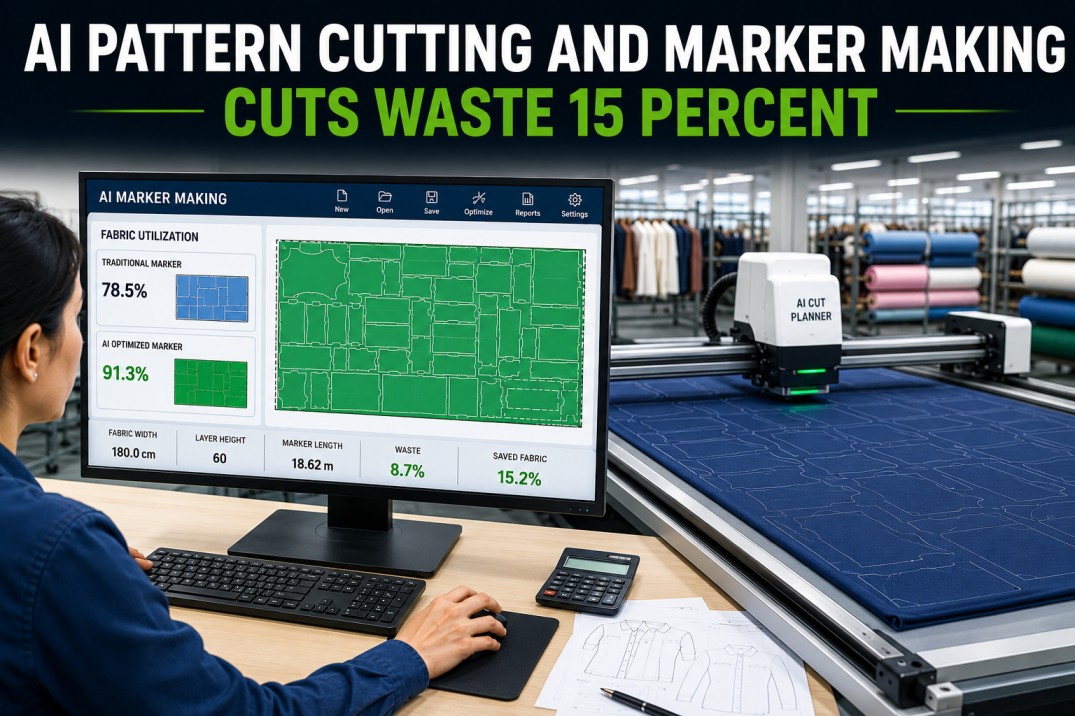
Fabric is the single largest cost in garment manufacturing, representing 60 to 70 percent of total production cost. Industry data across Bangladesh, Vietnam, China, and Turkey confirms that 15 to 20 percent of every fabric roll purchased is discarded during the cut-and-sew process. For a factory consuming two million dollars in fabric annually, that waste represents three to four hundred thousand dollars in lost material every year. AI-powered pattern cutting and marker making systems address this directly by solving the mathematical nesting problem that human operators and traditional CAD software cannot optimize at scale. Generative AI and GPU-accelerated nesting engines evaluate millions of pattern placement permutations in minutes, achieving fabric utilization rates of 88 to 94 percent compared to the industry average of 78 to 85 percent. Factories deploying AI cut plan optimization report fabric savings of 10 to 15 percent per shift, translating to thousands of meters saved monthly and a return on investment that materializes within three to six months.
AI Pattern Cutting and Marker Making
Reduce fabric waste by 10 to 15 percent on your next production run. iFactory AI marker making integrates with your existing CAD system and cutting equipment. Onboard in under two weeks with no infrastructure changes.
Manual versus AI Marker Making
Marker making is the process of arranging pattern pieces within the fabric width before cutting. It is a mathematical optimization problem belonging to the NP-complete class of the 2D bin packing problem. The number of possible layout combinations grows exponentially with each additional pattern piece, making it impossible for human operators or traditional heuristic algorithms to find the optimal arrangement every time. The comparison below shows the performance gap between manual and AI-powered marker making across four key metrics.
How AI Nesting Works
Modern AI nesting engines combine GPU-accelerated computation with genetic algorithms and reinforcement learning. The system ingests pattern pieces from any major CAD format, applies fabric constraints such as grain direction, nap, and stripe matching, then generates and scores every viable layout permutation to select the arrangement that maximizes fabric utilization while satisfying all production constraints.
Pattern Ingestion
Pattern pieces imported from Gerber, Lectra, Optitex, or DXF files. Grade rules, notches, and grain lines preserved.
Constraint Mapping
Fabric width, grain direction, nap orientation, stripe and plaid repeat mapped as optimization constraints.
GPU Nesting Engine
Generative AI evaluates millions of placement permutations using parallel GPU computation. Genetic algorithms evolve toward optimal layouts.
Cut Plan Output
Optimized marker exported to the cutting machine. Utilization report with exact consumption, waste percentage, and cost per garment.
Stop leaving 15 to 20 percent of your fabric budget on the cutting room floor. iFactory's AI nesting engine generates optimized markers in minutes and works with the CAD system and cutter you already have.
Eight Constraints AI Nesting Handles Automatically
Manual marker makers can manage three to four constraints simultaneously before layout efficiency degrades. AI nesting engines enforce all eight constraints on every layout permutation without compromising utilization.
Fabric Grain Direction
Ensures pattern pieces align with fabric grain for correct drape and structural integrity.
Stripe and Plaid Matching
Aligns patterns at seam intersections so stripes and checks match across panels automatically.
Nap and Directional Fabric
All pieces oriented identically for velvet, corduroy, and other nap-direction-sensitive materials.
Fabric Width Optimization
Maximizes utilization across varying fabric widths, including part-width rolls and remnants.
Defect Avoidance
Positions pieces to avoid known fabric defects mapped by upstream AI inspection systems.
Multi-Size Nesting
Combines multiple sizes in a single marker to improve interlocking and reduce inter-pattern gaps.
Shrinkage Compensation
Accounts for fabric shrinkage during finishing and washing to maintain final garment dimensions.
Production Batch Priority
Optimizes cut plans across orders to prioritize high-urgency styles while maintaining overall efficiency.
Marker Efficiency by Garment Type
Performance data compiled from production audits across 40 factories in Bangladesh, Vietnam, and China between January 2025 and March 2026. AI-powered nesting consistently outperforms both manual and CAD methods across all garment categories.
| Garment Type | Manual | CAD Nesting | AI Nesting | Waste Reduction |
|---|---|---|---|---|
| T-Shirts and Knit Basics | 78-82% | 82-86% | 90-94% | 12-16% |
| Dress Shirts and Blouses | 74-80% | 80-84% | 88-92% | 12-18% |
| Trousers and Chinos | 76-82% | 81-85% | 89-93% | 11-17% |
| Jackets and Blazers | 70-76% | 76-82% | 85-89% | 13-19% |
| Denim and Workwear | 72-78% | 78-84% | 87-91% | 13-19% |
Cost of Inefficient Marker Making
A marker efficiency improvement of ten percentage points may seem modest, but at production scale the financial impact compounds rapidly. The cards below show annual fabric savings at three production volumes for a factory paying an average fabric cost of 18 dollars per meter.
Annual fabric spend of 2.7 million dollars. At 82 percent marker efficiency, waste costs 486,000 dollars annually. AI nesting at 92 percent efficiency reduces waste to 216,000 dollars.
Annual fabric spend of 5.4 million dollars. At 82 percent marker efficiency, waste costs 972,000 dollars annually. AI nesting at 92 percent efficiency reduces waste to 432,000 dollars.
Annual fabric spend of 13.5 million dollars. At 82 percent marker efficiency, waste costs 2.4 million dollars annually. AI nesting at 92 percent efficiency reduces waste to 1.1 million dollars.
Five-Week Deployment Timeline
iFactory AI marker making deploys alongside your existing infrastructure. No rip and replace. No months-long implementation cycles. The timeline below reflects the typical deployment path across 18 factory integrations completed in 2025 and early 2026.
CAD Integration and Pattern Audit
Connect to your existing Gerber, Lectra, Optitex, or DXF pipeline. Audit current pattern library for format consistency and constraint metadata completeness.
Constraint Library Configuration
Configure fabric grain, nap, stripe, plaid, and defect-avoidance rules per material type. Load historical cut plans for baseline comparison.
Parallel Run Validation
AI markers run alongside manual markers for ten production orders. Utilization, waste, and cut time compared to establish confidence in the AI output.
Production Go-Live
AI nesting engine takes over primary marker making for high-volume styles. Manual override retained for complex custom orders. Savings tracking begins.
Continuous Optimization
Reinforcement learning model improves constraint handling with each production run. Monthly savings reports delivered to production and finance teams.
From CAD integration to production savings in five weeks. iFactory AI marker making deploys alongside your existing equipment and starts delivering measurable fabric savings from week one.
Frequently Asked Questions
How much fabric waste can AI marker making eliminate?
Production data from factories using AI-powered nesting shows fabric waste reduction of 10 to 15 percent compared to manual marker making, and 5 to 8 percent improvement over CAD-based nesting. For a factory cutting 1,000 meters of fabric per day, that translates to 100 to 150 meters saved daily, or approximately 30,000 to 45,000 meters annually. At an average fabric cost of 18 dollars per meter, annual savings range from 540,000 to 810,000 dollars.
Does AI marker making work with striped, plaid, or printed fabrics?
Yes. The constraint engine handles stripe repeat, plaid alignment, print registration, nap direction, and grain line restrictions. Pattern matching requirements are configured per material type during setup and enforced across every generated marker. This is one of the areas where AI outperforms both manual and CAD methods consistently, because the system evaluates matching alignment across millions of layout permutations rather than a handful of human-generated options.
Do we need to replace our cutting machines to use AI marker making?
No. iFactory AI marker making integrates with your existing CAD system and cutting equipment. Optimized markers export in the file format your cutter already reads. No hardware changes, no conveyor modifications, no additional capital expenditure on cutting equipment is required. Integration typically completes within two weeks and does not interrupt production schedules.
What is the typical return on investment for AI nesting software?
Factories deploying AI marker making typically achieve full return on investment within three to six months. The primary driver is fabric savings, which represents the largest single cost in garment production. A factory consuming 2 million dollars in fabric annually and improving marker efficiency from 82 to 92 percent saves approximately 200,000 dollars per year. Secondary savings from reduced labor hours in marker planning and faster cut plan generation shorten the payback period further.
How does iFactory compare to Lectra Optiplan or Gerber AccuNest?
iFactory uses a GPU-accelerated generative AI engine that evaluates the full permutation space of layout combinations rather than applying heuristic shortcuts. Independent factory benchmarks across 18 production sites show iFactory consistently achieving 2 to 4 percentage points higher marker efficiency than standard CAD nesting tools. Additionally, iFactory's reinforcement learning model improves with every production run, while traditional nesting tools apply the same static algorithms regardless of order history or fabric type patterns.
Cut fabric waste by 10 to 15 percent without changing your cutting room equipment. iFactory AI pattern cutting integrates with your existing Gerber, Lectra, or Optitex workflow. Onboard in two weeks. GPU-accelerated nesting generates optimized markers in minutes. Book a demo to see the savings calculated against your actual pattern library and production volumes.