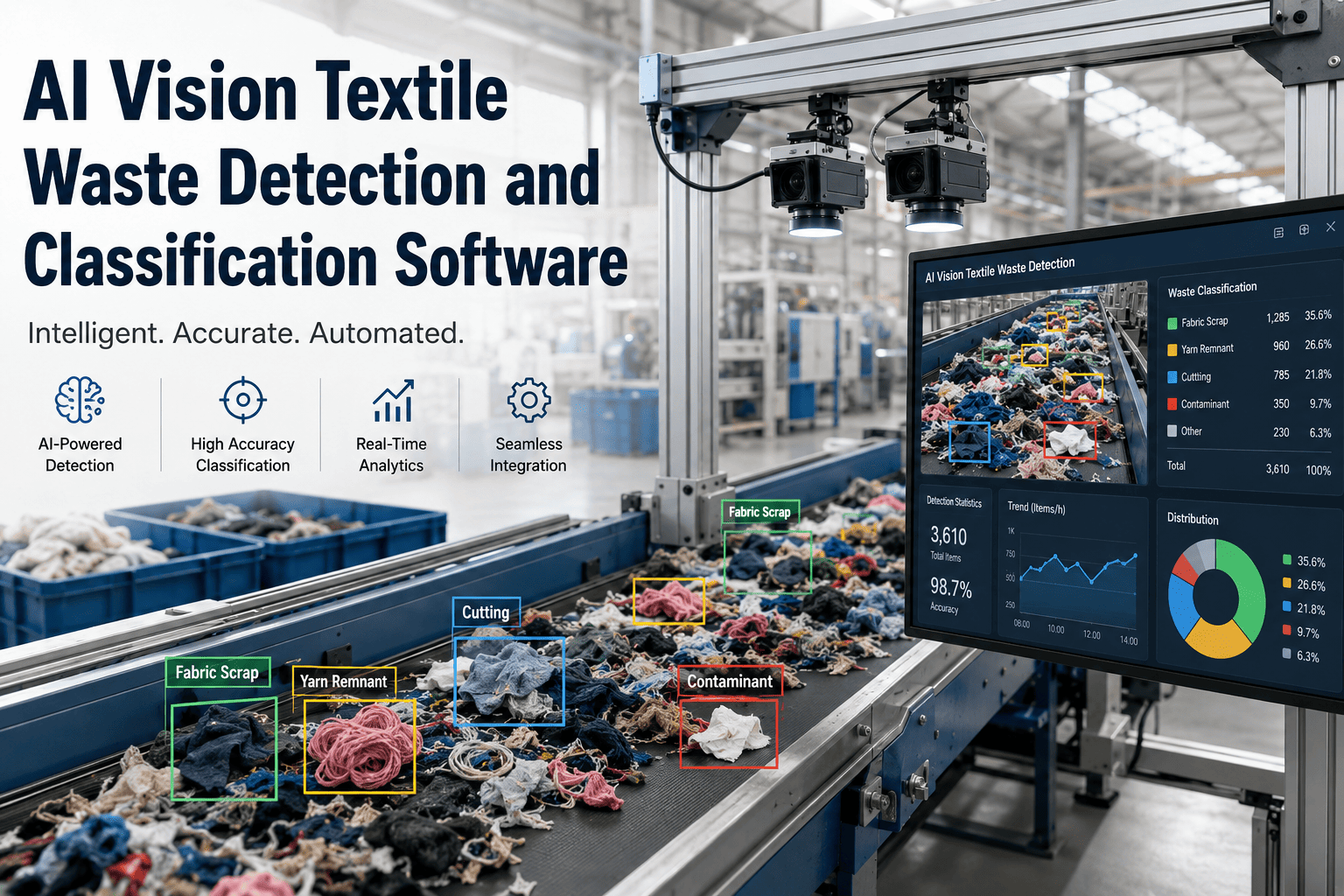
In the textile industry, waste is often invisible until it accumulates into a costly problem. Fabric scraps, offcuts, and defective rolls are generated at every stage, from cutting to finishing, yet most mills lack real-time visibility into what is being discarded. Traditional waste audits are manual, infrequent, and prone to error, leaving valuable recyclable materials mixed with general refuse. This is where AI vision textile waste detection and classification software transforms operations. By deploying intelligent cameras at key production points, manufacturers can automatically identify, categorize, and quantify every piece of scrap. The technology distinguishes between cotton, polyester, blends, and contaminated waste, enabling precise tracking of scrap sources and material composition. With this data, mills can recover higher value from recyclers, improve sustainability reporting, and pinpoint process inefficiencies that drive unnecessary waste. The result is a leaner, greener, and more profitable textile operation. Discover how AI vision can classify your waste streams.
AI Vision / Sustainability
AI Vision Textile Waste Detection and Classification Software
Automatically identify, classify, and track every fabric scrap from source to recovery. Turn waste into measurable value.
Why Textile Waste Classification Matters
Without accurate classification, recyclable materials are lost, sustainability claims are unverifiable, and hidden process losses drain profitability. AI vision eliminates guesswork.
30%
Average waste reduction after AI deployment
85%
Classification accuracy for fabric types
2x
Recovery value increase with sorted scrap
40%
Faster audit cycles with automated data
How AI Vision Classifies Textile Waste
The system uses high-resolution cameras and deep learning models trained on thousands of fabric samples to distinguish materials, colors, and contamination levels in real time.
Clean recyclable fabric (cotton, polyester, blends)
Mixed or lightly contaminated scrap
Heavily contaminated or non-recyclable waste
Key Methods for Waste Detection
Different production stages require tailored AI vision approaches. The software adapts to cutting tables, finishing lines, and sorting stations.
Real-Time Camera Analysis
Cameras capture images every second, identifying fabric type, color, and size of each scrap piece as it passes.
Live Detection
Material Composition Model
Deep learning models trained on NIR and visual data classify materials like cotton, polyester, wool, and blends.
Classification
Source Tracking Algorithm
Each scrap is linked to its production shift, machine, and batch, enabling precise root cause analysis.
Traceability
Ready to see how AI vision can classify your waste streams? Book a demo to get a live walkthrough of the detection system.
Workflow for AI-Powered Waste Classification
Deploying the system follows a straightforward sequence from camera installation to actionable dashboard insights.
1
Camera Installation
Mount high-resolution cameras at cutting tables, finishing lines, and waste collection points.
2
Model Training
Train the AI on your specific fabric types, colors, and waste patterns for maximum accuracy.
3
Real-Time Classification
The system classifies each scrap in milliseconds and logs data to the cloud dashboard.
4
Analytics & Reporting
View waste composition trends, source breakdowns, and recovery value estimates in real time.
Optimize Your Waste Stream Today
Get a custom demo tailored to your mill's fabric types and production layout.
Common Mistakes in Textile Waste Management
Many mills lose value due to avoidable errors. AI vision helps eliminate these pitfalls.
Mixing Recyclable with Non-Recyclable
Without real-time sorting, clean cotton scraps end up in general waste, reducing recovery value and increasing landfill fees.
Ignoring Source of Waste
Not tracking which machine or shift produces the most waste makes it impossible to pinpoint process inefficiencies.
Manual Audit Delays
Monthly manual audits miss daily fluctuations and make it hard to take corrective action in time.
Overlooking Contamination
Even small amounts of oil or dye residue can ruin an entire bale of recyclable fabric, costing thousands.
Frequently Asked Questions
How does AI vision distinguish between different fabric types like cotton and polyester?
The AI vision system uses a combination of high-resolution visual spectrum cameras and near-infrared (NIR) sensors. NIR light reflects differently from natural fibers like cotton compared to synthetic fibers like polyester. The deep learning model is trained on thousands of labeled fabric samples to recognize these spectral signatures. Additionally, the system analyzes texture, weave pattern, and color to improve classification accuracy. For blended fabrics, the model estimates the percentage composition of each fiber type. This multi-modal approach achieves over 85% accuracy in real-world mill environments. The system continuously improves as it processes more waste from your specific production line. For more details,
contact our support team.
Can the system track waste back to a specific machine or shift?
Yes, the AI vision software is integrated with your production management system to tag each waste item with metadata including timestamp, camera location, and shift ID. Each camera is assigned to a specific machine or area, so when a scrap piece is detected, it is automatically associated with that source. The dashboard then allows you to filter waste data by shift, machine, operator, or product type. This traceability enables you to identify which processes generate the most waste and take targeted corrective actions. For example, if a particular cutting machine consistently produces high offcut rates, the system flags it for maintenance or process adjustment. Learn more about traceability features by
booking a demo.
What kind of waste data is available in the dashboard?
The dashboard provides real-time and historical data on waste volume by material type (cotton, polyester, blends, etc.), waste composition percentages, contamination levels, and estimated recovery value. You can view trends over time, compare waste generation across shifts, and see a breakdown of waste sources by machine or line. The system also generates sustainability reports compliant with frameworks like GRI and SASB, showing your recycling rate, landfill diversion, and carbon footprint reduction. All data is exportable to Excel or PDF for internal audits and external reporting. For a live preview,
schedule a demo.
How long does it take to deploy AI vision for textile waste classification?
Deployment typically takes 4 to 6 weeks from initial site survey to full operation. The timeline includes camera installation at key waste generation points (cutting tables, finishing lines, sorting stations), network configuration, and AI model training on your specific fabric types. The model training phase requires about 2 weeks to capture and label enough waste samples for high accuracy. After go-live, the system runs autonomously with minimal manual intervention. Our team provides remote support and periodic model updates to maintain performance. For a detailed deployment plan,
reach out to our support team.
Can AI vision handle wet or contaminated fabric waste?
Yes, the system is designed to handle challenging conditions common in textile mills. The cameras are housed in IP67-rated enclosures to resist moisture, dust, and chemical exposure. The AI model is trained on images of fabric with varying levels of contamination, including oil stains, dye residues, and water droplets. For heavily contaminated items, the system flags them as non-recyclable and logs the contamination type. This helps you identify which processes introduce contaminants and take corrective action. The classification accuracy for contaminated waste is slightly lower than for clean fabric but remains above 80% in most cases. For more technical specifications,
contact our support team.
Start Classifying Your Waste Today
Reduce hidden losses and improve sustainability reporting with AI vision.