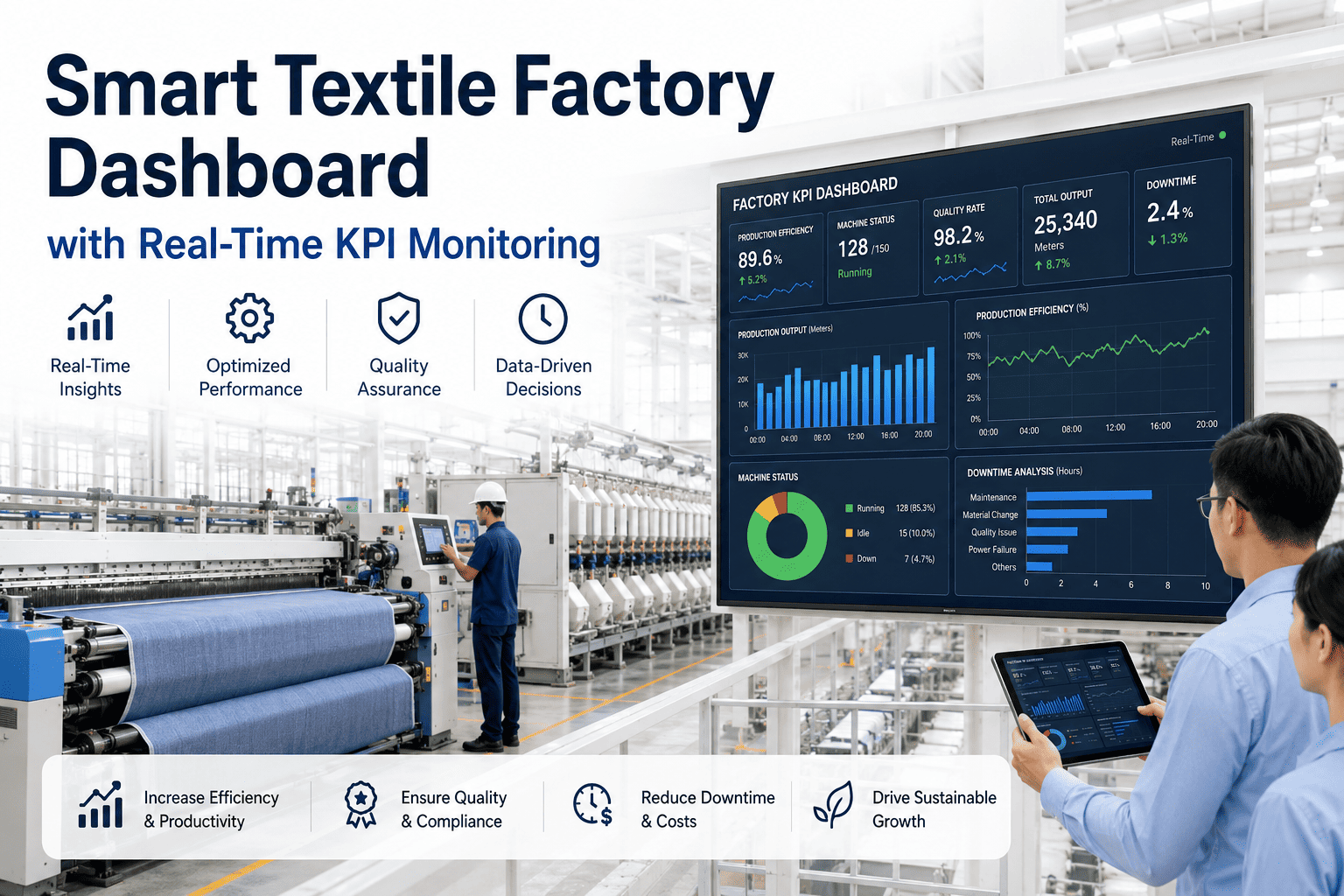
The textile factories winning on efficiency today are not the ones with the newest machines — they are the ones that have built a digital layer on top of their existing equipment. A digital maintenance strategy combines IoT sensors, AI-driven alerts, and a connected maintenance platform to give factory teams the visibility and speed they need to stop breakdowns before they happen. This guide walks you through exactly how to build and implement that strategy, step by step. If you'd rather see the full system live before you start planning, book a demo with iFactory and we will show you what deployment looks like across a real textile production environment.
Digital Maintenance · Implementation Guide
Your Step-by-Step Blueprint for Digital Maintenance in Textile Manufacturing
From IoT sensor deployment to AI-powered predictive alerts — here is the complete implementation framework textile factories are using to cut downtime by up to 45% and reduce maintenance costs by 30%.
$43.6B
Global industrial AI market in 2024 — growing at 23% CAGR through 2030
45%
Reduction in unplanned downtime with AI-IoT predictive maintenance systems
4 days → 2 hrs
Machine repair time improvement after full digital maintenance deployment
30%
Maintenance cost reduction reported by manufacturers using IoT-AI platforms
Book a Demo
Why Now
Why Textile Factories Can No Longer Afford to Delay Going Digital
The textile industry has historically lagged behind other manufacturing sectors in digital adoption. That gap is now a competitive liability. Factories that continue to rely on paper-based maintenance, reactive repair cycles, and manual scheduling are running at a structural cost disadvantage compared to those operating with real-time machine data and automated maintenance workflows.
Textile 4.0 is already here
AI, IoT, digital twins, and cloud platforms are being deployed in textile mills across Asia, Europe, and North America. Early adopters are reporting significant OEE gains — late movers are watching their margins compress.
Reactive maintenance is 3–5x more expensive
Every emergency repair costs between 3 and 5 times more than a planned intervention. In a factory with 150+ machines, the cumulative cost gap between reactive and digital-predictive maintenance runs into hundreds of thousands per year.
Skilled technicians are retiring
Experienced maintenance engineers carry years of machine knowledge that walks out the door when they leave. Digital systems capture, structure, and preserve that knowledge — making every new technician as effective as a veteran from day one.
Customers demand consistent quality
Tension drift, temperature anomalies, and needle wear all produce quality defects long before machines physically fail. Digital monitoring catches these deviations in real time, keeping product quality consistent and defect rates low.
The Roadmap
The 6-Phase Implementation Roadmap for Digital Maintenance
Implementing a digital maintenance strategy is not a single technology purchase — it is a structured programme. The factories that get it right follow a deliberate sequence: assess, connect, digitize, automate, analyse, and optimize. Here is exactly how each phase works in a textile context.
Phase 1
Asset Assessment & Risk Prioritisation
Week 1–2
Before any sensor is installed or any software is configured, map every machine in your factory against two criteria: failure frequency and production impact. Spinning frames that cause full line stoppages when they fail rank higher than auxiliary equipment whose failure is easily absorbed. This risk matrix determines your sensor deployment sequence and your maintenance software configuration priorities.
Outputs from this phase:
Prioritised machine risk register
Failure mode analysis per machine type
Sensor deployment plan with coverage map
Budget allocation by zone and department
Phase 2
IoT Sensor Deployment
Week 2–4
Install vibration, temperature, current, and pressure sensors on high-priority machines first. Most textile machinery accepts non-invasive, clamp-on sensors that require no production stoppage or specialist engineering. Each sensor begins transmitting data to a cloud gateway immediately after installation, with no pipe cutting, no machine modification, and no production interruption required.
Sensor types per textile machine:
Vibration — spinning frames, looms, winding units
Temperature — dyeing machines, dryers, motors
Current draw — all drive motors and compressors
Pressure — compressed air lines, hydraulic systems
Phase 3
CMMS & Platform Configuration
Week 2–3
While sensors are being installed, configure your digital maintenance platform in parallel. Load your machine register, define asset hierarchies by department and line, set up user roles for technicians and supervisors, and build your preventive maintenance schedule templates. iFactory deploys in parallel with sensor installation so that when sensors go live, the platform is ready to receive data and generate work orders from day one.
Platform configuration tasks:
Machine register and asset hierarchy
PM schedule templates by machine type
Technician roles and mobile app access
Spare parts inventory baseline and min-stock thresholds
Phase 4
Baseline Learning & Alert Calibration
Week 3–5
Once sensors are live, the platform enters a baseline learning period — typically 1–2 weeks — during which it establishes each machine's normal operating range across all monitored parameters. Alert thresholds are calibrated to each machine's actual profile, not generic industry defaults. This eliminates false alarms and ensures that every alert generated represents a genuine anomaly that warrants technician attention.
What gets calibrated:
Vibration alert bands per machine and RPM range
Temperature deviation thresholds per equipment type
Current draw anomaly sensitivity per motor size
Shift-aware thresholds for different production speeds
Phase 5
Automated Workflows & Work Order Integration
Week 4–6
Connect sensor alerts to automated work order generation. When a loom bearing vibration spike crosses its threshold, a work order is created automatically — with machine ID, fault type, priority level, and assigned technician — and pushed to the technician's mobile device within 60 seconds. No manual intervention. No communication lag. Maintenance response that previously took 30–120 minutes now happens in under two minutes.
Automation rules configured:
Sensor alert → work order → technician dispatch
PM due date → work order → scheduling queue
Parts stock below minimum → reorder notification
Overdue work order → supervisor escalation
Phase 6
Analytics, Reporting & Continuous Optimisation
Month 2 onwards
With 4–8 weeks of operational data, your maintenance dashboard begins showing patterns that were previously invisible: which machine models fail most frequently, which departments have the highest PM compliance rates, which spare parts are consumed fastest, and where your MTBF is improving or stagnating. These insights drive continuous improvement — adjusting PM intervals, reallocating technician workloads, and building the business case for equipment replacement or upgrade.
KPIs tracked automatically:
MTBF and MTTR by machine and department
PM compliance rate and work order backlog
Cost per machine and cost per repair type
OEE trend and downtime category breakdown
Need help structuring your risk assessment or scoping your sensor deployment before you start? The iFactory support team provides a pre-deployment consultation as part of every onboarding — mapping your machine park, identifying high-priority failure zones, and building a deployment sequence that gets you to value as fast as possible.
The Technology Layer
The Three Technologies That Power Digital Maintenance
IoT sensors are the data source for everything else in the system. In a textile factory, vibration sensors detect bearing wear on spinning frames weeks before audible noise develops. Temperature sensors catch motor overheating on dyeing machines before seal failure. Current sensors identify drive degradation on looms before the motor trips. Without sensor data, digital maintenance is not possible — with it, every machine tells you exactly what it needs and when.
5–10 yrBattery life on LoRaWAN textile sensors
90 secFrom anomaly detection to mobile alert
Raw sensor data without analysis is just noise. AI models analyse vibration frequency patterns, thermal signatures, and current draw trends to identify the specific signatures that precede each type of machine failure — distinguishing normal operational variation from a genuine degradation trend. Over time, the system learns your machines' individual behaviour, making its fault predictions progressively more accurate and its false alarm rate progressively lower.
82%Of asset failures preventable with AI-driven predictive maintenance
23% CAGRIndustrial AI market growth through 2030
A CMMS platform is where sensor intelligence becomes maintenance action. It receives sensor alerts, creates work orders, dispatches technicians, tracks completion, records parts used, and logs the full maintenance history per machine. Without a connected platform, sensor alerts remain data points with no structured response. With it, every alert becomes a traceable, auditable, responded-to maintenance event — building the operational record that drives continuous improvement.
14 daysTypical iFactory full deployment timeline
6 monthsAverage ROI payback period post-deployment
Readiness Check
Is Your Factory Ready to Go Digital? A Quick Self-Assessment
Digital maintenance does not require a greenfield factory or a large IT department. But understanding where you are starting from shapes how you sequence the implementation. Use this quick assessment to identify your starting position.
Do you have a digital record of all machines in your factory?
Start from Phase 2 — sensor deployment
Phase 1 asset assessment is your first priority
Do you have a structured preventive maintenance schedule?
Migrate your schedule into CMMS in Phase 3
Build PM templates from scratch in Phase 3 with iFactory support
Do you know which machines fail most often?
Use this data to prioritise Phase 2 sensor deployment
Phase 1 failure mode analysis will reveal this — start there
Do technicians receive work orders via a digital system?
Integrate with iFactory for sensor-triggered auto-dispatch in Phase 5
Phase 3 platform setup will deliver this capability from go-live
Do you track MTBF, MTTR, or maintenance cost per machine?
Excellent foundation — Phase 6 analytics will enrich these KPIs significantly
iFactory generates all KPIs automatically once the platform is live
Ready to Build Your Digital Maintenance Strategy?
iFactory gives textile manufacturers everything in one platform — IoT sensor integration, automated work orders, PM scheduling, machine health dashboards, and full KPI reporting. Most factories complete Phase 1–5 of this roadmap and are generating measurable results within 14–21 days of go-live.
Book a Demo
Frequently Asked Questions