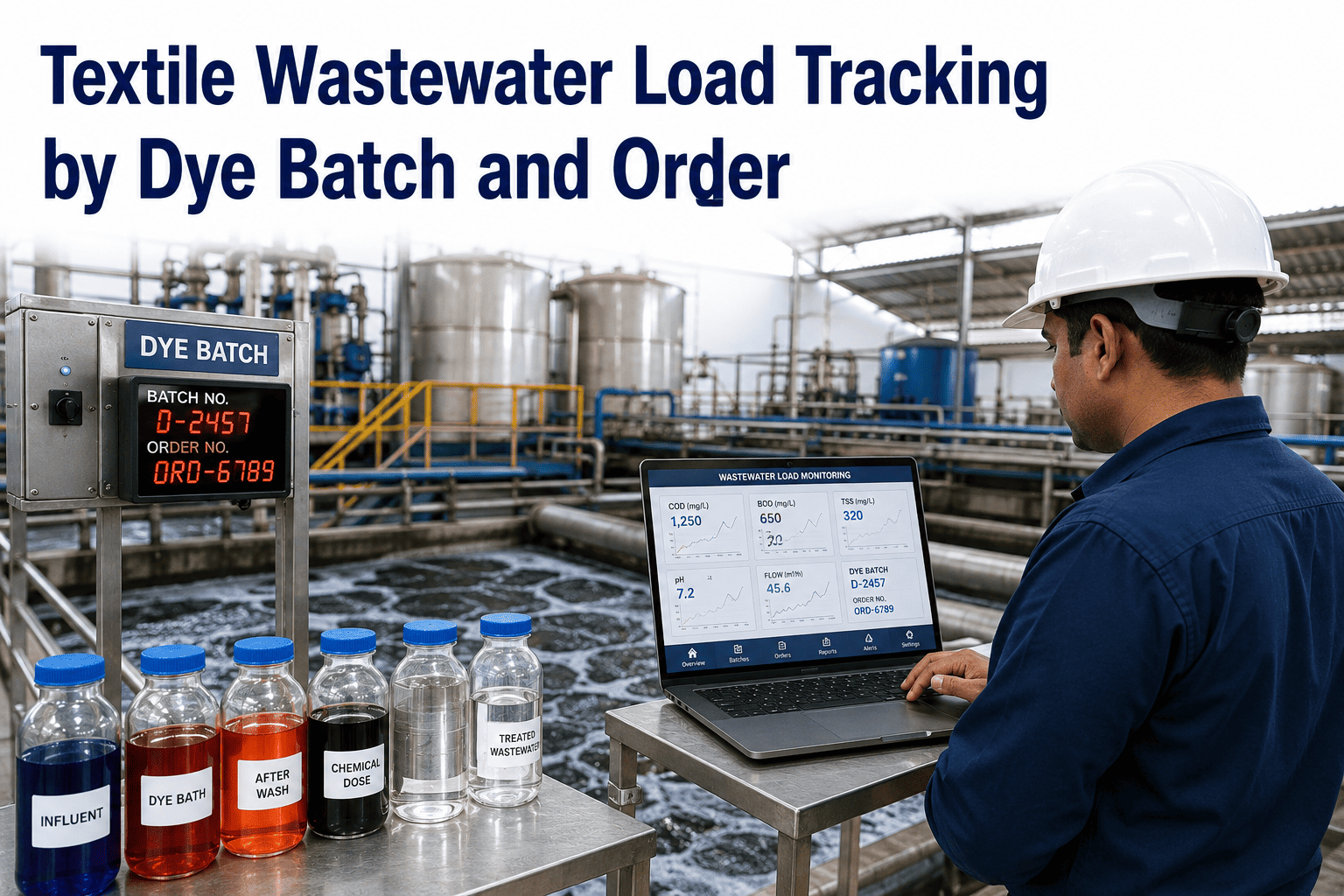
In the textile industry, wastewater management has evolved from a regulatory afterthought into a strategic imperative. For dye houses and finishing mills, the ability to attribute effluent load—including chemical oxygen demand (COD), biochemical oxygen demand (BOD), total dissolved solids (TDS), color intensity, water consumption, and chemical usage—directly to specific dye batches, recipes, machines, and customer orders is no longer a luxury; it is a competitive necessity. Without granular traceability, mills face compliance risks, inflated treatment costs, and missed opportunities for operational optimization. iFactory's Water & Effluent Analytics platform delivers exactly this capability, enabling enterprises to track every liter of water and every gram of chemical from recipe formulation through to effluent discharge. By integrating real-time sensor data with production records, our solution transforms raw wastewater data into actionable business intelligence. Book a Demo to see how leading textile manufacturers are achieving zero-liquid discharge compliance while reducing water costs by up to 35%.
Precision Effluent Accountability for Modern Dye Houses
Real-time, batch-level tracking of water, chemicals, and pollutants.
Why Batch-Level Wastewater Tracking Matters
Traditional effluent monitoring aggregates wastewater data at the plant level, obscuring the true source of pollution. This approach makes it impossible to identify which dye recipes, machine settings, or customer orders contribute disproportionately to COD, BOD, or color load. Without this granularity, mills cannot implement targeted reduction strategies or accurately allocate environmental costs. iFactory's platform changes this paradigm by linking every effluent metric to its originating batch, recipe, machine, and order. This enables precise root-cause analysis, dynamic recipe optimization, and transparent sustainability reporting for brands and retailers. The result is a closed-loop system where water usage and chemical discharge are continuously optimized, reducing both environmental impact and operational expense.
COD & BOD Attribution
Assign chemical oxygen demand and biochemical oxygen demand values to specific dye recipes and process parameters. Identify high-impact batches and reformulate to reduce load.
Color Load Tracking
Measure color intensity in effluent per batch, correlate with dye concentration and fixation rates. Optimize dye uptake to minimize color discharge.
TDS & Salinity Monitoring
Track total dissolved solids from salt and auxiliary chemicals used in dyeing. Pinpoint orders with high TDS contribution for process adjustment.
Water Consumption per Batch
Monitor real-time water usage for each dye batch and machine. Identify wastage patterns and enforce water-saving protocols per order.
Chemical Load Allocation
Attribute every kilogram of dye, auxiliary, and finishing chemical to its batch and customer order. Enable accurate environmental cost accounting.
Order-Level Compliance
Generate compliance reports per customer order, meeting ZDHC, bluesign, and local regulatory standards. Provide auditable data for brand audits.
From Batch to Discharge: The iFactory Traceability Flow
Recipe Formulation
Digital recipe record includes all chemicals, water volume, and process parameters. This data becomes the baseline for effluent prediction.
Batch Execution
Real-time sensors on dyeing machines capture actual water usage, chemical dosing, temperature, and duration. Data is streamed to iFactory's analytics engine.
Effluent Sampling
Automated samplers at the machine outlet measure COD, BOD, TDS, color, and pH. Each sample is timestamped and linked to the batch ID.
Data Correlation
iFactory's algorithms correlate effluent metrics with recipe, machine settings, and order details. Dashboards display load per batch, recipe, and customer.
Actionable Insights
Identify top-polluting recipes, optimize chemical dosing, and reduce water usage. Generate compliance reports automatically for ZDHC and local authorities.
Technical Architecture for Real-Time Effluent Analytics
iFactory's Water & Effluent Analytics platform is built on a robust IoT and data integration framework. At the machine level, flow meters, conductivity sensors, spectrophotometers, and pH probes collect data at intervals as frequent as every 10 seconds. This data is transmitted via industrial protocols (Modbus, OPC-UA) to an edge gateway, where initial validation and aggregation occur before being sent to the cloud or on-premise data lake. The platform then applies machine learning models to predict effluent load based on recipe parameters, enabling proactive adjustments. Integration with existing ERP and MES systems ensures that every batch is automatically linked to customer orders, production schedules, and inventory records. The result is a single source of truth for water and chemical usage across the entire dye house.
Transform Your Effluent Management Today
Gain complete visibility into your wastewater footprint. Reduce compliance risk and operational costs.
Regulatory Compliance and Brand Requirements
Textile mills face increasing pressure from both regulators and global brands to provide transparent, auditable wastewater data. Standards such as ZDHC (Zero Discharge of Hazardous Chemicals) require detailed reporting on chemical usage and effluent quality per production batch. iFactory's platform directly supports these requirements by automatically generating ZDHC-compliant reports that attribute every parameter to specific batches and orders. For brands like Nike, Adidas, and H&M, this level of traceability is a prerequisite for supplier partnerships. Mills using iFactory can provide their customers with a digital dashboard showing real-time and historical effluent performance, building trust and strengthening business relationships. Moreover, local environmental agencies often mandate daily or weekly reporting of COD, BOD, and TDS levels. Our platform automates this process, reducing manual effort and eliminating errors. Non-compliance can result in fines, production stoppages, or even license revocation. With iFactory, mills stay ahead of regulatory changes and demonstrate environmental stewardship.
Effluent Metrics Tracked per Batch and Order
| Metric | Unit | Typical Range | Regulatory Limit | Batch Variability |
|---|---|---|---|---|
| Chemical Oxygen Demand (COD) | mg/L | 200 - 3000 | 250 - 500 | High |
| Biochemical Oxygen Demand (BOD) | mg/L | 50 - 800 | 30 - 100 | Medium |
| Total Dissolved Solids (TDS) | mg/L | 1000 - 10000 | 2000 - 5000 | High |
| Color (ADMI) | ADMI | 50 - 2000 | 100 - 300 | Very High |
| pH | - | 6.5 - 10.5 | 6.0 - 9.0 | Low |
| Temperature | °C | 30 - 80 | 40 - 45 | Medium |
Cost Implications of Untracked Wastewater
Without batch-level tracking, mills often over-treat effluent to ensure compliance, wasting chemicals and energy. For example, if a mill treats all wastewater to the same standard regardless of actual load, they may use 20-30% more coagulants and flocculants than necessary. Additionally, high-polluting batches can be identified and reformulated to reduce treatment costs. iFactory's data shows that mills typically reduce chemical treatment costs by 25% within six months of implementing batch-level tracking. Water consumption itself can be reduced by up to 35% by identifying machines or processes that use excessive water. Furthermore, accurate load data enables mills to negotiate better rates with centralized treatment plants or justify investment in on-site treatment technologies like membrane bioreactors or reverse osmosis. The return on investment for iFactory's platform is typically less than 12 months, driven by savings in water, chemicals, energy, and compliance penalties.
Reduced Chemical Usage
Optimize coagulant and flocculant dosing based on real-time effluent load per batch. Avoid over-treatment and save up to 25% on chemical costs.
Lower Energy Consumption
Pumping and treating wastewater consumes significant energy. By reducing overall effluent volume and load, mills cut energy bills by 15-20%.
Avoid Compliance Fines
Non-compliance with discharge limits can result in fines of $10,000 to $100,000 per incident. Automated tracking ensures continuous compliance.
Enhanced Brand Reputation
Provide transparent sustainability data to customers and stakeholders. Strengthen partnerships with eco-conscious brands and retailers.
Integration with Existing Dye House Systems
iFactory's platform is designed to integrate seamlessly with existing infrastructure. Whether your dye house uses manual data entry, barcode scanners, or fully automated MES, our APIs and connectors ensure smooth data flow. We support integration with common ERP systems (SAP, Oracle, Microsoft Dynamics), MES platforms (Datacolor, GSD), and IoT sensor networks. For mills with legacy equipment, we offer retrofit sensor kits that can be installed without disrupting production. Our edge computing architecture ensures that data processing continues even if the internet connection is lost, with automatic synchronization when connectivity resumes. This resilience is critical for continuous manufacturing environments. The platform also supports multi-site deployments, allowing corporate sustainability teams to compare effluent performance across facilities and identify best practices.
Frequently Asked Questions
How does iFactory attribute effluent load to a specific dye batch?
iFactory's platform uses a combination of real-time sensor data and production records to link every effluent measurement to its originating batch. When a dye batch is executed, the system records the recipe, machine parameters, and start/end times. Effluent sensors at the machine outlet continuously measure COD, BOD, TDS, color, and pH. These measurements are timestamped and automatically correlated with the batch ID. The platform then aggregates this data to provide a complete effluent profile per batch, recipe, machine, and customer order. This traceability is achieved without manual intervention, ensuring accuracy and auditability. For more details on the integration process, contact our support team.
What sensors are required for batch-level effluent tracking?
The specific sensors depend on the parameters you need to track, but typical installations include flow meters for water consumption, conductivity sensors for TDS, spectrophotometers for color, and pH probes. For COD and BOD, online analyzers are available that provide near-real-time readings. iFactory offers pre-configured sensor kits that are compatible with most dyeing machines. These kits include edge gateways for data aggregation and secure transmission. Our team conducts a site survey to determine the optimal sensor placement and calibration requirements. We also provide ongoing maintenance and calibration services to ensure data accuracy. To discuss your specific needs, book a demo with our engineering team.
Can iFactory help with ZDHC reporting requirements?
Yes, iFactory's platform is designed to support ZDHC (Zero Discharge of Hazardous Chemicals) reporting standards. The system automatically generates reports that include chemical usage per batch, effluent quality parameters, and mass balance calculations. These reports can be exported in ZDHC's required format or customized to meet specific brand requirements. The platform also tracks restricted substances and ensures that no prohibited chemicals are used in production. By providing auditable, batch-level data, iFactory helps mills demonstrate compliance during brand audits and regulatory inspections. For a walkthrough of the ZDHC reporting module, book a demo today.
What is the typical ROI for implementing iFactory's Water & Effluent Analytics?
Most mills achieve a full return on investment within 12 to 18 months. The savings come from multiple sources: reduced water consumption (up to 35%), lower chemical treatment costs (up to 25%), decreased energy usage (15-20%), and avoidance of compliance fines. Additionally, mills can reduce labor costs associated with manual sampling and reporting. The platform also enables proactive maintenance of effluent treatment plants, reducing downtime and repair costs. Our customers report that the ability to provide transparent sustainability data has helped them win new business from eco-conscious brands, further increasing revenue. For a personalized ROI calculation based on your mill's data, book a demo with our team.
How does iFactory handle multi-site deployments?
iFactory's platform is built for scalability, supporting multi-site deployments with centralized data management. Each site has its own edge gateway and sensor network, but data is aggregated into a single cloud-based or on-premise data lake. Corporate sustainability teams can access dashboards that compare effluent performance across facilities, identify top-performing sites, and standardize best practices. The platform also supports role-based access control, allowing different users to view data relevant to their responsibilities. For multi-national textile groups, this capability is essential for meeting global sustainability targets. To learn more about multi-site deployment options, contact our support team.
Ready to Achieve Full Effluent Traceability?
Join leading textile mills that are setting new standards in sustainability and operational excellence.