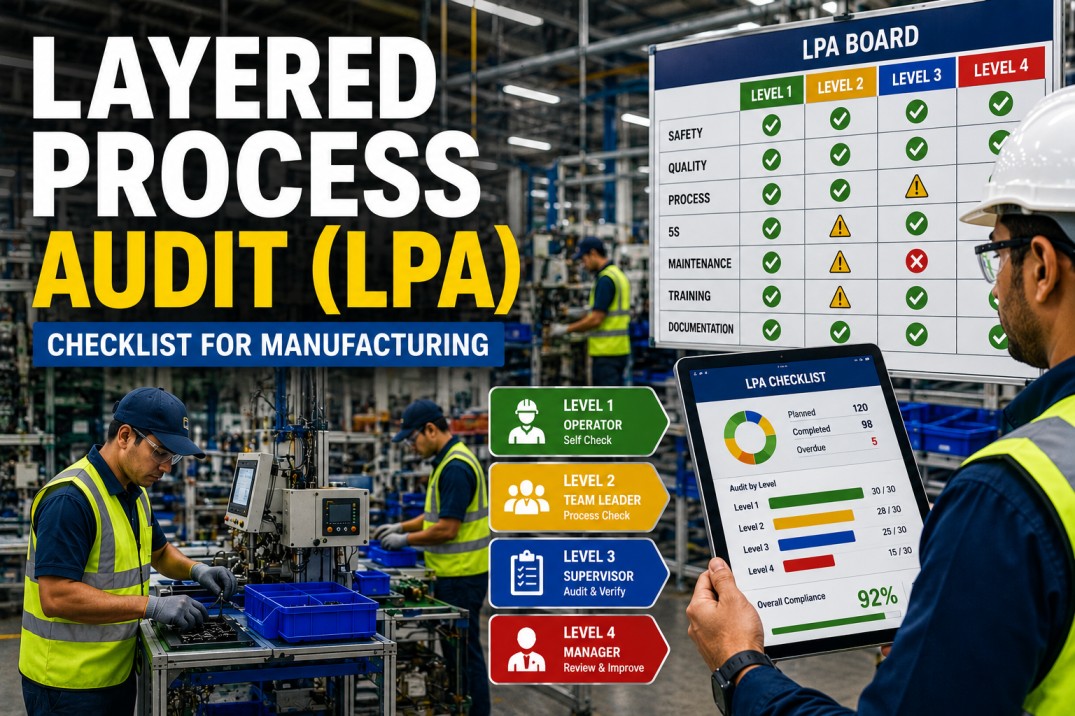
Layered Process Audits (LPAs) are the single most effective proactive quality tool in modern manufacturing — yet fewer than one in three facilities run them correctly. IATF 16949 Clause 9.2.2.3 and the AIAG CQI-8 guideline mandate that manufacturers implement a structured, multi-layered audit process where every organizational level verifies process compliance at the point of work. OEMs including GM, Stellantis, and Ford require LPA programs through their customer-specific requirements, and non-compliance can trigger production chargebacks and loss of supplier status. This LPA checklist template gives quality managers, plant supervisors, and operations leaders a complete framework covering all three audit layers with 30+ questions mapped to CQI-8 and IATF 16949 — designed for completion in 10 minutes per audit, every shift.
Run Your Complete LPA Program From a Single Dashboard — Across All Three Layers
iFactory's digital LPA module enforces audit schedules at every organizational level. Layer 1 operators complete daily checks on a mobile device. Layer 2 supervisors verify weekly. Layer 3 plant leaders review monthly trends. Findings auto-escalate, corrective actions are tracked to closure, and your entire audit trail is instantly accessible for IATF 16949 or CQI-8 review.
What Is a Layered Process Audit?
A Layered Process Audit (LPA) is a structured quality methodology where multiple organizational levels conduct frequent, standardized audits of critical manufacturing processes using predefined checklists. Unlike traditional product audits that inspect finished output, LPAs verify process inputs — machine settings, operator methods, work instruction adherence, tooling condition, and safety compliance — at the point of work. The objective is to catch process deviations before they produce defects, not to sort good parts from bad ones.
Select processes with the highest risk based on PFMEA, customer complaints, historical non-conformances, and control plan critical characteristics.
Each layer gets a tailored checklist: Layer 1 focuses on immediate process compliance (10-15 Yes/No questions). Layer 2 adds process consistency verification. Layer 3 covers systemic patterns.
Layer 1 audits run daily per shift. Layer 2 audits run weekly. Layer 3 audits run monthly. Digital LPA platforms automate scheduling and distribute checklists to the right person at the right time.
Auditors observe processes in real time, answer Yes/No questions, attach photo evidence where required, and capture e-signatures. Defects are flagged immediately with severity levels.
Audit data feeds a dashboard. Findings generate corrective actions with owners and deadlines. Management reviews trends weekly. Repeat issues trigger root-cause analysis and process updates.
How LPA Layers Work — Who Audits What, and How Often
The power of LPAs comes from the layered structure itself. Each tier audits the same processes using different lenses and frequencies. A finding from a Layer 1 operator that goes unaddressed will be caught by a Layer 2 supervisor the following week — creating a safety net that does not rely on any single individual. This is the mechanism that drives the 30-50% defect reduction documented across automotive, aerospace, and medical-device manufacturing.
Operator & Team Lead
Audits the immediate process zone — machine settings, torque values, work instruction adherence, PPE compliance, 5S condition, startup verification, and first-piece inspection. Layer 1 is the first line of defense against process drift. The auditor works in the area they operate.
- Is the torque tool calibrated with a valid sticker dated within the current shift?
- Is the current work instruction visible at the station and dated correctly?
- Are all 5S boundary markers clear and free of debris in the work zone?
Supervisor & Middle Management
Verifies Layer 1 audit completion and the quality of findings. Audits a cross-section of processes — not just their own area. Checks for process consistency across shifts, verifies that corrective actions from prior findings are closed, and identifies process drift patterns that a single-operator check would miss.
- Were all Layer 1 audits completed on the last three shifts with findings documented?
- Are open corrective actions from the prior week past due? Which ones and why?
- Does the process parameter log (temperature, pressure, cycle time) show any drift outside control limits?
Plant Manager & Senior Leadership
Evaluates the effectiveness of the entire LPA system. Reviews completion rates, finding rates, corrective-action closure velocity, and systemic trends across all departments. Layer 3 validates that the program is driving improvement and that resources are adequate. This is the layer that demonstrates leadership commitment to quality.
- Is the LPA completion rate above 95% across all layers this month? If not, what is the gap?
- Are repeat findings (same station, same issue within 90 days) being escalated for root-cause analysis?
- Does the monthly quality trend show improvement in first-pass yield and CoPQ consistent with LPA investment?
LPA Schedule & Frequency by Layer
Audit frequency is determined by process criticality and organizational layer. Higher-risk processes — recently launched, recently non-conforming, or safety-critical — warrant tighter frequency at every layer. The table below shows the standard CQI-8 recommended schedule and how digital enforcement changes compliance outcomes.
| Layer | Auditor | Frequency | Duration | Questions | Paper Compliance | Digital Compliance |
|---|---|---|---|---|---|---|
| Layer 1 | Operator / Team Lead | Daily per shift | 5-10 min | 10-15 | ~52% | ~94% |
| Layer 2 | Supervisor / Manager | Weekly | 15-20 min | 15-25 | ~41% | ~89% |
| Layer 3 | Plant Manager / Exec | Monthly | 20-30 min | 20-30 | ~33% | ~85% |
Source: Ease.io LPA Benchmark Report across 2.3 million audits and 2,200+ manufacturing sites (2025). Digital compliance figures reflect facilities using automated LPA platforms with scheduling enforcement.
LPA Checklist Categories & Sample Questions
Effective LPA questions are binary (Yes/No), observable, and tied to a specific evidence source. Each question should map to a PFMEA failure mode or control plan parameter. Below are the six standard LPA categories with sample questions for each layer.
Work Instructions & Documentation
Process Parameters & Controls
Equipment, Tooling & Maintenance
Operator Competency & Training
Material Identification & Traceability
Safety, 5S & Work Environment
Paper vs. Digital LPA: A Compliance Reality Check
Paper-based LPA programs suffer from three systematic failures: completion gaps, pencil-whipping, and delayed corrective actions. The data from the largest LPA benchmark study ever conducted shows that even well-intentioned paper programs achieve only 33-52% on-time completion across layers. Digital LPA platforms close these gaps through enforcement, automation, and real-time visibility.
- 33-52% on-time completion rates
- No enforcement — audits can be skipped without detection
- Pencil-whipping common (checking boxes without observing)
- Average 14+ days to close corrective actions
- No real-time visibility into program health
- 85-94% on-time completion rates
- System blocks shift start until audit is completed
- Randomized questions + required photo evidence
- Auto-escalation; average 4 days to close CAPAs
- Real-time dashboard with trend analysis and drill-down
Move Your LPA Program From Paper to a Digital System That Enforces Every Layer
iFactory gives quality and operations teams a purpose-built digital LPA platform — multi-layer audit scheduling, mobile-first checklists, automated escalation, real-time dashboards, and corrective action tracking. Stop guessing whether your audits are being done. Know with certainty.
Frequently Asked Questions
Is an LPA required by IATF 16949?
IATF 16949 Clause 9.2.2.3 requires that organizations incorporate an internal layered process audit process to assess compliance to standardized processes. OEM customer-specific requirements from GM, Stellantis, and Ford explicitly mandate CQI-8-aligned LPA programs. While IATF 16949 does not prescribe the specific CQI-8 format, any compliant manufacturing process audit system must include multiple organizational layers, a documented schedule, recorded findings, and corrective action tracking. Book a Demo to see how iFactory's LPA module satisfies these requirements out of the box.
What is the difference between a layered process audit and a product audit?
A product audit inspects finished output — measuring dimensions, testing functionality, verifying labeling. A layered process audit verifies that the process inputs, methods, and controls are correct — checking torque settings, work instruction adherence, calibration status, and operator behavior. Product audits find defects after they occur. LPAs prevent defects from occurring in the first place. Both are required under IATF 16949, but they serve fundamentally different purposes.
How many questions should an LPA checklist have for each layer?
Layer 1 checklists should have 10-15 binary (Yes/No) questions designed to be completed in 5-10 minutes. Layer 2 checklists typically include 15-25 questions covering process consistency and Layer 1 verification. Layer 3 checklists may include 20-30 questions focused on systemic trends and program effectiveness. The golden rule: if the checklist takes longer than the audit time window, reduce the question count. It is better to rotate question subsets than to overload auditors.
What is CQI-8 and how does it relate to LPA?
CQI-8 is the Layered Process Audit Guideline published by the Automotive Industry Action Group (AIAG), now in its 2nd Edition. It provides a standardized framework for designing, implementing, and evaluating LPA programs. CQI-8 covers checklist design principles, auditor training requirements, layered audit frequency guidelines, and a maturity assessment model. Most automotive OEM customer-specific requirements reference CQI-8 directly. A CQI-8-aligned LPA program is the accepted industry standard for automotive manufacturing process auditing.
How do you prevent pencil whipping in layered process audits?
Pencil-whipping — checking boxes without actually observing the process — is the single biggest threat to LPA effectiveness. Digital platforms prevent it through several mechanisms: requiring photo evidence on a subset of questions, randomizing question order to prevent rote memorization, setting minimum audit duration thresholds, and rotating auditor assignments. The most effective deterrent is requiring evidence that the auditor was physically present — geo-tagged timestamps, photo attachments, and operator signatures captured on a mobile device at the workstation. Book a Demo to see how iFactory stops pencil whipping.
Replace Paper LPA Forms With a Digital System That Enforces Every Audit, Every Layer, Every Shift
iFactory gives quality managers, plant supervisors, and operations leaders a complete digital LPA platform — from multi-layer scheduling and mobile-first checklists to real-time dashboards and corrective action closure. Stop chasing paper. Start preventing defects.