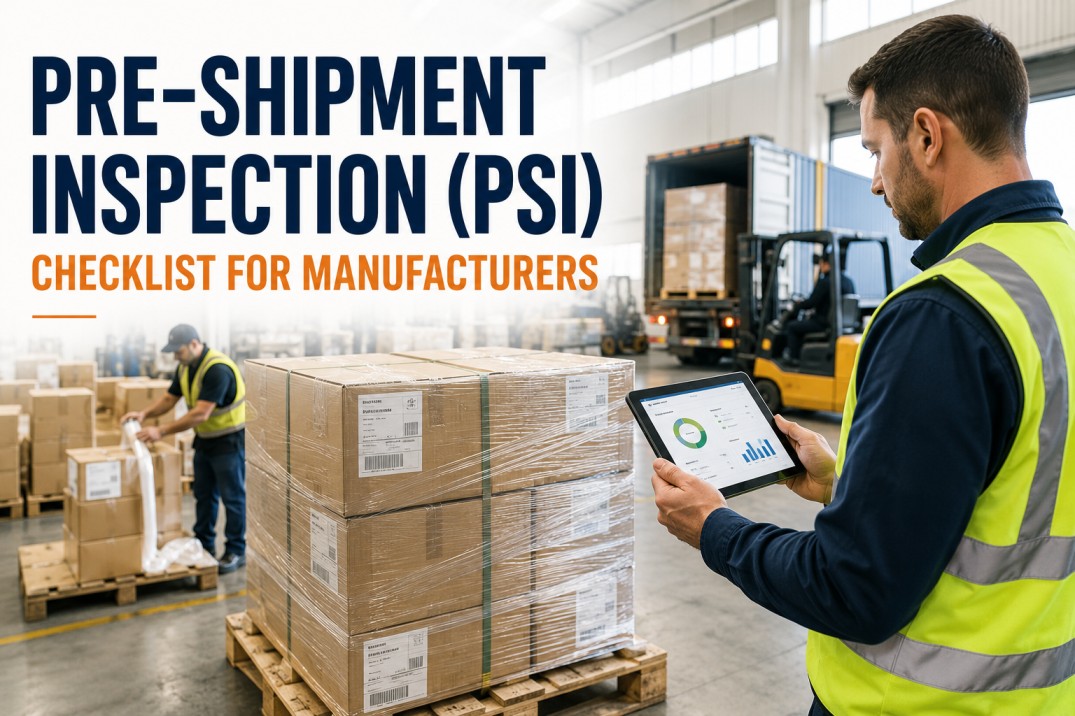
Every manufacturing shipment is the culmination of weeks — sometimes months — of production runs, supplier coordination, and quality checks. Yet a single missed carton marking, a barcode that fails to scan, or a random sample that surfaces undisclosed defects can hold an entire order — and damage a buyer relationship — before the container doors close. Pre-shipment inspection is the final quality gate before cargo loads, and this field-tested checklist gives your quality team the exact audit sequence to inspect with confidence, document with precision, and ship on time.
Pre-Shipment Inspection (PSI) Checklist for Manufacturers
35 inspection checkpoints across 5 categories — packaging, product quality, labeling, documentation, and container loading — built on ANSI/ASQ Z1.4 AQL standards and aligned with third-party inspection protocols accepted by US and EU retailers and importers.
What This PSI Checklist Covers
A complete pre-shipment inspection validates five distinct areas of the shipment before loading authorization is granted. Each area carries a different defect risk profile and documentation requirement for international trade compliance.
The Complete PSI Checklist
Work through each category in order. Check items off as your team completes them. Critical items carry zero-tolerance defect standards — any failure requires an immediate hold on loading authorization pending corrective action.
AQL Sampling Quick Reference
Use this table to determine your sample size and accept/reject thresholds before the inspection begins. Based on ANSI/ASQ Z1.4 General Inspection Level II — the standard applied to most consumer goods pre-shipment inspections globally. AQL 2.5 for major defects is the most widely used threshold for US and EU retail buyers.
| Lot Quantity | Sample Size | AQL 1.0 Ac / Re | AQL 2.5 Ac / Re | AQL 4.0 Ac / Re | Typical Use |
|---|---|---|---|---|---|
| 2 – 15 | 3 | 0 / 1 | 0 / 1 | 0 / 1 | Sample lots, prototypes |
| 16 – 50 | 8 | 0 / 1 | 0 / 1 | 0 / 1 | Small production runs |
| 51 – 90 | 13 | 0 / 1 | 0 / 1 | 1 / 2 | Low-volume orders |
| 91 – 150 | 20 | 0 / 1 | 1 / 2 | 1 / 2 | Small-batch orders |
| 151 – 280 | 32 | 0 / 1 | 1 / 2 | 2 / 3 | Mid-volume consumer goods |
| 281 – 500 | 50 | 0 / 1 | 2 / 3 | 3 / 4 | Standard wholesale orders |
| 501 – 1,200 | 80 | 1 / 2 | 3 / 4 | 5 / 6 | Most common FCL range |
| 1,201 – 3,200 | 125 | 2 / 3 | 5 / 6 | 7 / 8 | High-volume consumer goods |
| 3,201 – 10,000 | 200 | 3 / 4 | 7 / 8 | 10 / 11 | Apparel, accessories, FMCG |
| 10,001 – 35,000 | 315 | 5 / 6 | 10 / 11 | 14 / 15 | Mass retail, fast fashion |
Ac = Accept (maximum defects before pass). Re = Reject (minimum defects that fail the inspection). If defects found equal the Reject number, the inspection result is Failed. AQL 1.0 applies to regulated or higher-risk product categories. Source: ANSI/ASQ Z1.4 Table II-A.
PSI Defect Severity Classification
Every defect found during a pre-shipment inspection must be classified before it can be recorded, measured against the AQL threshold, and communicated to the buyer. Classification is the foundation of the pass/fail decision and drives corrective action priority.
A defect that poses a safety or health hazard to users, violates mandatory regulations, or could result in product liability or recall. Even a single critical defect discovered in the sample automatically fails the entire inspection, regardless of lot size or sample count.
- Exposed sharp edges, pinch points, or crush hazards
- Missing required safety certification marks
- Electrical hazard — uninsulated connections or wiring
- Toxic or restricted materials above regulatory limits
- Choking hazard risk in products for children under 3
A defect likely to cause product failure, reduce usability significantly, or result in consumer returns and negative reviews. Counted against the AQL 2.5 accept/reject threshold — if total major defects in the sample reach the reject number, the inspection is failed.
- Functional failure under normal use conditions
- Significant cosmetic damage clearly visible to buyers
- Wrong color, style, size, or variant shipped
- Missing required component in product or packaging
- Incorrect barcode content or barcode will not scan
A defect that deviates from specification but does not affect safety, primary function, or consumer experience in a meaningful way. Recorded and reported to the buyer but does not independently trigger a hold unless the total minor defect count exceeds the AQL 4.0 threshold.
- Surface scratch not visible during normal product use
- Minor packaging scuff or non-critical print smear
- Slight label misalignment within acceptable tolerance
- Non-structural cosmetic variation within variance range
- Minor dimensional deviation with no effect on product fit or form
Frequently Asked Questions
After 80 to 100 percent of production is complete and before container loading begins. This timing ensures the inspection reflects actual finished goods quality while still leaving enough time to rework or sort minor defects before the cargo is sealed. Scheduling too early — when production is still below 80 percent complete — risks inspecting a non-representative batch that does not reflect final production quality.
Three options are available: (1) the factory's own QC team conducting an internal PSI; (2) the buyer's in-house QC representative traveling to the factory; or (3) an independent third-party inspection company. Third-party PSI is the gold standard for international trade because it provides an unbiased, professionally documented assessment that buyers, retailers, and customs authorities accept as credible and impartial. Most major US retailers require third-party PSI from recognized inspection firms.
The industry standard for most consumer goods is AQL 2.5 for major defects and AQL 4.0 for minor defects, with zero tolerance for critical defects regardless of lot size. Higher-risk categories — electronics, toys for children under 3, food contact products, medical devices, and regulated safety products — typically require AQL 1.0 for major defects. When in doubt, match the AQL level to the worst-case consequence of a defect reaching your end customer.
The inspector issues a Failed or Pending report detailing every defect found, its severity classification, and photographic evidence. The buyer then decides between three options: (1) authorize factory rework followed by a re-inspection at the supplier's expense; (2) reject the shipment and issue a corrective action request; or (3) negotiate a commercial price adjustment for the defects found. Re-inspection fees, shipping delays, and any downstream costs are typically borne by the supplier when defects were within the factory's control to prevent.
No. A standard PSI uses AQL statistical sampling to inspect a representative subset of the production lot — not every single unit. AQL General Inspection Level II at AQL 2.5 provides approximately 95 percent confidence in outgoing quality at a fraction of the time and cost of 100% inspection. Full 100% inspection is reserved for safety-critical components, high-value precision parts, or categories where the cost of a field failure far exceeds the cost of inspecting every unit.
.jpg)

-checklist-for-manufacturers.jpg)