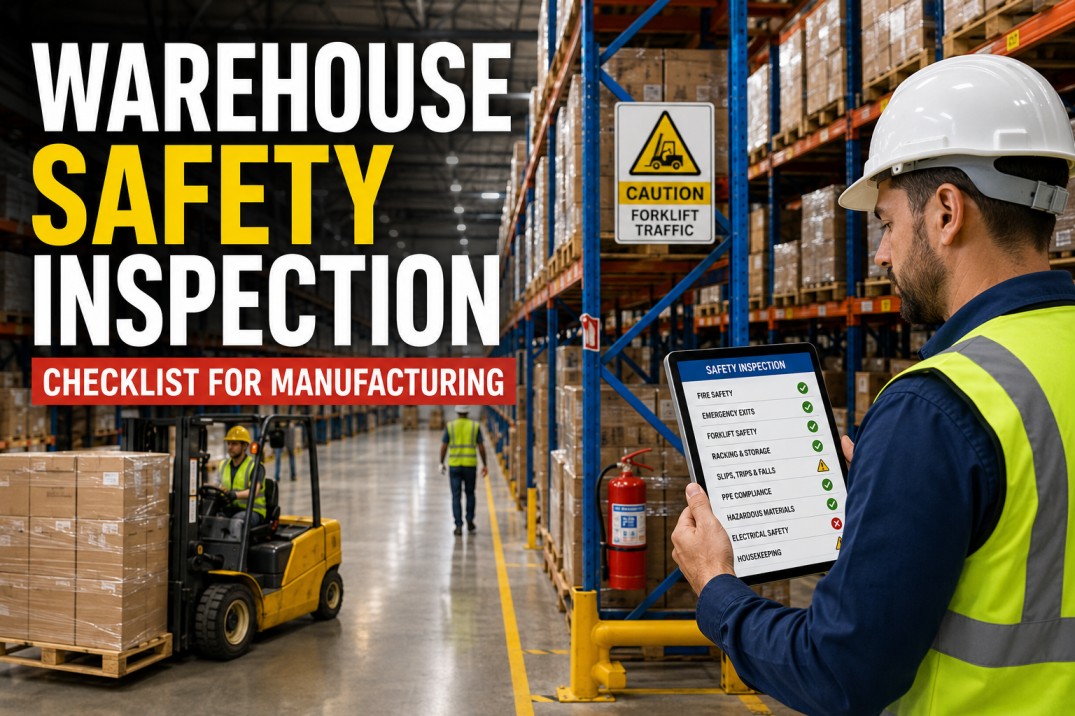
Warehouse Safety Inspection Checklist for Manufacturing

By Trevor Hamilton on May 30, 2026

warehouse-safety-inspection-checklist

Warehousing and distribution centers now face the most aggressive OSHA enforcement in history. In October 2023, OSHA launched a National Emphasis Program (NEP) targeting warehousing operations nationwide — conducting comprehensive safety inspections focused on powered industrial vehicles, material handling and storage, walking-working surfaces, means of egress, fire protection, and heat and ergonomic hazards. With warehousing injury rates more than double the private industry average and OSHA penalties reaching $16,550 per serious violation and $165,514 per willful violation, a single inspection finding multiple violations can produce penalties exceeding $200,000. This warehouse safety inspection checklist gives safety managers, operations leaders, and plant supervisors a complete compliance framework covering all six NEP focus areas — racking systems, forklift operations, dock safety, aisle management, emergency preparedness, and ergonomic risk — with 35 inspection checkpoints aligned to OSHA 29 CFR 1910 and ANSI MH16.1.

2x
Warehousing injury rate vs. private industry average — BLS 2021-2024
$16,550
OSHA maximum penalty per serious violation — each citation adds independently
6
OSHA NEP focus areas — PIV, storage, surfaces, egress, fire, heat and ergo
34,000+
Serious injuries annually from forklift-related incidents in US warehousing


Digital Warehouse Safety Platform

Run OSHA-Aligned Warehouse Safety Inspections From a Mobile Device — Across Every Zone

iFactory's warehouse safety inspection module lets safety managers conduct, schedule, and track inspections across all warehouse zones — racking, docks, aisles, emergency equipment, and material handling. Findings auto-escalate to the responsible person with photo evidence. Corrective actions are tracked to closure. Inspection records are retained automatically for OSHA NEP audit readiness.

Warehouse zone-based inspection checklists covering all six OSHA NEP focus areas
Rack damage traffic-light tagging with photo evidence and auto-assigned repair workflows
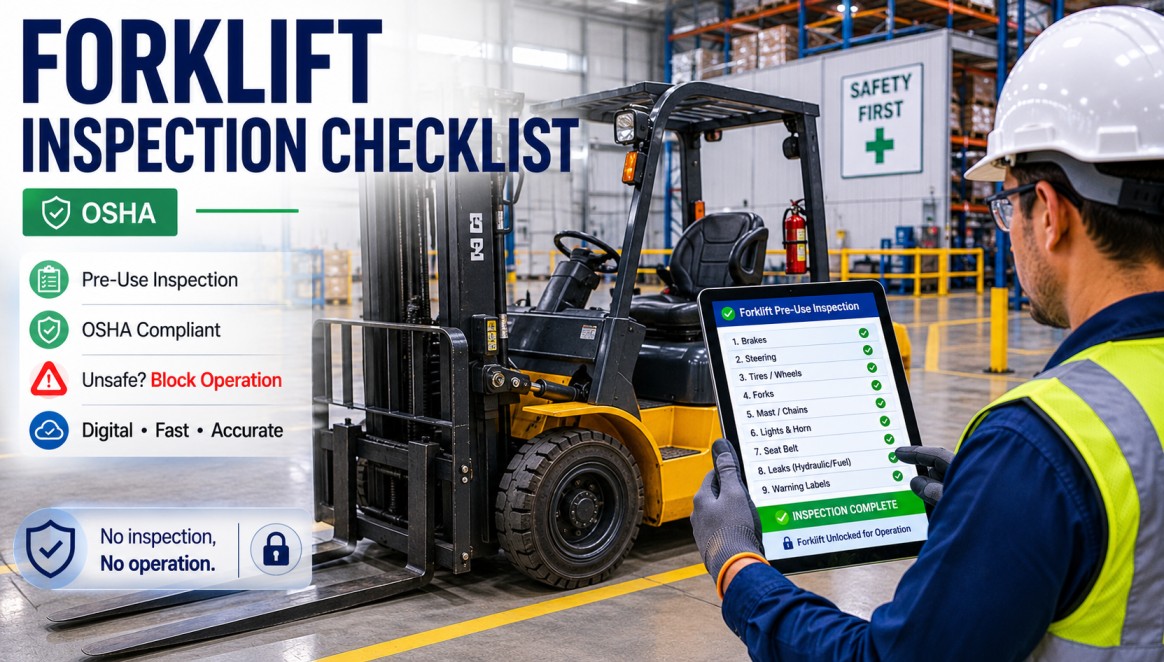
Forklift daily pre-use checks enforced digitally — no inspection, no operation
Zones

The Six Warehouse Hazard Zones That OSHA Inspectors Target First

OSHA's NEP CPL 03-00-026 directs compliance officers to evaluate six specific hazard areas during every warehouse inspection. These zones were selected based on BLS injury data showing they account for the vast majority of warehousing fatalities and serious injuries. Each zone below includes the specific OSHA standards inspectors will check and the most commonly cited violations.

01
Powered Industrial Vehicles
1910.178

Forklift operator training and certification, daily pre-shift inspections, overhead guard condition, seatbelt usage, travel speed, and load handling. OSHA checks that every operator is certified for the specific truck type they operate and that inspection logs are current. Forklift violations are perennially in OSHA's top 10 most-cited standards.

02
Material Handling & Storage
1910.176

Rack structural integrity, load capacity posting, pallet condition, stacking height and stability, aisle clearance, and sprinkler clearance (minimum 18 inches from stored materials to sprinkler heads). ANSI MH16.1 is the referenced design and inspection standard for industrial steel storage racks.

03
Walking-Working Surfaces
1910.22

Slip, trip, and fall hazards in aisles and work areas. Housekeeping condition, spill containment, floor condition, dock plate security, mezzanine guardrails, and ladder safety. OSHA requires that all walking surfaces be kept clean and dry and that permanent aisles be clearly marked.

04
Means of Egress & Fire Protection
1910.36-38

Unobstructed exit routes, illuminated exit signs, fire extinguisher inspection and placement, emergency action plan posting, alarm systems, and evacuation drill documentation. Blocked emergency exits are one of the most common — and most dangerous — warehouse violations.

05
Heat & Ergonomic Hazards
General Duty

Heat illness prevention program, hydration stations, work-rest cycles in warm environments. Ergonomic risk assessment for manual material handling, lift-assist equipment availability, task rotation, and employee training on proper lifting technique. Musculoskeletal disorders are the most common warehousing injury category.

06
Hazard Communication & PPE
1910.1200

Written hazard communication program, safety data sheets for all chemicals, container labeling, PPE hazard assessment, and required PPE availability and use. Battery charging areas for electric forklifts and propane storage areas are specific focus points during OSHA inspections.

Racks

Rack Inspection Traffic Light System — ANSI MH16.1 Damage Classification

The Rack Manufacturers Institute (RMI) and ANSI MH16.1 define a three-tier damage classification system that every warehouse should use. This system assigns a severity level and required action to every rack defect found during inspection. Using this system consistently creates a clear audit trail and ensures no damage goes unaddressed.

Green — Minor / Cosmetic
Surface scratches, minor paint wear, light scuffs on uprights or beams. No reduction in structural capacity. Safe for continued use. Document and monitor during next inspection cycle.
Monitor — document and recheck next cycle
Amber — Significant / Action Required
Bent uprights (less than 50% of flange width damage), loose anchor bolts, damaged welds, or missing beam safety clips. Load capacity may be reduced. Schedule repair within a defined timeframe. Unload the affected bay if damage is at the threshold.
Schedule repair — unload bay if near threshold
Red — Critical / Immediate Out of Service
Upright flange damage exceeding 50% of flange width, torn metal, completely sheared anchor bolts, missing beam connectors, or any visible crack in a structural member. Unload the bay immediately and isolate the affected area. Do not return to service until repaired and signed off by a qualified engineer.
Immediate — unload, isolate, tag out of service


Warehouse Inspection Management

Stop Using Paper Checklists — Digitise Your OSHA Warehouse Safety Inspections Today

iFactory replaces paper inspection forms with a digital warehouse safety platform. Safety managers schedule zone-based inspections, complete them on mobile devices with photo evidence, and track corrective actions to closure. Rack damage is tagged with the traffic-light system. Forklift daily checks are enforced at the device level. All records retained for OSHA audit readiness.

Zone-based inspection checklists aligned to all six OSHA NEP focus areas
Rack damage traffic-light classification with photo evidence and auto-repair assignment
Forklift daily inspection enforcement — no completed check, no clearance to operate
Checklist

Warehouse Safety Inspection Checklist — 35 Checkpoints

This checklist covers all six OSHA NEP focus areas across seven warehouse zones. Each checkpoint maps to a specific OSHA 29 CFR 1910 standard or ANSI MH16.1 requirement. Use this as your daily and weekly inspection framework — customise checkpoints for your specific facility layout, rack types, and equipment fleet.

A

Racking & Storage Systems

1910.176 / ANSI MH16.17
1Inspect uprights for bends, dents, tears, or cracks — flange damage exceeding 50% of flange width is criticalDaily
2Verify all beam safety clips and locking pins are present and fully engaged on every connectionDaily
3Check base plates and anchor bolts — no missing, sheared, or loose anchors on any uprightWeekly
4Confirm load capacity placards are posted on every rack bay and are legibleDaily
5Verify no pallet overhang beyond beam edge — overhang must not exceed 3 inchesDaily
6Check minimum 18-inch clearance between stored materials and sprinkler headsWeekly
7Inspect row spacers, upright guards, and end-of-aisle protection for damage or displacementWeekly
B

Forklifts & Powered Industrial Trucks

1910.1786
8Verify daily pre-shift inspection completed for every forklift before first use — documented with operator IDDaily
9Confirm operator certification current and available for each operator — certification records on fileMonthly
10Check seatbelt / operator restraint functional on every sit-down counterbalanced forkliftDaily
11Inspect overhead guard for cracks, deformation, or missing bolts — any damage requires engineering assessmentDaily
12Verify backup alarm operational on all forklifts — activates automatically on reverse engagementDaily
13Observe travel speed compliance — no speeding in aisles, at intersections, or near pedestriansWeekly
C

Aisles, Floors & Walking Surfaces

1910.225
14Confirm all permanent aisles clearly marked with floor tape or paint — markings not faded or obscuredWeekly
15Inspect aisles for obstructions — no pallets, equipment, or debris in travel pathsDaily
16Check floor condition — no cracks, holes, uneven surfaces, or standing water in travel areasWeekly
17Verify sufficient safe clearances for forklift turns and passage through doorways per 1910.176(a)Monthly
18Inspect dock plates and levelers for condition, secure positioning, and rated capacity postingDaily
D

Loading Docks & Shipping Areas

1910.178 / 1910.225
19Verify dock edge clear — no materials, equipment, or debris within 6 feet of unsecured dock edgeDaily
20Check truck restraint / wheel chock system operational — trailer cannot pull away until restraint engagedDaily
21Inspect dock leveler for proper operation — no hydraulic leaks, deck plate not cracked or bentDaily
22Confirm dock door functioning — roll-up door safety photo-eye sensors clean and unobstructedWeekly
23Verify dock area lighting adequate — no dark zones where forklifts maneuver near trailer edgesWeekly
E

Emergency Equipment & Egress

1910.36-38 / 1910.1576
24Verify all emergency exits unobstructed — no pallets, equipment, or storage within exit pathwayDaily
25Check exit signs illuminated and visible from every aisle — replace any burned-out or dim signsDaily
26Inspect fire extinguishers — monthly visual check, annual maintenance tag current, accessibleWeekly
27Confirm emergency action plan posted in visible locations — includes evacuation routes and assembly pointsMonthly
28Test emergency alarm system audible throughout the facility — including mezzanine and remote areasMonthly
29Verify first aid kits stocked and accessible — designated first aid responders identified on each shiftWeekly
F

Hazard Communication, PPE & Training

1910.1200 / 1910.1326
30Confirm written hazard communication program current — includes chemical inventory and SDS locationMonthly
31Verify all chemical containers labeled — including secondary containers with contents and hazard warningsWeekly
32Inspect battery charging area — ventilation adequate, acid spill kit available, PPE posted and wornWeekly
33Check PPE compliance — safety glasses, high-visibility vests, steel-toe footwear worn in all warehouse zonesDaily
34Verify LOTO procedures documented for all conveyor, baler, compactor, and dock equipment maintenanceMonthly
35Confirm new hire safety orientation completed before any employee begins independent warehouse workMonthly
OSHA's NEP on Warehousing (CPL 03-00-026) applies to over 1.7 million workers across warehousing, distribution, parcel delivery, and high-injury retail establishments. Inspections are comprehensive safety inspections — not partial walkthroughs. Every facility in scope should be running documented weekly inspections.
FAQ

Frequently Asked Questions

What does the OSHA NEP on warehousing mean for my facility?

OSHA's National Emphasis Program (NEP) CPL 03-00-026, effective October 2023, directs OSHA compliance officers to conduct comprehensive safety inspections at warehousing and distribution center operations nationwide. Inspections focus on six hazard areas: powered industrial vehicles, material handling/storage, walking-working surfaces, means of egress, fire protection, and heat/ergonomic hazards. If your facility operates under NAICS codes 423, 424, 492, or 493 (warehousing, distribution, parcel delivery), you are in scope. High-injury retail establishments in specific NAICS codes are also covered for partial inspections of loading and storage areas. Book a Demo to see how iFactory prepares your facility for OSHA NEP inspections.

How often should warehouse rack inspections be conducted?

The Rack Manufacturers Institute (RMI) and ANSI MH16.1 recommend a three-tier inspection cadence: daily visual walkthroughs by floor personnel to spot obvious damage, weekly documented inspections by a designated person responsible for rack safety (PRRS), and annual formal inspections by a qualified third-party rack engineer. High-traffic aisles, tight-clearance bays, and areas with a history of forklift impacts should be inspected monthly. Every inspection — including daily walkthroughs — should be documented with date, inspector name, findings, and corrective actions. Digital inspection systems auto-stamp this data and make the audit trail easy to produce when OSHA arrives.

What are the most commonly cited OSHA violations in warehouses?

The five most frequently cited OSHA standards in warehousing inspections are: 1) Powered Industrial Trucks (1910.178) — operator training and pre-shift inspection failures, 2) Hazard Communication (1910.1200) — missing SDS, unlabeled chemical containers, 3) Walking-Working Surfaces (1910.22) — slip/trip hazards and poor housekeeping, 4) Lockout/Tagout (1910.147) — missing machine-specific procedures for conveyor and baler maintenance, and 5) Means of Egress (1910.36-37) — blocked emergency exits and non-illuminated exit signs. These five categories account for over 60% of warehouse citations nationally.

What are the OSHA requirements for forklift inspections in warehouses?

OSHA 29 CFR 1910.178(q)(7) requires that powered industrial trucks be inspected before each shift — or at minimum once daily for continuous operations. The inspection must cover brakes, steering, controls, warning devices, mast, forks, tires, hydraulic systems, and safety devices. Any truck found to be unsafe must be removed from service immediately. Inspection documentation must include the date, truck ID, operator name, and any defects found. A forklift operated with a known defect is considered a willful violation — carrying penalties up to $165,514 per instance. Digital systems that block forklift operation until the inspection is completed are the most effective way to enforce compliance.

What is the traffic light system for rack inspection?

The traffic light system is the ANSI MH16.1-recommended method for classifying rack damage severity. Green indicates minor cosmetic damage (scratches, scuffs) — safe to use, document and monitor. Amber indicates significant damage (bent uprights under 50% flange width damage, loose anchors) — schedule repair and consider unloading the bay. Red indicates critical damage (flange damage exceeding 50%, torn metal, missing beam connectors, cracks) — unload the bay immediately, isolate the area, and do not return the rack to service until repaired and certified by a qualified engineer. A digital inspection platform makes this classification system easy to apply consistently and creates a clear audit trail for OSHA.


OSHA Warehouse Safety Programme

Replace Paper Checklists With a Digital System That Enforces Every Inspection, Every Shift

iFactory gives safety managers a complete digital warehouse inspection platform — zone-based checklists, forklift pre-use enforcement, rack damage traffic-light tagging, automated escalation, and corrective action tracking. All records retained for OSHA NEP audit readiness. Stop hoping your inspections are being done. Know with certainty.

Warehouse safety inspection templates covering all six OSHA NEP focus areas
Mobile-first inspections with photo evidence, e-signatures, and traffic-light damage classification
Forklift daily inspection enforcement with out-of-service tagging and supervisor escalation

Share This Story, Choose Your Platform!