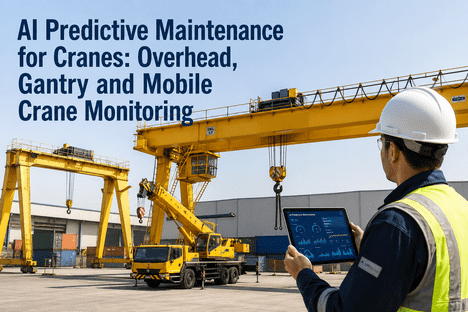
AI Predictive Maintenance for Cranes: Overhead, Gantry and Mobile Crane Monitoring
By Rebecca on June 9, 2026
In industrial facilities, crane failures on overhead bridge cranes, gantry systems, and mobile lifting equipment represent one of the most critical safety and production risks — OSHA data from 319 crane incidents over two decades shows 180 injuries and 161 fatalities, with 48% of incidents linked to poor crane maintenance and 13% involving wire rope failure. A single unplanned crane breakdown in a steel mill, automotive plant, or shipping terminal can halt all material movement beneath the crane, costing $50,000–$250,000 per hour in lost throughput while creating dangerous load-suspended situations. Traditional reactive and time-based inspection programs cannot address the variable duty cycles, load spectra, and environmental conditions that accelerate hoist motor wear, brake degradation, wire rope fatigue, and structural fatigue in crane systems. iFactory's predictive maintenance platform fuses hoist motor current, brake wear telemetry, wire rope inspection data, structural vibration, and equipment history into machine learning models that forecast hoist motor winding degradation, brake friction material wear, wire rope internal breakage, and structural fatigue 4-8 weeks in advance, enabling maintenance teams to act before the crane fails. Book a Demo to see how iFactory connects your crane fleet data to predictive intelligence.
Predictive Maintenance · Cranes & Hoists 2026
AI Predictive Maintenance for Cranes: Overhead, Gantry & Mobile Crane Monitoring
Hoist motor winding & bearing prediction · Brake system wear & air gap monitoring · Wire rope fatigue & internal defect detection · Structural fatigue & girder deflection forecasting · All flowing into iFactory CMMS & Shift Logbook.
Why Reactive Crane Maintenance Fails in Industrial Operations
Cranes operate under some of the most punishing mechanical duty cycles in industrial environments — a single overhead crane in a steel coil yard may execute 500+ lifts per shift, accumulating hoist motor starts, brake applications, and wire rope bends over sheaves that progressively degrade every component in the load path. Hoist motors experience winding insulation stress from repeated thermal cycling, with even a single over-temperature event capable of halving motor service life. Brake systems lose holding torque as friction material wears and air gaps widen — Konecranes data shows that when brake opening current drops below 5%, sudden brake failure and load drop become imminent. Wire ropes suffer broken wires, core degradation, and internal corrosion invisible to visual inspection, with discard criteria defined by OSHA at specific broken-wire thresholds. Structural components — bridge girders, end trucks, and runways — accumulate fatigue cracks from millions of load cycles. Fixed-interval maintenance replaces wire ropes, brakes, and bearings based on calendar time rather than actual duty cycles, meaning critical components are replaced too early in lightly used cranes or too late in high-duty machines, creating safety risks and wasted consumable spend. iFactory's condition-based approach replaces the calendar with data-driven prediction.
LIMITATIONS OF TIME-BASED CRANE MAINTENANCE PROGRAMS
1
Duty cycle variance ignored — same PM interval regardless of lifts per shift, load weight distribution, or operator behavior patterns
2
Sensor-blind to hidden defects — wire rope internal corrosion, brake air gap drift, and motor winding degradation invisible between quarterly inspections
3
Catastrophic failure safety risk — load drop from unmonitored brake wear or wire rope breakage can cause fatalities, OSHA data shows 48% of incidents linked to poor maintenance
4
No fleet-wide predictive visibility — maintenance decisions based on last crane alarm or annual inspection, not real-time degradation across hoist, brake, and rope condition data
Three Crane Failure Categories iFactory Predicts
01
Hoist Motor Winding, Bearing & Contactor Degradation Prediction
Hoist motor failures — winding insulation breakdown, bearing fatigue, and contactor weld — represent the highest-frequency electrical failure in overhead and gantry cranes. Each hoist motor may experience 200-500 starts per shift, with jogging and inching operations accelerating contactor wear and thermal stress on windings. iFactory ingests motor current signature, winding temperature, starts-per-hour data, and contactor cycle count to train ML models that predict winding insulation breakdown, bearing fatigue, and contactor failure 4-8 weeks in advance with 70-80% accuracy. Plants running these systems report 25-30% reductions in crane-related unplanned downtime. Maintenance planners schedule motor replacements and contactor rebuilds during planned plant outages rather than responding to hoist failure events that leave loads suspended mid-air. Book a Demo to see iFactory's crane hoist prediction models in production.
4-8 week lead time70-80% accuracy25-30% downtime reduction
02
Crane Brake System Wear, Air Gap & Torque Decay Forecasting
Crane brake systems — hoist brakes, trolley brakes, and bridge brakes — are the most safety-critical component on any overhead crane. Brake friction material wears progressively, air gaps widen as linings erode, and holding torque decays as spring sets fatigue. iFactory monitors brake opening current, brake application timing, holding current, and emergency stop frequency to detect early-stage wear patterns before brake performance degrades below safe thresholds. One steel mill using iFactory's brake monitoring detected critically worn brakes on 15% of its overhead crane fleet during the first quarter — conditions that could have led to load drops during routine production. The platform correlates brake wear trends with operator behavior data — jogging frequency, emergency stop counts, and overload events — identifying root causes of accelerated brake degradation and enabling targeted operator training.
Wire ropes, structural girders, and runway rails face variable load spectra, environmental conditions, and usage patterns that produce complex inspection data challenging conventional threshold-based approaches. Wire ropes degrade through broken wires, internal corrosion, core deterioration, and bend-over-sheave fatigue — much of it invisible to visual inspection until advanced stages. iFactory applies ensemble ML models that fuse magnetic rope inspection data, structural vibration, girder deflection measurements, and rail wear patterns to detect early-stage degradation. While prediction accuracy in this category is lower (50-60%), the platform's continuous learning loop improves model precision over time as more inspection and load cycle data accumulates. The Shift Logbook captures maintenance technician-reported anomalies — rope lubrication records, structural crack findings, rail gap measurements — alongside sensor data, creating a richer training corpus for the prediction models. Book a Demo to see iFactory's complete crane predictive maintenance platform.
Ensemble ML modelsContinuous learning loopShift Logbook correlation
How iFactory Transforms Crane Fleet Telemetry Into Predictive Intelligence
iFactory is the AI software intelligence layer — not a crane manufacturer or sensor vendor. The platform integrates with existing crane telemetry from PLC-based crane controls, VFD drives, brake monitoring systems, wire rope inspection sensors (magnetic flux leakage), load cells, limit switches, and CMMS platforms already deployed across your facility. The Shift Logbook captures maintenance technician shift reports, daily operator inspection checklists, wire rope replacement records, and repair actions alongside the sensor stream, creating a unified data fabric for predictive model training.
Asset Class
Telemetry Sources
iFactory Prediction Output
Business Impact
Hoist Motors
Current signature · winding temp · starts/hour · VFD data · contactor cycles
iFactory ingests motor current signature, winding temperature, starts-per-hour, and contactor cycle data from each hoist motor on overhead and gantry cranes. ML models trained on historical failure patterns predict winding insulation breakdown, bearing fatigue, and contactor weld failure 4-8 weeks in advance. Predicted failures are assigned a confidence score and recommended intervention window. Maintenance planners schedule motor replacements during planned plant outages and holiday shutdowns, avoiding hoist failure events that leave loads suspended and halt production. Every prediction event is logged in iFactory's Shift Logbook with full traceability to the motor telemetry that triggered the alert.
Friction Material, Air Gap & Torque Condition Monitoring
Continuous
Crane brake reliability is critical for personnel safety and load security — undetected friction material wear, air gap enlargement, and holding torque decay can lead to catastrophic load drops. iFactory monitors brake opening current, application timing, and emergency stop frequency to detect early-stage degradation. The platform pinpoints the specific brake (hoist, trolley, or bridge) requiring adjustment or relining before brake performance degrades below OSHA-mandated safe thresholds. Alerts route directly to the maintenance shift in the Shift Logbook with crane metadata, severity score, and recommended action timeline.
Wire Rope, Girder & Runway Rail Health Surveillance
Periodic + Continuous
Wire ropes and structural components face variable load spectra, environmental exposure, and usage patterns that produce complex data — making failure prediction more challenging than for hoist motors or brakes. iFactory applies ensemble ML models that fuse magnetic rope inspection results, structural vibration, and girder deflection measurements, with a continuous learning loop that improves prediction precision as more inspection data accumulates. The Shift Logbook captures maintenance technician-reported anomalies — broken wire counts, crack indications, rail wear measurements — alongside sensor data, creating a richer training corpus. The result is steadily improving prediction accuracy for wire rope replacement timing, structural fatigue crack growth, and runway rail degradation.
What iFactory Delivers for Crane Fleet Reliability
70-80%
Hoist motor & brake failure prediction accuracy
4-8 week advance warning vs suspended load crisis
$50-250K
Prevented loss per hour of crane downtime avoided
Lost throughput + maintenance overtime + safety risk
25-30%
Fewer unplanned crane-related production stoppages
Hoist motor · brake · contactor failures
48%
of crane incidents involve poor maintenance per OSHA
Predictive approach directly targets this risk
FAQ
iFactory is the AI software intelligence layer — not a crane or sensor manufacturer. The platform integrates with PLC-based crane controls, VFD drives, brake monitoring systems, wire rope magnetic flux leakage sensors, load cells, limit switches, and CMMS platforms already deployed across your facility. Your facility selects the sensor and telemetry hardware; iFactory turns the data into predictive intelligence, maintenance alerts, and shift-ready work orders.
Model tuning typically requires 6-12 months of operation on a specific crane fleet to eliminate false positives, tune threshold parameters, and build maintenance team confidence. The platform's continuous learning loop improves precision over time as more failure and operating data accumulates. iFactory recommends starting with one crane type and one failure mode — such as hoist motor winding degradation or brake wear prediction — proving value before expanding fleet-wide.
Yes. iFactory connects to SAP, Oracle, JDE, Microsoft Dynamics, and major CMMS platforms. The Shift Logbook captures maintenance technician shift reports, daily crane operator checklists, wire rope inspection results, and repair actions alongside sensor-generated predictions. Every prediction event, sensor reading, and maintenance action is recorded with full traceability for audit, compliance, and continuous model improvement.
Deploy iFactory for Crane Predictive Maintenance
AI-powered predictive maintenance platform connecting hoist motor, brake system, wire rope, and structural telemetry into one unified intelligence layer — with ML-based failure prediction, Shift Logbook integration, CMMS workflow automation, and fleet-wide reliability analytics for overhead, gantry, and mobile crane operations.