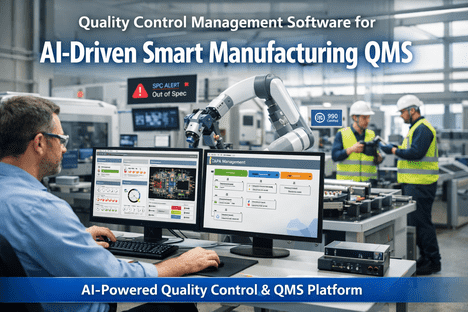
AI-Enabled Quality Control System for Manufacturing & Supply Chains
By will Jackes on March 12, 2026
Every defect has an origin story. A contaminated component that slipped through incoming inspection. A process parameter that drifted at shift change. An assembly step no one caught because every inspector was watching a different line. AI-enabled quality control systems find those stories before they cost you — catching defects at the supplier, at the line, and everywhere in between. With product recalls growing 25% year-over-year in Q1 2025 and automotive recall events costing up to $600 million each, the cost of waiting for quality problems to surface is now existential. iFactory's AI-enabled quality control system creates a continuous intelligence layer across your entire manufacturing and supply chain operation — from incoming materials to final shipment — so defects stop before they start.
The Quality Crisis Driving AI Adoption in 2026
+25%
Product recall growth Q1 2025 vs Q1 2024
— Xenoss.io Manufacturing Report, 2025
~20%
Of total revenue lost to poor quality for average manufacturer
— Overview.ai Industry Research, 2025
$600M
Maximum cost per automotive recall event — direct + supply chain
— McKinsey Analysis, 2025
20–30%
Of defects missed by traditional visual inspection methods
— Sandia National Laboratories
Where Defects Escape: The 5 Quality Control Gaps in Modern Supply Chains
Quality failures in manufacturing and supply chains don't happen at random. They happen at predictable points where legacy systems create blind spots. Understanding where your quality gaps are is the first step to closing them with AI:
01
Incoming Materials & Supplier Components
Static AQL sampling plans miss high-risk lots. Paper-based IQC doesn't connect to downstream production outcomes. Defective components enter the line undetected.
AI Fix:
Predictive IQC flags risky lots before they reach the line, using supplier history, past NCRs, and real-time production data to dynamically adjust inspection intensity
02
In-Process Production Inspection
Human inspectors sample 5–10% of output. Detection accuracy drops to 60–85% and declines further with shift fatigue. Defects at shift change and changeovers systematically escape.
AI Fix:
Computer vision inspects 100% of production at 10,000+ parts/hr with 99%+ accuracy — consistent across every shift, every hour, 24/7/365
03
Process Parameter Drift
Temperature, pressure, speed, and material property changes that fall within spec individually but combine to cause quality failures. Legacy SPC catches some — but only after defects form.
AI Fix:
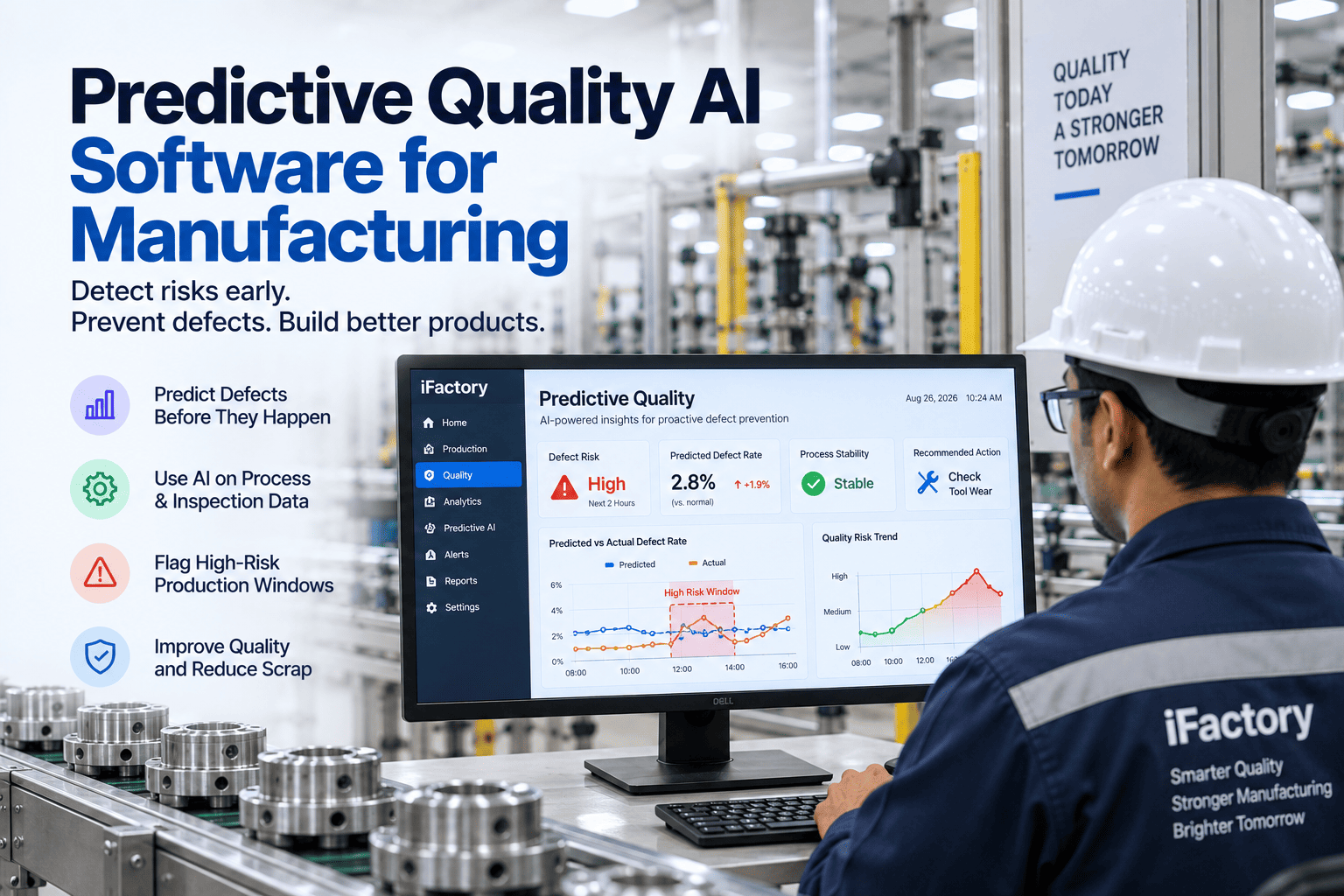
Predictive quality analytics monitors multivariate process signatures and detects drift before it produces defects — hours or days ahead of failure
04
End-of-Line & Final Inspection
Manual end-of-line inspection is the last barrier before shipment — but human error under high-volume conditions means defects slip through. In 2025, one FMCG recall alone cost $58 million.
AI Fix:
AI vision systems at end-of-line perform 100% automated final inspection — checking assembly completeness, labelling accuracy, seal integrity, and visual defects simultaneously
05
Corrective Action & Traceability Gaps
When defects are found, the manual CAPA process is slow, inconsistently followed, and disconnected from production data. Root cause analysis relies on memory and partial records — not complete data trails.
AI Fix:
Every defect automatically triggers a CAPA with full inspection evidence, lot traceability, and root-cause analytics — closing loops in hours, not days
The Evolution of Quality Control: From Clipboard to AI Intelligence
1990s–2000s
Manual & Statistical QC
Paper AQL tablesRandom samplingManual NCRsBatch reporting
20–30% defect miss rate
2010s
Rule-Based Digital QMS
Digital formsRule-based visionStatic SPCSiloed data
Better records, same blind spots
2025–2026
AI-Enabled QC System
100% AI inspectionPredictive analyticsAuto CAPASupply chain intelligence
99%+ accuracy · Defects prevented
How iFactory's AI-Enabled Quality Control System Works
iFactory operates as a continuous quality intelligence layer across your manufacturing and supply chain — connecting four phases of quality control into one unified, self-improving system:
Step 1
Sense
High-resolution vision cameras, IIoT sensors, and machine data feeds continuously capture quality signals across the production environment — from incoming dock to final packaging
Cameras · Thermal Sensors · CMM · IIoT · PLCs
Step 2
Detect
Deep learning CNN models analyze every unit at line speed — classifying defect types, calculating severity, and triggering automated rejection signals within 20 milliseconds of detection
CNN Vision · Edge AI · <20ms Latency · Auto-Reject
Step 3
Predict
Cloud ML models analyse process data across thousands of production cycles to detect early drift signatures — predicting quality failures hours or days before defects form, and prescribing corrections
Process ML · SPC · Digital Twin · Supplier Scoring
Step 4
Close Loop
Every detection event automatically spawns a CAPA, updates the compliance audit trail, feeds back into model training, and syncs with ERP and MES — creating a self-improving quality loop with no manual steps
Auto CAPA · Audit Trail · ERP/MES Sync · Retraining
From Supplier to Shipment — Quality Under Control
iFactory's AI-enabled quality control system covers every defect escape point in your manufacturing and supply chain. See it running live in your industry context.
iFactory's AI-enabled quality control system is built on four tightly integrated technology layers — each contributing a different dimension of quality intelligence across manufacturing and supply chain operations:
1
Computer Vision & Deep Learning Inspection
CNN models trained on your defect types — inspects 100% of output at line speed
Computer vision quality control systems now achieve 90–99%+ defect detection accuracy — up from 60–85% with traditional human inspection — with processing speeds under 200 milliseconds per unit (Rock & River, 2025)
2
Predictive Process & Supplier Quality Analytics
ML models that forecast quality failures and score supplier risk — before defects form
SPC & Process DriftSupplier ScorecardsPredictive IQCRoot Cause AIDemand Forecasting
AI models predict demand with 85–95% accuracy vs. 60–70% with traditional methods — and apply the same predictive intelligence to quality, flagging supplier risk and process drift before production is impacted (Pravaah Consulting, 2026)
3
Automated CAPA & Traceability Engine
Every defect event automatically triggers documented corrective action — end to end
Auto CAPA CreationLot Traceability8D AccelerationEscalation WorkflowsAudit Trail
With full supply chain traceability from supplier to shipment, AI-enabled quality systems reduce root cause analysis time from days to hours — and ensure every CAPA is created, assigned, and closed on a documented timeline
4
Unified Quality Intelligence Platform
Single system of record connecting manufacturing and supply chain quality data
ERP / MES / SCADASupplier PortalLive DashboardsMobile AppsCompliance Reports
By 2026, 45% of G2000 OEMs will connect field and engineering data via AI to improve product quality, lower production costs, and accelerate design cycles — the unified platform is what makes that connection possible (IDC FutureScape, 2026)
Full Supply Chain Quality Coverage — Supplier to Customer
Unlike point solutions that cover only one stage, iFactory's AI-enabled quality control system provides continuous quality intelligence across the entire value chain:
Tier 2+ Suppliers
Supplier qualification, risk scoring, and performance monitoring — before materials ship
Supplier Intelligence
Incoming Dock (IQC)
Predictive IQC dynamically adjusts lot sampling based on supplier risk signals and production history
Predictive IQC
Production Line
100% inline AI vision inspection at every station — detecting defects before they propagate
100% AI Inspection
End-of-Line & Packing
Final AI inspection verifies assembly completeness, labels, seals, and cosmetic quality before shipment
Final Verification
Customer Delivery
Full lot traceability ensures rapid response if field issues emerge — reducing recall scope and cost
Full Traceability
What AI-Enabled Quality Control Delivers: Real-World Results
These are documented outcomes from AI-enabled quality control deployments across automotive, electronics, semiconductor, and industrial manufacturing — with full source attribution:
200–300%
ROI from Full AI Quality Infrastructure
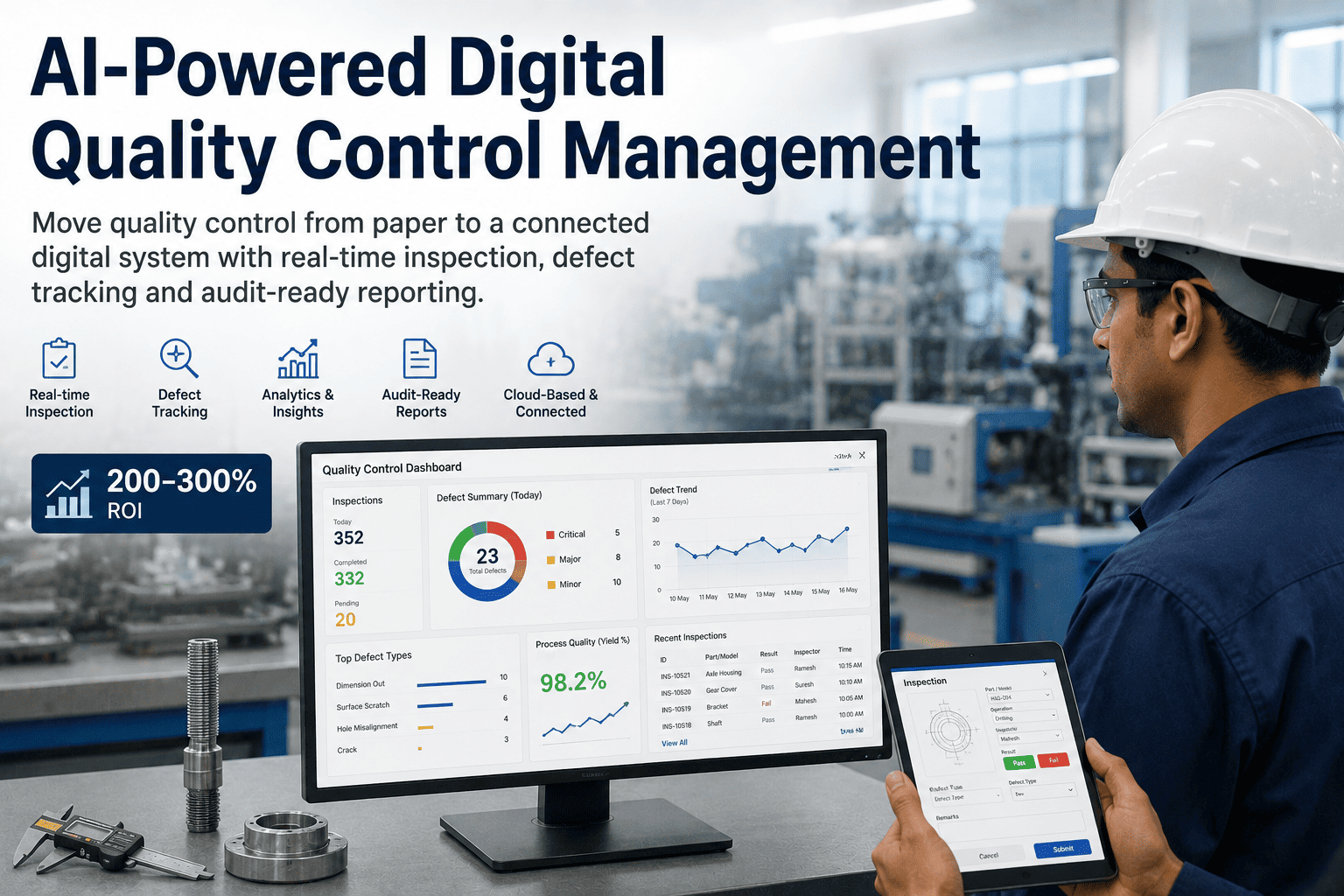
Full-fledged AI infrastructure delivers 200–300% ROI through significant defect reduction and faster inspection cycles — with higher accuracy and consistency than manual checks
Tech-Stack.com, December 2025
37%
Fewer Defects in Automotive Components
BMW AI vision deployments achieving 30–40% defect reduction and 37% fewer defects in automotive components, with $2M+ annual savings per facility
Rock & River / Jidoka Case Studies, 2025
40%
Less Waste & Scrap
Manufacturers report 40% reduction in waste and 25% faster inspection cycles from AI-driven quality control — delivering measurable ROI within 12–18 months
AI-Innovate Manufacturing, 2026
30%
Defect Detection Rate Improvement
Gartner projects 30% improvement in defect detection rates as over 50% of manufacturers integrate AI quality control — a structural improvement, not a one-time gain
Gartner, 2025
99%+
Defect Detection Accuracy
AI vision systems consistently achieve 95–99%+ accuracy — detecting defects invisible to the human eye at full production speed without fatigue-related decline
A3 Association / Overview.ai, 2025
6–12 mo
Typical ROI Payback Period
AI vision inspection and predictive maintenance deliver quick wins with 6–12 month payback — the fastest ROI category in manufacturing AI investment
Core Capabilities of iFactory's AI-Enabled Quality Control System
Every capability in iFactory's platform is designed to close a specific quality escape point — from incoming inspection through final shipment and supplier feedback:
100% Inline AI Visual Inspection
Deep learning vision cameras inspect every unit at machine speed — no sampling, no escapes, no fatigue. Automated rejection signals to PLCs within 20ms of detection.
Predictive Quality Analytics
ML models monitor process parameters to detect drift before defects form — shifting quality control from reactive detection to genuine prevention.
Supplier Quality Intelligence
Real-time supplier scorecards, predictive IQC that adjusts sampling by risk level, and automated NCR creation when incoming lots fail inspection.
Automated CAPA & Root Cause
Every quality event auto-generates a CAPA with inspection evidence, lot traceability, and AI-assisted root cause analysis — reducing investigation time from days to hours.
Compliance & Audit Trail
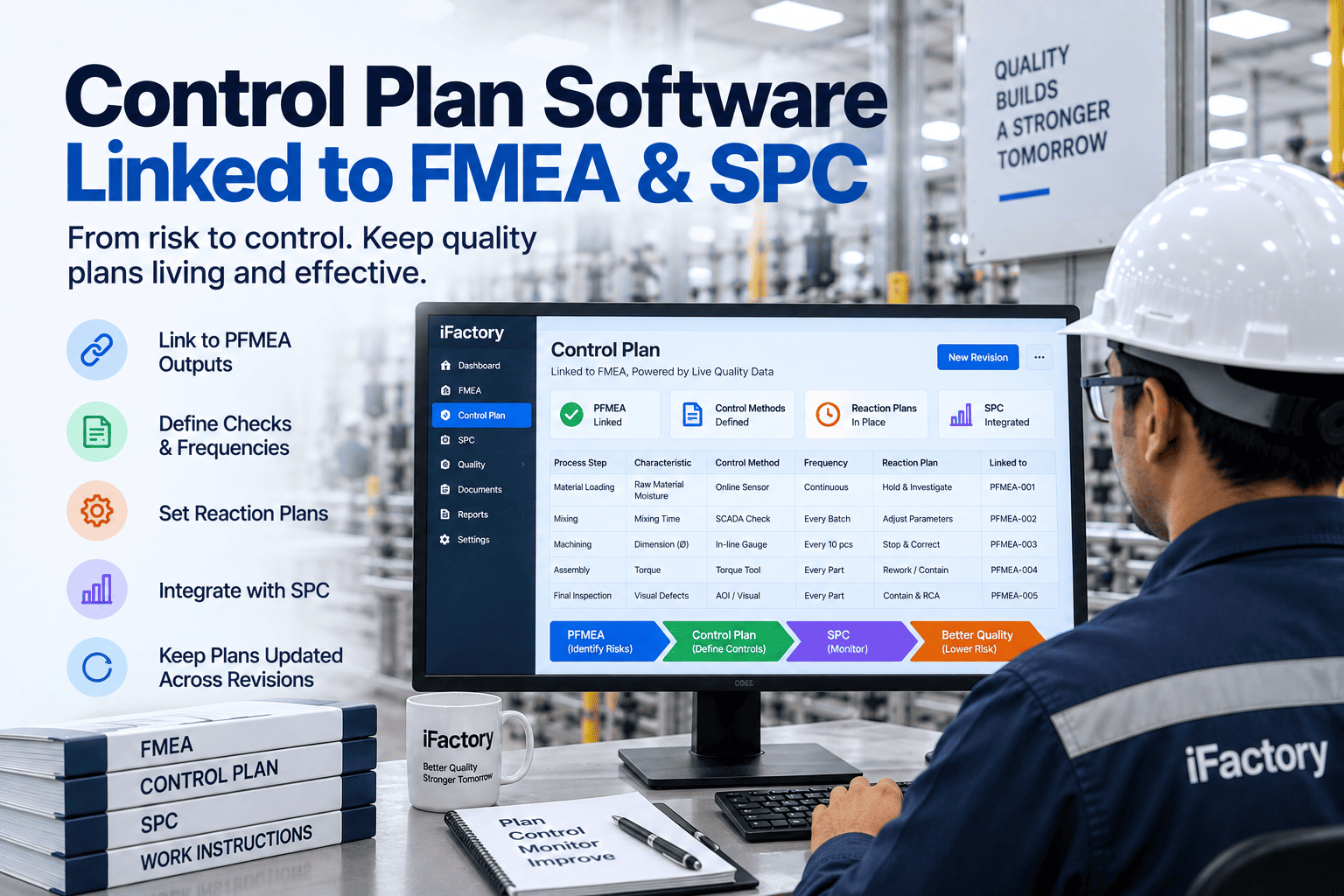
Every inspection, CAPA, and sign-off auto-logged in a tamper-proof audit trail. One-click compliance reports for ISO 9001, IATF 16949, FDA 21 CFR Part 11, and AS9100.
Live Multi-Site Quality Dashboard
Real-time quality KPIs across all lines, shifts, and global sites. Drill from plant-level score to individual defect image in three clicks — on any device.
Why Quality Leaders Are Moving to AI-Enabled Systems Now
"Supply chain disruptions cost manufacturers $184 billion annually. Excess inventory ties up capital while stockouts halt production. Companies that aggressively digitize their supply chains — including quality control — can expect to boost annual earnings growth by 3.2%, the largest increase from digitizing any single business area. By 2026, 75% of large enterprises will have adopted AI in their supply chain operations. Quality is where that AI delivers its fastest, most measurable return."
Implementation Roadmap: AI Quality Control Across Your Supply Chain
The most successful AI quality deployments follow a phased approach — prioritising the highest-cost quality escape points first, proving ROI at each stage before expanding:
Phase 1
Digitise & Baseline
⏱ Weeks 1–4
Replace paper inspection forms with digital workflows
Establish quality KPI baseline across production lines
Connect supplier data to incoming quality records
Quick win: Quality data centralised, traceability established
Phase 2
Deploy AI Inspection
⏱ Weeks 5–12
AI vision deployed on highest-defect inspection point
Connect IIoT sensors and machine data feeds
ERP, MES, SCADA integration and rejection automation
Quick win: 100% inline inspection live, first escapes eliminated
Phase 3
Predict & Automate
Months 3–6
Activate predictive quality and supplier scoring
Enable automated CAPA workflows end-to-end
Deploy predictive IQC at incoming dock
Quick win: Defects prevented before production, not after
Phase 4
Scale & Optimise
Month 6+
Roll AI inspection to all lines, sites, and supply chain tiers
Continuous model retraining — accuracy improves indefinitely
Outcome: Full supply chain quality under AI control
Frequently Asked Questions
What is an AI-enabled quality control system for manufacturing?
An AI-enabled quality control system for manufacturing uses machine learning, computer vision, and predictive analytics to automate quality inspection and control across the entire production and supply chain operation. Unlike traditional QMS platforms, AI-enabled systems inspect 100% of production output in real time, learn from every unit to improve accuracy, predict quality failures before defects form, and automatically trigger corrective action workflows. They integrate with IIoT sensors, vision cameras, ERP, MES, and SCADA systems to create a closed-loop quality intelligence system that operates continuously without manual intervention.
How does AI quality control improve supply chain quality management?
AI-enabled quality systems address supply chain quality at every stage — not just on the production line. At the incoming dock, predictive IQC dynamically adjusts inspection intensity based on supplier risk signals, past NCR history, and downstream production outcomes, flagging risky lots before they enter production. For supplier management, AI continuously generates scorecards from inspection data, delivery performance, and CAPA closure rates. Full lot traceability from supplier to customer means that if quality issues emerge in the field, root cause analysis is completed in hours rather than weeks. This end-to-end coverage fundamentally reduces the defect escape rate that costs manufacturers up to 20% of revenue annually.
What ROI can we expect from an AI-enabled quality control system?
Full AI quality infrastructure delivers 200–300% ROI through defect reduction and faster inspection cycles (Tech-Stack.com, 2025). Specific documented results include BMW achieving 30–40% defect reduction and $2M+ annual savings per facility, manufacturers reporting 40% less waste and 25% faster inspection cycles, and Gartner projecting 30% improvement in defect detection rates. Quick-win deployments like AI vision inspection typically achieve ROI within 6–12 months. For supply chain quality management specifically, AI supply chain digitisation delivers 3.2% annual earnings growth — the highest return from digitising any single business area (McKinsey).
How does iFactory integrate with existing manufacturing and supply chain systems?
iFactory integrates bidirectionally with SAP, Oracle, existing MES platforms, SCADA systems, and PLCs using standard industrial protocols including OPC-UA, MQTT, and REST APIs. On the supply chain side, iFactory connects to supplier portals, procurement systems, and logistics platforms to build a unified quality intelligence view from Tier 2 suppliers through to customer delivery. Integration is brownfield-ready — designed to connect to legacy machinery, existing cameras, and current systems without requiring a factory infrastructure rebuild. Most manufacturers go live on their first deployment within 4–10 weeks.
Which industries benefit most from AI-enabled quality control systems?
AI-enabled quality control systems deliver measurable ROI across all manufacturing verticals, with the highest-impact deployments in automotive (weld inspection, body panel vision, IATF 16949 compliance), electronics and semiconductors (PCB inspection, sub-0.1mm defect detection, high-speed throughput), pharmaceutical and medical devices (FDA 21 CFR Part 11, GMP compliance, contamination detection), aerospace and defence (AS9100, NDT inspection, dimensional precision), and food and beverage (HACCP, foreign body detection, label and seal verification). The common denominator is any manufacturer where defect escapes create significant downstream cost — whether through recalls, rework, returns, or regulatory non-compliance.