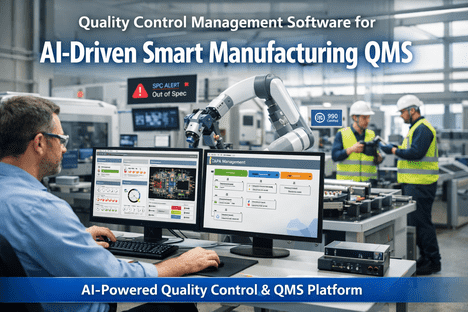
AI Quality Control Management Software for Smart Factories
By will Jackes on March 12, 2026
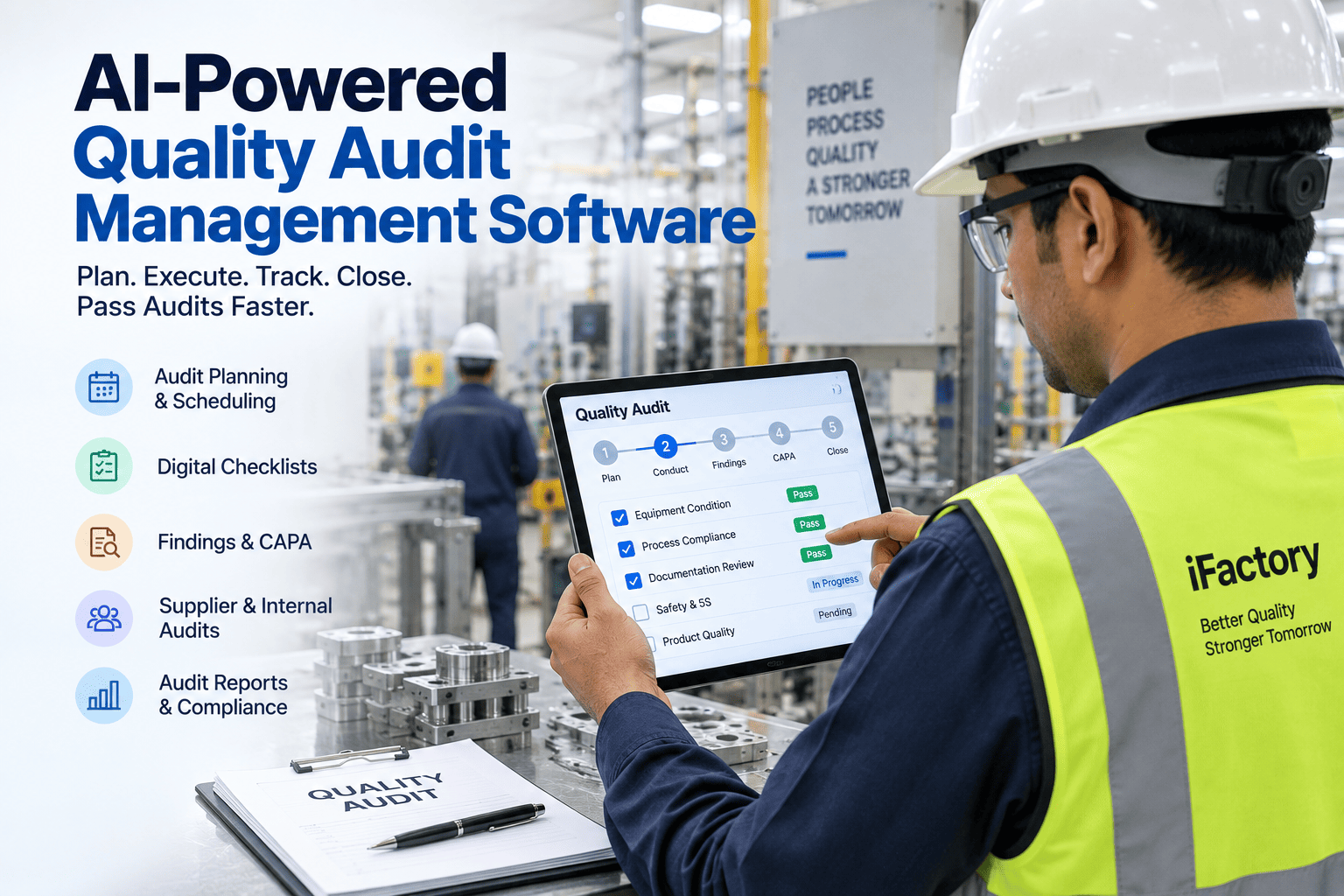
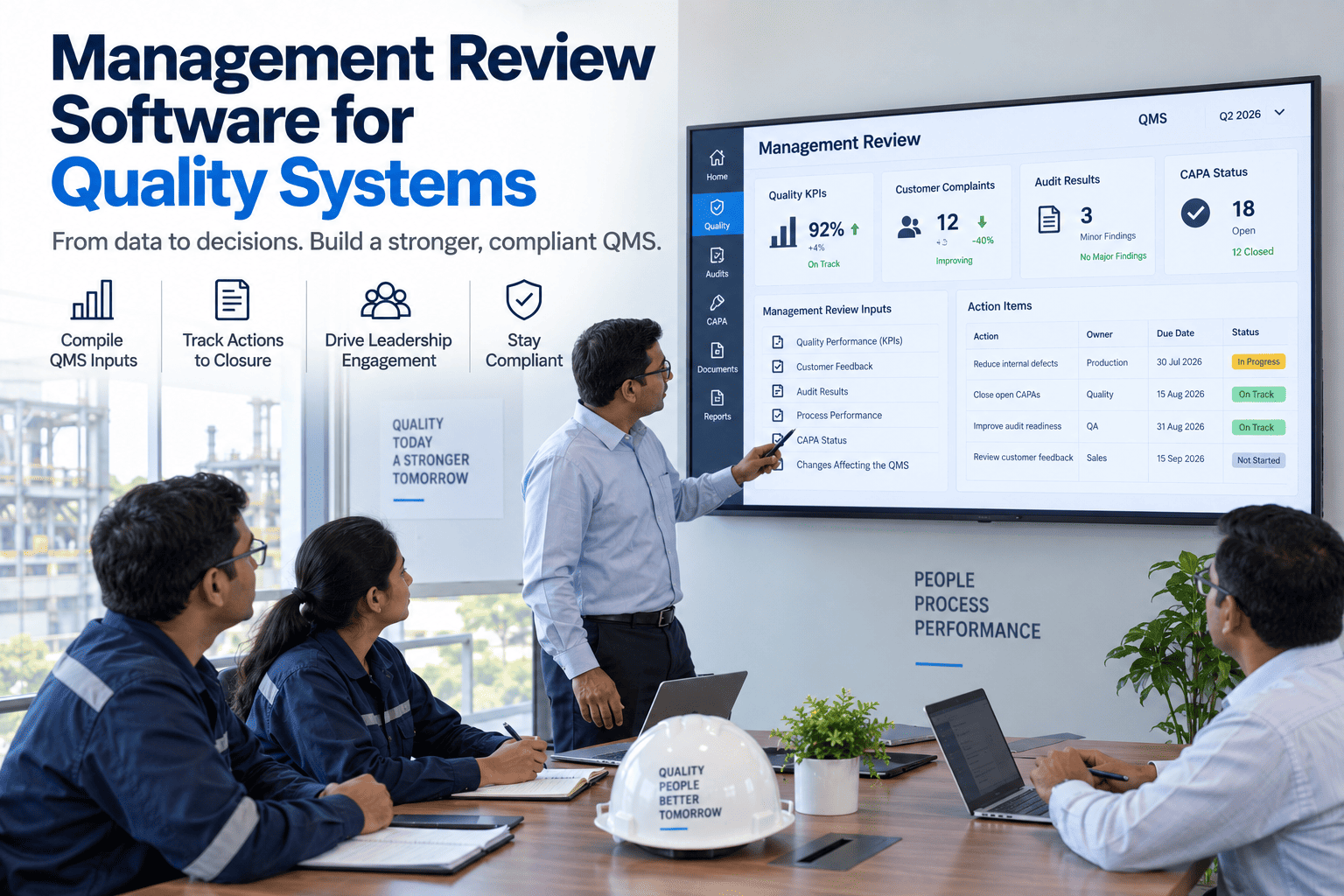
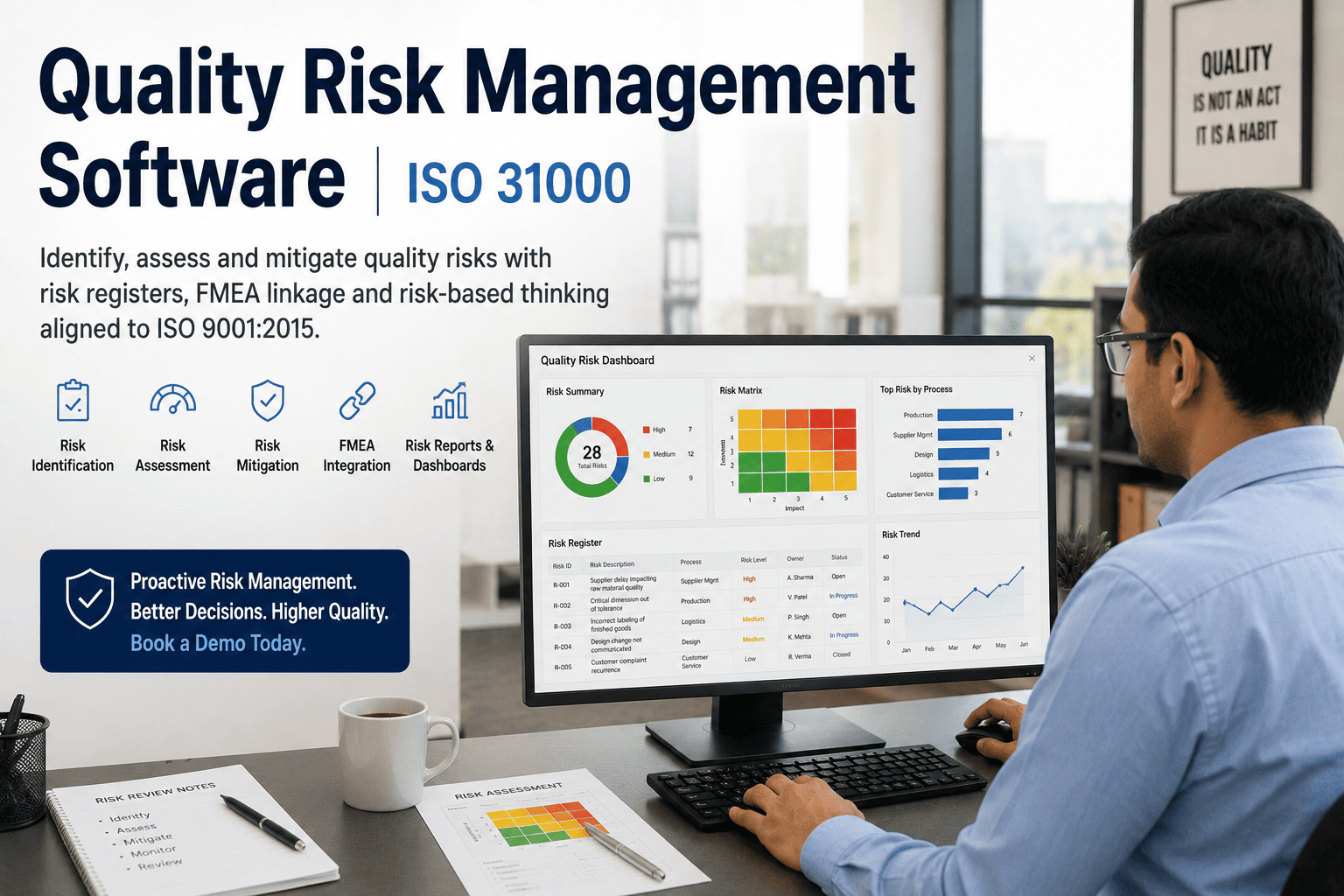
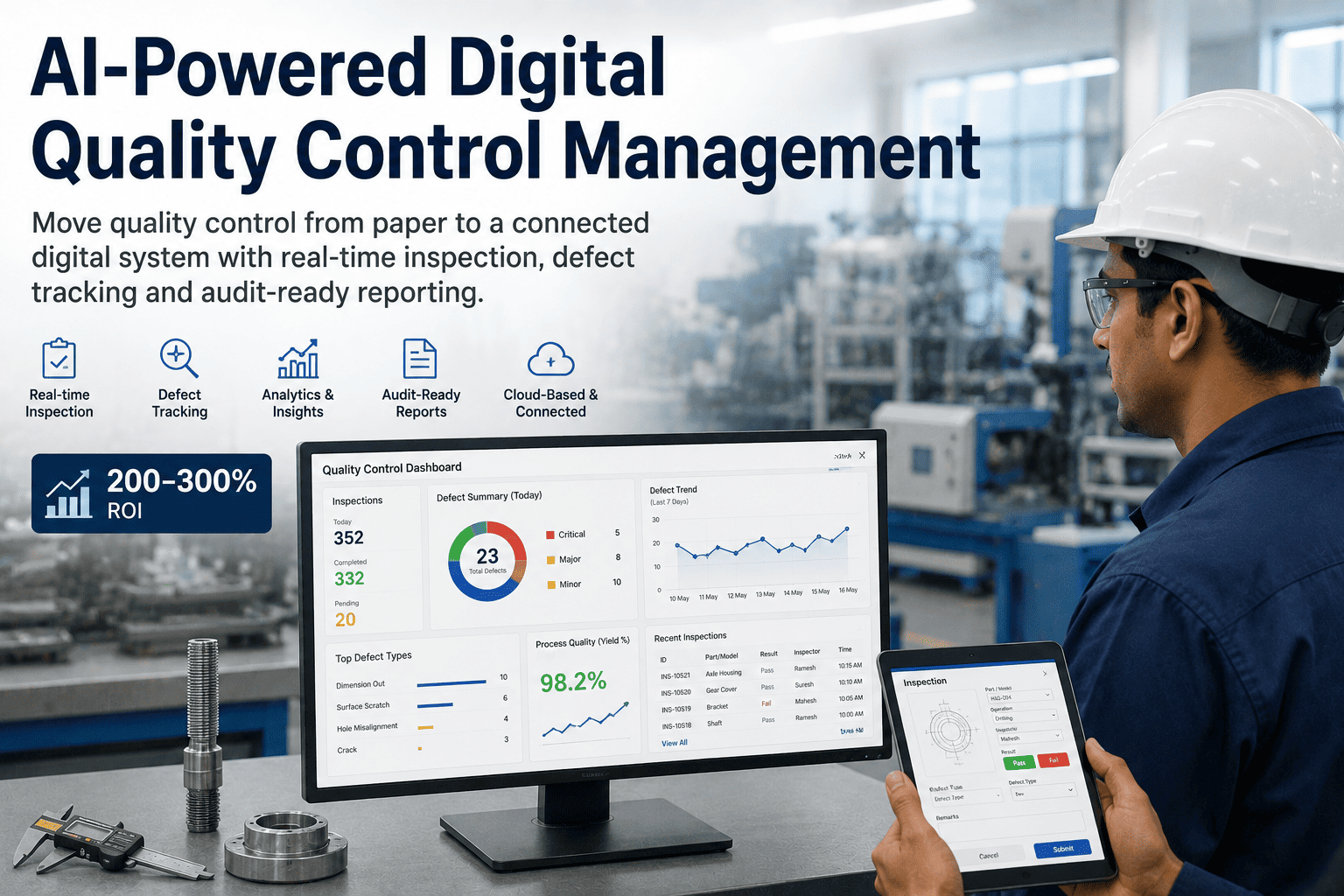
Most smart factories have the hardware. IIoT sensors. High-speed cameras. Connected PLCs. What they're missing is the software layer that turns all that raw data into quality intelligence. Without AI quality control management software, your factory generates thousands of quality signals every minute — and does almost nothing with them. Defects escape. Scrap piles up. Compliance audits become fire drills. With the right AI quality software, every one of those signals feeds a system that inspects 100% of production, predicts failures before they form, and closes the corrective action loop automatically. The smart factory market is growing from $171 billion in 2025 to $384 billion by 2034 — and AI quality software is the competitive engine at its core.
The Smart Factory Quality Software Evolution
Legacy Factory
Clipboard QC
Paper forms, batch reports, defects found days after shipment
Digital Factory
Rule-Based QMS
Digital forms, static thresholds, manual CAPA, siloed data
Smart Factory 2026
AI QC Software
Self-learning AI, 100% inline inspection, automated CAPA, closed-loop control
$384BSmart factory market by 2034 — Fortune Business Insights
41%of manufacturers prioritising AI vision as #1 investment in 2026 — A3 Survey
281%ROI achieved at the 1-year mark by one AI-powered QC implementation — IMEC
The Real Cost of Running Quality Control on Legacy Software
Before evaluating AI quality control software, it's worth understanding exactly what staying on traditional QMS or spreadsheet-based inspection is costing your factory every shift. These aren't theoretical risks — they're documented losses happening in factories right now:
~20%
Of total annual revenue lost to poor quality — scrap, rework, returns, and warranty costs in the average manufacturer
— Overview.ai Industry Research, 2025
74%
Of smart factory initiatives fail to achieve projected ROI in time — the majority stall at integration or data silos
— Deloitte Smart Factory Study, 2025
19%
Of manufacturers cite skilled workforce shortage as their #1 challenge — AI software multiplies the output of your existing quality team
AI Quality Software vs. Traditional QMS: What's Actually Different?
A lot of platforms call themselves "AI quality software" in 2026. Most are traditional QMS tools with a dashboard refresh. Here's how to tell the real difference — and why it matters to your defect rate and bottom line:
Traditional QMS
iFactory AI QC Software
Inspection Coverage
Traditional QMS
5–10% sample-based
→
iFactory AI
100% of every unit, every shift
Defect Detection
Traditional QMS
Manual or rule-based; 60–85% accuracy
→
iFactory AI
Deep learning CNN; 99%+ accuracy
When Issues Are Found
Traditional QMS
Hours or days after production
→
iFactory AI
In real time — at the point of defect
Corrective Actions
Traditional QMS
Manual CAPA tickets; often missed
→
iFactory AI
Auto-generated, assigned and tracked
Process Intelligence
Traditional QMS
Reactive — reports what happened
→
iFactory AI
Predictive — prevents failures before they form
System Learning
Traditional QMS
Static — same rules forever
→
iFactory AI
Self-improving — learns every cycle
Compliance Reporting
Traditional QMS
Manual compilation; days of prep
→
iFactory AI
1-click audit reports — ISO, IATF, FDA
ERP / MES Integration
Traditional QMS
Limited; often one-way data exports
→
iFactory AI
Bidirectional — OPC-UA, MQTT, REST
6 Core Modules of iFactory AI Quality Control Software
iFactory's smart factory quality platform is built around six integrated software modules — each solving a distinct quality challenge, all sharing a single data layer so intelligence flows between them automatically:
01
AI Visual Inspection
Deep learning computer vision inspects 100% of production at line speed — detecting surface defects, dimensional deviations, assembly errors, and contamination with 99%+ accuracy. No rule programming. No threshold tuning. Models self-improve with every unit.
99%+detection accuracy at 10,000+ parts/hr
02
Predictive Quality Analytics
ML models trained on your production history continuously monitor process parameters, material properties, and equipment states to detect quality-threatening drift — hours or days before a defect occurs. Shift from reactive detection to genuine prevention.
30%defect reduction within 12 months — BMW AI Vision case study
03
Automated CAPA Engine
Every defect detection or process alarm automatically spawns a CAPA workflow — assigned to the right person, with inspection evidence attached, deadline set, and escalation path configured. Zero manual ticket creation. 100% CAPA visibility from open to close.
100%automated CAPA creation — no defect falls through the cracks
04
Live Quality Dashboard
Real-time quality KPIs across all lines, shifts, and sites — updating every second as production runs. Drill from plant-level quality score to individual defect image in three clicks. Pareto charts, trend lines, and shift-comparison views built in.
Livemulti-plant visibility — accessible desktop, tablet, and mobile
05
Compliance & Audit Trail
Every inspection record, defect image, CAPA action, and operator sign-off is automatically timestamped and stored in a tamper-proof, searchable audit log. Generate ISO 9001, IATF 16949, FDA 21 CFR Part 11, and AS9100 compliance reports in one click.
1-clickaudit reports — what used to take days takes minutes
06
ERP / MES / SCADA Integration
Bidirectional integration with SAP, Oracle, existing MES platforms, SCADA systems, and PLCs via OPC-UA, MQTT, and REST APIs. Quality events trigger PLC rejection signals, ERP non-conformance records, and MES production holds simultaneously — with zero human bridging.
NativeERP, MES & SCADA sync — no manual data bridges
See All 6 Modules Running Live in Your Industry
iFactory AI Quality Software is purpose-built for smart factories in automotive, electronics, food & beverage, aerospace, and industrial manufacturing.
The Technology Stack Behind Smart Factory AI Quality Software
Understanding what makes AI quality software genuinely intelligent — rather than a relabelled QMS — comes down to the four technology layers that power it. Each layer performs a distinct function. All four must work together for quality to be truly automated:
1
Edge AI — Real-Time Inference at the Machine
Deep learning models running directly on edge hardware — no cloud round-trip
By 2026, edge AI will dominate for vision-based quality control — enabling near-instantaneous decisions without network dependency, even on legacy factory infrastructure. (RevGen Partners, 2025)
2
IIoT Data Layer — Smart Factory Sensor Fabric
Real-time ingestion of machine, process, and environmental data streams
Temperature SensorsVibration MonitorsPLC DataVision CamerasCMM Integration
34% of manufacturers are investing in active sensors as their #1 2026 priority — the data foundation that makes predictive quality analytics possible. (A3 Business Forum Survey, Jan 2026)
3
Cloud ML — Predictive & Continuously Learning Engine
Cross-cycle learning, process drift detection, and model retraining
Predictive AnalyticsSPC & Process ControlModel RetrainingCross-Line BenchmarkingSupplier Intelligence
$8.57B → $230.95B — AI in manufacturing market by 2034 at 44.2% CAGR, with quality control and predictive maintenance as the two highest-value applications. (IEN, 2025)
47% of quality leaders plan to use AI for quality tasks within 2 years — unified QMS platforms with built-in AI are how they'll do it. (Cloud QMS Smart Manufacturing Report, 2025)
Proven ROI: What AI Quality Software Delivers in Practice
The financial case for smart factory AI quality software is no longer theoretical. These are documented results from real deployments across automotive, electronics, semiconductor, and industrial manufacturing:
Smart Factory AI Quality Software — Documented Results
40%
Less Waste & Scrap
AI-Innovate Mfg. 2026
25%
Faster Inspections
AI-Innovate Mfg. 2026
30%
Defect Rate Drop
BMW AI Vision, 2025
281%
ROI at Year 1
IMEC Case Study, 2025
95% of smart factory AI adopters report positive ROI
12–24 months typical payback period for full AI quality deployment
3–6 months for initial quality improvements to become visible
Industries Using iFactory AI Quality Control Software
iFactory's AI quality platform is deployed across six major manufacturing verticals — each with industry-specific defect types, regulatory requirements, and quality challenges:
Automotive
IATF 16949, zero-defect body panels, weld inspection, supplier quality
BMW achieved 30% defect rate reduction and 15% customer satisfaction improvement with AI vision
3D laser scanning + AI analysis delivering 100% inspection coverage on large components
Expert Perspective on AI Quality Software in 2026
"AI is no longer a popular trend in manufacturing — it has become a structural pillar of business strategy. The leaders emerging today treat AI as a core component of their operating system, integrating it with automation platforms, digital twins, and advanced analytics to drive continuous improvement and future-proof their production ecosystems. Manufacturers that invest in internal AI expertise and cross-functional operating models will be best positioned to deploy trusted AI at scale."
— AI Adoption in Manufacturing: Insights, ROI Benchmarks & Trends, Tech-Stack.com, December 2025
Smart Factory AI Quality Software: Your Implementation Roadmap
The manufacturers achieving the fastest ROI from AI quality software follow a proven phased rollout — delivering measurable results at every stage while building toward full smart factory quality automation:
Phase 1
Foundation
⏱ Weeks 1–4
Deploy cloud QC platform & configure quality KPIs
Digitise all inspection checklists and non-conformance forms
Establish production quality baseline for ROI measurement
Quick win: Quality data centralised, paper eliminated
Phase 2
Connect
⏱ Weeks 5–12
Deploy AI vision on highest-defect inspection station
Connect IIoT sensors, cameras, and MES data feeds
Integrate with ERP & SCADA — activate automated rejection
Quick win: 100% inspection live, first defect escapes eliminated
Phase 3
Predict
⏱ Months 3–6
Activate predictive quality analytics on process data
Enable automated CAPA workflows end-to-end
Launch live quality dashboards for all stakeholders
Quick win: Defects prevented before production, not after
Phase 4
Scale
Month 6+
Roll out AI inspection to all production lines and sites
Activate supplier quality intelligence module
Continuous model retraining — accuracy improves indefinitely
Outcome: Full smart factory quality automation at scale
Build Your Smart Factory on a Foundation of AI Quality
iFactory's AI Quality Control Management Software — machine vision, predictive analytics, automated CAPA, and compliance management in one platform. Start with one line. Prove ROI in months. Scale with confidence.
What is AI quality control management software for smart factories?
AI quality control management software for smart factories is a platform that uses deep learning computer vision, machine learning, and automated workflows to inspect 100% of production output in real time, detect defects at machine speed, predict process failures before they form, and automatically trigger corrective actions — all integrated with your existing ERP, MES, SCADA, and IIoT infrastructure. Unlike traditional QMS platforms that process batch reports after the fact, AI quality software operates as a live intelligence layer: every inspection result, process signal, and quality event feeds a system that acts autonomously and improves continuously.
How is AI quality software different from a standard QMS platform?
Traditional QMS platforms are primarily document and workflow management systems — they store records, manage non-conformances, and track audits, but they don't actively participate in quality control during production. AI quality software adds a live intelligence layer that inspects production in real time, learns from every unit, predicts failures before defects form, and closes CAPA loops automatically. The measurable difference: traditional QMS tells you what went wrong. AI quality software stops it from happening — and keeps reducing defect rates over time as the models improve.
What ROI can we realistically expect from AI quality control software?
Documented results from smart factory AI quality deployments include 40% reduction in waste, 25% faster inspection cycles, 30% drop in defect rates within 12 months, and one manufacturer achieving 281% ROI at the one-year mark (IMEC, 2025). Research confirms 95% of smart factory AI adopters report positive ROI, with most achieving full payback within 12–24 months and initial quality improvements visible within 3–6 months. The primary financial drivers are scrap and rework reduction, lower manual inspection costs, fewer customer returns, and reduced audit preparation time.
How does iFactory AI quality software integrate with our existing factory systems?
iFactory integrates bidirectionally with SAP, Oracle, existing MES platforms, SCADA systems, and PLCs using standard industrial protocols including OPC-UA, MQTT, and REST APIs. Integration is bidirectional — quality events trigger actions in all connected systems simultaneously (PLC rejection signal, ERP non-conformance record, MES production hold), and production data flows into quality analytics automatically. Most manufacturers complete initial integration and go live within 4–10 weeks without a full line infrastructure upgrade.
Does AI quality software work for mid-sized manufacturers, not just large enterprises?
Absolutely. iFactory is designed to deliver smart factory quality results at every scale. The phased rollout model (Foundation → Connect → Predict → Scale) means you start on a single high-priority inspection station, prove ROI, and expand systematically — without committing full capital upfront. As a cloud-based SaaS platform, iFactory eliminates large infrastructure investment. It's designed to be brownfield-ready: connecting to legacy machinery and existing cameras without requiring a full factory rebuild. Mid-sized manufacturers in automotive supply chains, electronics, and food production are among the fastest AI quality software adopters in 2025–2026.