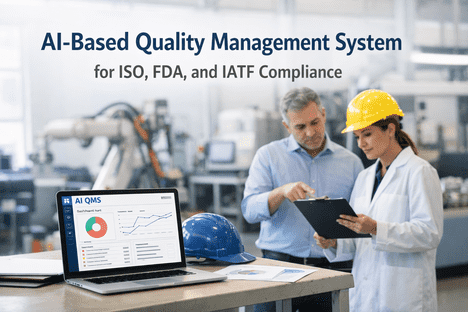
Quality failures do not show up as a line item on your P&L — they show up everywhere else. The Institute of Industrial and Systems Engineers puts the Cost of Poor Quality at 5–35% of annual revenue depending on product complexity, with the typical manufacturer burning 20% of total sales on scrap, rework, warranty claims, and recalls. For a $50M plant, that is up to $17.5M evaporating every year into a cost center nobody runs well. The plants solving it are not adding more inspectors or thicker procedure binders. They are replacing the legacy quality stack with an AI-powered QMS — a single platform where inspections, SPC, CAPA, audits, supplier quality, and compliance run as one connected system, with machine learning catching defects manual inspection biologically cannot. The numbers are not subtle: Intel documents $2M annual savings from AI vision inspection on wafer production. An electronics manufacturer cut defect escape rate from 2.3% to 0.1%, saving $1.8M in warranty claims. Industry benchmarks show 374% three-year ROI with 7–8 month average payback. This page walks through what iFactory's AI-powered QMS actually does, the modules it ships with, how it closes the loop between detection and corrective action, and the deployment path that proves ROI in under 60 days.
AI-Powered QMS Platform · Built for Smart Manufacturing
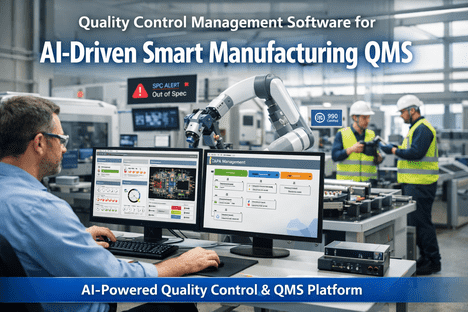
Quality Control Management Software for AI-Driven Smart Manufacturing
One platform for inspections, SPC, CAPA, audits, supplier quality, and compliance — powered by AI that catches defects humans can't, closes corrective actions automatically, and keeps you audit-ready 365 days a year.
99%+
AI inspection accuracy vs 70–80% manual
374%
Three-year ROI — Forrester research
7–8 mo
Typical payback period on AI QMS deployment
90%
Defect rate reduction at mature adopters
Sources: IISE Research · Forrester · Intel AI Vision Case · Jidoka / BMW Implementation · Gartner QMS Magic Quadrant · iFactory Deployment Data 2026
The Real Cost of Poor Quality — By the Numbers
Most quality teams track defect rates. Few track what those defects actually cost the business. Here is what Cost of Poor Quality (COPQ) looks like scaled across industries — pulled from IISE research, Institute of Industrial Engineers benchmarks, and documented case data. The number is almost always bigger than leadership expects.
Cost of Poor Quality · % of Annual Revenue
Typical ranges observed across manufacturing sectors · IISE & industry benchmarks
Electronics & Semiconductors
Automotive & Heavy Industrial
Pharma, Medical, Aerospace
The iFactory QMS Platform — Ten Modules, One System
Traditional QMS platforms are stitched together from document control plus a CAPA database plus an SPC tool plus a supplier portal plus whatever the quality team built in Excel. iFactory ships as a single connected platform where every module shares the same data model, the same workflows, and the same AI layer underneath. Below is what you get on day one.
01
AI Inspection
Computer vision & sensor-based defect detection at 200+ parts/min with 99%+ accuracy and full traceability.
02
Statistical Process Control
Real-time SPC charts, control limits, Cp/Cpk tracking, and AI-powered drift detection before specification breach.
03
CAPA Management
Closed-loop corrective & preventive actions with automated root-cause analysis, task assignment, and verification.
04
Non-Conformance Tracking
Log, quarantine, disposition, and resolve every non-conformance with full audit trail and pattern detection.
05
Document Control
Version-controlled procedures, work instructions, and forms with electronic signatures and controlled distribution.
06
Audit Management
Internal & external audit planning, checklists, findings tracking, and closure — ready for ISO, FDA, or customer.
07
Supplier Quality
Vendor scorecards, incoming inspection, supplier CAPA, PPAP, and automated re-qualification workflows.
08
Risk & FMEA
Design & process FMEA, risk registers, severity-occurrence-detection scoring, and AI-surfaced emerging risks.
09
Training & Qualification
Role-based training assignments, competency tracking, certification expiry alerts, and audit-ready records.
10
Quality Analytics
Real-time dashboards, predictive quality trends, defect Pareto analysis, and yield optimization across all sites.
AI Inspection — Four Detection Layers That Catch What Humans Miss
Human inspectors biologically top out at 70–80% accuracy under production conditions, with accuracy degrading 15–25% after just two hours of continuous inspection. AI does not get tired. But the real breakthrough is not raw accuracy — it is layering multiple detection modalities so different defect types get caught by the right AI model at the right stage of production.
Layer 01
Computer Vision
Surface defects, cracks, scratches, misaligned components, dimensional errors, colour inconsistencies — captured at 10,000+ parts/hour with sub-millimetre precision.
Catches: Visual & dimensional defects
Layer 02
Sensor Anomaly
Vibration signatures, temperature drifts, pressure fluctuations, and acoustic anomalies — the process deviations that cause defects before they ever appear visually.
Catches: Process deviations at source
Layer 03
SPC Drift Detection
Process drift beyond control limits, batch-to-batch variation, slow parameter shifts that traditional SPC misses because the change happens too gradually to flag.
Catches: Statistical drift & trends
Layer 04
Cross-Modal Correlation
Patterns only visible when multiple data streams analyze together — a bearing vibration + temperature rise + quality dip that individually look normal but together signal failure.
Catches: Compound root-cause signatures
Want to see the AI detection stack running on your own product samples? Book a 30-minute platform demo.
Human Inspection vs AI Inspection — Side by Side
This is where most quality leaders get their wake-up call. Manual inspection isn't bad at its job — the human visual system was designed to scan for predators, not catch 50-micron scratches at 120 parts per minute. The biological ceiling is the problem, and no amount of training or procedure rewrites raises it.
Capability
Human Inspector
iFactory AI Inspection
Detection Accuracy
70–80% under production conditions
99%+ consistent across all shifts
Inspection Speed
2–3 parts per minute
200+ parts per minute
Consistency Over Shift
15–25% accuracy drop after 2 hours
Identical performance 24/7
Inter-Inspector Agreement
55–70% agreement on defect severity
100% — same model, same call
Minimum Defect Size
0.5–1.0 mm (practical limit)
Sub-millimetre down to 50 microns
New Defect Adaptation
Retraining, documentation updates
Continuous learning from new samples
Annual Cost per Station
$30K–50K per inspector
$30K–200K one-time + low OpEx
The Closed-Loop CAPA Workflow
Catching defects is only half the system. The other half is making sure each defect you catch never happens again. iFactory's CAPA module closes the loop automatically — from the moment AI detects an anomaly to the moment the corrective action is verified effective.
01
Detect
AI flags defect, drift, or non-conformance in real time. Quarantine triggered automatically if severity threshold crossed.
Seconds
02
Investigate
Auto-correlate with process variables, equipment state, material batch, and operator shift. Evidence packaged in one view.
Minutes
03
Root Cause
Guided 5-Why and fishbone frameworks. AI suggests likely root causes based on cross-plant pattern history.
Hours
04
Corrective Action
Work orders, document updates, training assignments, and supplier notifications triggered automatically.
Days
05
Verify & Close
Post-action monitoring confirms defect did not reoccur. CAPA auto-closes once statistical threshold is cleared.
Weeks
Compliance Built In, Not Bolted On
Every iFactory QMS workflow ships with compliance scaffolding for the standards your auditors actually care about. Electronic signatures, audit trails, validation documentation, and role-based approvals are not features you configure — they are the default behaviour of every module.
ISO 9001
General Manufacturing
Quality management system fundamentals — applicable to any production environment.
IATF 16949
Automotive
Automotive-specific QMS standard required across OEM supply chains — PPAP, APQP, FMEA.
ISO 13485
Medical Devices
Medical device QMS standard with design controls, risk management, and traceability.
FDA 21 CFR Part 11
Life Sciences
Electronic records and signatures compliance for pharma, biotech, and medical devices.
AS9100
Aerospace & Defense
Aerospace quality standard extending ISO 9001 with risk, configuration, and safety requirements.
HACCP & GFSI
Food & Beverage
Hazard analysis and critical control point documentation with full traceability.
GMP
Pharmaceutical
Good manufacturing practices for pharmaceutical production — batch records and validation.
ISO 27001
Information Security
Data security management across your quality records and platform infrastructure.
Industry-Specific Quality Deployments
Different industries face different defect profiles, tolerance requirements, and regulatory scrutiny. iFactory ships pre-trained AI models and industry templates for the sectors where AI quality delivers the sharpest ROI.
Automotive
Paint defects, weld quality, assembly verification, fastener torque
30–40% defect reduction · BMW case · 22% OEE lift
Electronics
Solder joint cracks, component misalignment, surface scratches, PCB shorts
Defect escape 2.3% to 0.1% · $1.8M saved
Semiconductor
Wafer indentations, grinding marks, contamination, bubbles, mount shift
$2M annual savings · Intel case
Food & Beverage
Seal integrity, label placement, fill levels, foreign object detection
85% fewer packaging complaints
Pharmaceutical
Capsule integrity, tablet defects, vial contamination, label compliance
Tens of millions saved in reduced recalls
Aerospace
Composite layup flaws, weld porosity, fastener verification, surface integrity
AS9100 audit-ready · zero-escape targets
The ROI Math — Show Your CFO, Not Your Peers
AI quality software is one of the few Industry 4.0 investments with a financial case that survives a rigorous CFO review. The formula is straightforward: quantify current COPQ, model detection improvement, subtract platform cost. For a typical mid-market plant, the numbers look like this.
Scenario · $50M Annual Revenue Plant
Typical 20% COPQ · Moving from manual-plus-SPC to AI-powered QMS
Current annual COPQ
$10.0M
60% reduction achievable
$6.0M saved
Warranty claim reduction
$1.8M
Inspector labour optimized
$0.7M
Platform investment (amortized)
-$0.2M
Net year-one value
+$8.3M
Payback period
7–8 months
Savings multiple
40x investment
Want this math run on your actual COPQ and product mix? Book a 30-minute ROI modeling session.
Your 8-Week Deployment Path
Enterprise QMS rollouts historically took 6–18 months before anyone saw real savings. The iFactory deployment pattern is the opposite — a single high-impact inspection station goes live in 6–8 weeks, proves ROI, and scales from validated wins.
Week 1–2
Install & Connect
Position cameras at highest-impact station (30 min per camera). Connect to existing PLC/SCADA. Configure QMS modules.
Week 3–4
Data & Training
Capture 500–2,000 training images across good, marginal, defective parts. Train custom AI model on your product.
Week 5–6
Shadow Run
AI runs alongside manual inspection. Compare outputs. Resolve edge cases. Target 99%+ recall before handover.
Week 7–8
Go Live & Scale
AI live in production. Continuous learning lifts accuracy from 90% to 99%+. First ROI validated. Plan next station.
What You Get In Year One
37–90%
Defect rate reduction across deployments
85%
Fewer customer complaints at mature adopters
5–15%
Yield improvement across production lines
100%
Audit-ready records across every module
Frequently Asked Questions
What is the difference between a traditional QMS and an AI-powered QMS?
Traditional QMS platforms are record-keeping systems. They document CAPA, audits, and non-conformances after the fact. AI-powered QMS detects defects in real time using computer vision and sensor anomaly detection, predicts process drift before specifications are breached, correlates quality data with equipment and supplier variables automatically, and closes the CAPA loop without human routing. Traditional QMS tells you what went wrong; AI-powered QMS prevents it from happening.
Book a demo to see the difference on live data.
How does iFactory QMS handle compliance with ISO 9001, IATF 16949, FDA 21 CFR Part 11, and ISO 13485?
Every iFactory QMS module ships with compliance scaffolding built in — electronic signatures, tamper-evident audit trails, role-based approvals, validation documentation, and configurable workflows that map directly to standard requirements. Pre-built templates exist for ISO 9001, IATF 16949, ISO 13485, FDA 21 CFR Part 11, AS9100, HACCP, and GMP. You do not configure compliance; you inherit it.
Can iFactory QMS integrate with our existing ERP, MES, and PLM systems?
Yes. iFactory integrates with SAP, Oracle, Dynamics, Microsoft 365, Salesforce, and any MES or PLM through standard APIs (REST, OPC-UA, MQTT). Pre-built connectors exist for the most common enterprise stacks. Quality data flows automatically into financial and operational reporting, eliminating duplicate entry and giving every team access to the same source of truth.
Ask support about your specific integration stack.
How long does it take to deploy AI inspection, and what does it cost?
First AI inspection station goes live in 6–8 weeks including camera installation, image labeling, model training, and shadow-run validation. Deployment cost ranges $30K–$200K per inspection station depending on complexity, lighting requirements, and line speed. Subsequent stations deploy faster as the platform is already in place. Most manufacturers hit ROI within 7–8 months.
Does AI inspection replace our quality team?
No — it multiplies them. AI handles the repetitive detection work (scanning 10,000+ parts per hour at 99% accuracy) that burns out human inspectors. Your quality team shifts from front-line inspection to strategic reliability engineering: CAPA investigation, supplier quality improvement, process capability analysis, and continuous improvement. In practice, AI turns novice operators into expert-level responders through guided workflows, which directly addresses the workforce crisis.
What types of defects can AI inspection actually catch?
AI vision catches surface defects (scratches, cracks, dents), dimensional errors, colour variations, missing or misaligned components, fill-level errors, label compliance issues, and contamination — down to sub-millimetre precision (50 microns on optical inspection). Sensor-based AI layers catch process deviations (vibration, temperature, acoustic anomalies) that cause defects before they appear visually. The four layers working together catch visual, process, statistical, and compound defect signatures that any single detection method would miss.
Stop Running Quality on Three Disconnected Systems
One Platform. Ten Modules. AI That Catches What Humans Can't.
Book a 30-minute platform demo with an iFactory quality specialist. We will walk you through live AI inspection on your own product samples, show you the CAPA workflow running on real plant data, and map the 6-8 week deployment path that proves ROI before the end of the quarter.
10 Modules
Inspection, SPC, CAPA, audits, supplier, risk
4 Layers
AI detection — vision, sensor, SPC, cross-modal
8 Standards
ISO, IATF, FDA, AS9100, HACCP built in
6–8 Weeks
From install to first AI station live