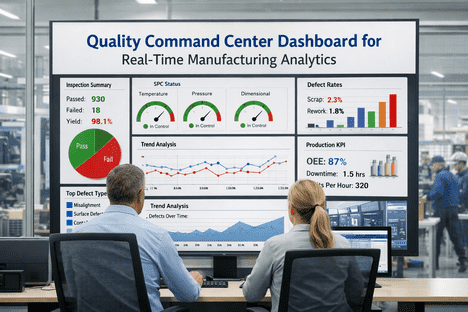
Your quality team used to catch defects after production. Then came scheduled audits and standardized checklists. Now, in 2026, manufacturing quality has entered a new era—digital, data-driven, and powered by AI. Imagine your quality management system flagging a deviation the moment it occurs on the shop floor, automatically triggering a CAPA workflow, notifying the right engineer, and updating your compliance record—all before a single defective unit ships. This isn't a vision for the future. It's what leading manufacturers are doing right now, and it's why the quality management software market is growing from $12.5 billion in 2025 to over $31.5 billion by 2034.
The Quality Control Evolution
Past
Reactive
Catch defects after they happen
Present
Preventive
Scheduled audits & checklists
2026
Predictive + Digital
AI detects, logs & resolves in real time
$31.5B
QMS market size by 2034
10.8%
Annual CAGR growth rate
75%
of large enterprises adopting AI-enabled QMS by 2026
Why 2026 Is the Digital Quality Tipping Point
The convergence of AI, IoT, and cloud platforms has made digital quality control more accessible and more powerful than ever. With defect escape costs rising and customer expectations tightening, manufacturers can no longer afford paper forms, manual audits, or disconnected spreadsheets to ensure consistent product quality.
200–300%
ROI from AI-powered quality inspection infrastructure through defect reduction and faster cycles
— Tech-Stack.com, 2025
20%
Reduction in overall manufacturing costs with AI-driven quality control systems
— Industry Analysis 2025
19.7%
Manufacturing holds the largest global share of QMS software demand in 2025
— SNS Insider Market Report
Ready to future-proof your manufacturing quality? See how iFactory AI transforms product quality and compliance.
The Digital Quality Management Technology Stack
Modern digital quality control isn't a single tool—it's an integrated ecosystem where IoT sensors, mobile workflows, AI analytics, and compliance management work together to create end-to-end quality intelligence across every stage of production.
Vision Systems
Temperature
Pressure
Dimensional
Vibration
Barcode / QR
46% of manufacturers already using IIoT for quality data collection today
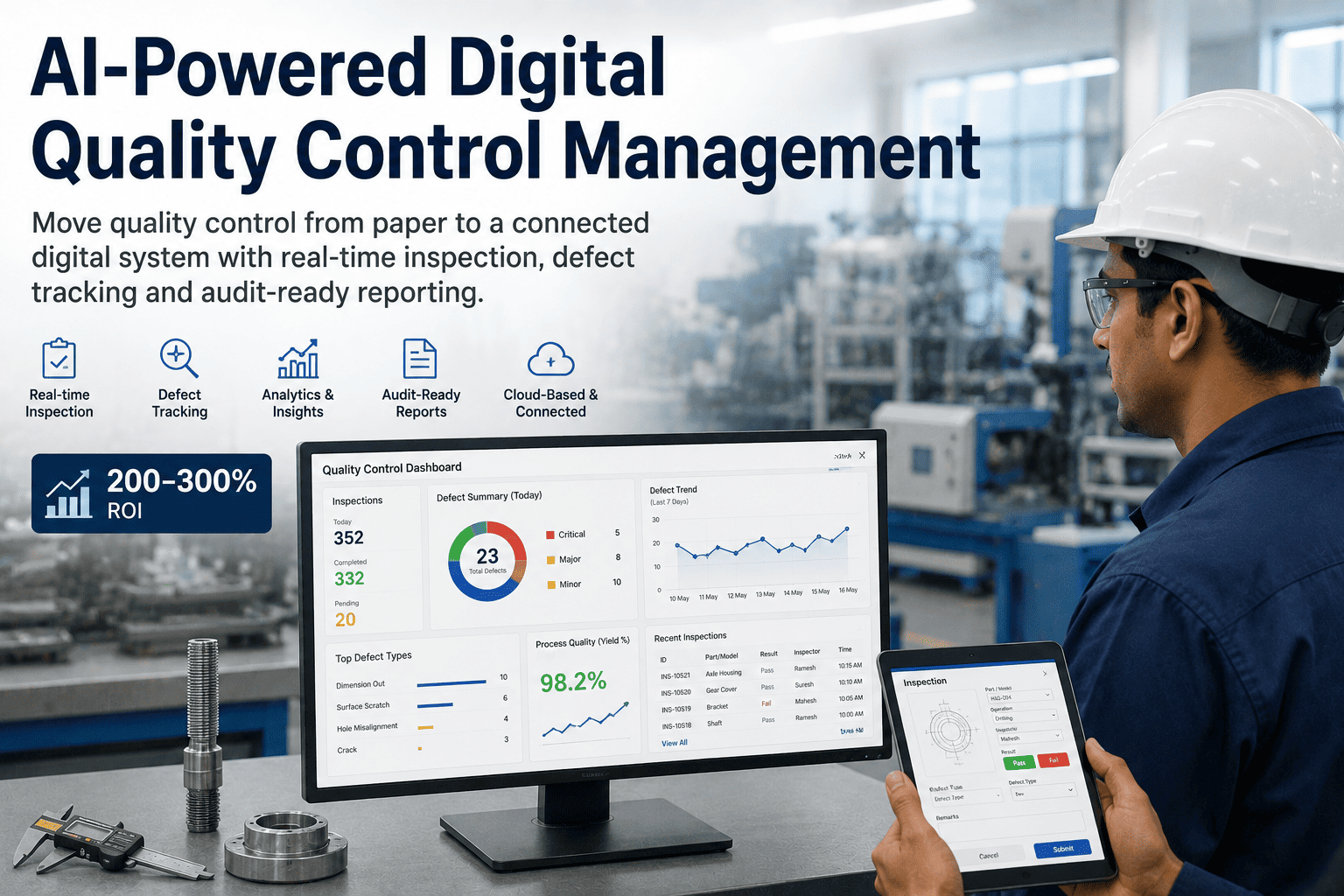
Technicians conduct inspections on mobile or tablet apps with digital checklists, mandatory photo capture, and e-signatures—right at the machine, with offline support for uninterrupted shop floor coverage.
58 min saved per quality inspector daily with mobile-first digital workflows
Pattern recognition, defect prediction, and root-cause analysis. ML models continuously improve accuracy with every inspection—flagging high-risk production windows before failures actually occur.
90%+ defect detection accuracy in mature AI quality control implementations
Automated CAPA workflows, one-click audit-ready reporting, supplier quality tracking, and ISO/FDA compliance documentation—all unified in a single digital quality management system.
$31.5B QMS platform market projected by 2034 — manufacturers digitizing now lead the field
From Reactive Inspections to Predictive Quality: The 2026 Standard
Traditional quality control catches defects after they've already been produced. Digital quality management—the competitive standard in 2026—identifies deviations as they form and prescribes the exact corrective action to prevent non-conforming product. If a process parameter drifts out of tolerance, the system doesn't wait for a report—it triggers an automated CAPA, alerts the responsible engineer, and logs everything for your next audit automatically.
Paper forms and spreadsheet inspection logs
Defects found at end-of-line or after shipment
Manual CAPA tracking via email threads
Humans decide what action to take—no guidance
Result:
High rework & recall exposure
Digital checklists with photo capture & e-signatures
AI flags deviations in real time at point of production
Automated CAPA workflows with full accountability tracking
One-click audit reports with end-to-end traceability
Result:
30–50% defect rate reduction
Want to see digital quality management in action? Talk to our manufacturing quality specialists.
Transform Your Factory's Quality Operations Today
iFactory's Digital Quality Control Management System integrates IoT sensors, AI analytics, mobile inspections, and automated compliance workflows to eliminate defects and ensure consistent production quality. See measurable results within weeks of deployment.
Key Capabilities That Define Best-in-Class Quality in 2026
The modern digital quality control management system goes far beyond basic inspection logging. Here are the capabilities that separate manufacturing quality leaders from those still relying on outdated manual processes:
Real-Time Production Quality Monitoring
Continuous data streaming from sensors and inspection inputs with instant anomaly detection across every line, shift, and production site
90%+
defect detection accuracy with AI-powered vision systems
Digital Inspection Checklists
Configurable digital forms that guide technicians step by step, enforce mandatory fields, and capture photo evidence—fully replacing paper on the shop floor
58 min
saved per quality technician every single day
Defect Tracking & Root-Cause Analysis
Log, categorize, and analyze every non-conformance with built-in 5-Why and fishbone tools that prevent recurring defects and close CAPA faster
30–50%
reduction in defect recurrence rates (McKinsey)
Compliance & Audit Management
Maintain a complete, timestamped audit trail for ISO 9001, IATF 16949, FDA 21 CFR Part 11, and more—generate audit-ready reports in minutes, not days
25–30%
productivity uplift in quality management processes
The ROI of a Digital Quality Control Management System
The business case for digital quality management is no longer theoretical. Manufacturers implementing AI-driven quality platforms report dramatic, measurable returns across defect rates, compliance costs, and production efficiency:
30–50%
Defect Rate Reduction
McKinsey Research
25%
Lower Quality-Related Costs
Deloitte Analysis
200%+
ROI from AI Quality Infrastructure
Tech-Stack.com 2025
20%
Manufacturing Cost Savings
Industry Benchmarks 2025
75% of large enterprises are adopting AI-enabled QMS tools by 2026 to automate predictive analytics and real-time defect tracking — manufacturers who wait risk falling permanently behind.
Want to calculate your specific quality management ROI? Get a customized savings analysis from iFactory.
Expert Perspective
"Quality management software allows manufacturers to capture data in real time and report on issues immediately, enabling them to be identified and addressed before they escalate. It simplifies compliance with reporting requirements and ensures that critical information is never lost in the field. The software offers significant advantages over manual methods, particularly in meeting industry standards and regulatory requirements—transforming quality practices from documentation exercises into genuine continuous improvement engines."
— Quality Management Expert Insights, Capterra 2026
Questions about implementing digital quality control in your factory? Our technical team is ready to help.
Your Digital Quality Transformation Roadmap
Successful digital quality adoption follows a phased approach that balances quick wins with long-term capability. Start with your highest-risk production areas, prove value fast, then scale across the operation.
Deploy cloud QMS platform
Replace paper with digital checklists
Establish baseline KPIs (defect rate, CAPA time)
Install IoT sensors on critical assets
Enable real-time quality dashboards
Integrate with existing ERP / MES
Activate AI defect prediction models
Enable automated CAPA workflows
Train quality team on new processes
Scale to all product lines and sites
Activate supplier quality intelligence
Continuous model improvement & compliance expansion
The Future of Quality Control Starts Now
iFactory's Digital Quality Control Management System brings together inspection management, real-time defect tracking, AI analytics, and automated compliance—purpose-built for manufacturers at every scale. Eliminate escapes, reduce rework costs, and stay audit-ready at all times.
Frequently Asked Questions
What is a digital quality control management system for manufacturing?
A digital quality control management system replaces paper-based inspection forms, manual defect logs, and disconnected spreadsheets with integrated digital workflows, real-time monitoring dashboards, and AI-powered analytics. It connects shop floor data from IoT sensors and mobile inspections directly to quality dashboards, automated CAPA workflows, and compliance records—giving manufacturers complete visibility over product quality at every production stage. In 2026, these platforms are transforming how manufacturers prevent defects rather than simply documenting them.
How does AI improve quality control in manufacturing?
AI transforms quality control from reactive defect catching to proactive defect prevention. Machine learning models analyze sensor data, inspection histories, and production parameters to identify patterns that precede failures—flagging high-risk windows before non-conforming units are produced. AI also accelerates root-cause analysis, dynamically adjusts inspection sampling based on supplier risk scores, and auto-triggers CAPA workflows. Studies show AI-enabled quality systems achieve 90%+ defect detection accuracy and deliver 200–300% ROI through reduced rework and faster inspection cycles.
What compliance standards does the iFactory QMS support?
iFactory's platform maintains a complete, timestamped audit trail that satisfies ISO 9001:2015, IATF 16949, FDA 21 CFR Part 11, AS9100, ISO 14001, GMP, and other major standards. Audit reports that previously took days to compile can be generated in minutes, with full traceability from raw material inspection through final product release and customer delivery.
How long does it take to see results after implementation?
Most manufacturers using iFactory see measurable improvements within the first 4–6 weeks of deployment. Digital inspection checklists eliminate paper-related errors from day one. Real-time monitoring dashboards go live in weeks 5–12, and AI-driven defect prediction models mature over months 3–6 as the system learns your specific production patterns. Full ROI is typically realized within 12–24 months.
What ROI can manufacturers expect from digital quality management?
Organizations implementing digital quality management report 200–300% ROI within 24 months, with 30–50% reduction in defect rates, 25% lower quality-related costs, and up to 20% reduction in total manufacturing costs. Mobile-first workflows save each quality technician an average of 58 minutes daily. Leading implementations achieve full payback within the first year through reduced rework, fewer customer returns, and significantly lower audit preparation costs.