Next-Gen AI Quality Control Management for Industry 4.0 Factories
By will Jackes on March 11, 2026
Your production line runs faster than any human inspector can follow. Traditional quality checks—manual spot-sampling, paper logs, end-of-line sorting—were built for a different era. In Industry 4.0, quality control happens at machine speed: every unit inspected, every micron measured, every deviation flagged before it leaves the station. AI-powered quality control management is no longer a competitive advantage for a few early movers—it is rapidly becoming the baseline standard for smart factories worldwide. With the AI in manufacturing market expanding from $34 billion in 2025 to over $155 billion by 2030, and Toyota already reporting a 53% reduction in production defects through AI, manufacturers who delay are falling permanently behind.
The Quality Inspection Evolution
Past
Manual
Human spot-checks & paper logs
Present
Automated Vision
Rule-based machine vision systems
Industry 4.0
AI + Predictive QC
Self-learning AI prevents defects before they form
$155BAI in manufacturing market by 2030
99%+Defect detection accuracy with AI vision
76%of manufacturers implementing AI inspection by 2026
Why Industry 4.0 Demands AI Quality Control — Right Now
Industry 4.0 is defined by connected machines, real-time data, and autonomous decision-making. Traditional quality management — paper checklists, periodic audits, and end-of-line sampling — is structurally incompatible with this environment. As production speeds increase and product complexity grows, human inspection becomes the bottleneck that limits both quality and throughput. The cost of doing nothing is measurable: every average manufacturer loses roughly 20% of annual revenue to poor quality costs.
20%
Of total annual revenue lost to poor quality costs in the average manufacturing company
— Overview.ai Industry Report 2025
53%
Reduction in production defects achieved by Toyota using AI quality management systems
— Articsledge Manufacturing, 2026
35.3%
Annual CAGR of the AI in manufacturing market — the fastest-growing technology sector in industry
The AI Quality Control Technology Stack for Industry 4.0
Next-generation AI quality management isn't a single product — it's four interconnected layers working together at machine speed, continuously learning and improving with every inspection cycle across every production line.
1
Machine Vision & Smart Sensor Layer
High-Res Cameras (up to 45MP)Thermal Imaging3D Laser ScanningHyperspectralUltrasonic NDTX-Ray Vision
500+ FPS multi-camera systems now deployed across automotive lines — detecting defects below 5 microns at full production speed
2
Edge AI Processing
Convolutional neural networks (CNNs) and deep learning models run locally at the edge for sub-20-millisecond inference — fast enough to flag and reject defective units mid-line without cloud latency. Edge accounts for 33% of new AI QC installations in 2025.
<20ms defect detection latency — real-time rejection at production speed, no cloud dependency
3
Predictive Quality Analytics Engine
Cloud-based ML models aggregate inspection data across thousands of production cycles to identify process drift, predict quality failures before they occur, and continuously retrain on new defect types — improving accuracy with every inspection.
99%+ defect detection accuracy in mature AI implementations — surpassing the maximum possible accuracy of human inspectors
4
Unified AI Quality Management Platform
All inspection data, defect records, CAPA workflows, and compliance documentation unified in one platform — integrated with ERP, MES, and SCADA systems for end-to-end quality intelligence and one-click audit reporting.
$50.5B automated industrial quality control market projected by 2035 — the fastest-growing segment in smart manufacturing
AI vs. Traditional Quality Control: The Industry 4.0 Divide
The gap between AI-powered and rule-based quality inspection isn't incremental — it's structural. AI systems learn and self-improve; traditional systems require manual reprogramming for every new defect type. That difference compounds over time into a quality advantage that is very hard to close once established.
Rule-Based / Manual QC
Fixed rules must be hand-coded for each defect type
85–90% accuracy — misses subtle, complex defects
Samples a fraction of production — escapes go undetected
Cannot predict failures — only reacts after the fact
No learning — performance stays flat over time
Result:~20% revenue lost to quality costs
AI-Powered Quality Control (Industry 4.0)
Self-learning CNNs adapt to new defects automatically
99%+ accuracy — detects defects below 0.1mm in real time
100% of units inspected — zero escapes due to sampling
Predictive analytics flag process drift before failures occur
Continuously improves — accuracy increases with every cycle
Result:Up to 53% defect reduction + 6–12 month ROI
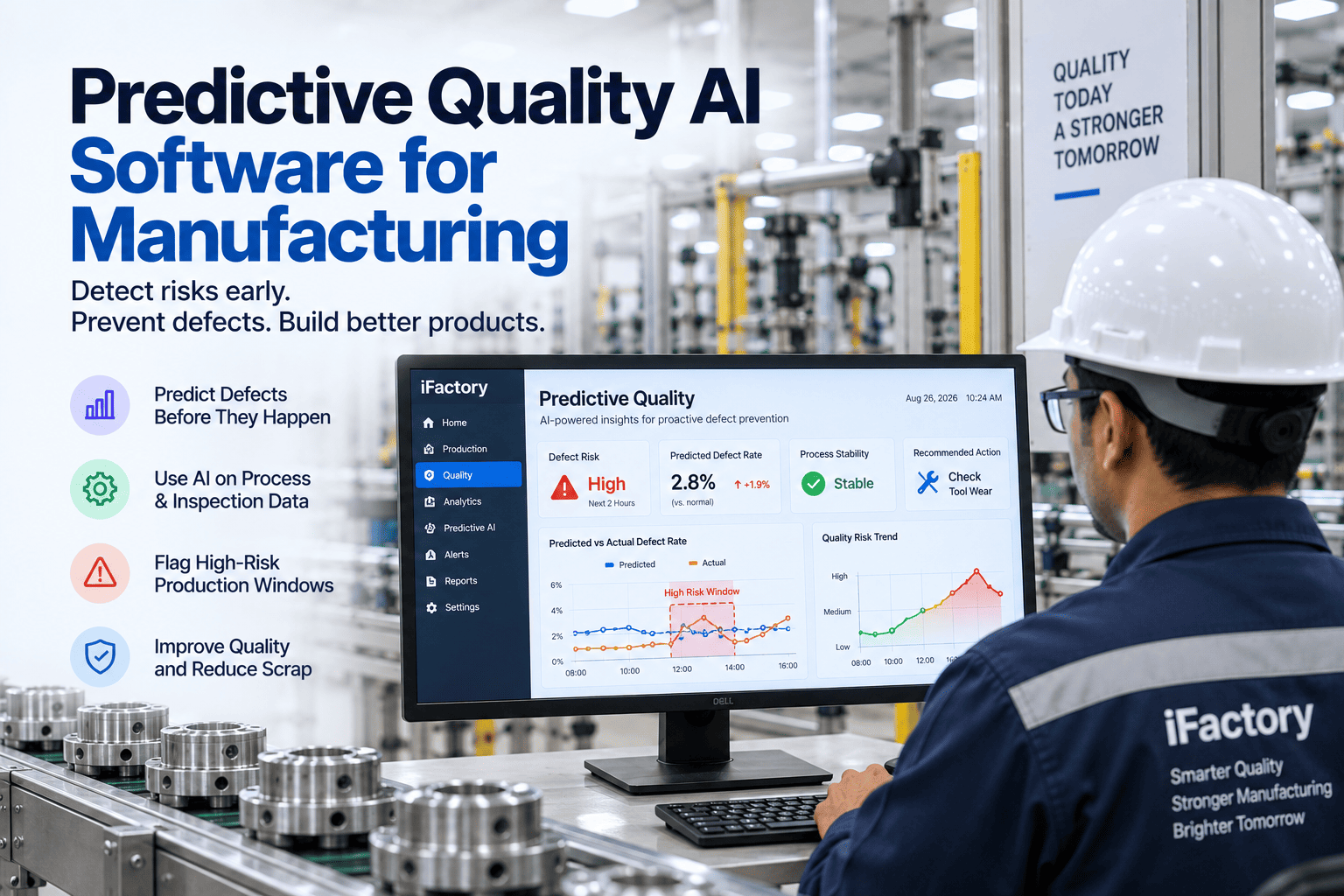
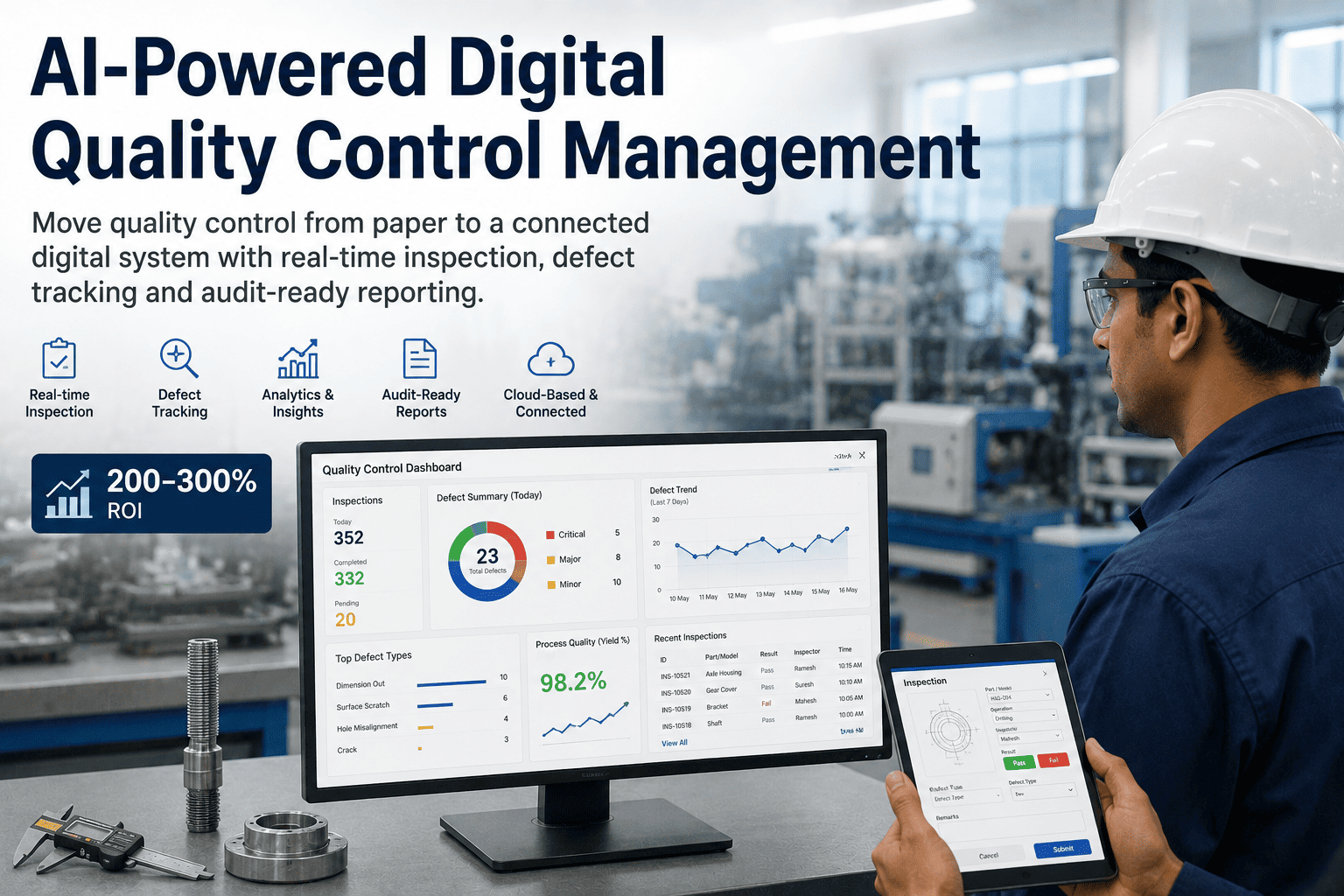
iFactory's AI Quality Control Management System combines machine vision, edge AI, predictive analytics, and automated compliance — purpose-built for Industry 4.0 manufacturers. Inspect every unit, at full production speed, with accuracy that no human team can match. See measurable defect reduction within weeks of deployment.
Core AI Quality Capabilities for the Smart Factory
iFactory's AI quality control management platform delivers the capabilities that define best-in-class Industry 4.0 manufacturing — from the shop floor to the boardroom:
Machine Vision & AI Defect Detection
Deep learning models inspect 100% of production at full line speed — detecting scratches, cracks, dimensional deviations, contamination, and misalignments invisible to human eyes
99%+detection accuracy — down to 0.1mm defect size
Predictive Quality Analytics
ML models analyze production parameters, historical defect patterns, and sensor streams to detect process drift and predict quality failures before a single non-conforming unit is produced
40%less waste with AI-driven predictive quality optimization
Digital Twin Quality Simulation
Virtual replicas of production lines allow quality teams to simulate process changes, test new product variants, and model failure scenarios — without ever touching a live production line
29%reduction in defects via AI production defect monitoring (2024 data)
Automated Compliance & Traceability
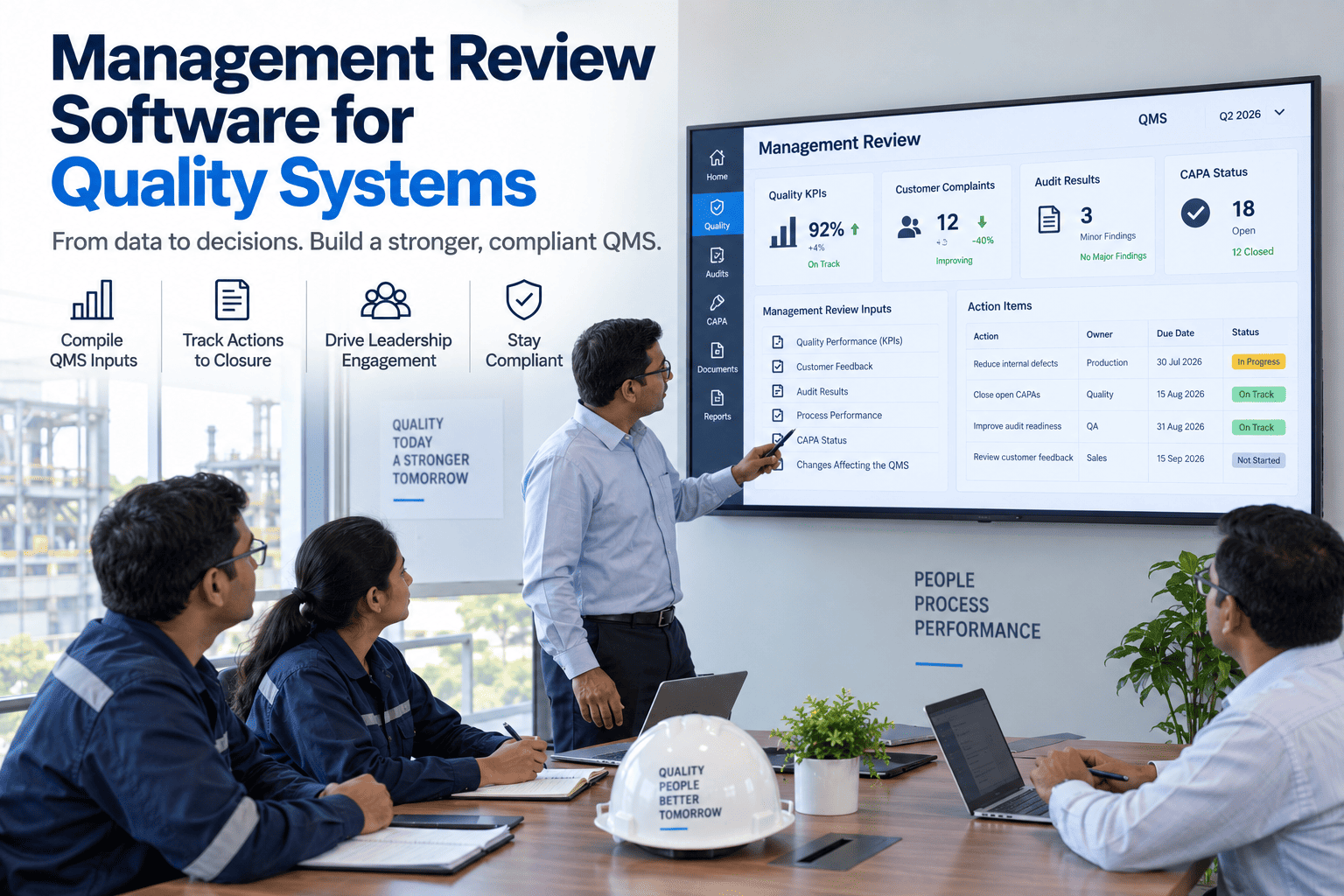
Every inspection image, defect log, and CAPA action is automatically timestamped and stored — creating a complete, audit-ready quality record for ISO, IATF, FDA, and customer audits without manual documentation
25%faster inspection cycles with AI-driven automated QC workflows
The ROI of AI Quality Control in Industry 4.0
The business case for AI-powered quality management delivers across every major financial metric — from scrap and rework to warranty claims and labor costs. Leading implementations achieve full payback within 6–12 months:
Proven Results from AI Quality Control Deployments
53%
Defect Reduction (Toyota AI)
Articsledge Manufacturing 2026
40%
Less Waste & Scrap
AI-Innovate Industry Study
83%
Fewer Defect Escapes (Automotive)
Deloitte 2024 Analysis
6–12 mo
Typical Full ROI Payback
Overview.ai Implementations
Intel saves $2 million annually from AI vision inspection alone. A leading European automotive manufacturer reduced warranty claims by 47% within one year of deploying AI visual inspection — and a semiconductor manufacturer increased throughput by 50%.
"AI-driven quality control uses machine learning and computer vision to detect microscopic defects with 95–99% accuracy at full production speed, transforming quality assurance from reactive inspection into proactive prevention. Real-world implementations across automotive, electronics, and food industries demonstrate a 40% reduction in waste and inspection cycles that are 25% faster. This delivers measurable ROI by preventing defects rather than just identifying them — a fundamental shift in what quality control means for the Industry 4.0 factory."
The most successful AI quality deployments follow a proven phased approach — pilot on your highest-value inspection point, prove ROI, then scale with confidence across every line and site.
Phase 1
Assess
Weeks 1–3
Map highest-cost defect types & inspection points
Baseline current defect rate, scrap & rework costs
Define ROI targets and success metrics
Phase 2
Pilot
Weeks 4–10
Deploy AI vision cameras on priority inspection line
Train initial CNN models on defect image library
Validate accuracy against baseline — target 99%+
Phase 3
Connect
Months 3–5
Integrate with ERP, MES & SCADA systems
Enable automated CAPA & defect workflow triggers
Activate predictive quality analytics engine
Phase 4
Scale
Month 6+
Roll out AI inspection to all lines and sites
Activate digital twin quality simulation
Continuous model retraining & performance improvement
The Industry 4.0 Quality Standard Starts Here
iFactory's AI Quality Control Management System delivers machine vision inspection, predictive defect analytics, automated CAPA workflows, and compliance management — all in one platform designed for the pace and complexity of Industry 4.0. Inspect every unit. Prevent every escape. Prove ROI within months.
What is AI quality control management for Industry 4.0 factories?
AI quality control management for Industry 4.0 uses machine vision, deep learning, and predictive analytics to inspect 100% of production units at full line speed — automatically detecting defects, flagging process drift, triggering corrective actions, and maintaining a complete digital quality record. Unlike traditional rule-based machine vision, AI systems learn from data, continuously improving their accuracy with every inspection cycle. This makes them capable of catching subtle, complex defects that fixed rules and human inspectors miss, while operating 24/7 without fatigue or variability.
How accurate is AI defect detection compared to human inspection?
AI defect detection consistently outperforms human inspection in both accuracy and consistency. State-of-the-art AI vision systems achieve 99%+ defect detection accuracy — detecting surface defects as small as 0.1mm — while human inspection accuracy typically ranges from 60–85% depending on fatigue, lighting, and inspector experience. A 2025 report from the Consumer Technology Association found AI systems achieving 99.97% accuracy on PCB solder joint inspection, a task that has become practically impossible for human inspectors due to component miniaturization. Siemens has reported a 30% inspection accuracy improvement, while Foxconn achieved an 80% improvement in defect detection rates after deploying AI vision systems.
What types of defects can AI quality systems detect?
Modern AI quality control systems detect a wide spectrum of defects across product types and industries: surface defects (scratches, dents, cracks, contamination, discoloration), dimensional deviations (out-of-tolerance measurements), assembly errors (missing components, misalignments, incorrect orientations), weld defects (porosity, undercut, incomplete fusion), label and packaging errors, and even subsurface anomalies using X-ray or ultrasonic sensing. AI anomaly detection modes can also flag unknown defect types the system was never explicitly trained on — catching quality issues before they are even classified.
What ROI can we expect from AI quality control implementation?
Most manufacturers achieve full ROI within 6–12 months of deploying AI quality control. Key value drivers include: reduced scrap and rework (up to 40% less waste), lower escape costs (fewer customer returns, recalls, and warranty claims), labor savings from automated inspection, and faster throughput by removing the inspection bottleneck. Intel saves $2 million annually from AI vision inspection. A leading automotive manufacturer reduced warranty claims by 47% within one year. At a macro level, AI quality management reduces overall manufacturing quality costs — which average 20% of revenue — by 30–53% in mature implementations.
How does AI quality control integrate with existing Industry 4.0 systems?
iFactory's AI quality platform integrates bidirectionally with your existing ERP (SAP, Oracle), MES, SCADA, and PLC systems through standard industrial protocols. Inspection results trigger automated signals to reject mechanisms, conveyors, and upstream process controls in real time. Quality data feeds into your existing reporting, compliance, and analytics infrastructure. Deployment is designed to work alongside — not replace — existing equipment; existing cameras can often be reused, and integration with legacy machinery is handled through iFactory's edge connectivity layer. Most manufacturers are live with their first AI inspection station within 4–10 weeks.