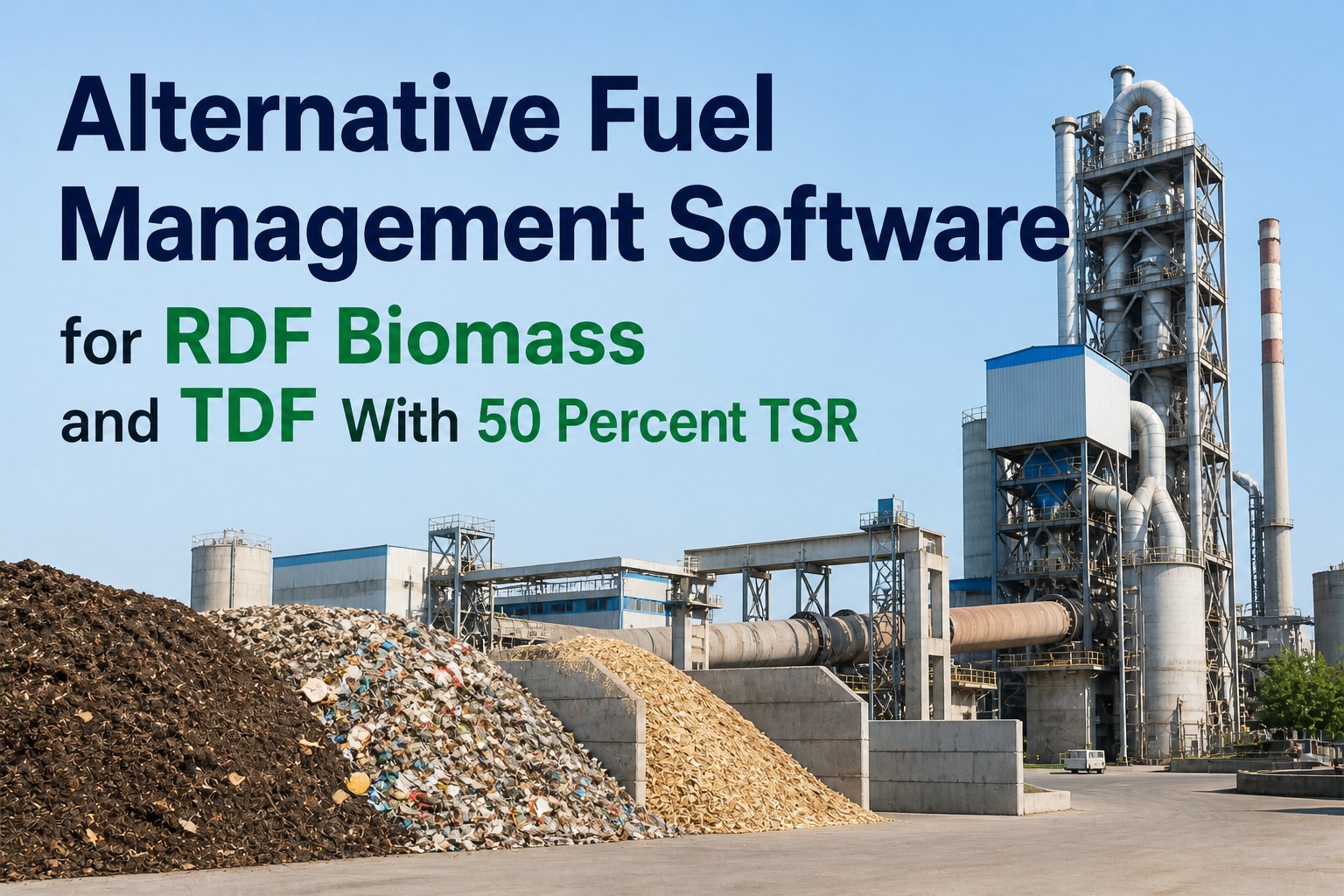
The cement plants pushing past 50% thermal substitution rate (TSR) in 2026 aren't the ones with the cleanest RDF supply contracts — they're the ones whose AI handles fuel variability faster than a human burner ever could. RDF moisture swings from 12% in summer to 30% in winter. Tire-derived fuel arrives with sulfur loads that change between trucks. Biomass calorific value drifts seasonally by ±20%. Above 50% TSR, flame shape degrades and reducing conditions appear. Free lime drifts before the lab can catch it. iFactory's alternative fuel management platform stitches AI vision on the conveyor, IR thermography on the burner, and reinforcement learning on the setpoints — turning fuel variability from an upset into a baseline operating condition the kiln can actually live in. References from ABB Ability and Carbon Re's Delta Zero confirm the operational direction the industry is moving in.
Alternative Fuel Management — RDF, Biomass & TDF Past 50% TSR
Join the iFactory pyroprocess team for a live walk-through of an AI platform sustaining 50%+ thermal substitution rate across mixed RDF / biomass / TDF feeds. Vision-based fuel characterization, calorific predictor, IR-guided flame stability, RL setpoint coordination — closed-loop and proven across operating cement plants.
Why Every Percent of TSR Is Worth Real Money
Fuel is 30–40% of cement production cost. Coal and petcoke aren't just expensive — they carry carbon-pricing exposure under EU ETS, CBAM, and equivalent regimes. RDF and biomass aren't just cheaper; in many regions plants are paid to take the waste. Every TSR percentage point is direct margin plus avoided carbon liability. Book a 30-minute briefing to model what that math looks like for your kiln.
Publicly committed AFR target across operations as of 2026.
Sustainable substitution rate at the main burner under closed-loop AI control.
Physically achievable substitution at the calciner with optimized feed conditions.
Versus coal — direct climate impact recorded by carbon-accounting research.
Each Alternative Fuel Behaves Differently — AI Treats Them All
Generic combustion control assumes a steady fuel. Alternative fuels are anything but. RDF varies by truck. Biomass varies by season. TDF varies by tire batch. The AI treats each load as its own characterization problem — then coordinates the burner accordingly.
Highest variability. Winter moisture spikes cool the flame. Plastics fraction shifts CV by ±25%. Vision AI on the conveyor classifies composition before it reaches the feeder.
Carbon-neutral but high-K₂O / Na₂O ash drives volatile circulation and preheater build-up. AI tracks alkali burden and adjusts secondary air to manage cycling.
Highest CV — but introduces Fe (steel wire) and S that shift iron modulus and SO₃ cycling. AI rebalances raw mix and fuel split when TDF flow rises.
From Tipping Floor to Flame — Where AI Intervenes
A fuel particle's journey from delivery truck to combustion takes 30–60 minutes. The AI watches it at four checkpoints, characterizing variability and adjusting downstream actions before each problem becomes one.
Vision AI on overhead camera classifies incoming fuel by type, particle size, contamination, and visible moisture. Lots flagged for rejection or for blending priority before unloading completes.
Hyperspectral / NIR + vision predicts calorific value, moisture, and chlorine content per metre of belt. Continuous calorific stream — not lab-batch averages — feeds the burner controller.
RL agent decides feed-rate split between RDF, biomass, TDF, and coal/petcoke to hit a target heat-input profile. Optimizes for cost, TSR, emissions, and stability — simultaneously.
IR thermography reads flame shape, length, and core temperature in real time. RL adjusts primary air, swirl, and fuel injection geometry to keep the flame stable as fuel mix shifts.
Why a Live Calorific Value Stream Changes Everything
Most plants run volumetric feeders — constant kg/h. But constant mass flow with varying CV means the actual heat input swings ±15%. The kiln sees those swings as flame instability, free lime drift, and NOx spikes. A real-time CV predictor lets the AI run on heat flow instead.
Vision · IR · RL — Three Models, One Fuel Brain
No single AI architecture handles fuel variability end-to-end. Vision sees what's coming. IR sees what's burning. RL decides what to do. The platform composes them — each handling what it's best at.
Fuel-type classification, particle size estimation, contamination detection, and moisture inference from surface texture. Edge-deployed on Jetson Orin at every conveyor and tipping point.
- RDF / biomass / TDF / mixed classification
- Particle size distribution from imagery
- Contaminant flagging (PVC, metal, oversize)
- Moisture inference from spectral signature
Long-wave IR camera on the burner hood reads flame shape, length, and core temperature distribution every 100ms. Detects flame lift, impingement, and reducing-zone formation before sensors catch it.
- Flame shape index in real time
- Burning zone temperature distribution
- Reducing condition early warning
- Flame instability index
RL agent owns burner setpoints, fuel-feeder rates, primary air, and swirl. Reward function balances TSR, kcal/kg, free lime, and CO/NOx jointly. Trains in the digital twin first.
- Multi-feeder rate coordination
- Primary/secondary air balancing
- Burner swirl & momentum control
- Joint TSR / quality / emissions reward
What Manual Operation Can't Do — And Why It Stalls Below 30%
Most plants stall their TSR ramp at 25–30% not because the supply runs out, but because the next 5% destabilizes the kiln in ways manual operators can't recover from quickly enough. Here's what gets in the way — and how AI removes each barrier.
Where the Industry Is Already Pointing
iFactory isn't claiming this approach in isolation. The direction of travel is now industry-standard — what differs is implementation depth and how on-prem-sovereign the architecture really is.
ABB has documented multi-fuel kiln control with model-predictive optimization across mixed alternative fuels. The reference confirms the operating approach — multi-objective control across fuel mix, kiln stability, and emissions — at scale.
UK-based AI specialist focused on cement decarbonization. Public material details RL-style approaches to reduce fuel cost and emissions in real time. Validates the core architecture iFactory has productized for on-prem deployment.
The competitive references run cloud-tilted architectures. iFactory deploys the same model families fully on-prem — Jetson at the conveyor, H200 at the plant, optional GB300 at enterprise. No production data leaves the site. Read more.
How the System Actually Closes the Loop
Closed-loop on alternative fuels is harder than closed-loop on coal — the AI has to handle inputs that change every truck-load. Here's the data flow that makes it work. Schedule a deployment review with our pyroprocess team.
What Cement Plant Heads Ask About AFR AI
Most plants stalled at 25–30% have a clear runway to 45–55% with closed-loop AI control on existing equipment. Past 55% usually requires feed-system upgrades — but the AI tells you exactly which constraint is binding before you spend capex.
Helpful, not required. The platform works on RGB vision plus existing fuel-feeder data and DCS measurements. Hyperspectral or NIR adds 15–25% accuracy on calorific prediction — typically retrofitted in phase 2 once the core stack proves out.
The RL reward function makes emissions a hard constraint. Permits stay first. The AI co-optimizes TSR with NOx and CO compliance — never sacrifices one for the other. Documented results actually show NOx down as TSR rises, because flame stability improves with continuous control.
Yes. iFactory's AI sits above the APC layer — sending optimized setpoints into your existing optimizer rather than replacing it. Most customers keep their APC and pair it with our fuel-side intelligence stack.
Built for Fuel Variability — Not Just Steady-State Coal
Get Your TSR Roadmap From Current to 50%+
Thirty minutes with our pyroprocess engineers. Bring your current TSR, fuel mix, conveyor layout, and burner type. We'll model the realistic ceiling for your kiln, identify the top three barriers blocking your next 10 points, and outline a 90-day closed-loop deployment path. Talk to support if you want preliminary scoping first.