Most SAP enterprises on Azure aren't running a clean two-tier model. They're running a patchwork: S/4HANA Private Cloud on Azure, legacy ECC still on-prem, a mix of data sitting in SAP HANA and in on-premises data warehouses, and a board-level mandate to deploy AI — yesterday. This reference architecture cuts through the complexity and shows exactly how Azure, S/4HANA, and on-premises AI inference fit together: the data flow, the governance checkpoints, and the Joule integration patterns that actually hold up under production load.
Building Azure + SAP On-Prem AI Architecture
Join the iFactory team on architecting Azure × SAP on-prem AI. Explore deployment lanes, Business Data Cloud architecture, and hybrid SAP+AI reference models—built on 1,000+ enterprise implementations. Engage with our architects, model your use case in real time, and leave with a clear, actionable strategy.
Why Three-Layer Hybrid Is the Default — Not the Exception
SAP enterprises don't wake up and choose complexity. They inherit it. What looks like a "simple Azure migration" is almost always three overlapping challenges arriving at once. If you're already in this position, schedule a 30-minute architecture triage with our team before committing to a migration path.
ECC Still On-Prem
50% of SAP customers doing a system conversion keep ECC running in parallel during migration. AI deployments can't wait 18 months for full cutover — they need to bridge now.
Data Sovereignty Rules Out Cloud-Only
Healthcare, defense, and regulated manufacturing can't route sensitive inference through hyperscaler endpoints. On-prem AI inference isn't optional — it's compliance.
Joule Needs Context Joule Doesn't Have
Joule is not supported on classic on-prem S/4HANA. For Private Cloud, it requires UI compliance and BTP setup. Bridging that gap is where most AI projects stall.
AI Unit Economics Are Opaque
SAP's shift to consumption-based pricing means less than 40% of cloud revenue is now licensing. Enterprises have no reliable forecast model for AI Units before they commit.
The Three-Tier Stack — How It Actually Fits Together
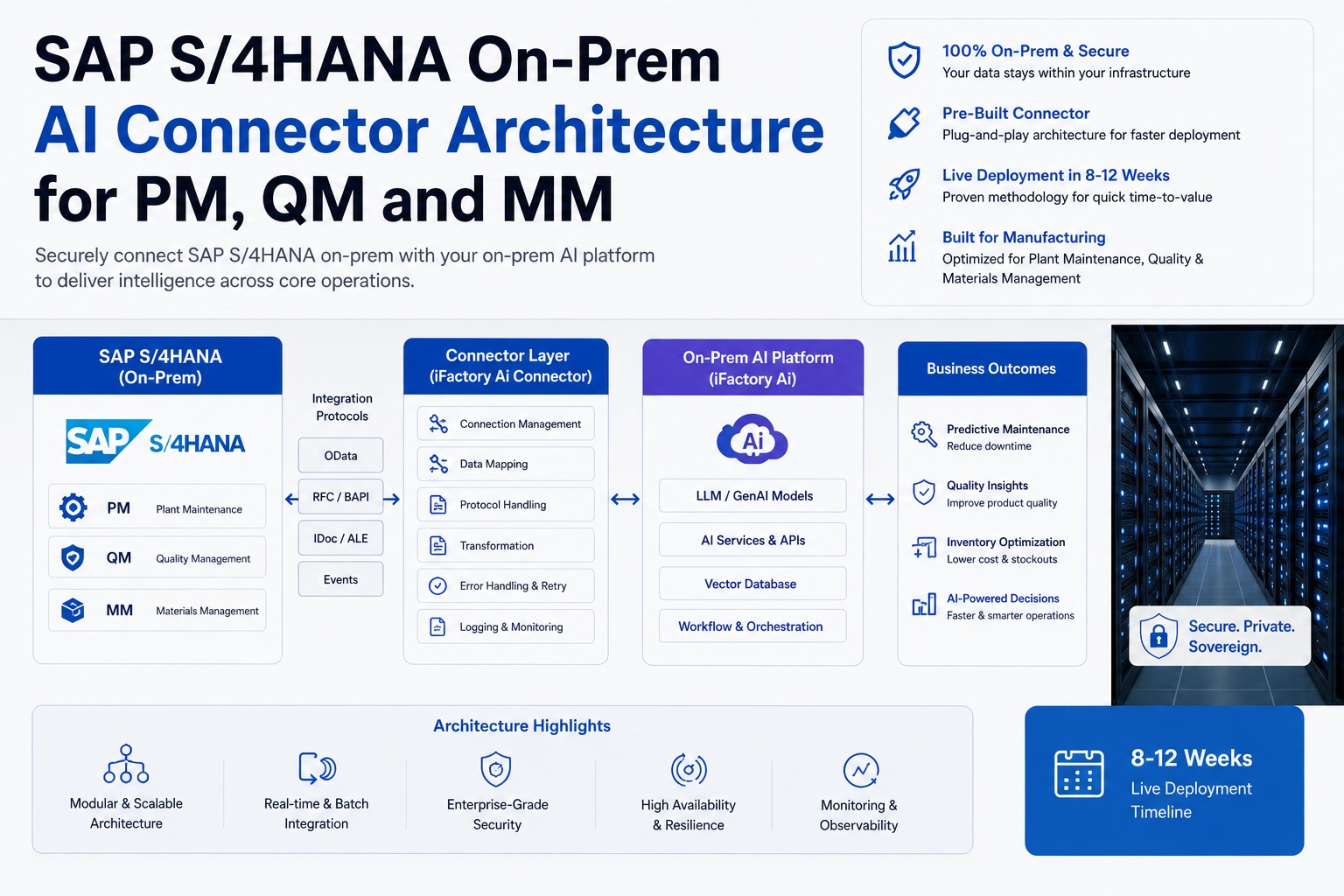
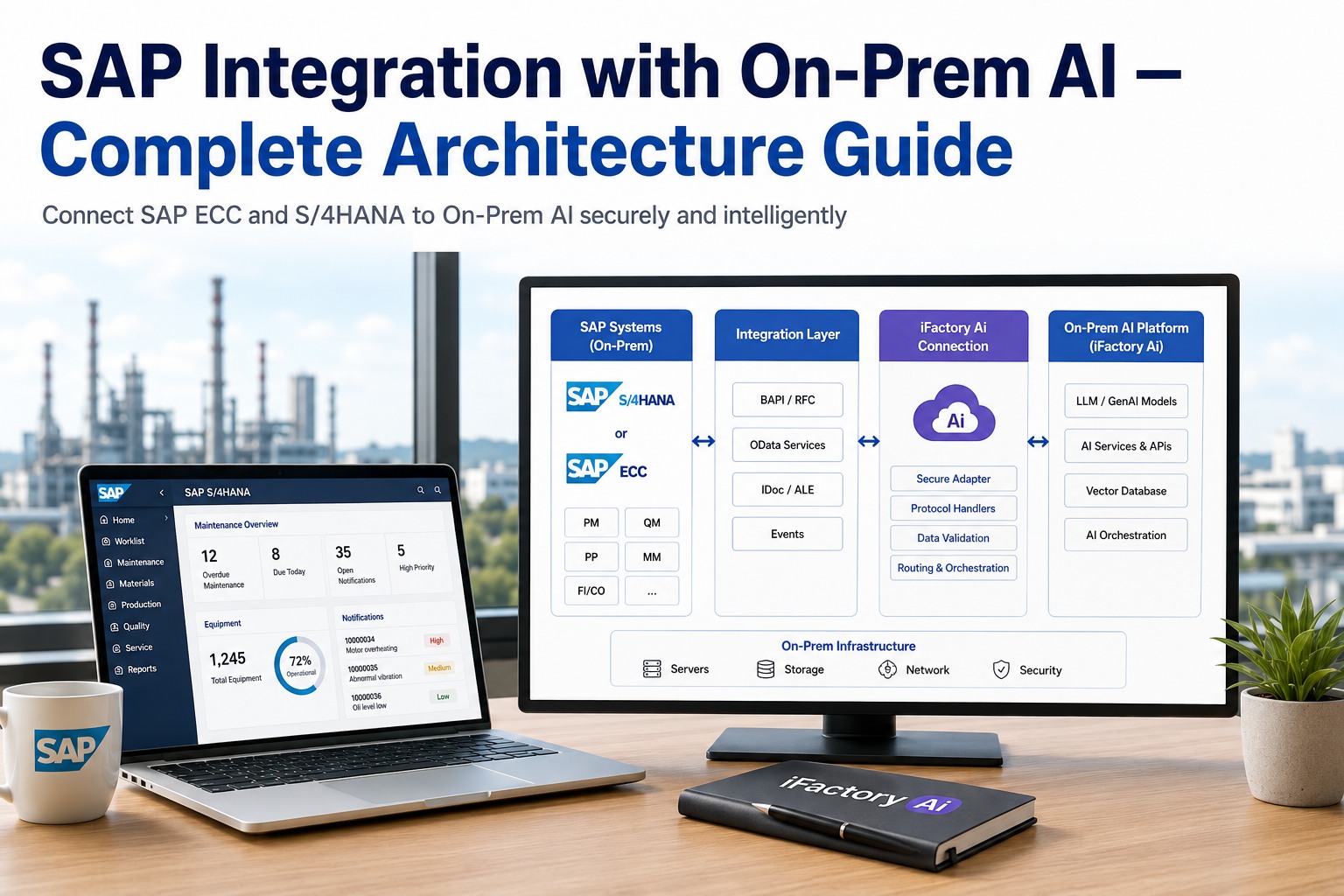
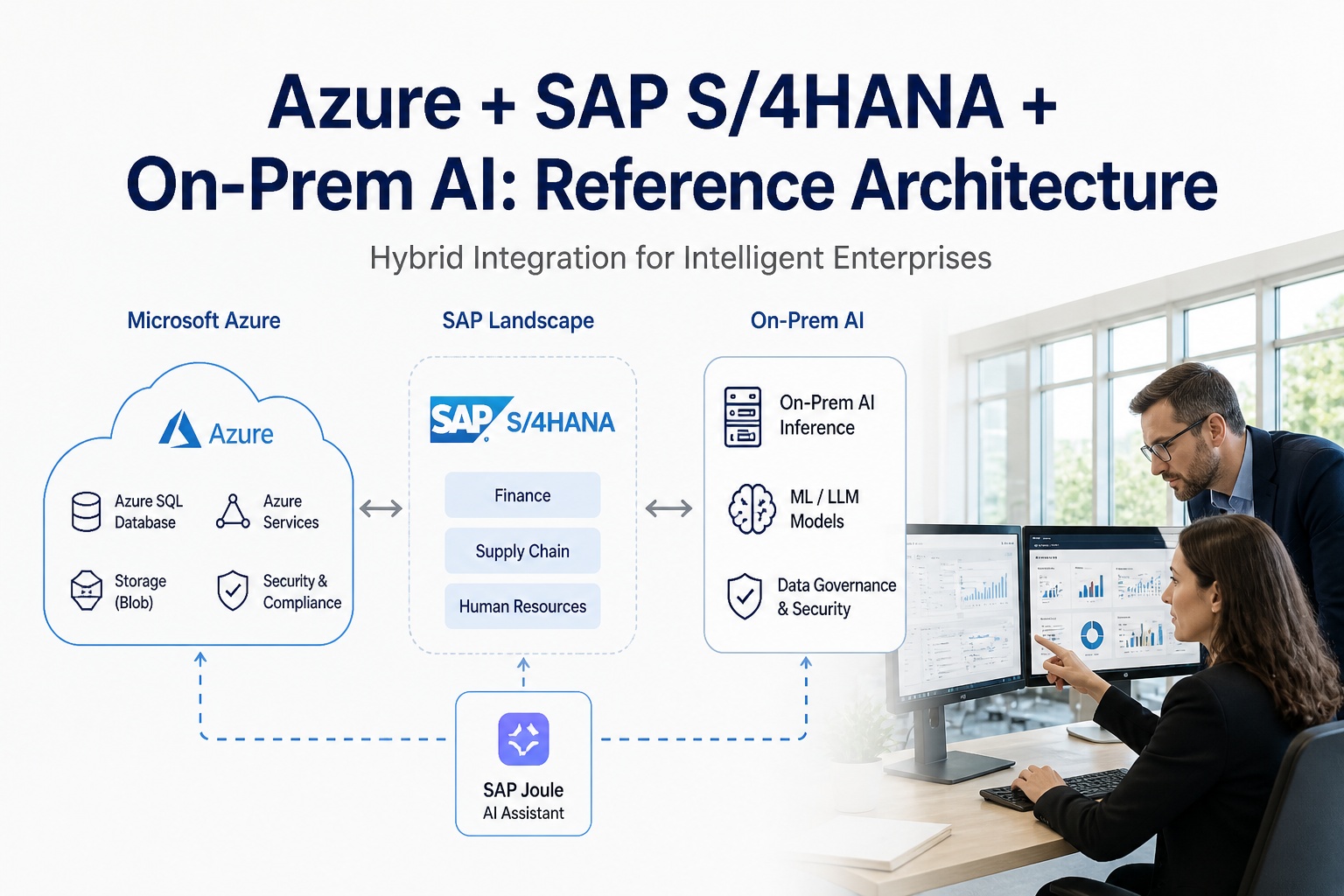
This is the production-validated architecture pattern for enterprises running Azure for SAP, S/4HANA Private Cloud, and on-premises AI inference in parallel. Each tier has a distinct role — and distinct governance requirements. Not sure which tier your workload belongs to? Explore our on-prem AI integration patterns or talk to our team directly.
How a Joule Agent Request Traverses the Stack
Understanding the exact path a request travels — and where decisions happen — is what separates a working hybrid architecture from one that fails at the governance checkpoint.
Business user submits a natural language query — "summarize open purchase orders over 90 days" — inside the SAP Fiori interface. The request hits the Joule runtime layer in S/4HANA Private Cloud on Azure.
SAP BTP receives the request and routes it through AI Foundation — the unified layer that maps the query against SAP's 7.3M ERP data fields and determines which skills or agents to invoke. This is where Business Data Cloud semantic harmonization runs.
The router checks three conditions: (a) does the data contain regulated fields? (b) is the requesting entity in a sovereignty-restricted region? (c) is on-prem GPU latency acceptable for this use case? Based on the answer, it routes to Azure OpenAI, on-prem Blackwell cluster, or SAP's own model endpoints.
If the query touches ECC data or on-prem warehouse records, SAP Cloud Connector executes principal propagation — passing the authenticated SAP user identity to on-premises APIs without re-authenticating. Data returns encrypted through the ExpressRoute private circuit.
Synthesized response returns to the Joule UI. Simultaneously, the AI Units consumption event is written to the cost monitor, the agent action is logged in SAP LeanIX for audit, and Azure Purview records the data lineage event. Complete in under 3 seconds for non-regulated queries.
Three Joule Patterns — Match Yours to Your Edition
The right Joule integration pattern depends entirely on your S/4HANA edition and ECC migration status. Getting this wrong means re-architecting after go-live. Book a pattern-matching session and we'll identify yours in 30 minutes — at no cost, before Sapphire or on-site.
Native Joule — Zero Bridge Required
Joule is supported natively on S/4HANA Public Cloud from release 2408 onward with proper entitlement. AI Foundation is pre-wired. The main work is skill configuration, not plumbing. On-prem AI connects via Azure OpenAI service routing for edge cases.
BTP-Mediated Joule with Custom Skills
Joule is available in Private Cloud but requires UI compliance validation and BTP setup before activation. This pattern adds Joule Studio for custom skill authoring — bridging on-prem ECC data via Cloud Connector and custom ABAP RESTful APIs. Highest architectural flexibility.
Side-by-Side AI — Joule Not Applicable
Joule is explicitly not on the roadmap for classic on-prem S/4HANA. The alternative: deploy AI side-by-side via Azure ML or on-prem GPU cluster, integrate with SAP via OData/BAPI calls, and surface insights through custom Fiori tiles or embedded analytics. Effective, but not Joule.
Five Governance Checkpoints — Where Most Projects Fail
Every Azure × SAP × AI architecture fails at one of these five checkpoints. Identify yours before you go to production. If you're unsure where your current design stands, reach out to our support team for a pre-flight governance review — we typically respond within one business day.
Every data field that enters the AI pipeline must be classified before the inference router makes its call. Use Azure Purview + SAP Information Lifecycle Management together — not one or the other.
The authenticated SAP user identity must propagate through Cloud Connector to on-prem APIs without re-authentication breaks. Test this with your actual ECC authorization objects — not mock data.
SAP's shift to consumption pricing means uncontrolled Joule usage creates unforecast budget spikes. Set hard AI Units caps per user group and per agent type before enabling broad rollout.
SAP LeanIX in the AI Agent Hub logs every agent action. This isn't optional for regulated industries — it's the proof of control that auditors require. Verify log completeness before enabling autonomous agent actions.
Any custom ABAP or BTP extension that surfaces data to AI must pass SAP's A–D Rating Extensibility Model (introduced August 2025). Extensions rated C or D block future upgrades.
What We Bring to Your Azure × SAP AI Architecture
Architecture diagrams are the easy part. Production-grade hybrid AI deployments across 1,000+ enterprise customers have taught us where the real problems live. Schedule a live architecture walkthrough and see how the patterns in this guide apply to your specific stack — S/4HANA edition, ECC timeline, and data residency requirements included.
On-Prem GPU Cluster Design
Blackwell-based GPU cluster architecture for SAP-context AI inference. Sub-50ms latency on plant-floor workloads. Validated against regulated industry data classification requirements.
Joule Deployment Lane Modeling
We map your S/4HANA edition, ECC migration timeline, and BTP entitlement to the right Joule integration pattern before a single line of code is written. Pattern A, B, or C — with concrete timelines.
AI Units Forecasting Tool
Plug in your user count, use-case mix, and Joule tier. Get an annualized AI Units consumption forecast across three scenarios — conservative, expected, and peak. Size your block before the 100-unit minimum.
50+ Pre-Built SAP + OT Connectors
Validated connectors for common on-prem OT systems, ECC modules, and third-party data sources. Skip the integration plumbing. Spend the budget on the AI capabilities that move the business.
Why SAP Enterprises Choose iFactory Over Generic Integrators
Most system integrators can read the SAP documentation. Very few have shipped 1,000+ production Azure × SAP × AI deployments and built the tools to prove it. Here is the difference that shows up on day one. Questions before you decide? Talk to our support team — no sales call required.
Every engagement is led by SAP-certified solution architects — not junior consultants reading playbooks for the first time.
We built our platform for enterprises that can't go cloud-only. On-prem GPU inference, Cloud Connector bridging, and BTP extension — all under one SLA.
Our AI Units forecasting tool models your consumption before you commit — so the first invoice isn't a surprise. No vendor does this for free. We do.
Our architects are at OCCC all three days of SAP Sapphire 2026. Book a slot, bring your stack details, leave with a verified architecture plan — not a brochure.
Walk Away with Your Azure × SAP AI Architecture Sketch
Thirty minutes with our architects. Bring your S/4HANA edition, your ECC migration timeline, and your data sovereignty requirements. We'll map your Joule deployment lane, identify your governance checkpoints, and give you a concrete 8-week path to production — not another slide deck.