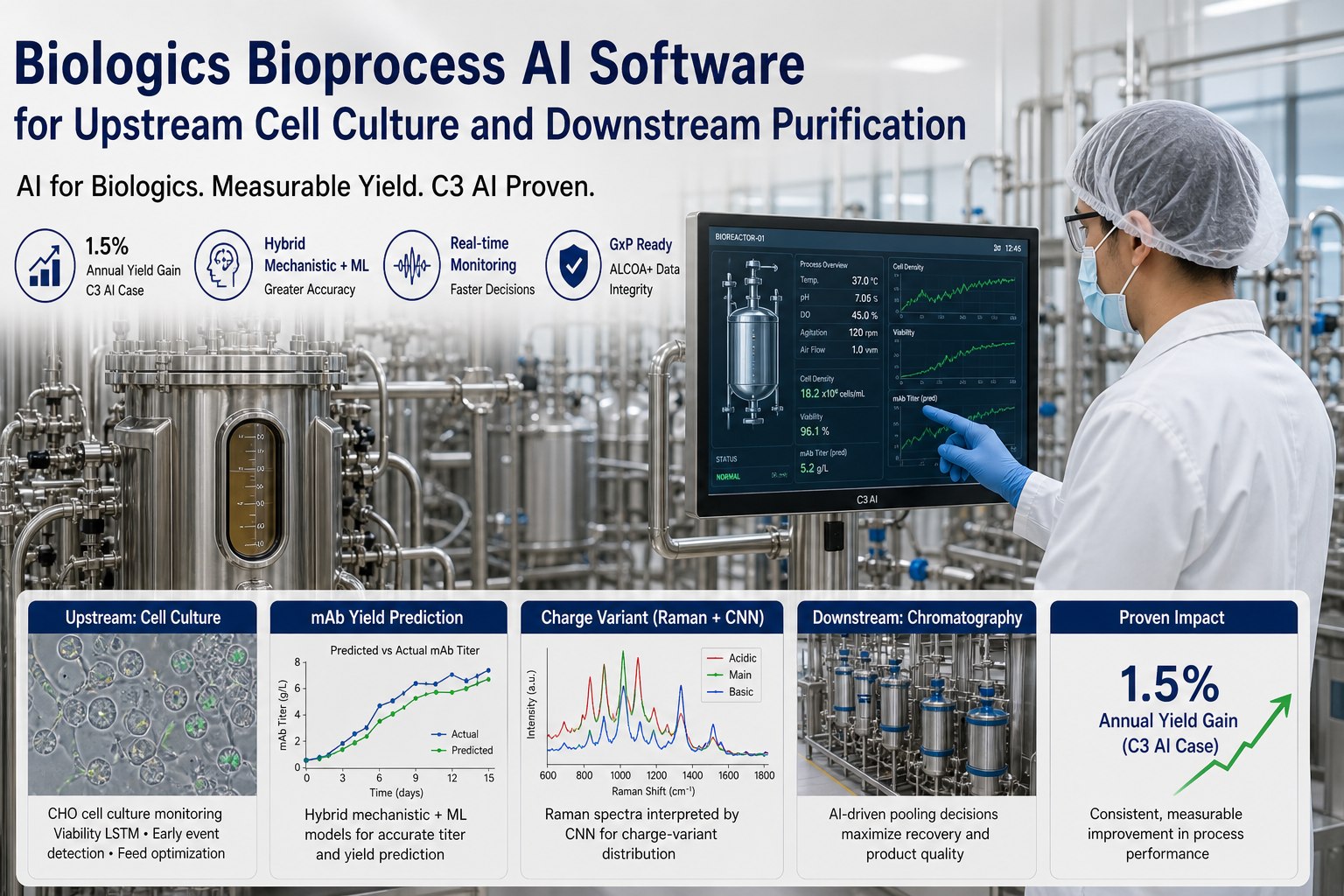
Biologics manufacturing is unforgiving. A CHO bioreactor running mAb production has 50+ variables — pH, DO, glucose feed, temperature shift, ammonia drift, viable cell density — and they all interact non-linearly. Miss the right harvest window by 6 hours and you've left grams of product in the bioreactor. Pool the wrong fractions on the cation column and your charge-variant profile is out of spec. The iFactory Biologics & Bioprocess AI platform is built for this — hybrid mechanistic-plus-ML models for upstream, Raman-trained CNNs for in-line PAT, LSTM forecasting on viable cell density and titer, and Gaussian Process Bayesian optimization for chromatography pooling. All on-prem on NVIDIA GB300, with a plant LLM that drafts batch reports while the column is still running.
Biologics & Bioprocess AI — Upstream to Downstream
Join the iFactory bioprocess team for a live walk-through of an AI platform deployed in operating mAb facilities. CHO cell culture monitoring, mAb yield prediction, viability LSTM, charge-variant Raman+CNN, and chromatography pooling — built on hybrid mechanistic-ML, deployed on 1,000+ enterprise stacks.
A 1.5% Annual Yield Gain Pays for Everything
For a $2B mAb franchise, a 1.5% yield improvement is roughly $30M annually — and that's the documented result from large biopharma deployments using AI on bioprocess data. The math behind that number is what this page is about. Book a 30-minute briefing to see how it maps to your titers and tankage.
Upstream and Downstream Need Different AI
A bioreactor is a living system. A chromatography column is not. Pretending they're the same problem is why most generic industrial AI fails in biologics. Our platform splits the model architecture along the same line your process does.
- Hybrid mechanistic + ML — Monod kinetics ground the model, ML captures residuals
- LSTM forecasting — viable cell density, titer, viability 24–72h ahead
- Raman + ML — glucose, lactate, glutamine, ammonia, mAb in-line
- Gaussian Process — feed strategy & medium optimization
- Anomaly detection — contamination signature, foaming, agitator drift
- CNN on UV/Raman — real-time charge-variant prediction during pooling
- PLS on Protein A — load forecasting, breakthrough prediction
- GP-based pooling — Bayesian optimization of fraction selection
- Aggregate prediction — viral inactivation, UF/DF endpoint
- Buffer prep AI — conductivity, pH, osmolality verification
Why Pure ML Fails in Bioprocess — And What We Do Instead
A CHO culture has 14 days of dynamic behavior, maybe 20 historical batches per process, and 50+ measured variables. That ratio defeats deep learning. The answer is hybrid modeling — let the biology do half the work.
Monod kinetics, Pirt's maintenance equation, mass balances on glucose / glutamine / oxygen / mAb. Captures the 80% of behavior that biology has known for decades.
XGBoost or LSTM trained on what the mechanistic model misses — clone-specific metabolic shifts, lactate switch behavior, ammonia sensitivity, scale-down vs scale-up bias.
Forecasts VCD, titer, glycoform, charge variant 24–72h ahead. Survives small datasets. Stays interpretable for regulators. Generalizes to new clones with re-fitting only the residual layer.
Inside a CHO Bioreactor — What the Platform Predicts
Five forecasts that change how upstream operators run their tanks. Each runs continuously through the cell culture, updating as fresh Raman and offline data come in.
LSTM forecasts viable cell density 48h ahead with confidence intervals. Detects culture inflection points — exponential, stationary, decline — before classical metrics react.
Hybrid mechanistic-ML predicts harvest titer 72h before harvest. Lets ops decide whether to extend, harvest early, or boost feed strategy mid-run.
Single Raman + ML model tracks glucose, lactate, glutamine, glutamate, ammonia, mAb, plus 90+ trace metabolites. Replaces 60% of offline assays.
Spotting the lactate-consumption inflection 8–12h early lets ops adjust temperature shift timing and protect product quality through stationary phase.
Correlates ammonia, osmolality, and pH excursions to predicted glycoform shifts. Guards against subtle drift in galactosylation and high-mannose content.
Gaussian Process recommends bolus vs continuous feed, glucose set-point, and amino acid supplementation — by clone, by scale, by media lot.
Where Pooling Decisions Become Algorithm
The biggest preventable yield loss in biologics is over-pooling — operators take wide pool windows for safety and leave product on the column. AI tightens the pool by predicting charge variants in real time. Talk to our chromatography specialists for a column-specific assessment.
PLS on UV + conductivity + pressure predicts breakthrough 30 min ahead. Optimizes loading density without risk of dynamic binding capacity overshoot.
CNN trained on Raman/UV spectra predicts acidic, main, and basic charge variant fractions in real time during elution. Pool window auto-narrows around target species.
Hybrid model forecasts HMW species and host cell protein clearance. Triggers fraction diversion before contaminants exceed CQA limits.
LSTM predicts permeate flux decline, fouling onset, and final formulation osmolality. Cuts UF/DF cycle variance to under 6%.
Five Model Families. One Validated Pipeline.
How the Platform Sits in a Biologics Plant
A bioreactor train, a clean utility skid, an automated chromatography line, a fill-finish suite — all stitched into the same AI layer with strict GxP boundaries. Schedule an architecture walkthrough with our deployment engineers.
GB300 + H200 — Sized for Biologics Workloads
Lightweight CNN-Raman inference at the bioreactor or chromatography skid. Sub-100ms response on streaming spectra.
Hybrid mechanistic-ML training, LSTM fitting, GP optimization. Per-clone retraining handled here without core impact.
Plant LLM inference (70B), full bioreactor digital twin, multi-site model registry. Liquid-cooled rack-scale.
DCS Alone · Generic AI · iFactory Biologics AI
| Capability | DCS Alone | Generic AI | iFactory Biologics AI |
|---|---|---|---|
| Hybrid mechanistic + ML | No | Rare | Native — Monod-grounded |
| CNN-Raman charge variant | No | No | Real-time during elution |
| VCD/titer LSTM forecast | No | Generic | Per-clone calibrated |
| Chromatography pooling AI | No | No | GP-based Bayesian |
| Multi-clone generalization | — | Retrain from zero | Refit residual layer only |
| Glycoform CQA tracking | Offline only | No | Predicted in-process |
| Annual yield gain documented | — | Variable | ~1.5% mAb yield |
| Sovereignty | On-prem | Cloud | On-prem GB300 |
| Validated deployment | — | 9–18 months | 14–18 weeks |
From Kickoff to Validated Production
What Bioprocess Leaders Ask First
Yes — that's exactly why we use hybrid models. Pure deep learning needs hundreds of batches; the mechanistic core lets us deliver useful forecasts from 15 batches by anchoring the physics first and learning only the residuals.
No. The mechanistic core stays fixed. Only the ML residual layer refits per clone — typically 4–6 weeks of work on existing campaign data. The CNN-Raman model often transfers directly with calibration adjustments.
That's the recommended path. Phase 1 is advisory — operators see predictions and act on them manually. Phase 2 enables closed-loop control on individual unit ops as each model passes PQ. Most customers go closed-loop on chromatography pooling first.
Yes — and they prefer them. Pure black-box models face scrutiny. Hybrid models with explicit mechanistic structure are exactly what ICH Q8/Q9/Q10 frameworks are designed for. We provide the validation evidence package as standard.
Built by Bioprocess Engineers — Not Cloud-First Vendors
Get a Clone-Specific AI Plan for Your Plant
Thirty minutes with our bioprocess engineers. Bring your clone library, current PAT footprint, and most painful unit op. We'll map exactly where AI lands first — usually chromatography pooling or VCD forecasting — and how we deploy without disrupting your campaign schedule.