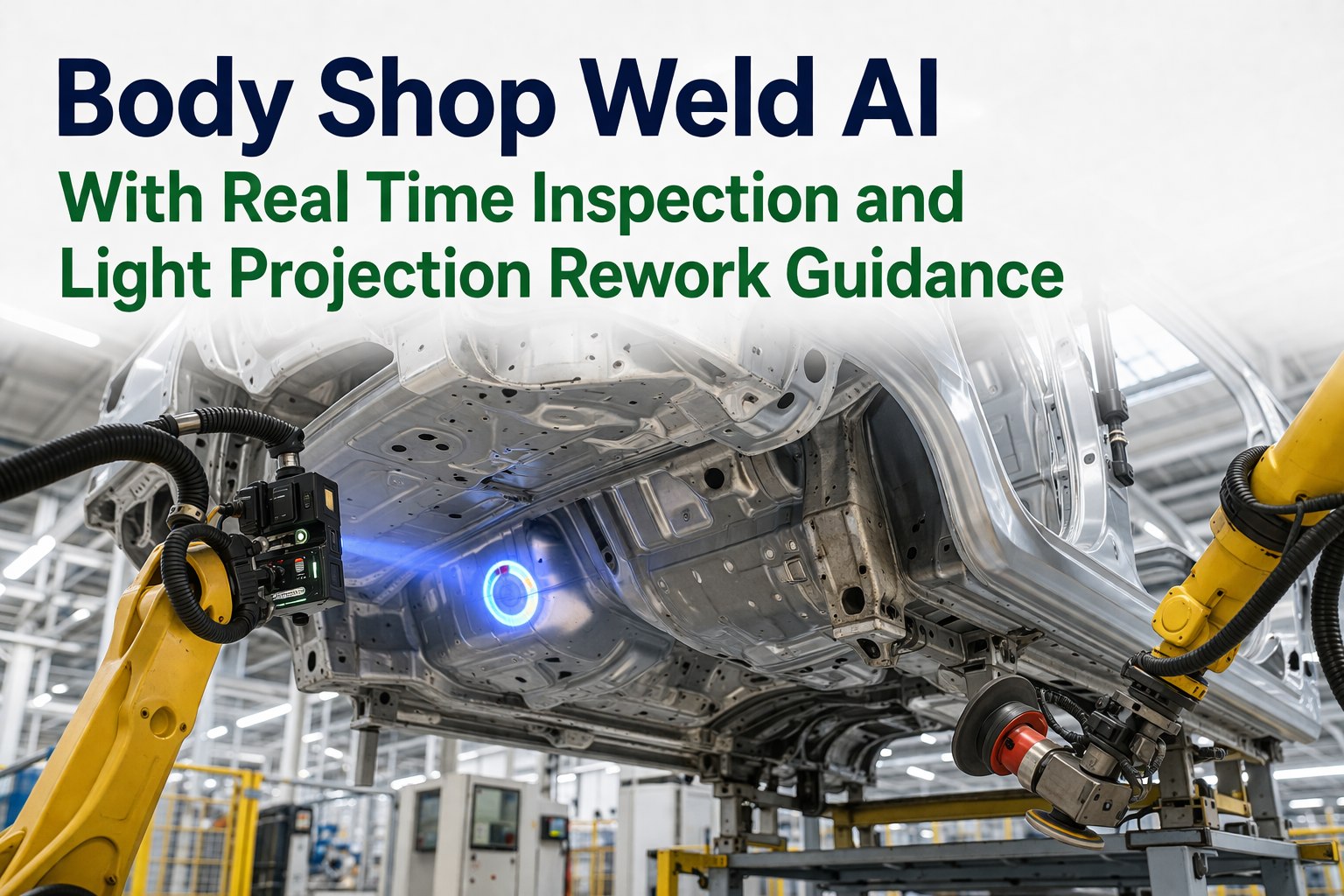
Body shops are where weld spatter happens and where someone — historically a worker with a grinder, in awkward postures, hours at a time — has to remove it. Underbody welds are the worst: ergonomically punishing, hard to inspect, and a single missed spatter ball can sever a cable harness during downstream assembly. Audi's Neckarsulm A5/A6 body shop changed that pattern in 2026. AI cameras now flag weld spatter on the underbody in real time, project blue light directly onto the affected spot, and a grinding robot arm goes straight to the marked location and removes it — no human in the loop. This page is the iFactory reference for that workflow: Vision Transformer detection on Jetson edge, light-projection coordination, ROS2 grinding-robot integration, and a plant LLM drafting weld-quality reports for QA. The Audi pattern is now scaling to six Ingolstadt plants. Here's how to bring it to yours.
Body Shop Weld AI — Detect, Project, Grind
Join the iFactory automotive team for a live walk-through of the body-shop weld AI workflow: real-time spatter detection · blue-light projection onto the exact spot · automated robot grinding. The Audi Neckarsulm pattern, productized for OEMs and Tier-1 BIW lines.
Why Underbody Welds Are the Hardest Job on the BIW Line
A typical body-in-white floor pan carries 4,000+ resistance spot welds, MIG welds, and laser-stitch welds. Spatter is a normal byproduct — molten metal ejecta that lands on cable runs, tape lines, and adjacent panels. Left in place, it cuts harnesses six stations downstream. Removed manually, it costs operators their wrists and shoulders. Book a 30-minute review and we'll map this against your specific BIW process.
A modern unibody carries thousands of joins — every one a spatter source. 100% inspection by humans is not realistic at takt time.
The body sits at the inspection station for about 10 seconds before moving. Detection, decision, and marking all need to fit inside it.
One missed spatter ball cuts a wire 6 stations down. Rework cost compounds — and the failure often shows up post-paint.
Manual underbody grinding is among the most ergonomically punishing tasks on the floor. Awkward postures, vibration exposure, particulate.
What's Actually Running on the A5/A6 Body Shop
Audi's Neckarsulm A5/A6 body shop is the proven reference for what this looks like at scale. Real plant. Real volume. Real series production. The Volkswagen Group's first AI-supported weld spatter detection system — now scaling to six Ingolstadt plants. Below is what the press releases describe in plain English, and what we've productized.
Detect → Project → Grind
The system has three coordinated stages, each one running on the right hardware tier. Detection runs at the edge for latency. Projection coordinates with body position. Grinding integrates with the robot fleet through ROS2. The entire cycle completes inside the body's takt window at the station.
Multiple high-resolution cameras under the body station capture the underbody as it indexes into position. Vision Transformer model on Jetson Orin runs inference per camera, locating individual spatter balls down to ~1mm with sub-100ms latency. Trained on plant-specific imagery — not stock datasets.
Detected coordinates feed a calibrated projector array. A blue marker beam lands directly on the metal at the spatter location — visible to operators, but more importantly, machine-readable by the downstream grinding cell. The marker becomes the physical handoff between perception and action.
Grinding robot integrated via ROS2 receives the spatter coordinates directly. End-effector path planning, force control, and tool engagement all run on the H200 controller. Robot arrives at the mark, applies the right grinding pressure, removes the spatter, and verifies clean — all inside the takt window.
Not Every CNN Can See Underbody Spatter Reliably
The classic factory-vision answer is YOLO or a ResNet-class CNN. Both work for many tasks. Underbody weld spatter is not one of them — backgrounds shift with sealer beads, cables, and shadow patterns. A 1mm spatter ball against a busy underbody texture is a long-tail problem. Vision Transformer architectures handle it better because attention generalizes where convolutional priors over-fit.
Sealer beads, harness clips, anti-flutter pads, and seam tape all sit on the same underbody surface. ViT attention isolates the metallic spatter signature from the surrounding clutter that fools CNNs.
Underbody illumination is non-uniform. ViT's global self-attention learns lighting-invariant spatter features instead of brightness-cued shortcuts.
A5, A6, sedan, Avant, electric variants — same body shop, different floor pans. ViT generalizes across variants from one labeled dataset; CNNs typically need per-variant tuning.
Some spatter clusters are the unusual ones — overlapping balls, oxidized surfaces, partial occlusion by cables. ViT handles long-tail cases that didn't appear in early training data better than locally-constrained CNNs.
Three Compute Tiers — Edge, Plant, Enterprise
Every stage of the workflow has its own physics. Detection needs sub-100ms latency at every camera. Robot path planning needs deterministic compute on the plant floor. Model training, plant LLM, and digital twin live in the enterprise core. The hardware tiers map cleanly to NVIDIA's product line.
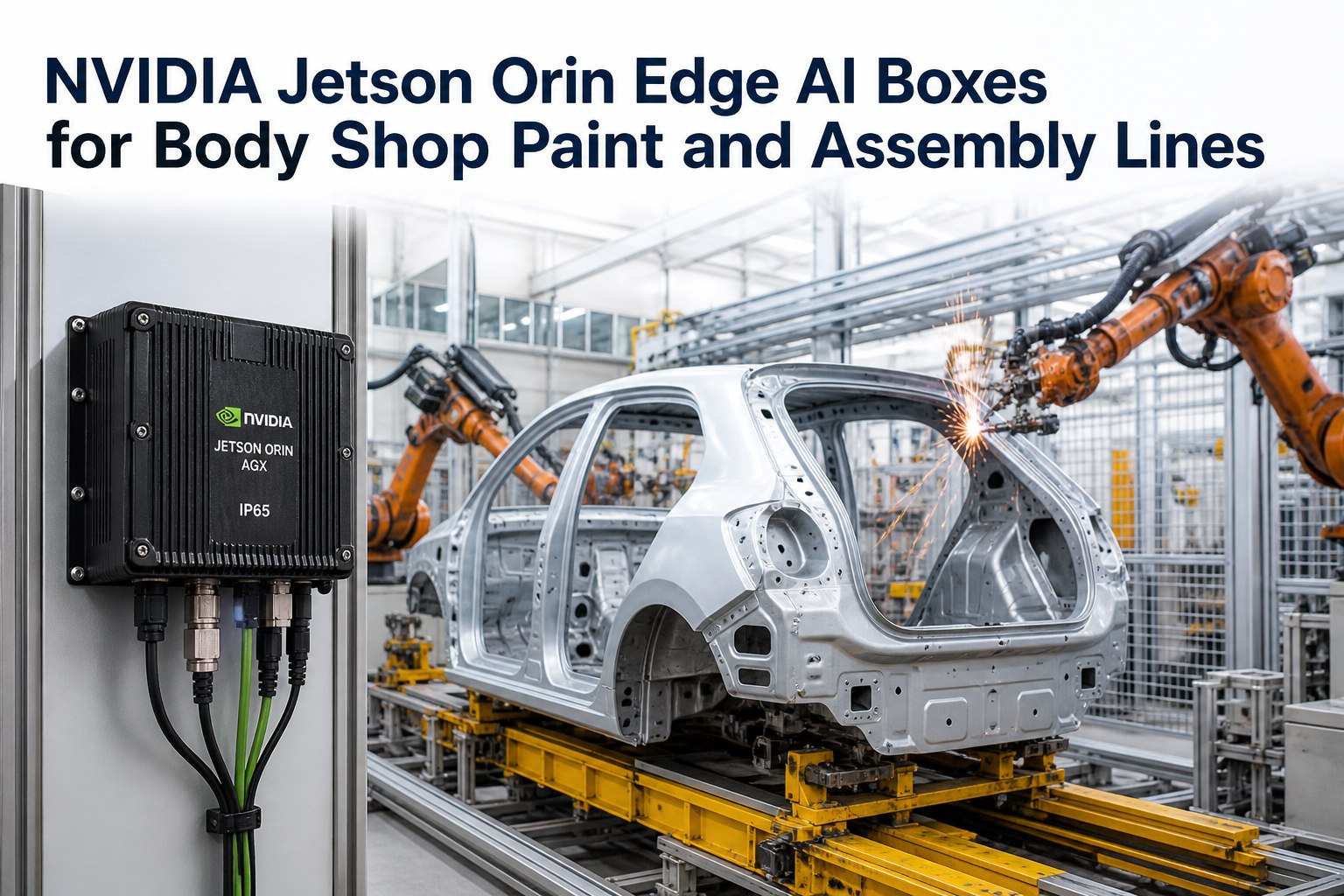
- Vision Transformer inference
- Sub-100ms per frame
- IP65 enclosure for shop floor
- Air-cooled · no DC infrastructure
- One per camera angle
- ROS2 robot orchestration
- Light-projection coordination
- Model retraining on shift data
- Standard 14 kW rack
- One node per body shop
- Multi-plant model registry
- Plant LLM (Llama 3.1 70B)
- Digital twin simulation
- Synthetic data generation
- One rack per OEM enterprise
The Plant LLM That Drafts the Weld-Quality Report
Every body that passes through the inspection station leaves a trail — coordinates of every spatter found, every grind action taken, post-grind verification result. A plant LLM fine-tuned on your QA documentation turns that trail into a draft weld-quality report a human QA reviewer can sign off on in seconds, not minutes.
What Changes on the Floor When This Goes Live
The visible change is that one ergonomically punishing job is gone. The harder-to-see change is that downstream rework drops, harness damage stops, and weld-gun maintenance becomes data-driven. Five concrete shifts, all measurable inside 90 days. Talk to our automotive team for an impact model on your specific BIW line.
Every body, every spatter, every shift. No sampling. No spot-checks. The data set itself becomes the audit trail.
Cable harness damage from missed spatter — historically a recurring downstream rework category — drops out of the defect mix.
The most demanding underbody grinding posture is replaced. Operators redeploy to higher-skill verification roles.
Spatter pattern by gun, by hour, by body location. Welding-tip wear and electrode condition become observable in real time.
The whole detect-project-grind cycle fits inside the existing takt window. No line slowdown. No station added.
Audi's pattern: Neckarsulm first, then 6 Ingolstadt plants. Single trained model template scales across BIW lines with calibration only.
Manual · CNN-Only · iFactory ViT + Light + ROS2
| Capability | Manual Inspection | CNN-Only Vision | iFactory Weld AI |
|---|---|---|---|
| Inspection coverage | Sample-based | 100% but lower accuracy | 100% · ViT-grade |
| Detection rate | Operator-dependent | ~92% | 99%+ first pass |
| Variant generalization | Skill carries over | Per-variant retrain | One model · all variants |
| Marking method | Marker pen / chalk | None — log only | Blue light · machine-readable |
| Rework method | Manual grinder | Manual rework | ROS2 robot · automated |
| Cycle time inside takt | Often misses | Possible | Yes · <10s end-to-end |
| Welding-gun feedback | None | None | Real-time spatter trends |
| QA report | Hand-written | Manual | Plant LLM draft · auto |
| Multi-plant scale | Per-plant training | Per-plant retrain | Calibration only |
From Site Survey to Closed-Loop Production in 16 Weeks
What Body Shop Engineers Ask First
Most BIW underbody inspection stations don't have AI-grade cameras yet — that's the one piece typically added. We specify off-the-shelf industrial cameras with the resolution and frame rate the ViT model expects. No proprietary hardware lock-in.
Anything with ROS2 or a vendor bridge — KUKA, Fanuc, ABB, Yaskawa. Audi's pattern uses a robot already on the line repurposed for grinding. We integrate; we don't dictate the brand.
Augments, doesn't replace. The plant LLM drafts the weld-quality report; a human QA reviewer signs off. Existing audit and traceability requirements stay intact. Most customers see the QA team move from data entry to exception review within the first quarter.
Yes — that's how Audi did it: Neckarsulm first, then six Ingolstadt plants in series. The trained ViT model transfers; new plants typically need 4–6 weeks of recalibration on their specific variant mix and lighting conditions, not a full retrain.
Built for Body-Shop Reality — Not Lab Demos
Get the Detect-Project-Grind Plan for Your Body Shop
Thirty minutes with our automotive deployment team. Bring your body station layout, current grinding robot inventory, and a few weeks of underbody defect data. We'll model the realistic spatter-detection coverage, identify the right camera and projector placements, and outline a 16-week path to closed-loop production. Talk to support for preliminary scoping if you'd prefer to start there.