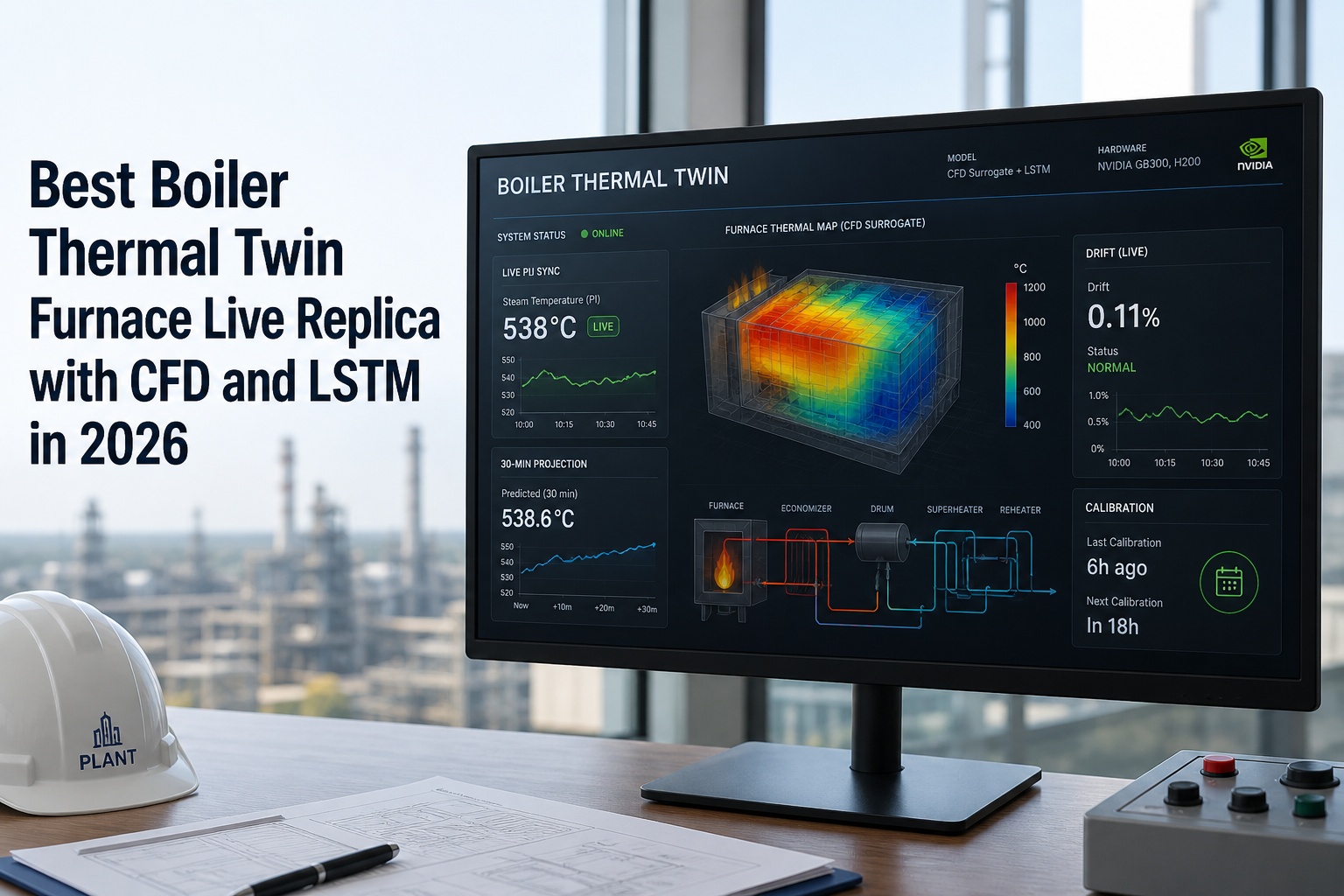
A boiler thermal twin is not a 3D model on a screen. It's a live mathematical replica of your furnace running in lock-step with the real plant — taking 69+ DCS tags every few seconds, fusing them with a CFD-derived surrogate, and projecting where the main steam temperature, tube wall temperature, and flue gas profile will be in 30 minutes. iFactory's twin runs on the on-site GB300 + H200 stack. Live PI: 538.0 °C. 30-minute projection: 538.6 °C. Drift vs measured: 0.11%. Last self-calibration: 6 hours ago. Those four numbers are the entire job description of a working boiler thermal twin. Everything else is plumbing. The twin doesn't replace your DCS — it lives alongside, advising the shift engineer on where the unit is heading, where the soot blower needs to fire next, and which tube panel will exit normal range first. Power and a network drop into your historian are the only things you provide. We handle the CFD surrogate generation, LSTM residual training, calibration cadence, and the operator-facing dashboard. One-time CapEx — no per-projection billing, no cloud sync, no kill switch. You own the twin, the weights, the data. To scope a unit, get a turnkey quote.
Boiler Thermal Twin — CFD Surrogate + LSTM Residual, On-Prem
A live mathematical replica of your furnace, running lock-step with the plant on the GB300 + H200 stack. Live PI 538.0 °C · 30-min projection 538.6 °C · drift 0.11% · last cal 6 h ago. CFD-derived surrogate captures the physics. LSTM residual captures what the physics misses. Self-calibrates every 4–8 hours from your historian. Shipped to your plant, deployed by our engineers, owned by you. No cloud. No per-projection billing.
What a Working Twin Actually Looks Like
This is the live status panel from a real-world deployment — anonymized, but every metric is what an operator actually sees. The twin re-projects every 30 seconds. Drift is computed continuously. Self-calibration triggers automatically when drift exceeds threshold or every 8 hours, whichever is first.
Four numbers. Updated every 30 seconds. Calibrated every 6 hours. That is the entire user-facing surface of a working boiler thermal twin. Everything else — the CFD physics, the LSTM compensation, the 69-tag ingest, the GB300 inference — happens beneath. Schedule a session to see this run on your unit.
Three Layers. Physical Plant Maps to Math.
A digital twin isn't a single model — it's a stack. The physical plant generates DCS tags. The twin layer fuses physics-based and data-driven models. The AI layer projects, ranks, and explains. Here's the topology that runs on your GB300 + H200 nodes.
- Main steam temperature (MS-T-001)
- Furnace exit gas temp (FEGT)
- Tube wall temps (8 zones)
- Steam flow, desuperheater flow, O₂
- Coal feeder rate, mill outlet, blower
- POD reduced-order CFD surrogate
- LSTM residual compensator
- State estimator + Kalman filter
- Self-calibration loop
- Confidence-bounded outputs
- 30-min temperature projection
- Tube panel out-of-band ranking
- Soot-blower scheduling advice
- Heat-rate / fuel-bias suggestions
- LLM "why is FEGT trending?" Q&A
CFD Surrogate + LSTM Residual = What Actually Works
Pure CFD is too slow for real-time — a single high-fidelity furnace simulation takes hours per case. Pure data-driven LSTM is fast but blind to physics. The working answer is the hybrid: a fast CFD surrogate (built once from POD reduced-order modeling) plus a small LSTM that learns whatever the surrogate gets wrong. Together they project in < 200 ms.
Built once from a full high-fidelity CFD campaign — 50–200 simulated operating points spanning the full load envelope. POD (Proper Orthogonal Decomposition) extracts the dominant modes. The surrogate evaluates in < 50 ms instead of hours.
- Captures conservation laws + radiative heat transfer
- Generalizes across load points
- Predictable behavior in unseen conditions
- Re-built only on major refurbishment
A small LSTM (under 2 M params) trained on the gap between surrogate prediction and live PI. Captures fouling drift, fuel quality variation, sensor bias, and slow degradation that the original CFD assumptions never modeled.
- Trained on 6+ months of plant history
- Re-tunes during self-calibration
- Catches what the physics model can't
- Bounded — never overrides physics
The combined model holds drift below 0.5% over an 8-hour window — typically running closer to 0.1–0.2% during steady-state operation. When drift exceeds threshold, the residual auto-retunes from the most recent PI window without operator intervention. Talk to support for the full validation methodology.
The Twin Tells You Where the Unit Is Heading
Reactive monitoring is an alarm at 543 °C and a derate. Proactive monitoring is a 30-minute heads-up that the unit will exit the target band, with enough lead time for the operator to bias fuel, adjust desuperheater flow, or fire a soot blower. The projection horizon is configurable (5 min / 15 min / 30 min / 60 min) — 30 minutes is the operator-preferred window.
0.11% Drift. Why That Number Matters.
"Drift" is the single most important quality metric for a thermal twin. It's the rolling RMSE between what the twin projected and what the plant actually did, computed over the most recent measurement window. Below 0.5% means the twin is trustworthy enough to drive operator decisions. Above 1.5% means it's a curiosity, not a tool.
Twin drives operator advice, soot-blower scheduling, fuel-bias recommendations. Plant copilot uses twin output without caveats.
Twin still useful — projections shown with confidence band. Self-calibration scheduled at next opportunity. No advice on aggressive moves.
Forced self-calibration triggered. LSTM residual retuned on most recent 4-hour PI window. Operator notified, advice paused.
Surrogate need rebuild — major plant change suspected (refurb, fuel change). Reliability team alerted, twin marked as advisory-only.
The Twin Recalibrates Itself. Every 4–8 Hours.
A static twin drifts. A self-calibrating twin holds its accuracy across shift changes, fuel quality swings, and slow degradation. iFactory's calibration loop runs without operator intervention — pulling the latest PI window, re-tuning the LSTM residual, validating against held-out samples, and atomically swapping the new model in. Zero unit impact, full audit trail.
Auto-fired every 4–8 h, or on drift threshold breach. Operator can also force on-demand from the dashboard.
Last 4-hour PI history pulled from historian. ~5,000 samples per signal. Statistical outliers flagged and excluded.
Residual LSTM fine-tuned on H200. ~2-3 minute training run. CFD surrogate untouched. Old + new models compared.
If new drift < old drift, atomic model swap. Else reject and roll back. Both outcomes logged with timestamp + audit trail.
Three Roles. Three Views. One Twin.
The twin is the same underlying math regardless of who's looking — but each role gets a view tuned to their job. Operators see the next 30 minutes. Reliability sees the panel-by-panel breakdown. Schedulers see the heat-rate and fuel-bias projection.
- Live PI vs 30-min projection
- "Will I exit target band?" Y/N
- Soot-blower fire recommendation
- Desuperheater flow advice
- One-line plant copilot summary
- Tube wall temp by zone & panel
- Out-of-band panels ranked
- Slag / scale buildup precursors
- Drift trend over 7 / 30 / 90 days
- Cal history with success rate
- Heat rate projection by load
- Fuel quality sensitivity curves
- De-rate risk windows
- O₂ + air bias optimal points
- Day-ahead bid support data
Where the Twin Actually Runs
A boiler thermal twin is GPU-heavy. The CFD surrogate inference runs continuously, the LSTM residual re-trains every 4–8 hours, and the plant copilot LLM serves operator queries. iFactory ships the GB300 + H200 stack pre-configured for this workload — sized to your unit, racked in your plant DC, ready to ship.
Runs the CFD surrogate every 30 seconds. Hosts the LSTM residual retraining. Streams live PI tags from your historian. Multi-cell deployments use H200 to also serve the Live Insights Feed.
Hosts the sovereign LLM that explains the twin's projections in plain English. RAG-grounded on 6+ months of historian, MES, and CMMS context. Same node serves cross-plant copilot.
Both nodes rack in your plant data centre, behind your IEC 62443 zone segmentation. No outbound API calls. No model registry sync. Audit-logged historian read-only.
Six Reasons Reliability & Operations Pick Us
Most "boiler digital twin" pitches end at a 3D geometry viewer. iFactory ships the CFD surrogate, the LSTM residual, the calibration loop, the operator dashboard, and the on-site GPU stack — all integrated, all on your floor. Schedule a working session for your unit.
Real CFD surrogate from POD reduced-order modeling, not a black-box LSTM-only "AI digital twin." Physics that holds up in unseen operating conditions, not just the training distribution.
Calibration runs every 4–8 hours without operator intervention. Drift held below 0.5% across shift changes, fuel quality swings, and slow degradation. No "the twin worked at commissioning" problem.
Designed by control-room engineers, not data scientists. Plain-language projections, soot-blower scheduling advice, plant copilot Q&A. Shift engineers actually use it — that's the whole test.
Every PI tag, every twin output, every operator action stays inside your fence. No cloud sync. No vendor data lake. NERC CIP / ISO 27019 / IEC 62443 audit-ready.
Existing DCS, existing CMMS, existing historian dashboards keep working exactly as before. The twin lives alongside, not on top of. No rip-and-replace.
One-time CapEx. No per-projection billing. No per-tag licensing. You own the GB300, the H200, the surrogate, the LSTM weights, the data. Talk to support for terms.
All You Provide. Seriously.
Most "digital twin" deployments stall on CFD compute access, historian credentials, and dashboard integration. iFactory inverts that. Talk to deployment support for a remote walkthrough.
- Power — 3-phase circuit at the plant DC for the GB300 + H200 rack
- Network drop — Gigabit uplink with read-only path to historian + DCS zone
- GB300 + H200 plant node build, ship, install
- Initial CFD campaign on your geometry & fuel
- POD surrogate training
- LSTM residual training on historian backfill
- Self-calibration loop & thresholds
- Historian + DCS read-only OPC UA bridge
- Operator + reliability dashboard
- Plant copilot LLM grounded on your unit
From PO to First Live Projection
Twin deployments take longer than insights-feed deployments because the CFD surrogate has to be built once on your geometry. Typical timeline 8–14 weeks. After commissioning, calibration is fully automated.
Furnace geometry, burner config, fuel spec received. Initial CFD campaign on 50–200 operating points. POD surrogate extracted. Validated against vendor curves.
Historian backfill (6+ months) pulled. Residual LSTM trained on surrogate vs PI gap. Drift validated to < 0.5%. GB300 + H200 hardware racked & pre-configured.
Engineers fly in. Hardware racked, network bridged to historian, twin goes live in shadow mode for reliability team validation.
Operator dashboard live in control room. Calibration loop active. Plant copilot tuned. Training delivered. Year-one support active.
Buy It Once. Own It Forever.
No SaaS subscriptions. No per-projection billing. Year-one support is included; everything after that is optional.
GB300 + H200, CFD surrogate, LSTM weights, deployment, training, year-one support — single PO. Sits on your balance sheet as a depreciable asset, not a cloud line item.
You own the boxes, the trained surrogate, the LSTM weights, the dashboard, every byte of plant data. Full audit rights. No vendor lock on data export.
After year one, renew remote support & CFD refresh annually, run it in-house with handover docs, or mix. The twin keeps running either way.
What Plant & Reliability Buyers Ask
No. The twin lives alongside the DCS, advising — never controlling. Existing alarms and trips fire exactly as before. The twin's job is to give the shift engineer a 30-minute heads-up so they have time to act before an alarm becomes a derate. Talk to support for the integration architecture.
3–6 weeks depending on furnace geometry complexity and fuel variability. We run the simulations on dedicated GPU infrastructure on our side — you don't need a CFD license or HPC cluster. Outputs are validated against vendor performance curves before POD surrogate extraction.
The CFD surrogate need rebuilding. The LSTM residual will catch it first — drift will exceed 1.5% within hours and the twin will be marked advisory-only. Refresh costs roughly 1/3 of the original CFD campaign. Talk to us about lifecycle support terms.
Fixed price per unit, scoped to furnace size, fuel complexity, and historian backfill scope. No per-projection billing, no recurring fees. Includes hardware, CFD campaign, LSTM training, deployment, training, and year-one support. Get a quote — written proposal back in 5 business days.
Get a Quote on Your Unit.
Watch the boiler thermal twin run on a live 660 MW unit Or send your furnace geometry, burner config, and historian backfill — we come back with a fixed-price BOM in 5 business days. Hardware, CFD campaign, LSTM training, deployment, dashboard, training, and year-one support all included. No recurring fees. You own the platform outright the day it goes live.