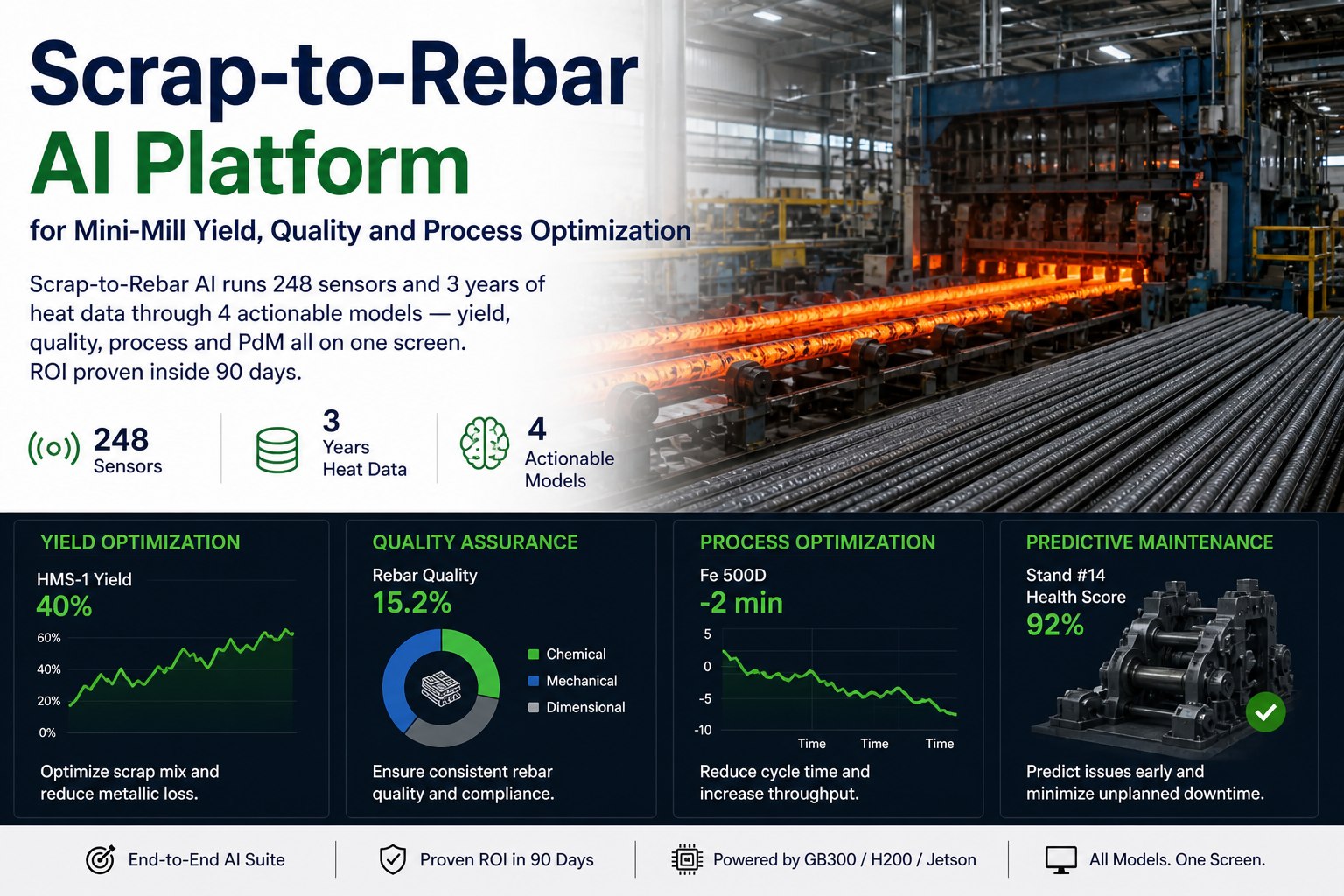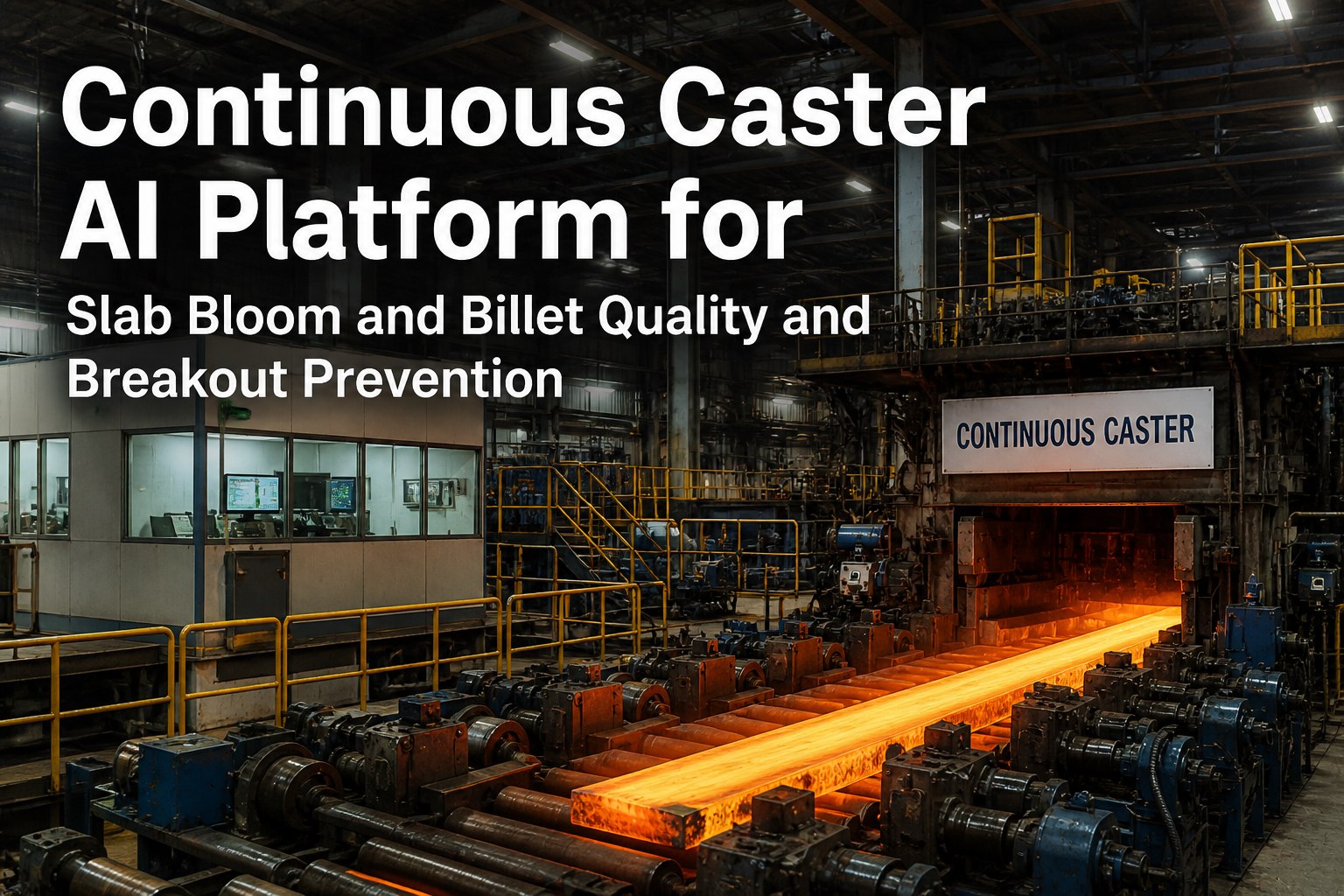
The continuous caster is the choke point of every modern steel plant. Liquid steel enters the top, semi-finished product exits the bottom — and what happens in between determines yield, surface quality, internal soundness, and whether the line keeps running at all. A mould breakout costs hours of downtime, dozens of meters of damaged equipment, and a real safety event. A worn segment roller bearing throws off shape and forces a planned outage. EMS settings tuned for one grade silently underperform on the next. Cooling water ΔT drift erodes shell thickness without anyone noticing until the next shift. iFactory's Continuous Caster AI Platform reads the four zones of the caster as four distinct AI problems — mould thermal pattern recognition (CNN), segment roller predictive maintenance (LSTM), strand visual inspection (Vision Transformer), and cooling ΔT anomaly trends — and surfaces them on one operator screen.
Continuous Caster AI — Slab, Bloom & Billet Quality, Breakouts Prevented
Join the iFactory steel team for a live walk-through of an AI platform purpose-built for continuous casting machines. Mould-thermocouple breakout predictor · segment roller PdM · EMS optimization · cooling-water ΔT trends — drives yield up and breakout claims down on every strand.
Four Zones. Four Failure Modes. Four Different Models.
The continuous caster is one machine in shape but four AI problems in substance. Pretending it's one model — or worse, one alarm threshold — is why legacy breakout prediction systems generate so many false alarms while still missing real events. iFactory reads each zone with the model architecture appropriate to its physics. The caster cross-section below is the page's organizing logic. Book a 30-minute review for a zone-by-zone walkthrough on your specific caster.
Sticker Breakout Prediction — Why CNN, Not Logic Rules
Legacy breakout prediction systems use logic rules on individual thermocouple-pair temperature trends. They work — until the false-alarm rate makes operators tune them out, or a non-canonical breakout pattern slips through. CNN architectures read the entire mould thermocouple array as a 2D spatio-temporal image, recognizing patterns no fixed rule set was ever designed to catch.
A sticker forms below mould level when the thin solidified shell adheres to the copper wall. As the strand descends, the sticker propagates upward as a characteristic temperature signature across multiple thermocouple pairs. By the time the sticker reaches mould bottom, the shell is too thin — the steel breaks out.
Sticker patterns aren't always canonical. Casting speed changes, mould level fluctuations, and taper/mould issues all produce signatures legacy rule-based BOPS misclassifies. A CNN trained on labeled historical events generalizes across these variations, reduces false alarms, and locates the breakout origin within the thermocouple grid.
Pre-event detection triggers casting-speed reduction within seconds — the same intervention legacy systems perform, but earlier and with fewer interruptions to good heats. Operator console flags the affected face, column, and depth so the supervisor sees exactly where the model is concerned.
Bearing-Wear PdM Across Every Roller of Every Segment
A modern slab caster has 14+ segments below the mould, each holding multiple roller pairs that support and bend the strand from vertical to horizontal. Bearing failures here force unplanned outages, throw off cast geometry, and damage adjacent rollers. The LSTM watches per-roller vibration and bearing temperature signatures continuously — across every roller of every segment.
Bearing wear on a roller progresses through characteristic vibration and thermal phases — early skidding, escalating impact patterns, then accelerated thermal runaway. Each phase has its own time-domain signature. LSTM excels at this kind of sequential degradation modeling, which generic threshold-alarm tools miss.
Models train per-roller, not per-segment. A 14-segment caster with 4 rollers per segment is 56 LSTM instances — each calibrated to its own normal envelope, retrainable as bearings are replaced. Remaining-useful-life output is in casting hours, not abstract risk scores.
Bearing changes move from after-failure to scheduled-during-planned-outage. Caster availability typically lifts 1-3% just from this transition. Maintenance buys parts in advance, deploys crew on planned shifts, and avoids the cascading damage of running a degraded roller into the next one.
Vision Transformer for Strand Surface + EMS Tuning
The strand zone is where surface defects become visible and where electromagnetic stirring (EMS) settings determine inclusion distribution and inner soundness. Vision Transformer cameras downstream of the segments catch scale buildup, longitudinal cracks, transverse cracks, scarfs, star cracks, and oscillation marks — and the same platform tunes EMS current and frequency per grade for inclusion control.
Longitudinal cracks, transverse cracks, scarfs, star cracks, scale, oscillation mark depth, slag inclusions surfacing. ViT generalizes across slab, bloom, and billet formats with one trained model — outperforming per-format CNNs on the long tail of rare defects that drive customer claims.
Electromagnetic stirring settings (current, frequency, position) drive inclusion distribution, columnar-equiaxed transition, and centerline soundness. The platform learns the combination that minimizes claim-relevant defects per grade and per width — and recommends settings before each heat starts casting.
Surface defects often correlate with mould events upstream. The platform's heat-ID linkage means a scarf detected in Zone 3 can be traced to a mould-level fluctuation 90 seconds earlier — root-cause analysis that takes weeks of QA investigation today.
Per-Spray-Zone ΔT Anomaly Trends — The Silent Yield Killer
Spray cooling zones below the segments determine final shell thickness and internal temperature profile. A 2°C ΔT drift across a single zone is invisible on operator dashboards but compounds across the strand into shape and internal-quality issues that show up at the shear, the inspection bench, or worst — at customer.
Inlet/outlet temperature ΔT per spray zone, water flow per nozzle bank, spray pressure, header pressure, and nozzle blockage indicators. Each is benchmarked against the historical envelope for the current grade, casting speed, and width. Drift outside that envelope flags before symptoms surface.
Cooling consistency is the single biggest non-obvious driver of internal soundness in rebar-grade billets and Al-killed slab. Most yield "loss" attributed to chemistry or rolling actually originates in cooling drift. The platform makes this visible for the first time at most plants.
Nozzle blockage and ΔT drift surface as actionable maintenance tickets, not dashboard noise. The platform routes them into existing CMMS workflows so the spray zones get attention on the next planned outage — before they break the next campaign.
Edge + Plant + Enterprise — Sized for Caster Workloads
- CNN sticker prediction inference
- ViT strand surface vision
- Per-roller LSTM execution
- <1s response on mould events
- IP65 / steel-mill environment
- Cooling ΔT anomaly engine
- EMS closed-loop optimization
- Operator console & HMI
- Heat-ID-anchored data lake
- One node per caster
- Multi-caster CNN retraining
- EMS optimization model registry
- Cross-plant defect knowledge graph
- Quality genealogy across mills
Logic-Rule BOPS · Generic Caster Tool · iFactory Zone Platform
| Capability | Logic-Rule BOPS | Generic Caster Tool | iFactory Caster AI |
|---|---|---|---|
| Breakout prediction | Threshold rules | Single-model ANN | CNN · spatio-temporal grid |
| False alarm rate | High | Medium | Reduced via grid context |
| Non-canonical patterns | Often missed | Variable | CNN generalizes |
| Segment roller PdM | None | Threshold vibration | LSTM per roller · RUL |
| EMS optimization | Manual setpoints | Static recipe | Closed-loop per grade |
| Strand surface vision | Manual inspection | CNN per format | ViT · all formats one model |
| Cooling ΔT trends | Trend chart only | Per-zone alarm | Anomaly + CMMS push |
| Heat-ID linkage | None | Stage-only | Continuous across zones |
| Operator surface | Multiple HMIs | Vendor portal | Single screen · 4 zones |
| Cloud dependency | None | Vendor-specific | None — fully on-prem |
From Mould Instrumentation Audit to Full Platform in 16 Weeks
Most steel plants deploy in priority order: mould CNN first (highest safety + downtime payback), segment LSTM next, then strand ViT and cooling ΔT in parallel. Schedule a deployment review with our caster engineering team.
What Caster Engineers Ask First
No. The CNN can run alongside the existing BOPS for as long as you want, with both alarms surfaced to the operator. Most plants run dual-path for 60-90 days, compare event capture rates and false-alarm rates, then either retire the legacy system or keep it as a redundant safety layer.
The model trains on every recorded sticker event plus normal-operation patterns. Plants typically have 50-200 documented events across 12-24 months, which is sufficient. The model also benefits from cross-plant transfer learning when the customer permits — anonymized event signatures from other deployments improve generalization on rare patterns.
Yes — vibration spectrum signatures separate bearing wear from drive-side mechanical issues. The output classifies failure mode (bearing inner race, outer race, cage, drive coupling) along with the RUL estimate, so maintenance arrives with the right parts.
Yes. Cameras are positioned downstream of the segments where strand temperature has dropped enough for surface inspection but well above ambient. The ViT model is trained on hot-strand imagery; it does not assume cooled product.
Built Zone-by-Zone — Because the Caster Doesn't Have One Failure Mode
Get the Zone-by-Zone Plan for Your Caster
Thirty minutes with our caster engineering team. Bring your mould thermocouple layout, recent breakout history, segment maintenance records, and any chronic surface defect categories. We'll model the per-zone deployment priority for your specific caster, validate that mould instrumentation supports CNN training, and outline a 16-week path to full four-zone platform live. Talk to support for preliminary scoping if you'd prefer to start there.