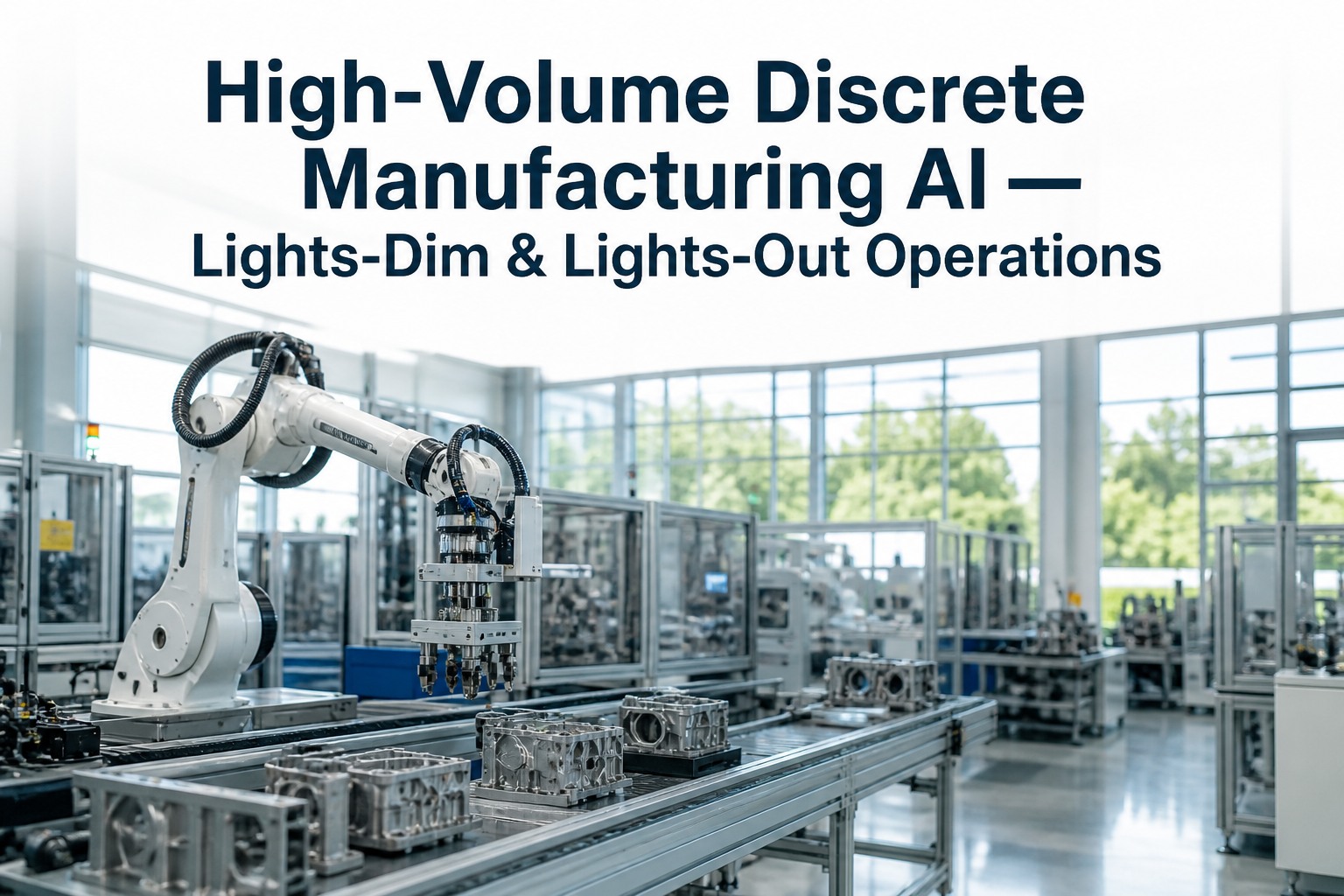
The fully lights-out factory has been promised for 30 years. A handful of plants achieved it — FANUC's own factory in Oshino, a few Asian electronics lines. Tesla famously tried it on the Model 3 line, walked it back, and Elon admitted "humans are underrated." Here's the math nobody puts on the brochure: the last 10% of edge cases consumes 60–70% of the automation budget, multiplies risk, and stretches payback past most CFOs' patience. The smarter play is lights-dim — autonomous AI running 80% of the routine, a lean overnight crew handling exceptions, and the LLM in between for shift handover and root-cause diagnosis. You capture 60–80% of the lights-out savings at 25–35% of the capex, in 90 days instead of 5 years. This page is the playbook.
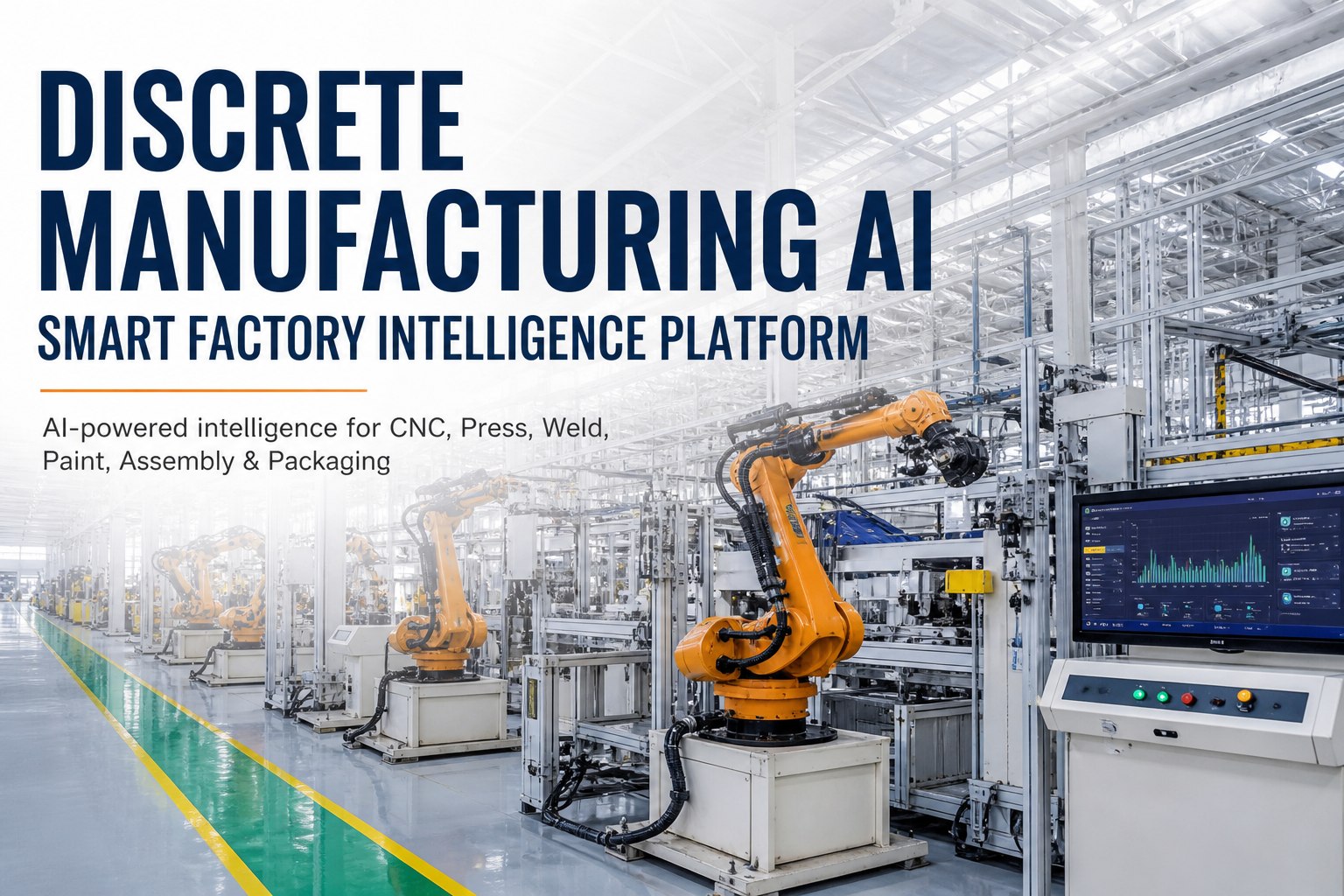
High-Volume Discrete Manufacturing AI Lights-Dim & Lights-Out Operations
For high-volume discrete plants running 2–3 shifts at scale. Predictive maintenance, vision QC, and adaptive control loops run autonomously. The plant LLM handles exceptions, shift handover, and operator chat. Lights-dim is the realistic 60–80% capture of full lights-out economics — at a fraction of the cost and risk.
Lights-On · Lights-Dim · Lights-Out
Manufacturing autonomy isn't binary. There's a spectrum, and most published "lights-out" case studies are actually lights-dim with marketing. Here's where each mode lands on labor, capex, risk, and time-to-value.
- Full crew per shift
- AI as dashboard
- Human in every decision
- Baseline cost & risk
- 2–4 ops cover whole plant overnight
- AI runs routine 24×7 autonomously
- Humans on exceptions only
- LLM does RCA & shift handover
- Zero shift labor
- Every edge case automated
- Massive capex on rare events
- 5–7 yr deployment, ROI cliff
Why Most Lights-Out Programs Stall
Lights-out fails for the same reason every time — the long tail of edge cases. The first 80% of automation is achievable; the last 20% breaks the budget, then breaks the program. Talk to our automation strategists if you've already started down this road.
The first 80% of automation costs 30% of the budget. The last 20% — the rare events, weird parts, novel defects — costs the other 70%. Most plants run out of capex before they finish.
A single un-modeled failure at 03:00 with no humans on site can cascade for 4–6 hours before anyone arrives. The cost of one bad night often exceeds a year of overnight crew.
Product mix, supplier quality, and tooling drift constantly. A truly lights-out cell needs continuous re-automation. Most teams don't have the headcount to keep up.
Lights-out programs typically chew through capex for 5–7 years before crossing the savings line. CFO patience usually runs out at 3.
Why Lights-Dim Is the High-IQ Bet
Lights-dim captures the bulk of lights-out's value — without the bulk of its risk. Multi-modal AI runs the routine, a lean crew handles the exceptions, and the LLM bridges the two. The math comes out 2–3× better than full lights-out on a risk-adjusted basis.
What Runs Autonomously vs. What Stays Human
The architectural insight that makes lights-dim safe: autonomous loops use deterministic AI (vision, PdM, RL — all certifiable, fast, bounded). The LLM is invoked only on exceptions, where humans are already in the loop. The two halves never share the same control path.
How the Two Halves Compose
Sensors feed deterministic edge AI. Edge AI runs the routine. Anything outside policy escalates up — to the LLM for diagnosis, to the human for approval. The autonomous path never waits on the LLM. The LLM never bypasses the human.
Crawl · Walk · Run · Optional Sprint
Most plants reach lights-dim on routine off-shifts within 90 days. Lights-out for selective high-volume cells is an optional later phase — pursue it only where the math actually works.
AI in advisory mode. Vision QC, PdM, and adaptive control all generate recommendations. Operators stay in command. Goal: trust calibration.
Closed-loop on day shifts with operators watching. AI handles routine; humans review every exception. Vision QC moves to autonomous accept/reject.
Lean overnight crew (2–4 ops). AI fully autonomous on routine. LLM handles exception RCA & shift handover. The 60–80% savings start landing.
For specific high-volume, low-variance cells where the long-tail math actually works — pursue full lights-out. Only after lights-dim is proven.
What Lights-Dim Looks Like in Dollars
Take a typical $300M-revenue high-volume discrete plant running 3 shifts. Apply the lights-dim capture rates against industry-benchmark loss buckets. The math:
Built for Lights-Dim — Not Generic Automation
Vision, PdM, RL, and the plant LLM compose on day one. Most automation vendors give you one model class and a roadmap for the others. We ship the orchestrator pre-wired.
Our autonomous loops never call the LLM. That's not a limitation — it's the design. Sub-second control needs deterministic AI; LLMs go where humans already are: exceptions, RCA, handover.
NVIDIA GB300 + H200 + Jetson silicon shipped to your plant. One-time purchase, no recurring license, no cloud dependency. Your weights, your data, your platform.
From PO to off-shift lights-dim in under 90 days. Our network engineers and field techs handle cabling, switching, PLC/SCADA integration, and operator training — globally.
What High-Volume Plant Heads Ask First
Yes — and they should. Vision QC, PdM, and adaptive RL control are deterministic, certifiable, and sub-100 ms. LLMs are slower, probabilistic, and need supervision. Mixing them into the closed loop is a category error. We keep them strictly separated by design.
The orchestrator detects it's outside policy and escalates. The lean overnight crew gets a paged alert with an LLM-drafted RCA and the top-3 ranked options. Average human-in-the-loop response is 4–7 minutes — vs the 2–4 hour delay typical in pure lights-out programs.
Two metrics: exception escalation rate < 0.5% over 90 days, and zero unbounded events in the last 60. We measure both continuously after lights-dim go-live. Most cells never qualify — and shouldn't. The ones that do are typically high-volume, low-variance cells (label-only packaging, single-SKU cells). Talk to our team about the qualification framework.
Yes — that's the design. iFactory sits above your existing automation, sending optimized setpoints into your DCS, PLCs, and robot controllers via OPC-UA / MQTT. We don't rip out anything; we make what you have smarter and run it lights-dim.
Get a Quote. Or Join Webinar.
Send us your line list, current shift structure, and the cells you'd take lights-dim first. Fixed-price proposal in 5 business days, including the multi-modal AI stack, 90-day deployment, and year-one support.