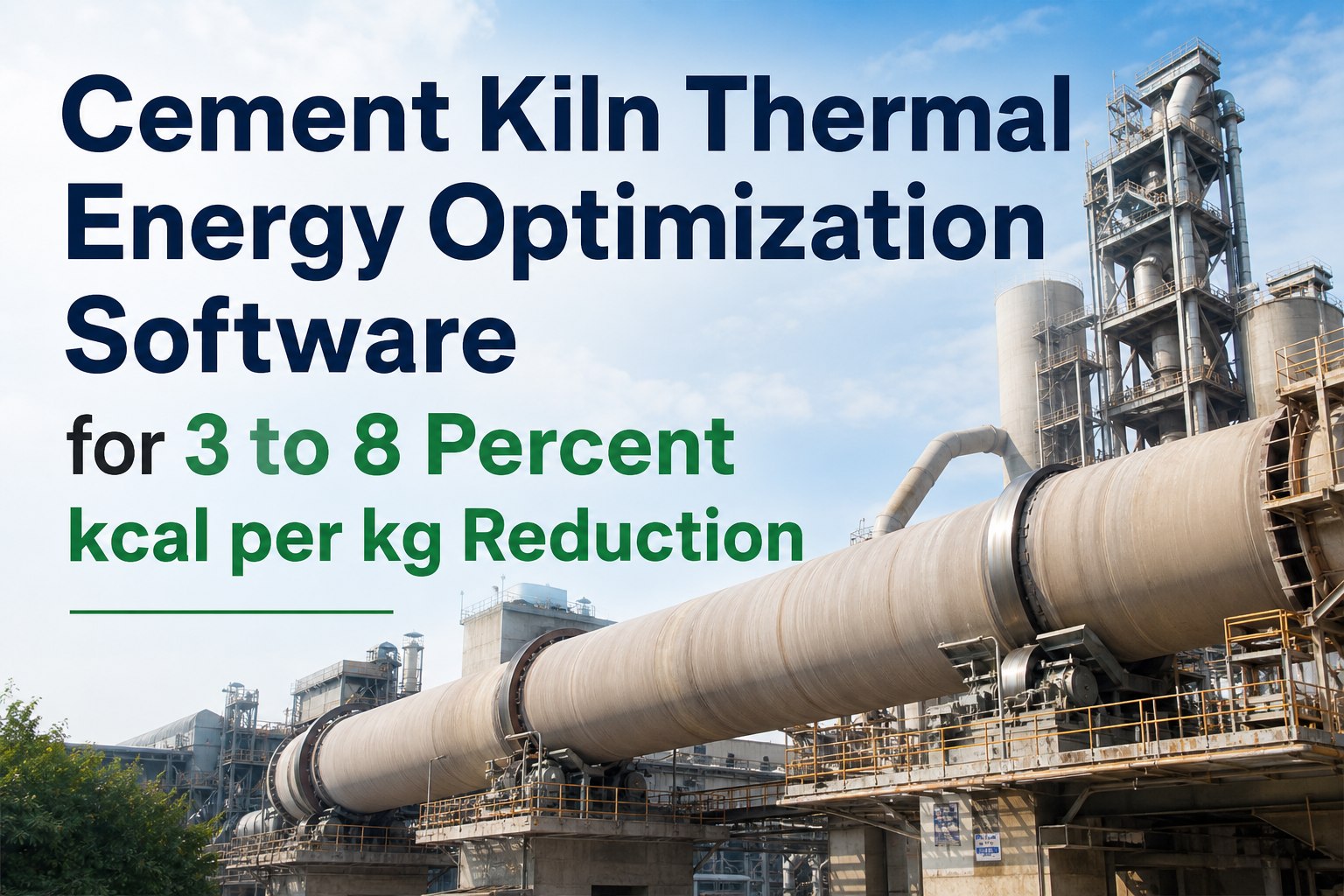
A modern dry-process cement kiln burns 3,000–3,500 MJ of thermal energy per tonne of clinker — and only half of it actually goes into clinker formation. The rest leaves as preheater exhaust, kiln-shell radiation, and cooler vent losses. The math is brutal: every 10 kcal/kg saved on a 5,000 TPD line is worth $100K–$300K a year. This is the page where we show you exactly how iFactory AI moved one customer from 780 kcal/kg to 738 kcal/kg — a 5.4% drop, $2.07M in annual fuel savings, NOx down 12%, free lime tighter than before, and a closed-loop control architecture built on RL-PPO, CFD-trained neural surrogates, and live thermal-balance reconciliation.
Kiln Thermal Energy Optimization — 3–8% kcal/kg Reduction
Join the iFactory pyroprocess team for a live walk-through of a closed-loop kiln optimization system that delivered 780 → 738 kcal/kg in 60 days, $2.07M/yr per kiln line, NOx -12%, with zero clinker quality loss. RL-PPO + CFD neural surrogate + thermal balance — deployed on operating cement plants.
From 780 kcal/kg to 738 kcal/kg — In 60 Days
A 5,000 TPD dry-process kiln line. Veteran operators, modern preheater, well-maintained cooler. Already running below the regional benchmark. Then the AI went live — and the kiln found 42 kcal/kg that 30 years of human optimization had left on the table.
Why No Operator — However Experienced — Can Reach 738
The kiln's thermal efficiency depends on 200+ interacting variables. Feed chemistry, moisture, particle size, fuel CV, alternative-fuel ratio, secondary-air temp, tertiary-air temp, cooler grate speeds, cyclone pressure drops, exhaust composition, kiln speed, ID-fan damper. A senior burner can hold 8–12 in their head at once. The AI holds all 200, simultaneously, every second. Book a 30-minute briefing to see how this maps to your kiln.
- Burner momentum
- Primary/secondary air ratio
- Fuel CV variability
- AFR blend stability
- Flame shape & length
- Cooler grate speed
- Bed depth uniformity
- Secondary air temp (>900°C)
- Tertiary air takeoff
- Red-river prevention
- Kiln-shell radiation
- False air ingress
- Refractory condition
- Door & seal integrity
- Exhaust temp control
- Kiln speed coupling
- Feed chemistry drift
- Free lime safety margin
- Coating & ring formation
- Calciner load split
Three Models, One Closed-Loop Brain
No single model can run a kiln. Reinforcement learning needs a safe environment to explore. CFD is too slow for real-time. Thermal balance is real-time but blind to flame physics. The answer is to compose all three — each handling what it's best at.
Proximal Policy Optimization agent learns the optimal action policy across kiln speed, fuel split, ID-fan, and cooler grates. Reward function balances kcal/kg, free lime, and NOx. Trains in the digital twin, deploys to the live kiln only after passing safety gates.
Deep neural network trained on thousands of CFD simulations of your specific kiln geometry. Predicts flame shape, burning-zone temperature distribution, and material trajectory in milliseconds — what real CFD takes 6 hours to compute.
Real-time first-principles heat & mass balance reconciles every sensor against physical conservation laws. Flags drift, ID-fan-damper miscalibration, and false air. Acts as the safety envelope — RL cannot move outside thermodynamically valid bounds.
Why the AI Doesn't Just Burn Less — It Burns Better
The fastest way to drop kcal/kg is to under-burn. The cost shows up in free lime two hours later, then in cement strength two weeks later, then in a customer complaint two months later. iFactory's reward function makes that trade impossible — quality is a hard constraint, not a soft preference.
What 3–8% Looks Like For Your Plant
For a 5,000 TPD plant spending $20–45M annually on kiln fuel, a 3–8% reduction is worth $1.2–3.5M per kiln line. Multi-kiln operators stack the savings — and the AI scales without per-line model rebuilds.
Run 3 kiln lines averaging 5.4%? That's $6.2M annually. Run 30 lines? $62M. The AI normalizes across all your plants — identifying the thermal-efficiency leader and replicating those operating profiles automatically across the rest of your fleet. Talk to our cement team for a multi-site rollout plan.
From Connection to Closed-Loop in 90 Days
No new sensors required for most plants. No DCS replacement. No production stop. The AI sits in advisory mode for the first 30 days, then transitions to closed-loop only after every model has passed safety qualification on your specific kiln. Schedule a deployment review with our pyroprocess engineers.
OPC-UA bridge from DCS, historian replication, fuel-flow and emissions data feeds. Establish 14-day baseline kcal/kg signature.
Build kiln-specific CFD model, train neural surrogate, calibrate against measured flame and burning-zone behavior.
RL-PPO agent trains in the digital twin against millions of simulated shifts. Reward function tuned with operator feedback.
Recommendations to operators first. Once proven for 14 days, transition to closed-loop with operator override always available.
What Your Burner Sees on Shift
Closed-loop doesn't mean lights-out. The burner stays in command — but with an AI co-pilot that explains every move it suggests, in plain English drafted by a fine-tuned plant LLM.
"Secondary air temperature trending toward 905°C while preheater exhaust is 318°C — both above plant average. Closing ID damper 2.3% reduces false air, lifting secondary air temp to ~915°C. Increasing cooler grate 2 maintains bed depth uniformity. Predicted impact: −2.1 kcal/kg, free lime steady at 1.4%, NOx -8 mg/Nm³. Inside all guardrails."
Manual · Expert System · iFactory AI
The cement industry has tried "kiln optimization" for 30 years. Most of it was rule-based expert systems that handled 8–12 variables and froze the moment fuel quality changed. RL on a CFD-trained twin is genuinely different.
| Capability | Manual / DCS | Rule-Based Expert System | iFactory RL-PPO + CFD-NN |
|---|---|---|---|
| Variables handled simultaneously | 8–12 | 20–40 | 200+ |
| Adapts to fuel quality changes | Operator does | Manual rule update | Automatic |
| AFR rate sustained | 15–25% | 25–35% | 40–60% |
| Free lime prediction horizon | Reactive (lab) | 5–10 min | 15–30 min ahead |
| Closed-loop control | No | Limited | Yes — with safety envelope |
| Typical kcal/kg saving | Baseline | 1–2% | 3–8% |
| NOx co-optimization | Trade-off | Reactive | Joint reward function |
| Time to first value | — | 6–12 months | 60–90 days |
What Cement Plant Heads Ask First
No. Most APC systems handle the inner loop — direct controller logic. iFactory's RL agent sits above your APC, sending optimized setpoints into it. Your DCS doesn't change. Your APC doesn't change. The AI just gets smarter setpoints to your controllers.
That's actually where the AI shines. Manual operators back off AFR when blend variability spikes. The CFD-NN models combustion behavior across blend compositions, so the RL agent can sustain 40–60% AFR rates that a human burner won't risk. Higher AFR = lower fuel cost = more savings stacked on top of thermal optimization.
Two safeguards. First, the live thermal balance acts as a physics envelope — RL cannot move outside conservation-law-valid states. Second, every quality CQA is a hard constraint in the reward function, not a soft penalty. Quality must stay in spec for any move to even reach the DCS.
OPC-UA read/write is supported on virtually every modern DCS — Siemens, ABB, Honeywell, Yokogawa, Emerson. We bridge in read-only mode first, prove value in advisory phase, then enable validated write-back through an audit-logged channel. No firmware changes on your DCS.
Built for Pyroprocess — Not Retrofitted From Generic AI
Get a kcal/kg Reduction Plan for Your Kiln
Thirty minutes with our pyroprocess deployment engineers. Bring your current kcal/kg, fuel mix, kiln capacity, and DCS make. We'll model the realistic 3–8% range for your specific line, identify the top three driver-tree branches we'd attack first, and outline a 90-day path to closed-loop — without disrupting production.