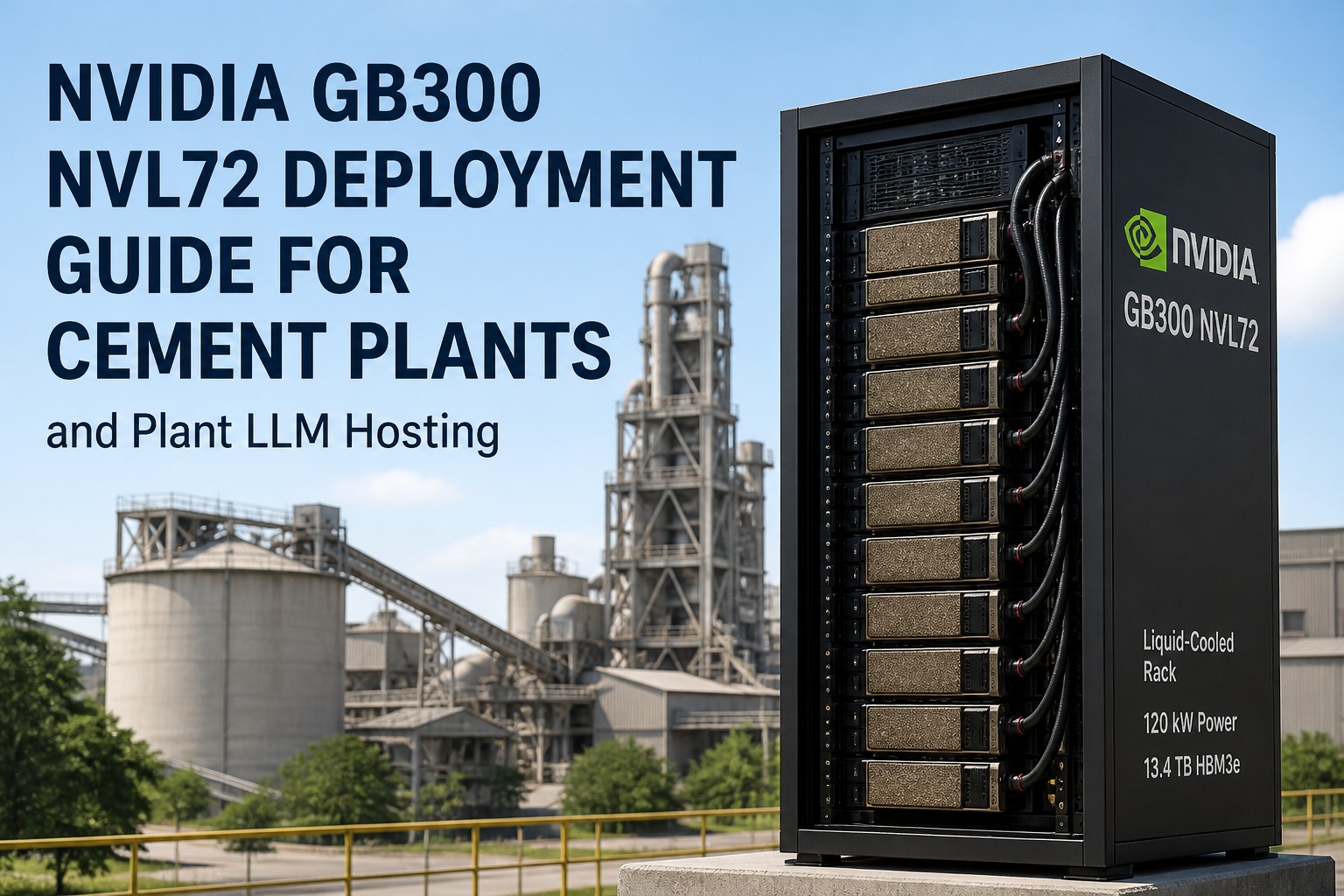
Cement plants are not data centers. The kiln building hits 50°C in summer, the floor is coated in raw-meal dust, and the IT room is sized for SCADA workstations and a few rack PCs. But the AI workload a modern cement plant needs — a trillion-parameter plant LLM, real-time digital twins of kiln + grinding + cooler, and pyroprocess RL agents that suggest setpoints every 30 seconds — won't fit anywhere else. The answer is the NVIDIA GB300 NVL72: 72 Blackwell Ultra GPUs, 36 Grace CPUs, 20 TB of HBM3e, fully liquid-cooled at ~120 kW in a single rack, dropped into a small purpose-built AI room next to the central control room. This guide breaks down the GB300 spec sheet, the cement-plant workloads it runs, the liquid-cooling setup, the 120 kW rack power plan, and the workload mix that justifies the rack inside the fence line.
GB300 NVL72 Inside the Cement Plant
Join the iFactory team for a live walkthrough of deploying NVIDIA GB300 NVL72 — 72× Blackwell Ultra GPUs, 20 TB HBM3e, liquid-cooled rack — inside cement plants for trillion-parameter plant LLM hosting, full kiln + grinding twins, and pyroprocess RL agents. Built on 1,000+ enterprise deployments.
The Three Numbers That Make GB300 a Cement-Plant LLM Host
Specifications matter when a single rack has to host a trillion-parameter LLM, run twins for kiln + grinding, and serve operator queries with sub-second response. These are the three that decide it.
1,400 PFLOPS at FP4 for inference, 720 PFLOPS at FP8/FP6, 360 PFLOPS at FP16/BF16. Blackwell Ultra adds 2× attention-layer acceleration vs Blackwell — directly relevant for transformer-based plant LLMs.
288 GB HBM3e per GPU × 72 GPUs = ~20 TB rack-level HBM at 8 TB/s per GPU. Long-context LLMs, full plant twins, and historical simulation data all stay on-rack. No paging out, no swap-storms.
5th-gen NVLink + NVSwitch creates a single 72-GPU domain. 1.8 TB/s per GPU. The rack acts as one accelerator. ConnectX-8 SuperNIC adds 800 Gb/s per GPU for multi-rack scale-out.
Four Reasons GB300 Lands in Cement Plants in 2026
Cement is one of the most energy-intensive industries on earth. AI on the kiln, mill, and cooler is not optional in 2026 — it's the difference between competitive and obsolete. Schedule a sovereign-AI scoping call for your plant.
The plant LLM does operator copilot, pyro RCA, and shift-log Q&A. A 70B model fits in HBM with headroom; a 405B or trillion-parameter model fits when sharded across the 72-GPU NVLink domain.
Full physical twins of the pyroprocess line, vertical roller mills, and grate cooler run as continuous simulations. RL agents train against the twin, not against the live plant.
RL agents trained for fuel-feed, kiln speed, calciner split, and air distribution. Suggest setpoints every 30 seconds. Verified to deliver 8–15% energy savings on operational plants.
Cement formulations, fuel-mix recipes, and emissions data stay inside the plant. No cloud egress. Compliance with data-residency regimes in EU, India, China, and growing US states.
Where the GB300 Sits in the Plant Architecture
The GB300 doesn't replace the DCS. It sits one tier above — beside the central control room, behind the IT/OT firewall, fed by OPC-UA streams from the existing PLCs and historians. Operators never touch it directly; their copilot does.
Six Workloads the Rack Runs Concurrently
A cement-plant GB300 is not a single-tenant LLM box. It runs six workloads in parallel, each pinned to a slice of the 72-GPU pool. NVLink keeps the slices coherent; Mission Control orchestrates.
Llama 3.1 70B (or Mixtral 8x22B) for operator copilot, shift-log Q&A, and pyroprocess RCA. ~16–24 GPUs, depends on concurrent users.
Pyroprocess physics + ML hybrid. Continuous simulation against live DCS streams. ~12 GPUs for the active twin instance.
Vertical roller mill twin — particle-size distribution, throughput, power draw. ~8 GPUs. Catches mill instability hours ahead.
RL agents train against the twin, not the live kiln. ~12 GPUs during training cycles, idles between training windows.
Free-lime, liter-weight, and mineralogy prediction 15–30 min ahead. ~6 GPUs. Eliminates the lab-sample delay.
RAG embeddings, vector DB, and incremental fine-tune jobs. ~6 GPUs steady-state, scales up nights.
How a 120 kW Rack Stays Inside Spec
120 kW in a single rack is roughly 4× the density of a typical enterprise compute rack. Air alone cannot remove that heat. The GB300 uses a hybrid architecture: ~90% of heat is captured by direct liquid cooling, ~10% by air for OSFP modules, drives, and PDB components.
Cold plates on every GPU, every Grace CPU, and every NVSwitch. Coolant supplied by a Coolant Distribution Unit (CDU) — typically rear-of-rack or in-row. Inlet 30–35°C, return 45–50°C.
OSFP optical modules, NVMe drives, and power distribution boards still need air. Plant uses cool aisle/hot aisle layout — the small rack count means rear-door heat exchangers are usually enough.
Liquid-to-liquid CDU between rack loop and facility loop. Leak detection, flow monitoring, and coolant-quality sensors integrated. Redundancy is N+1 minimum for production AI rooms.
Facility loop tied to dry coolers, evaporative coolers, or tied into existing plant chilled-water with a heat exchanger. Cement plants often have surplus thermal capacity — re-use is realistic.
120 kW Per Rack — How the Power Side Lays Out
A 120 kW rack is a small substation in itself. The GB300 ships with 6 or 8 power shelves at 33 kW each, fed by a 48V DC busbar. The plant electrical team has to plan for redundancy, ground integrity, and harmonics.
6 to 8 × 33 kW shelves. Configured for N+1 redundancy in production. Typical AI room runs 7 shelves: 6 in service + 1 standby.
48V DC busbar runs the length of the rack. PDU level monitoring per shelf. Per-tray current sensing for hotspot detection.
415V three-phase or 480V depending on region. Dedicated transformer strongly recommended. Rack-level smoothing reduces grid demand peaks by up to 30%.
Static UPS for the AI room (5–10 min). Diesel or BESS for plant-wide. The rack is graceful-shutdown aware via Mission Control.
~3,000 lb per rack on 42U footprint. Most cement plant IT rooms need a floor-loading review. Reinforced concrete pad usually adequate.
TIA-942 grounding scheme. Single-point ground reference. Bonding to plant ground grid validated by IR drop and earth-fault tests.
GB300 NVL72 vs Older Options for Cement-Plant AI
Cement plants comparing GB300 to older H100/H200 air-cooled servers or earlier GB200 racks should know the deltas. Here's the side-by-side.
| Spec | H100 8-GPU | H200 8-GPU | GB200 NVL72 | GB300 NVL72 |
|---|---|---|---|---|
| GPU Count | 8 | 8 | 72 | 72 |
| HBM per GPU | 80 GB | 141 GB | 192 GB | 288 GB |
| Rack-Level HBM | ~640 GB | ~1.1 TB | ~13.4 TB | ~20 TB |
| FP4 Compute | — | — | ~0.7 EF | 1.1–1.4 EF |
| NVLink Domain | 8 GPUs | 8 GPUs | 72 GPUs | 72 GPUs |
| Cooling | Air | Air | Liquid | Liquid (DLC) |
| Rack Power | ~10 kW | ~12 kW | ~120 kW | ~120 kW |
| Best For | Single-model | Long-context | Frontier training | Reasoning + LLM hosting |
The 16-Week GB300 Deployment Cycle for a Cement Plant
Dropping a GB300 NVL72 into an operating cement plant is a coordinated facilities, IT, OT, and AI project. Sixteen weeks is realistic when site readiness is started in week one.
What Cement Plant Teams Ask Before Racking a GB300
These come up in every GB300 scoping call. Reach out to our support team for tailored answers on your plant.
Yes — if you want to host a 70B+ plant LLM, run continuous twins for kiln and mills, train RL agents, and serve operator queries from a single sovereign box. Smaller boxes force you to choose. The 72-GPU NVLink domain lets all of it run side-by-side.
Usually no — at 120 kW and 3,000 lb, you need a small purpose-built room with reinforced floor, dedicated CDU, and dedicated power feed. Most cement plants build a 200–400 sq ft AI room next to the central control room.
No. The GB300 sits one tier above the DCS. It reads OPC-UA from the historian and DCS, runs twins and RL, and pushes setpoint suggestions back. The DCS still owns control. Operator approval still required for every change.
Cement-plant AI deployments routinely deliver 8–15% energy savings on the kiln plus 3+ TPH grinding throughput. On a 5,000 TPD plant that exceeds $1.5M/year in fuel alone. GB300 capex amortizes inside year two on most plants.
Why Cement Plants Choose iFactory for GB300 Deployments
A GB300 in a cement plant is a facilities, electrical, OT, AI, and audit project all at once. Most integrators do one. We do all of them. Book a deployment-readiness review and we'll model your AI room before you sign a PO.
Get a Sovereign-AI Plan for Your Cement Plant
Thirty minutes with our infrastructure engineers. Bring your plant layout, current DCS footprint, and emissions targets. We'll size the GB300 deployment, scope the AI room, model the workload mix, and give you a concrete 16-week deployment plan — before you commit a single dollar to AI hardware.