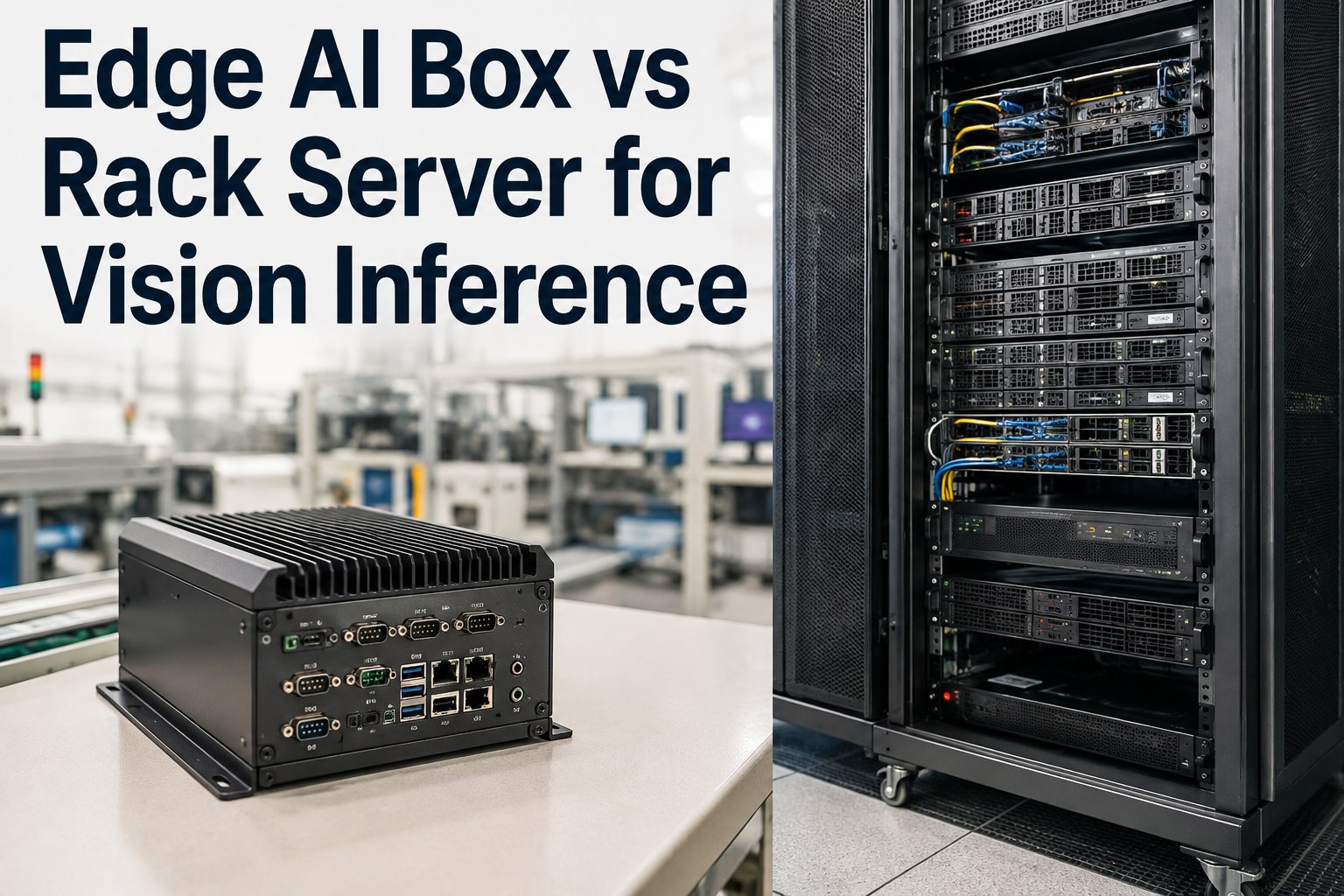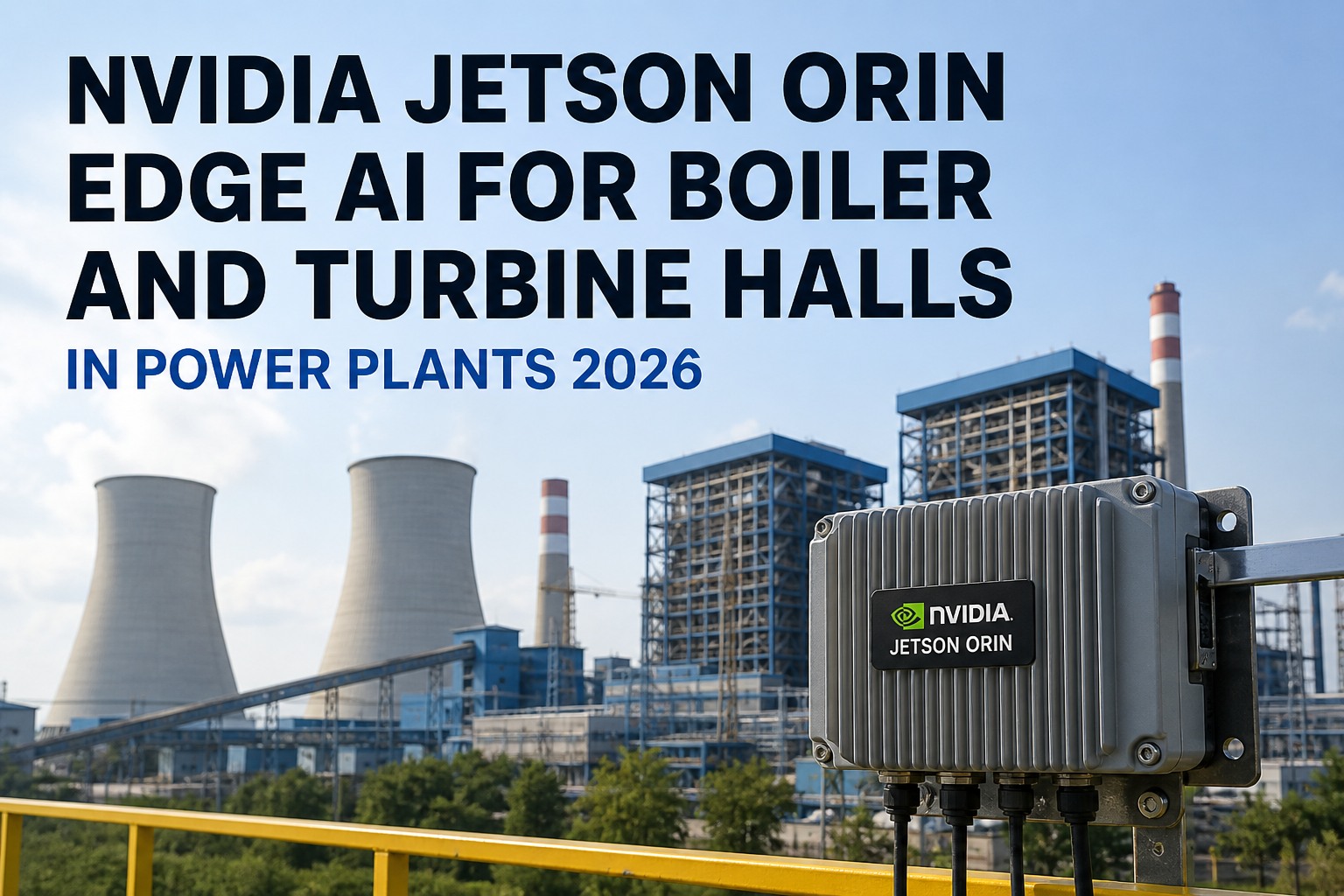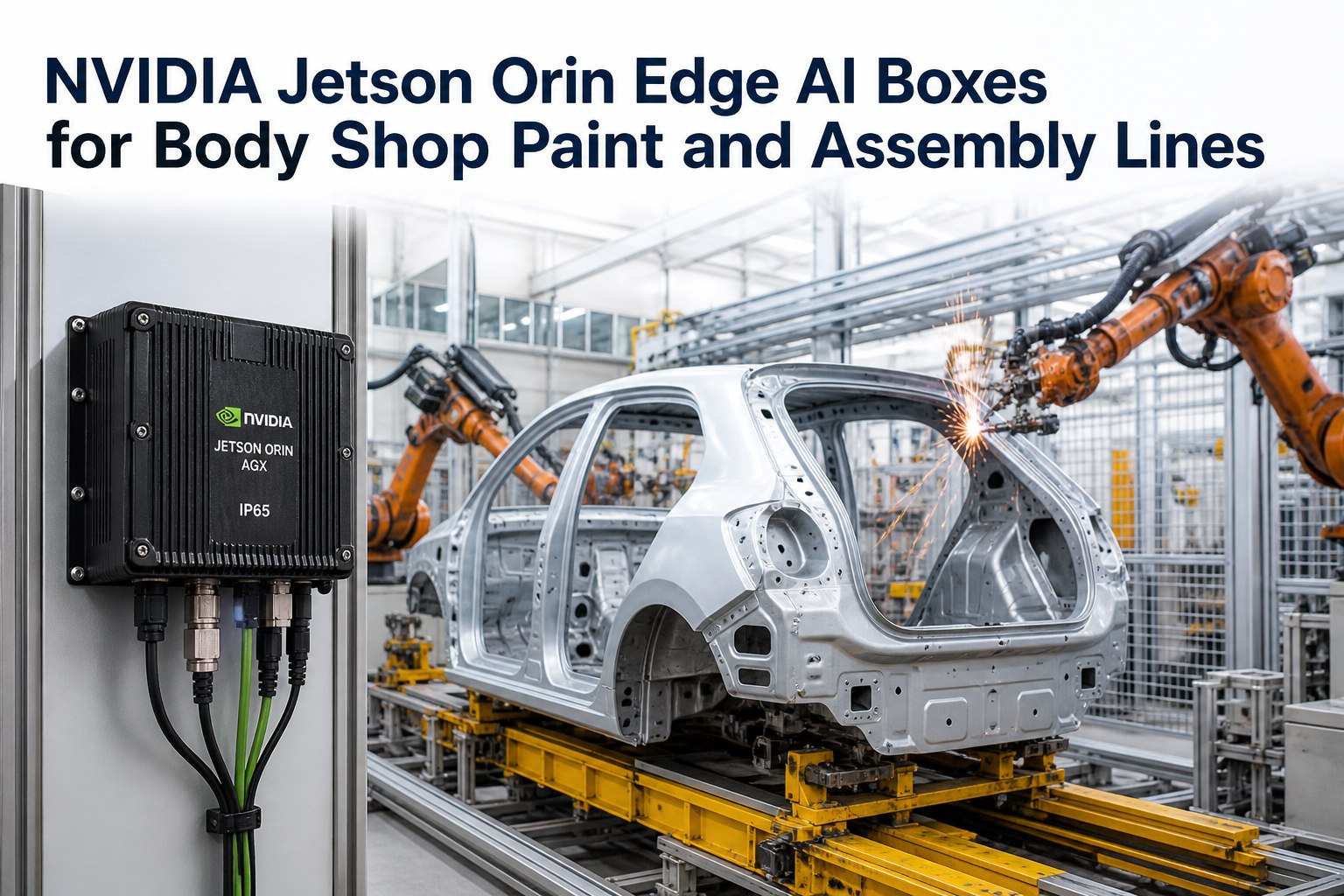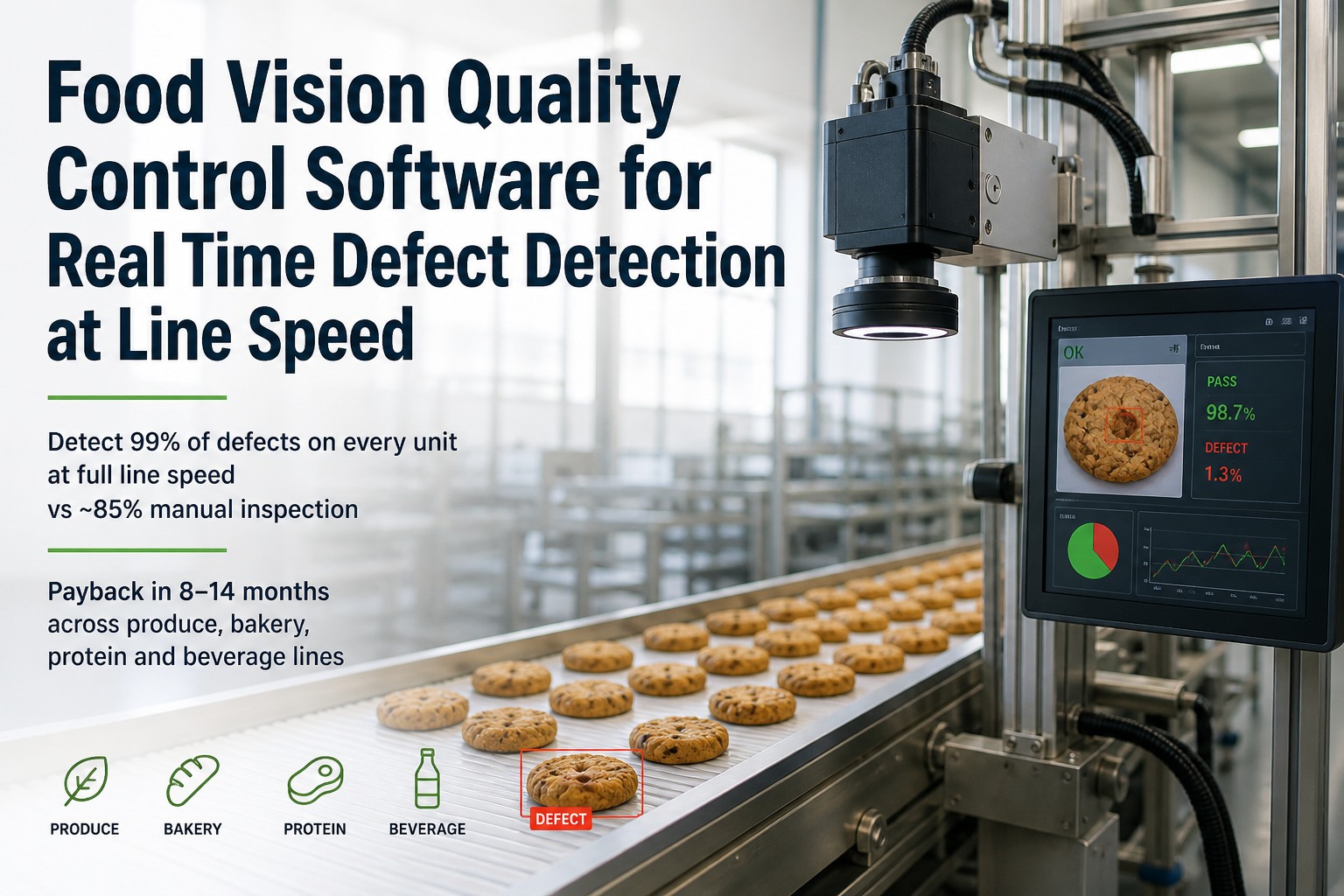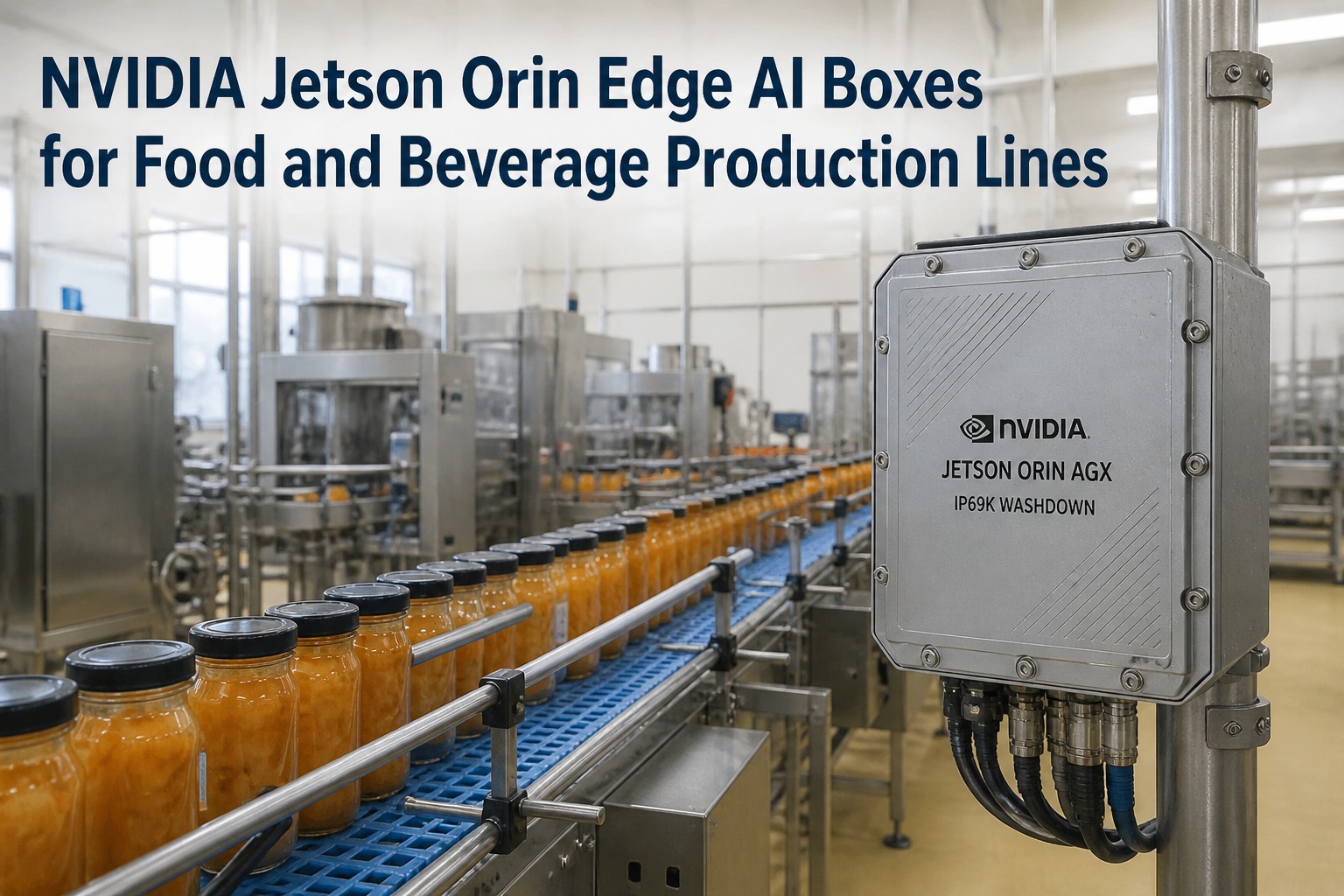
Food and beverage production lines aren't friendly to AI hardware. They get hosed down at 80°C with 100 bar of caustic foam, three shifts a day. They run product changeovers every two hours. They can't afford a 200 ms round-trip to a hyperscaler region when a fill-volume reject decision needs to land in 50 ms. The answer is not "more cloud"—it's NVIDIA Jetson Orin AGX 64GB modules, mounted in IP69K-rated washdown enclosures, doing real-time vision QC, fill-volume CV, and X-ray ML right at the line. The LLM lives upstream on a GB300; the edge does what only the edge can do. This guide breaks down where Jetson sits on a protein, dairy, bakery, or beverage line, what the washdown enclosure has to handle, and how OTA updates keep models fresh without a single line stop.
Jetson Orin Edge AI on F&B Production Lines
Join the iFactory team for a live walkthrough of deploying NVIDIA Jetson Orin AGX 64GB modules in IP69K washdown enclosures across protein, dairy, bakery, and beverage lines. Cover line placement, model selection, sub-50 ms inference, and OTA model rollouts—built on 1,000+ enterprise implementations.
Five Reasons F&B Lines Run Inference on the Edge — Not in the Cloud
A reject decision on a fill line happens in milliseconds. A cloud round-trip kills it. Edge AI on Jetson Orin is not a preference—it's a physics requirement. Book a 30-minute call with our edge AI engineers to walk through your line's specific timing constraints.
A capper rejector at 600 cans/min has ~30 ms to decide. Cloud round-trip alone is 80–150 ms. Jetson AGX hits sub-50 ms inference with a YOLOv8-class model directly at the conveyor.
Six 4K cameras at 60 fps generate ~3.6 Gbps per line. Streaming raw video to a cloud GPU is impossible at scale. Edge does inference locally; only events and metrics travel upstream.
OT networks drop, get reconfigured, or have IT/OT firewall windows. Edge inference keeps the line running through any uplink failure—batches and metrics replay when the link is back.
Recipe images, fill profiles, and X-ray patterns are trade secrets. Edge processing keeps the raw imagery inside the plant; only model outputs and audit-grade evidence packs travel.
At 30,000+ inferences per shift per line, cloud GPU billing punishes you. Edge inference on a Jetson AGX module amortizes across years of decisions—token-per-watt-per-dollar wins decisively.
Jetson AGX vs NX vs Nano — Match the Module to the Workload
Not every camera point on a F&B line needs 275 TOPS. Pick the right module per task: AGX for X-ray ML and multi-camera fusion, NX for single-line vision QC, Nano for simple presence/absence checks.
The flagship for multi-camera, multi-model lines. Runs 6+ cameras at 60 fps with YOLOv8 + EfficientNet + LSTM-tiny concurrently. The right choice for X-ray ML, multi-modal sensor fusion, and lines that demand multiple model pipelines on one box.
Sweet spot for single-line vision QC. Handles 2–3 cameras with one or two models well within the inference budget. Smaller form factor fits tighter washdown enclosures, and the 25–40W power band suits PoE++ deployments at the line.
Best for simple, single-purpose vision tasks. Presence/absence, label-on-bottle, basic OCR, or as a downstream auxiliary node. Lowest power, smallest enclosure, and easiest cabling—great for distributed sensor points around the plant.
What an IP69K Washdown Enclosure Actually Has to Survive
F&B sanitation is brutal. The enclosure has to laugh off 80°C water at 100 bar, caustic and acid chemical cycles, and operators that aim hoses directly at electronics. IP69K is the ceiling of the IP rating scale—anything less fails on a Saturday night washdown.
Dust-tight + high-pressure / high-temperature water jets (80°C, ~100 bar) from any angle. The highest rating on the IP scale. Anything below this fails on production washdown cycles.
Crevice-free welds, internally mounted hinges, rounded corners. No catch points where bacteria can shelter. Standard tooling opens the latch—no proprietary keys.
Pantone 287 blue—deliberately visible to vision systems and metal detectors so a fragment is caught immediately. Captivated screws prevent over-torque damage.
10–15° slope ensures water and caustic do not pool. Stand-off feet for weld-mount, hydrophobic vents to prevent condensation forming inside the enclosure.
The Four Models You Actually Run on a Jetson at the Line
Edge AI in F&B is not one model—it's a lineup. YOLO for objects, MobileNet for fast classification, EfficientNet for harder cases, and LSTM-tiny for time-series anomaly. The LLM lives upstream on the GB300; the edge stays focused on what only it can do at sub-50 ms.
Real-time object detection for foreign material, mis-orientation, label position, fill-line height. Quantized to INT8, runs at 60+ fps on Jetson NX. The bread-and-butter line model.
Lightweight classification for changeover validation, blister-pack defects, color-grade scoring, and label OCR confirmation. EfficientNet for harder cases where MobileNet accuracy isn't enough.
Foreign material detection in protein, dairy, bakery products. Trained on plant-specific X-ray imagery. AGX-class compute required for grayscale 4K processing at line speed without false rejects.
Anomaly detection on filler valve pressure, capper torque, and conveyor encoder traces. Sub-millisecond inference. Catches mechanical drift before it shows up in vision.
Where Jetson Boxes Sit on a Real Production Line
A typical bottling, canning, or packaging line has 4–7 critical inspection points. Each point gets a Jetson box sized to its workload, all reporting upstream to a plant-level GPU node for aggregation, retraining, and LLM-driven analytics.
Presence + count verification. Pallet pattern check. Inbound damage scan.
Fill-volume CV at 600 units/min. Foam height. Filler valve LSTM-tiny anomaly.
Foreign material detection. Plant-trained CNN on grayscale X-ray imagery.
Cap presence, torque visualization, seal integrity. YOLOv8 + MobileNet stack.
Label position + OCR. Date code legibility. Allergen warning verification.
Case count, pattern, palletizer outbound damage scan.
How the Jetson Fleet Talks to the Plant GPU Core
Edge does inference; the GB300 upstream does training, LLM, retrieval, and reporting. The two layers communicate through a hardened OT/IT bridge so the line keeps running even when the upstream is in maintenance.
Rolling Out a New Model to 30+ Jetson Boxes — Without Stopping a Line
Edge fleets fail when updates require physical access. The OTA strategy that works in F&B is staged, signed, canary-first, and reversible. Talk to our support team for an OTA-readiness review of your current edge fleet.
New model artifact built upstream on GB300, signed with a per-plant key, pushed to the Model Registry Cache in the DMZ. Nothing reaches the edge yet—just stages for verification.
One Jetson on a non-critical inspection point pulls the new model. Runs in shadow mode—old model still controls; new model's inferences are logged and compared. KPI deltas measured for 8 hours.
If canary clears, the model rolls to a 25% cohort. Boxes pull during their idle window between batches. A/B comparison continues; rollback path retained.
Full fleet rollout once cohort metrics are clean for 24 hours. Deltas remain monitored. If any box flags an anomaly, automatic rollback is triggered without operator action.
Where Jetson Edge Lands by F&B Sector
The same Jetson hardware shows up across protein, dairy, bakery, and beverage—but the camera, lighting, and model mix changes per sector. Here's the field-level deployment map.
| Sector | Primary Workload | Module Choice | Models | Lighting |
|---|---|---|---|---|
| Protein (Beef / Poultry / Pork) | X-ray ML, foreign material, fat content | AGX 64GB | Custom CNN + EfficientNet | IP69K LED bar + X-ray |
| Dairy (Yogurt / Cheese / Milk) | Fill volume, seal integrity, label OCR | AGX 64GB + NX | YOLOv8 + MobileNet | IP69K dome + back-light |
| Bakery | Color/bake-grade, defect, count | NX 16GB | EfficientNet + YOLOv8 | Diffuse IP69K LED |
| Beverage (Bottling / Canning) | Fill height, cap, label, date code | AGX + NX combo | YOLOv8 + MobileNet + OCR | IP69K barlight + polarized |
| Frozen / Ready Meal | Tray fill, seal, allergen split | NX 16GB + Nano | YOLOv8 + MobileNet | IP69K LED + thermal |
| Confectionery / Snack | Shape, count, decoration uniformity | NX 16GB | YOLOv8 + EfficientNet | IP69K dome + ring |
The 8-Week Edge AI Rollout for a 4-Line F&B Plant
A first-time Jetson fleet rollout on a 4-line plant is a coordinated facility, IT, OT, QA, and engineering project. Eight weeks is realistic with pre-built washdown enclosures and pre-trained baseline models.
What F&B Plant Teams Ask Before Deploying Jetson
These come up in every Jetson edge scoping call. Reach out to our support team for tailored answers on your line.
Bandwidth and latency. Six 4K cameras at 60 fps push ~3.6 Gbps per line, and the round-trip easily breaks the 50 ms inference budget. Edge keeps raw video local; only events leave the box.
Yes—when mounted in an IP69K enclosure with FDA-grade gaskets, EHEDG glands, and a 15° sloped top. The Jetson module itself never gets wet. We've run units through three years of daily caustic-foam cycles with no failures.
The line falls back to its existing PLC reject logic—Jetson is additive, not authoritative. Hot-swap modules can be swapped in under 10 minutes. The OTA channel re-provisions the new module from the registry automatically.
No. The LLM lives upstream on the GB300 where it has the memory, retrieval, and context to answer reasoning queries. The edge does pure CV/ML at sub-50 ms—exactly what only the edge can do.
Why F&B Plants Choose iFactory for Jetson Edge Deployments
A Jetson fleet on a working production line is an OT-grade install—not an IT project. Hygienic compliance, safety, washdown survival, and OTA discipline come first. Book a deployment-readiness review and we'll model your edge fleet line-by-line before you sign a PO.
Get a Jetson Deployment Plan for Your F&B Lines
Thirty minutes with our edge AI engineers. Bring your line layout, washdown SOP, and inspection-point list. We'll map module choice per point, size your washdown enclosures, and give you a concrete 8-week rollout plan—before you commit a single dollar to hardware.