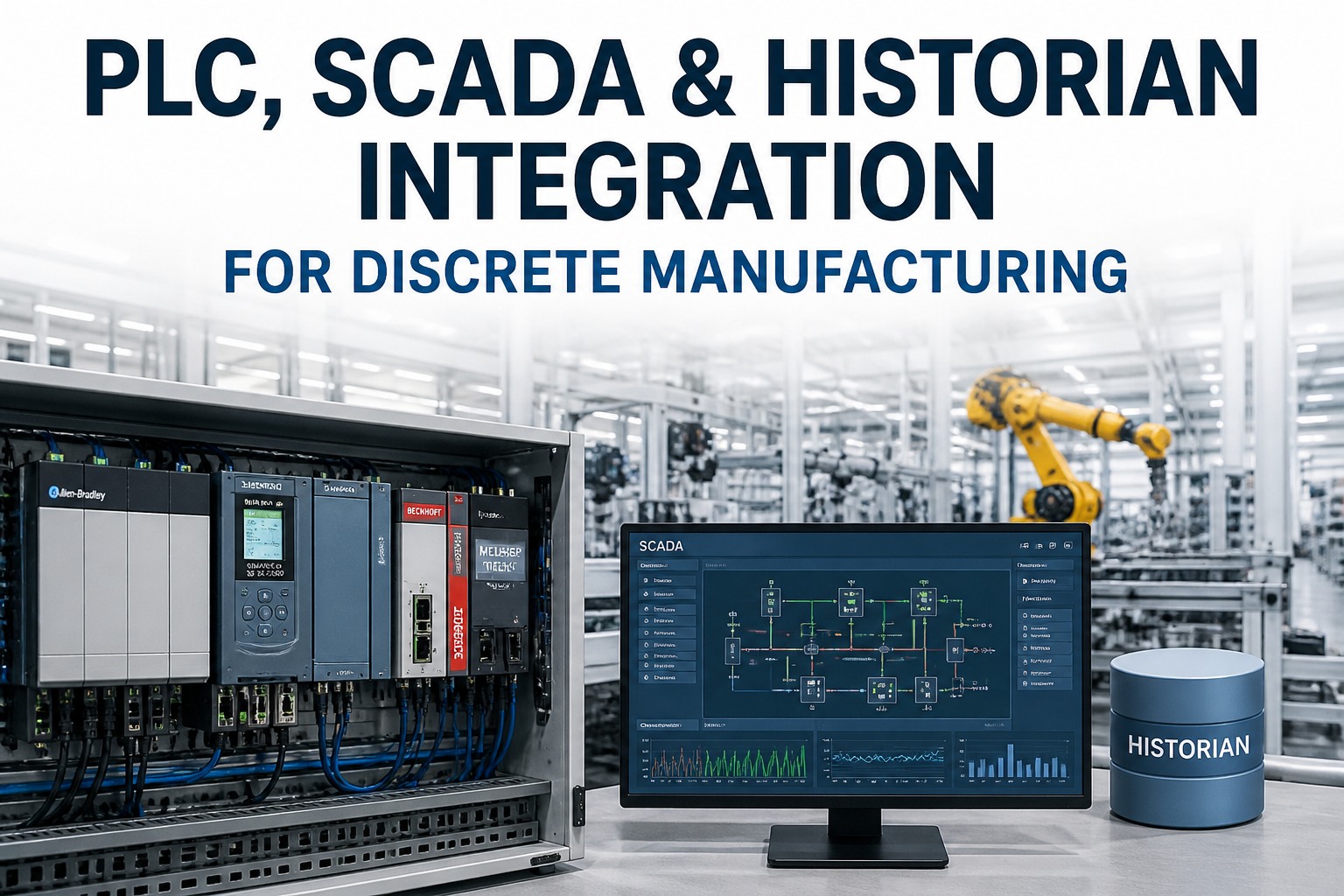
You already have Rockwell ControlLogix on the filler line, Siemens S7-1500 on the case packer, Schneider M580 on the brewhouse. The historian is AspenTech IP.21 or AVEVA with eight years of tag history. SCADA is Ignition, Wonderware, or FactoryTalk View. The question for AI in F&B isn't whether to replace that — it's how to bridge it into a real-time AI layer without breaking shifts. iFactory's integration pattern: read everything via OPC UA + MQTT (Sparkplug B), stream through a time-series ETL pipeline, write back through an audited conduit. No rip-and-replace. No production downtime. 12–24 months of historian backfilled for AI training before go-live.
PLC, SCADA & Historian Integration for Food & Beverage Plants
A reference integration pattern for bridging existing F&B control stacks — Rockwell ControlLogix, Siemens S7, Schneider M580, Ignition, Wonderware, AspenTech IP.21 — into AI workloads. OPC UA + MQTT Sparkplug B native, sub-100 ms write-back, 12–24 months historian backfilled before go-live. Brownfield-ready, on-prem, audit-traceable. Designed for IT/OT engineers who need a working topology, not a sales pitch.
The Stack You Already Have — Supported Day One
No greenfield assumption. Most F&B plants run a heterogeneous mix of brownfield equipment from multiple decades. iFactory bridges all the major PLC, SCADA, and historian platforms in production use today. Talk to our integration team if your stack isn't listed — coverage continues to expand.
A Five-Layer Bridge — Native Where It Has To Be
The integration isn't a single protocol — it's a stack. Native fieldbus where the PLC lives. OPC UA where systems agree on semantics. MQTT Sparkplug B where high-throughput pub/sub matters. Streaming ETL where data needs context. Time-series + AI where decisions are made.
From PLC Tag to AI Decision · Inside 100 ms
A typical write-once-read-many pattern: a tag changes value at the PLC, a message hits the broker, the streaming pipeline normalizes and contextualizes it, AI models run inference, and a setpoint flows back to the PLC — all inside a 100-millisecond budget.
Write-Back Done Safely · ISA-88 Aligned
Reading data is the easy half. Writing setpoints back to the line is where most integrations either fail safety reviews or introduce risk. Our write-back path is a one-way conduit with three guardrails — physics envelope, audit log, operator override.
Inference produces a candidate setpoint with a quality score. ISA-88 batch ID and phase are bound to the decision before it leaves the AI layer.
Every move is checked against thermodynamic, mass, and equipment-spec bounds. Out-of-bound = rejected before it reaches the conduit. Hard guardrail, not a hint.
Signed payload, IEC 62443 SL-3 conduit, append-only audit log. Every setpoint write is replayable for FDA, SQF, or BRC audit traceability.
Setpoint applied at the SCADA write-tag (not direct PLC write — preserves the SCADA's safety logic). Operator override on every line, always available.
12–24 Months of History — Replayed Before Go-Live
AI models can't be trained on a week of data. The backfill phase replays your existing historian — IP.21, AVEVA, PI — into the new pipeline, time-aligned and quality-flagged, so models are pre-trained on real plant behavior before they touch a single live tag.
Read-only connector to AspenTech IP.21 / AVEVA / PI. Pull tag list, sample rates, units, quality flags.
Map historian tags to ISA-88 batch model · equipment hierarchy · units & cells · phase identification.
Stream historical data through the same pipeline as live data. Quality flags preserved. Time alignment to ms.
Vision QC, PdM, recipe scheduler — all pre-trained on your real plant data. Day-one accuracy, not 6-month learning curve.
Why 12–24 months matters: seasonal patterns, supplier batches, equipment overhauls, recipe revisions — all show up in historical data. Models trained on a week catch routine behavior; models trained on two years catch the rare-but-expensive cases. Get a quote with backfill scope sized to your historian.
A Typical F&B Plant Implementation
Concrete example: a beverage plant with 4 production lines, mixed Rockwell + Siemens controls, AVEVA SCADA, and AspenTech IP.21 historian. Here's how the integration physically lays out.
Custom Integration · SaaS Connectors · iFactory ETL
There are three ways to bridge a brownfield F&B plant into AI. Only one ships pre-tested for the actual stack you're running today.
| Capability | Custom Build | SaaS Connectors | iFactory Streaming ETL |
|---|---|---|---|
| OPC UA + MQTT Sparkplug B | You implement | Vendor-specific | Native, day one |
| Time to first live tag | 3–6 months | 2–4 weeks | 5–10 days |
| Historian backfill | Manual scripts | Often unsupported | 12–24 mo replay built in |
| ISA-88 batch context | Custom modelling | Generic | Pre-mapped per vendor |
| Write-back safety envelope | You build | Often missing | Physics + audit + override |
| Multi-vendor PLC support | One-by-one | Vendor lock-in | 10+ vendors out of the box |
| End-to-end latency | Variable | 200–500 ms | < 100 ms |
| IEC 62443 SL-3 conduits | Manual | Rare | Pre-configured |
| Plant DC sovereignty | Yes (your build) | No (cloud) | Yes (on-prem) |
Why Controls & IT/OT Teams Pick Us
Six things make iFactory's integration pattern different from custom builds and SaaS connectors. Each one is the result of building this for plants where production can't pause for a six-month integration project.
Most integration vendors assume a clean slate. We assume you have 4 PLC brands from 3 decades, two SCADA versions, and a 12-year-old historian. That's the actual plant — and the pattern is built for it from day one.
Most "MQTT-compatible" platforms wrap legacy connectors in a translation layer. Our pipeline was built around Sparkplug B from layer 0 — birth/death certificates, primary host store-and-forward, the whole spec.
12–24 months of historian replayed through the same Kafka/Flink pipeline as live data. Models hit production already calibrated to your specific plant — no 6-month learning curve while AI just watches.
Hard guardrail, not a hint. Every candidate setpoint is bounds-checked against thermodynamic, mass, and equipment-spec limits before it leaves the AI layer. Out-of-bounds = rejected, not logged-and-retried.
Rockwell PhaseManager, Siemens Braumat, ProLeit, Wonderware InBatch — all mapped to canonical ISA-88 phases at deployment time. Batch context flows into AI inference natively, no custom modelling.
Conservative deployment pattern. We connect read-only for 30+ days and prove the data pipeline before any write-back is enabled. Zero risk to production during validation. Talk to support for the validation framework.
What Controls & IT/OT Engineers Ask First
Yes. Many F&B plants still run OPC DA on older Wonderware InTouch or pre-2015 Rockwell. We deploy OPC DA-to-UA gateway brokers that bridge legacy clients into the unified pipeline. The legacy systems don't have to upgrade for AI to work.
Tag-list versioning is built into the pipeline. The MQTT broker uses Sparkplug B birth/death certificates, so a PLC reboot or tag-list update is detected and the stream catalog auto-updates. Schema changes that would break downstream are flagged before they ship.
Both are supported via OPC UA aggregators (Experion has native UA from R510; DeltaV via the OPC UA Connector). Honeywell PHD historian is supported directly. Mixed PLC/DCS plants are common in beverage and dairy, and the pattern handles both.
No. Read-only OPC UA from the controller backplane requires no PLC code changes — just a configuration on the OPC UA server side. Write-back uses SCADA write-tags (already exposed by your HMI), again with no PLC code modification. Talk to our team with your specific PLC and SCADA versions and we'll confirm.
Get a Quote. Or Join the Webinar.
Send us your PLC, SCADA, and historian inventory — we come back with a fixed-price integration scope in 5 business days. The proposal includes OPC UA + MQTT bridges, streaming ETL pipeline, ISA-88 alignment, write-back conduits, historian backfill, and IEC 62443 zone configuration.