A progressive die for an automotive Class A panel costs between $200,000 and $1,000,000. A single catastrophic die failure from an undetected misfeed costs $50,000 to $500,000 in tooling repair plus weeks of production disruption. At 20-300 strokes per minute, conditions deteriorate in seconds — and the press doesn't pause for second opinions. Press stamping AI isn't about marginal optimization. It's about asset protection at the most expensive moment in the day. iFactory deploys three model families running simultaneously on the same press: anomaly ML on the tonnage signature catches misfeeds before the damaging stroke; Vision Transformer on Class A panels catches tears, splits, dimples, scratches; and an LSTM on cumulative sensor data predicts die wear before quality drops. One platform, three assets protected, no cloud dependency.
Press Stamping AI for Class A Panels and Die Health
Join the iFactory automotive team for a live walk-through of three AI model families running in parallel on automotive press lines. Tonnage signature anomaly · Class A vision (tear/split/dimple/scratch) · die-wear LSTM — protecting the most expensive tooling on your floor.
Why Press Stamping AI Is Asset Protection — Not Optimization
Die damage in metal stamping is the most expensive preventable maintenance event in the industry. The investment a single die represents, the rate at which a production press destroys things when something goes wrong, and the duration of the recovery — together they make press stamping a category where prevention dominates the value calculation. Book a 30-minute review for a tailored protection model on your press.
Progressive and transfer dies are the most valuable tooling in manufacturing. An automotive Tier-1 stamping die set lives in this range. A line that runs 4 dies has a million dollars or more in tooling within reach of a single bad stroke.
One undetected misfeed. One short feed. One foreign object. The damage spans tooling repair plus weeks of production disruption. Insurance against this event is what tonnage signature monitoring actually buys you.
Strokes per minute. At these rates, conditions deteriorate rapidly and failures escalate in seconds. Human reaction time is not the right safety mechanism. Edge-deployed AI inference at sub-50ms is.
Industry typical for well-maintained stamping presses. The 7-12% gap is dominated by die changes, mechanical failures, and setup. Each percentage point recovered is real money — and AI-driven die life prediction is how you recover it without changing the press.
What the Press Tells You — Every Single Stroke
Every stamping operation has a characteristic force-vs-position curve through the press cycle. This is the tonnage signature. Deviations indicate die wear, stock variation, misfeeds, foreign objects, or setup problems. Force curve monitoring is the premium die protection application — and the input that anomaly ML reads on every stroke.
Anomaly ML · Vision Transformer · LSTM — Running in Parallel
Each model family protects a different asset. The anomaly ML protects the die from catastrophic damage. The Vision Transformer protects the panel from leaving the press as a defective Class A surface. The LSTM protects production schedule by predicting die wear before quality drops. They run on the same plant H200, share signals, and feed one operator dashboard.
DBSCAN-class density anomaly model on the tonnage signature, sampled every degree of crank rotation. Catches misfeeds, short feeds, slug pulls, foreign objects, and abnormal force signatures before the next damaging stroke. Field-proven approach — Ford Motor Company's stamping press monitoring at Almussafes uses an analogous DBSCAN-based virtual sensor on real-time tonnage data.
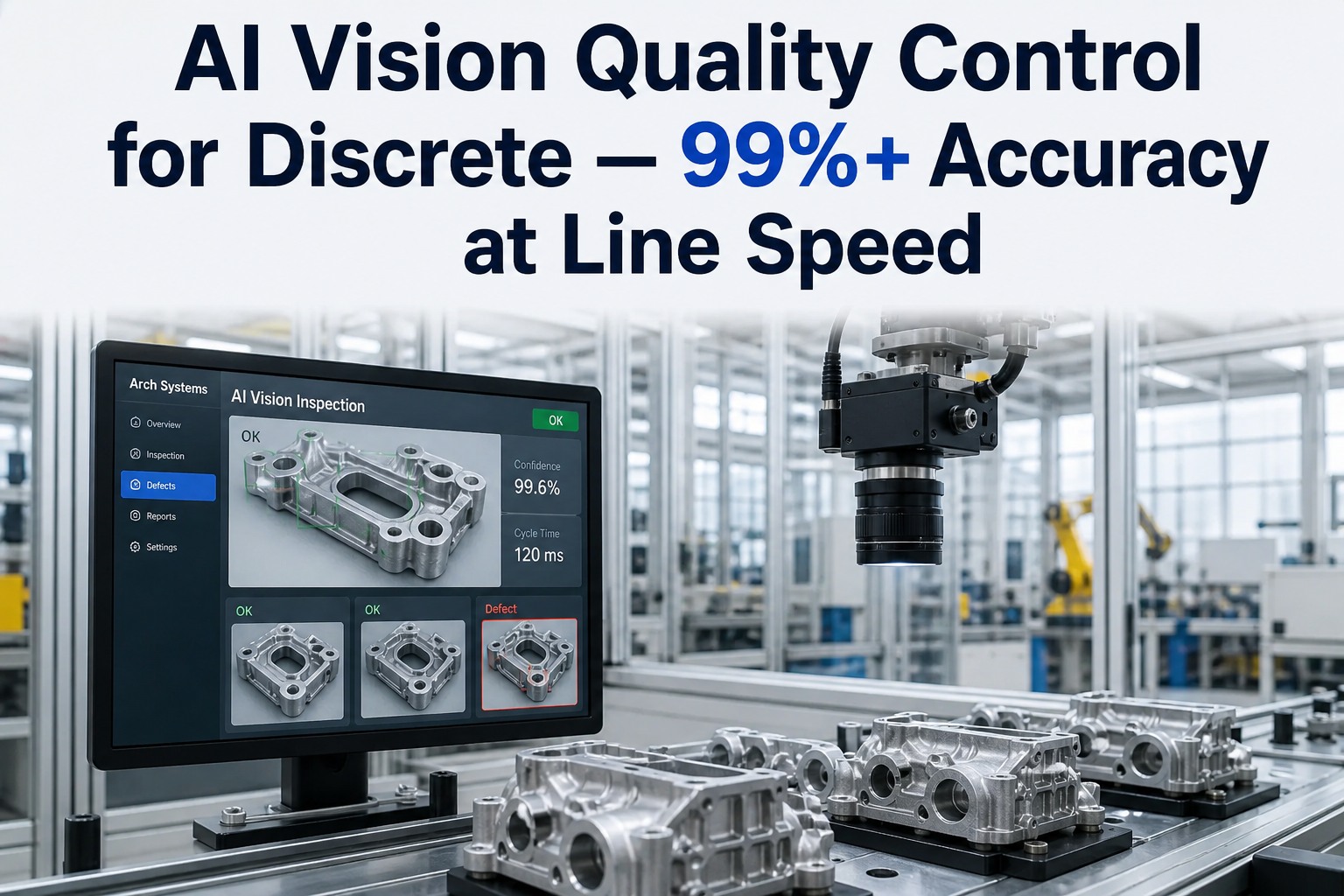
Vision Transformer on post-press inspection cameras. Detects tears, splits, dimples, scratches, burrs, wrinkles, thinning, and die marks against curved sheet-metal surfaces with reflective lighting. ViT generalizes across Class A panels — hood, roof, door skin, fender — better than per-panel CNNs. One trained model handles the variant mix.
LSTM on cumulative sensor sequences — tonnage, acoustic emission, temperature, stroke count. Estimates die wear progression in-process and predicts remaining useful life. Schedules die maintenance before quality drops, not after. Comparable transformer-based architectures published in 2025 outperform LSTM baselines on this task; iFactory ships LSTM as the production-stable default with Transformer as an opt-in upgrade.
What the Vision Transformer Catches on the Hood, Roof, Door, Fender
Class A panel defects are particularly hard for generic vision systems because the surface itself is reflective, curved, and visually complex. A 0.3mm dimple looks identical to a reflection unless your model has the right architectural priors. ViT handles it. Talk to our press-shop specialists for a defect-library walkthrough on your specific panels.
Sheet metal failed in the draw — most often at radii or beads. Catastrophic for the panel, often caused by stock thickness variance or die-tip wear. Caught in vision; correlated upstream with tonnage signature.
Localized depression in the Class A surface, typically <1mm deep but visible on the painted body. Causes: die contamination, slug, foreign object on the working surface.
Linear surface defect from die galling or transfer rail contact. Often associated with progressing die wear — the LSTM's job to predict before scratches start showing up.
Sharp metal protrusion at trim edges, hazardous to handle and impossible to paint over. Indicates trim die wear or misalignment.
Buckling under draw, common on deep-draw panels. Caused by binder pressure imbalance or blank misalignment. Detected by ViT, root-cause traced through tonnage curve shape.
Stretch-induced reduction in metal thickness without breaking through. Predictive of imminent splits — a leading-indicator catch by the AI before the next stroke produces the tear.
Two Compute Tiers — Edge and Plant
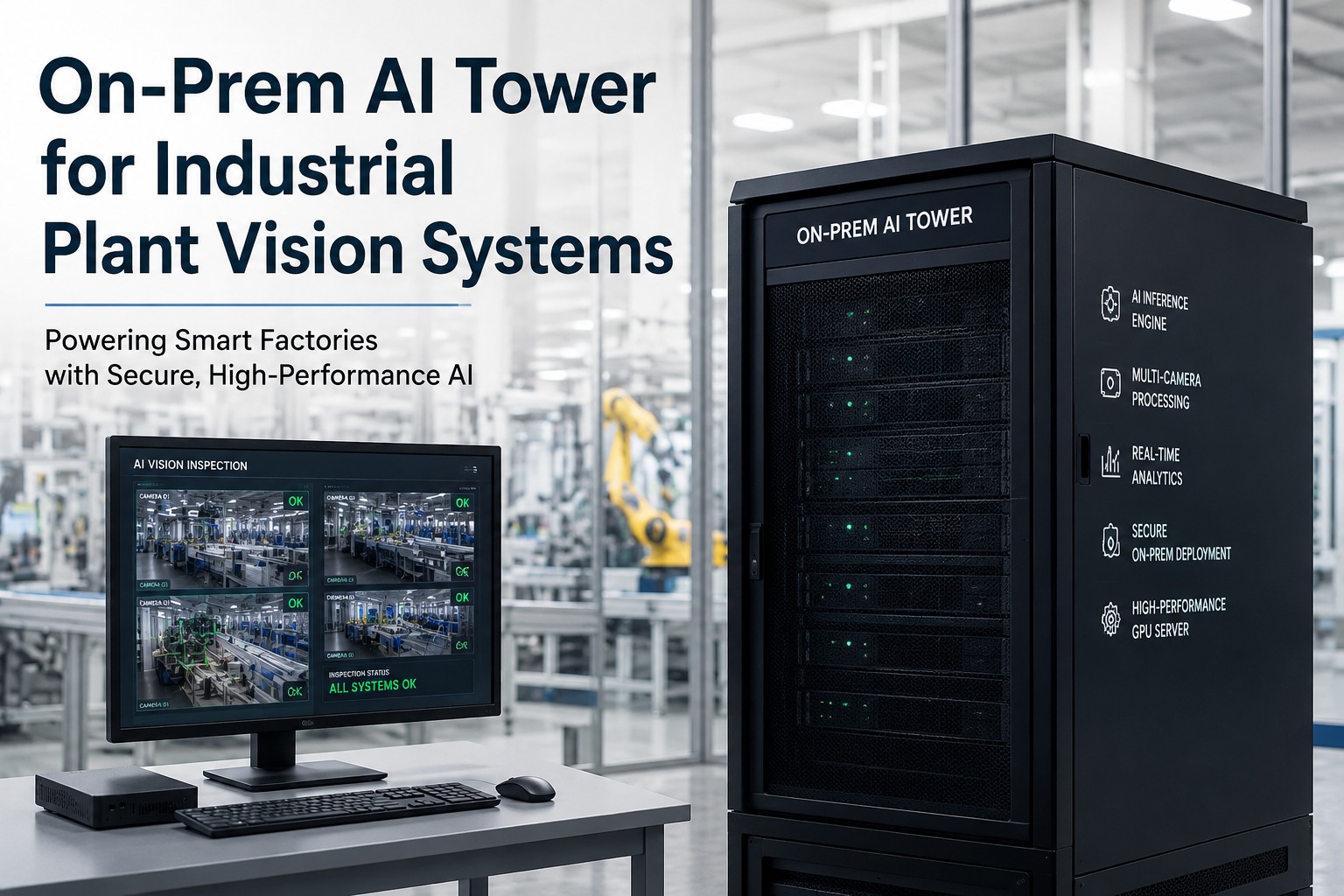
Press stamping AI does not need an enterprise GPU rack. The compute lives on the press floor: Jetson Orin per press for the anomaly ML and Vision Transformer inference, and one H200 server in the plant for the LSTM die-wear models and cross-press analytics. No cloud. No external dependency. Stamping data is among the most sensitive process IP an OEM owns — it stays inside.
- Anomaly ML on tonnage signature
- Vision Transformer per camera
- <50ms inference for press halt
- IP65 enclosure for press environment
- Direct PLC interlock for stop command
- LSTM die-wear models
- Cross-press analytics & trends
- Model retraining on shift data
- Operator dashboard & alerts
- One node per press shop · 14kW rack
Conventional Press Monitoring · Generic AI Vendor · iFactory
| Capability | Conventional Monitoring | Generic AI Vendor | iFactory Press AI |
|---|---|---|---|
| Tonnage monitoring | Threshold-based | Single-stage ML | Anomaly ML · DBSCAN-class |
| Misfeed detection | Late · post-stroke | Reactive | Pre-stroke halt · <50ms |
| Class A vision | Manual inspection | CNN per panel type | ViT · all variants one model |
| Defects covered | Inspector-dependent | 2-3 categories | 8 categories Class A |
| Die wear prediction | Scheduled changeout | None | LSTM · RUL in strokes |
| Sensor integration | Tonnage only | Tonnage + vision | Tonnage + acoustic + temp + vision |
| Action speed | Operator response | Operator review | Direct PLC interlock |
| Cloud dependency | None | Required | None — fully on-prem |
| Multi-press scaling | Per-press setup | Per-press retrain | Calibration only |
From Sensor Install to Press-Halt Interlock in 14 Weeks
Most press shops deploy in priority order: tonnage anomaly first (the highest-value protection), Class A vision next, die-wear LSTM last (because it benefits from the data the first two start collecting). Schedule a deployment review with our press-shop engineers.
What Press Shop Engineers Ask First
Yes — but only after PQ. Anomaly ML on the Jetson edge produces a stop command on the same control bus the press already uses for E-stops. Inference time is <50ms; press deceleration time depends on the press. Most shops start in advisory mode (alert only) and graduate to direct interlock after 30+ days of false-positive data demonstrates safe operation.
Usually not. Standard 4-corner load cell setups produce sufficient signal for the anomaly ML. We add acoustic emission and temperature sensors if they're not already present, since the LSTM die-wear model benefits from those streams.
Yes. ViT generalizes across panel shapes much better than CNNs. Hood, roof, door skin, fender, quarter panel — one trained model template handles all of them. Plant-specific fine-tuning takes 3-4 weeks on labeled imagery from your line.
Correct — no LLM. Press stamping is a real-time control problem; LLM latency and probabilistic output are wrong tools for halting a 300-SPM press. Operators get a direct dashboard. Reports are generated by structured templates against the model outputs, not a language model.
Built for Asset Protection — Not for Slide Decks
Get the Asset-Protection Plan for Your Press Line
Thirty minutes with our press-shop engineering team. Bring your press inventory, current tonnage monitoring setup, recent die failure history, and Class A panel defect data. We'll model the realistic catastrophic-failure exposure on each press, identify which protection layer to deploy first, and outline a 14-week path to direct PLC interlock. Talk to support for preliminary scoping if you'd prefer to start there.