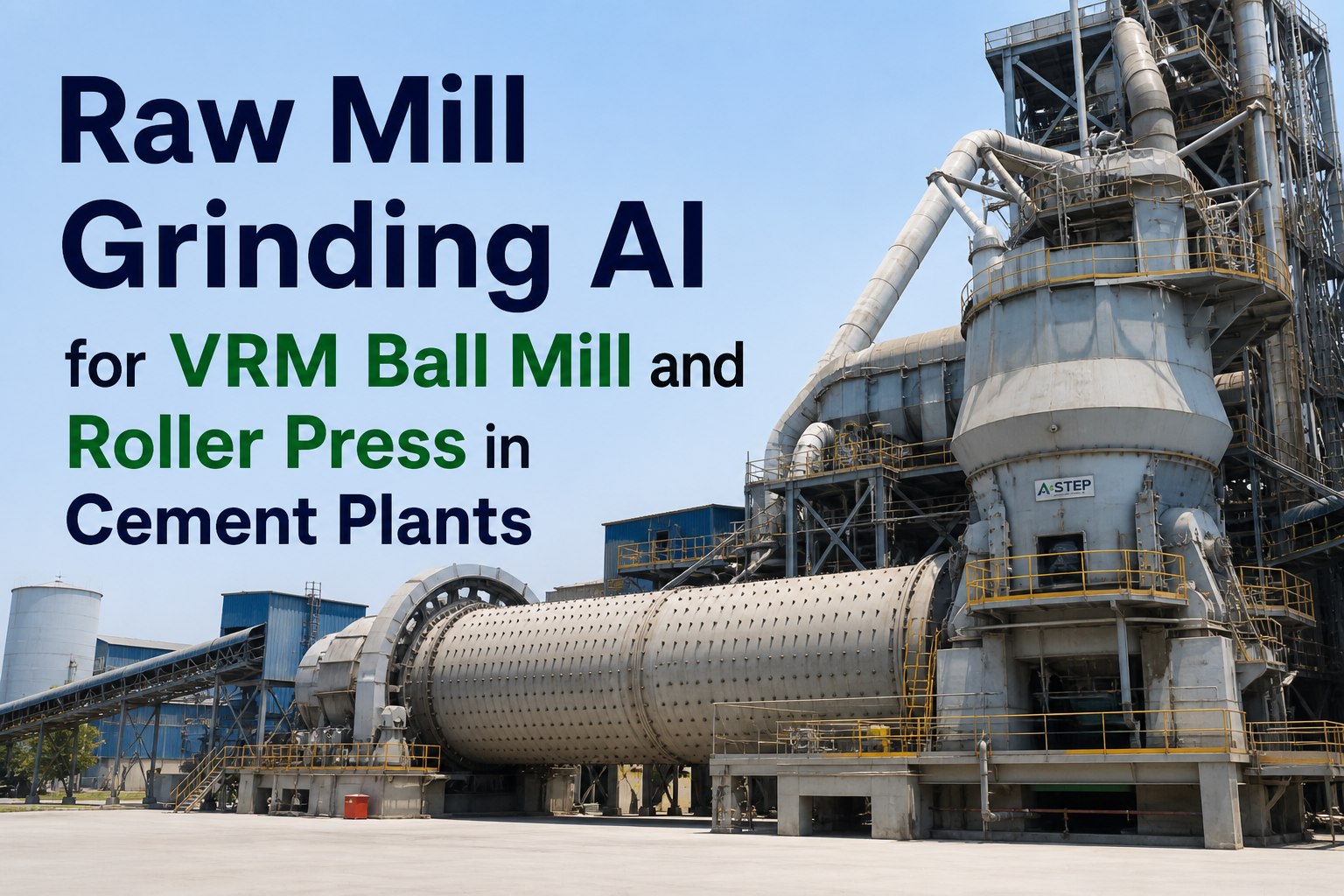
The raw mill is the most underrated AI opportunity in a cement plant. Everyone optimizes the kiln. Few realize that 60–70% of plant electricity is consumed in grinding, and that an unstable raw mill is the single biggest reason a kiln line drifts. When the mill chatters, particle size distribution wobbles, Blaine fineness swings, and the preheater inherits a feed that the burner has to fight. This page is about a different kind of optimization — neural-network-based ventilation prediction (BNN, RMSE 0.6 in published industrial study), LSTM forecasting on roller-press hydraulics, and Blaine soft sensors that replace the 4-hour lab loop. The downstream impact is bigger than the mill itself: a stable raw mill is a stable kiln.
Raw Mill Grinding AI — VRM, Ball Mill & Roller Press
Join the iFactory grinding team for a live walk-through of an AI platform tuned to all three raw-mill technologies. BNN ventilation prediction · LSTM hydraulic forecasting · Blaine soft sensor — feeding stable raw meal into the preheater so your kiln stops fighting the mill.
Why the Raw Mill Is the Real Bottleneck
Plant managers focus on the kiln because that's where the dollars burn. But the raw mill decides what the kiln has to burn. Inconsistent raw meal — wrong fineness, wrong moisture, drifting LSF or silica modulus — forces the burner to overburn for safety. That's where 30–50 kcal/kg of waste actually originates. Book a 30-minute briefing to see how raw mill stability translates into kiln savings.
Lab feedback every 4h · operator runs conservatively
Cyclone efficiency swings · heat exchange degrades
Free lime safety margin widens · 30–50 kcal/kg waste
The kiln pays for the mill's instability — every shift
VRM vs Ball Mill vs Roller Press — Same Goal, Different Physics
Most cement plants run one of three raw grinding configurations. Each has its own physics, its own sensor signature, and its own AI model architecture. The platform recognizes which mill you have and applies the right stack.
- Hydraulic pressure (250–600 bar)
- Table speed
- Dam ring height
- Gas flow / classifier speed
- Mill differential pressure
- LSTM on hydraulic pressure
- Vibration anomaly detector
- Blaine soft sensor
- Closed-loop classifier control
- Mill outlet pressure
- Separator fan amperage
- Mill ventilation rate
- Fill level (acoustic / power)
- Recirculating load
- BNN ventilation predictor
- Acoustic fill-level inference
- Recirculating load LSTM
- Separator efficiency optimizer
- Roller hydraulic pressure
- Roller skew & gap
- Feed bin level
- Bearing temperature
- Wear-flange condition
- Hydraulic pressure ML
- Skew detection (vibration)
- Bearing thermal forecast
- Condition-based PdM
The Boosted Neural Network That Predicts Mill Ventilation
Ball mill ventilation is the most under-instrumented critical variable in cement grinding. Too little air → coarse powder, output drops. Too much → cushioning, energy waste. Published research at the Ilam cement plant trained a Boosted Neural Network on 2,000+ records across 35 variables — and achieved RMSE 0.6, beating Random Forest (0.71) and SVR (0.76). iFactory productized that approach.
Replacing the 4-Hour Lab Loop With a 5-Second Prediction
Blaine fineness is the single most important raw-meal quality metric. Today, most plants take a sample every 2–4 hours, run it in the lab, and feed the number back to the operator 30+ minutes later. By the time it arrives, the mill has changed. The Blaine soft sensor closes that gap — predicting fineness continuously from operating signals.
- Sample taken at outlet
- Transit to lab
- Air permeability test
- Results entered manually
- Operator adjusts classifier
- Live mill power, vibration
- Classifier speed & pressure drop
- Recirculating load
- Feed PSD inference
- Soft sensor predicts Blaine
Three Models. Edge + Plant. No Cloud.
No LLM here. The raw mill needs deterministic, explainable models that can survive a regulator's review and an old plant manager's skepticism. Three architectures, edge and plant deployment, fully on-prem.
Best-in-class for multivariable nonlinear ventilation modeling. Outperforms Random Forest and SVR on the same dataset. Highly explainable through feature-importance ranking — you see which sensors drive the prediction.
Time-series forecasting for hydraulic pressure, vibration, recirculating load, and bearing temperature. Captures the multi-minute lag dynamics that classical control loops miss. Predicts 15–60 minutes ahead.
Inferential measurement of Blaine fineness, moisture, and PSD from existing process signals. No new lab equipment. No new probes. The sensor lives in software and replaces the lab loop in real-time.
What a Stable Raw Mill Does to Your Kiln
The downstream effect is the real ROI. Stable raw meal lets the kiln operator drop the safety margin — the conservative buffer they keep against feed variability. Less buffer = lower kcal/kg = compounding savings. Talk to our pyroprocess team to model the cascade for your specific line.
How It Plugs Into Your Existing Mill
No new sensors required for most plants. The BNN, LSTM, and soft sensor all run on data your DCS already collects — power, vibration, pressure, temperature, flow. Connection is read-only OPC-UA. Closed-loop control comes later, only after each model passes parallel-run validation.
OPC-UA bridge to mill DCS. Read-only. Historian replication. No firmware changes on your side.
BNN/LSTM/soft sensor trained on 60–90 days of historical mill data. Feature importance reviewed with operations team.
Predictions and recommendations shown to mill operator. Operator decides each move. Model accuracy validated daily.
Once each model passes 14 days of advisory accuracy, classifier and ventilation move to closed-loop with operator override always available.
What Mill Engineers Ask First
Almost certainly. Mill power, mill outlet pressure, separator fan amperage, classifier speed, vibration on at least one mill journal — that's the minimum, and 99% of operating mills have it. The published BNN study used 35 variables but the top two predictors alone account for most of the signal.
The BNN architecture transfers — the variables change. For VRM, the equivalent model targets hydraulic pressure stability and table-speed coupling. We have separate model templates for VRM, ball mill, and roller press, calibrated on each mill type's physics.
It complements lab — doesn't replace. Lab measurements continue at their normal cadence and are used to retrain the soft sensor periodically. The soft sensor fills the 4-hour gap with continuous prediction. After 60–90 days, soft-sensor accuracy is typically within ±15 cm²/g of lab — close enough for closed-loop classifier control.
Layered, not replaced. iFactory's models sit above your existing optimizer or expert system, sending refined setpoints into them. Your existing platforms stay in place. The only changes are in their recommended setpoints — which now come from a richer model.
Built for Real Mill Physics — Not Generic AI
Find Out What Your Raw Mill Is Costing Your Kiln
Thirty minutes with our grinding engineers. Bring your mill type (VRM / ball / roller press), capacity, and the last 6 months of Blaine variability. We'll model the realistic kWh/t reduction at the mill, plus the cascading kcal/kg savings at the kiln your stability gives you. Most plants find the kiln-side number is bigger than the mill-side number.