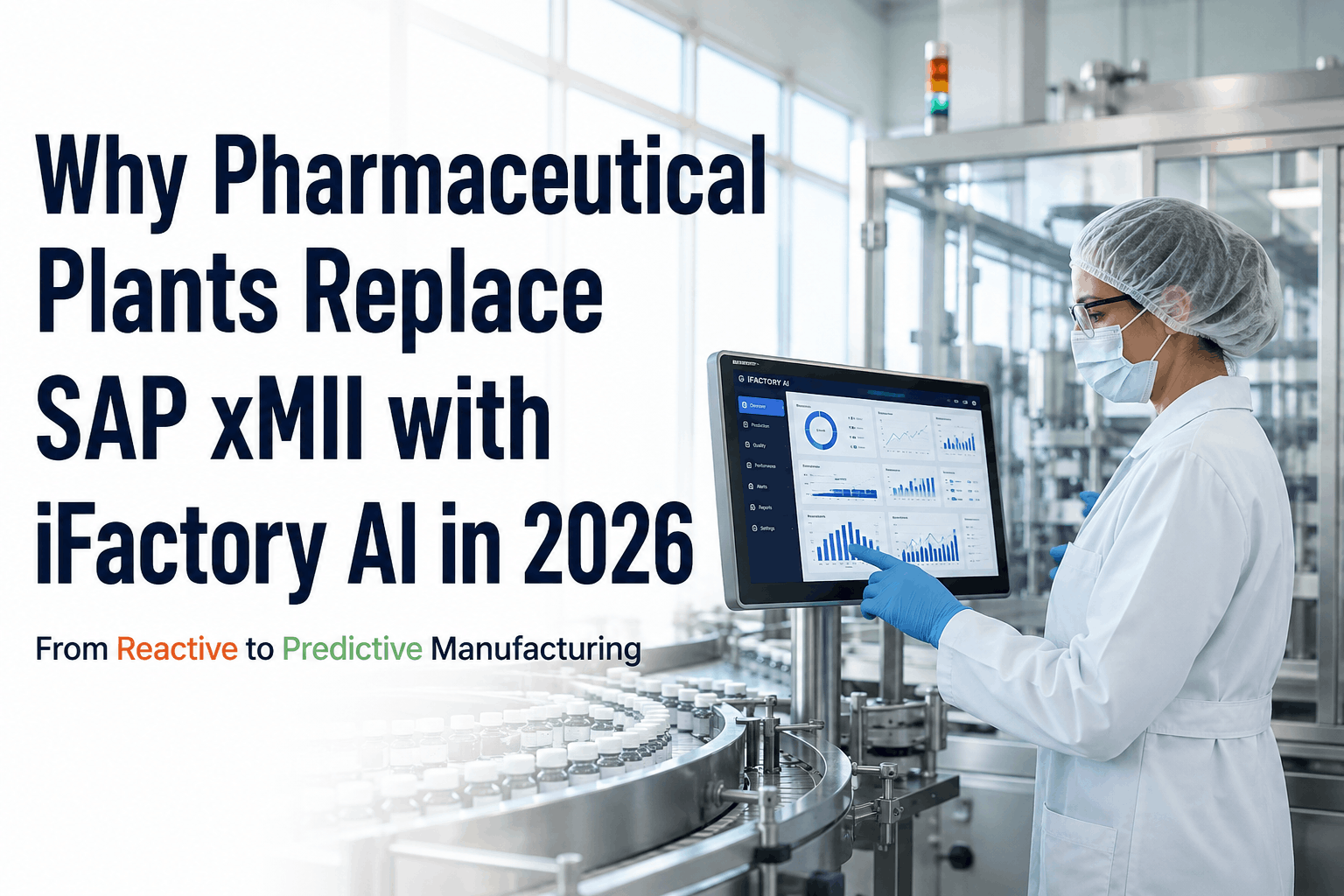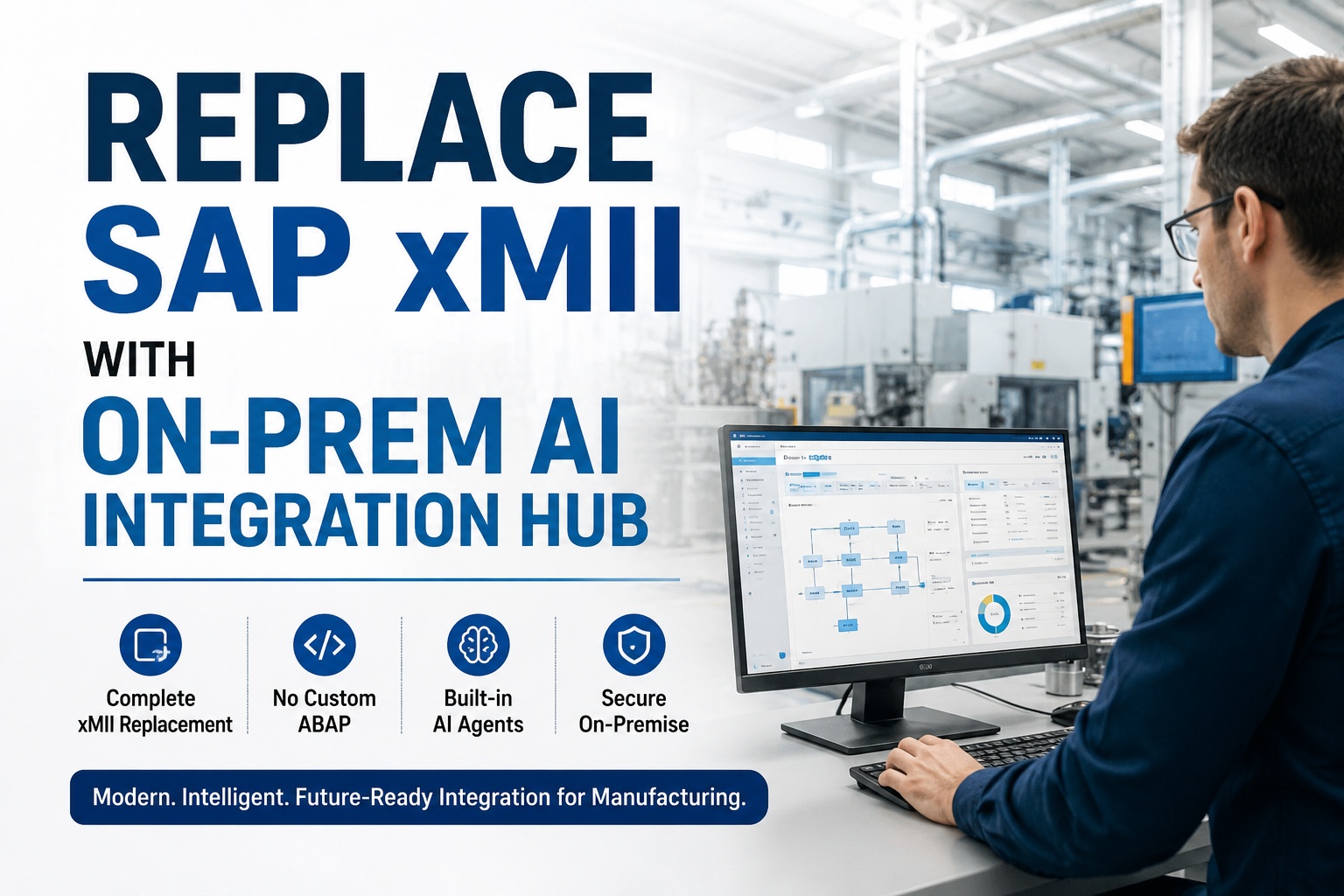
SAP MII — formerly xMII, formerly Lighthammer — has powered shop-floor-to-ERP integration for nearly two decades. SAP's strategic direction now points toward Digital Manufacturing Cloud and S/4HANA Manufacturing for Production Engineering and Operations, and the MII platform itself is on the longest possible glide path to end-of-development. This guide is the working architect's plan to retire SAP xMII while keeping every dashboard, every PLC mapping, every transaction workflow, and every historian connection — and gaining a sovereign on-prem AI brain on top. Production-tested migration runbook, 8 to 12 weeks, zero ABAP customization, zero data loss.
Replacing SAP xMII with iFactory On-Prem AI Integration Hub
A working architect's plan to retire SAP MII without losing dashboards, transaction logic, PLC mappings, or historical data — and gain a sovereign on-prem AI brain on top. 8 to 12 weeks. Zero ABAP customization. Zero data loss.
End-of-line platform
- No active feature development
- Zero AI/ML integration native
- Custom logic stuck in legacy runtimes
- MII consulting talent leaving the market
- Cloud-only roadmap from SAP for the future state
Modern integration plus AI brain
- Full xMII feature parity, day one
- NVIDIA DGX AI brain on the same hardware
- Modern OData and REST APIs, no ABAP custom
- Sovereign — runs entirely on-premise
- Live in 8 to 12 weeks with full migration support
What You Get — Turnkey xMII Migration Package
Hardware, software, migration tooling, training, and support. Pre-configured, racked, and shipped. Plug and migrate.
Hardware
NVIDIA DGX, pre-racked, ships ready. Replaces xMII server infrastructure.
Migration Toolkit
BLS transaction parser, dashboard converter, PLC mapping importer, historian replay.
Training
Operator playbooks, Basis runbooks, plant IT handover docs.
Support
24×7 monitoring, parallel-run safety net, SLA-backed cutover.
xMII Is Not Dying — It Is Frozen
SAP has not pulled the plug on MII, but the platform has not received material feature development in years. The strategic direction is Digital Manufacturing Cloud — which requires RISE licensing and cloud deployment. For plants that need on-prem integration plus AI, neither MII nor DMC is the answer. iFactory is.
Six xMII Pain Points, Six iFactory Answers
Every pain below is something we have seen across MII customer sites in the last 18 months. The answer column is what iFactory ships as standard — not a custom build, not a roadmap promise.
Custom BLS transactions and SQL queries trapped in legacy MII runtime. Hard to audit, hard to upgrade.
Visual flow builder with auditable, versioned transactions. BLS imports converted automatically by the migration toolkit.
Dashboards built in iGrid and chart components. Maintained only by senior MII consultants who are retiring or already gone.
Modern web dashboards with role-based access. iGrid layouts can be visually replicated by your team using the no-code dashboard builder.
UDS connectors to OPC-DA on aging Windows machines. Security patches slow, attack surface growing every year.
Modern Linux-based connector layer with OPC UA, MQTT, REST, and Sparkplug B. CVE patching on a defined cadence.
No native AI/ML. To get predictions you bolt on Python servers, custom REST endpoints, and middleware that nobody owns.
NVIDIA DGX AI brain on the same chassis. Predictive maintenance, vision QM, and demand sensing in-platform, not bolted on.
SAP roadmap pushes toward DMC, which is cloud-only and requires RISE/GROW licensing. Sensitive plant data has to travel out.
Stays on-premise by design. Air-gap supported. Sovereign for regulated industries — pharma GxP, defense, utilities.
Operator UIs unchanged for 10 years. Voice, chat, and smart glasses are simply not in the platform.
Voice copilot, chat-grounded queries, and smart glasses HUD ship in the same release as the integration layer.
Every xMII Component Has an iFactory Equivalent
The map below shows how each major xMII building block translates to its iFactory counterpart. Most migrations cover all seven of these in the same project.
OPC-DA, ODBC, IDoc receivers for shop-floor data ingestion.
OPC UA, MQTT, Sparkplug B, Modbus, REST, plus SAP RFC and OData. Linux-based, CVE-patched.
Visual transaction designer for shop-floor logic and SAP postings.
Modern node-based flow editor. Version-controlled. Auditable. BLS imports auto-converted by the migration toolkit.
Legacy thin-client dashboards built with custom layout XML.
Responsive, mobile-ready, role-based. Reproduces iGrid layouts visually for operators who learned on the old UI.
Java connector to SAP ECC and S/4HANA for BAPI calls and IDoc transfers.
BAPI, bgRFC, IDoc, OData out-of-the-box. Pre-tested on ECC 6.0 EHP4 through S/4HANA 2024.
Read-only connector to OSIsoft PI, IP.21, GE Proficy.
Native ingestion from PI, IP.21, Proficy. Plus internal time-series store for AI training, with bidirectional historian replay.
Email and SAP notification alerting on rule conditions.
Rule-based plus AI-driven anomaly detection. Email, SMS, Teams, voice, SAP PM notification — all in.
No native AI/ML, no vision, no LLM operator copilot.
NVIDIA DGX with vision, time-series, and foundation LLMs. Predictive maintenance, vision QM, voice copilot — net new capability layered on the same hardware.
From xMII to On-Prem AI — Five-Stage Migration Journey
Each stage is gated. No stage runs until the prior stage proves out. Parallel-run is enforced through stage 4 — your existing xMII keeps running until the cutover is signed off.
Assess
BLS inventory, dashboard catalog, PLC mapping audit, historian point list, SAP integration scope.
Build
iFactory connector layer wired in parallel. BLS converted via migration toolkit. Dashboards rebuilt and validated against current xMII output.
Pilot
One line cut to iFactory. xMII continues running in shadow. Side-by-side comparison of transactions, dashboards, and alerts for two full shifts.
Cutover
Plant-wide cutover line-by-line. Parallel-run continues for 2 weeks post-cutover. xMII decommissioned only after sign-off.
AI Live
NVIDIA DGX AI brain activated. PdM, vision QM, copilot, energy. Net-new capability beyond anything xMII could provide.
Side-by-Side — Where iFactory Matches and Where It Extends
The matrix below covers every major xMII capability. Green check means equivalent or better; the AI brain rows show net-new capability beyond what xMII ever offered.
Migration Risk Controls — No Bridge Burned Until It Is Safe
An xMII replacement is a high-stakes change. Four risk controls are non-negotiable on every iFactory migration project — every one of them designed to let you abort and stay on xMII if anything looks wrong.
Parallel Run
xMII keeps running through stages 3 and 4. iFactory shadows in real time. Decommission only after written sign-off.
Reversibility
Every BLS conversion preserves the original source. If a transaction fails validation, the original xMII version can be restored within hours.
Diff Reports
Automated transaction-by-transaction comparison against xMII output. Differences flagged. Cutover blocked on unresolved diffs.
Rollback Window
14-day post-cutover safety window. iFactory and xMII can run in mixed mode if needed — the connector layer supports both.
Day-One After Cutover — Familiar Operator Experience
The operator dialogue below is what your shift supervisor sees the morning after cutover. The questions are the same questions they asked xMII for years. The answers are now grounded in live SAP, live sensors, and an on-prem AI brain.
· Mixer #2 vibration trending up since 02:00 — predicted bearing failure in 5–7 days (PdM model). SAP PM WO auto-drafted, pending your approval.
· QM viscosity drift visible across 4 lots — within spec but the drift slope predicts breach in 2 lots if uncorrected.
· Closure cap consumption 12% above baseline today — auto-PO ready to submit on your approval.
All three findings are net-new. Your xMII dashboard would have shown the OEE number but missed the three actions behind it.
See an xMII migration end-to-end at SAP Sapphire 2026
Live walkthrough of a 12-week MII to iFactory cutover — BLS conversion, dashboard reproduction, AI activation, parallel run. Book a 20-minute floor session.
Frequently Asked Questions
Do I need to buy NVIDIA servers separately?
No. Fully-loaded NVIDIA DGX AI servers are supplied and installed as part of the iFactory package. They ship pre-racked, pre-cabled, with all NeMo, RAPIDS, NIM, and Agent Toolkit components pre-installed alongside the xMII migration toolkit and connector library. You provide power and Ethernet. We provide the rest.
Can we keep xMII running indefinitely if we want to?
Yes. iFactory does not force a decommission date. xMII can run in parallel during stages 3 and 4. After cutover, the 14-day rollback window keeps xMII available. Many customers run mixed for one to two months before fully retiring MII servers.
What happens to our custom BLS transactions?
The migration toolkit parses BLS XML and converts each transaction to an iFactory visual flow. Roughly 85% of typical BLS transactions convert with zero manual rework. The remaining 15% — usually heavy SQL or recursive logic — get hand-mapped by the iFactory delivery team during stage 2.
Will operators have to relearn the interface?
Minimal relearning. Dashboards are visually replicated to match the xMII iGrid layouts operators know. Underneath, the engine is new and faster, but the surface looks familiar. Voice and chat copilots are net-new, opt-in, and trained alongside the cutover.
Does this work if we are mid-S/4HANA migration?
Yes. iFactory works on ECC 6.0 and S/4HANA simultaneously. If your xMII is currently bridging an ECC system that is about to become S/4HANA, the iFactory connector layer carries through — same configuration, different SAP endpoint. The MII-to-iFactory migration does not need to wait for the S/4HANA cutover.
What about historian data? Do we lose history?
No. iFactory connects to existing PI, IP.21, or Proficy historians read-only — no migration of historical points required. New time-series goes into the iFactory data fabric in parallel with the existing historian. You keep your archive; we add the AI training store.
How does this compare to SAP Digital Manufacturing Cloud?
DMC is the cloud successor SAP recommends. It requires RISE/GROW licensing and sends plant data to SAP BTP in the cloud. iFactory stays on-prem, supports air-gap, and adds an AI brain DMC does not have. The two can coexist where DMC handles MES execution and iFactory handles AI — but most customers replacing xMII go with iFactory as the single platform.
What is the typical cost saving versus keeping MII?
Customers report two saving categories. One — operating cost reduction from retiring aging MII server infrastructure and the consultant pool needed to maintain it. Two — new value from the AI brain, typically 45% unplanned downtime reduction, 30% defect reduction, and $2.3M average 3-year savings per plant. Most projects pay back inside 14 months.
Replace xMII Cleanly. Add an AI Brain. Sleep Better.
Full migration runbook, parallel-run safety, transaction-by-transaction diffing, and an NVIDIA-powered AI brain on the same chassis. 8 to 12 weeks. Zero data loss.