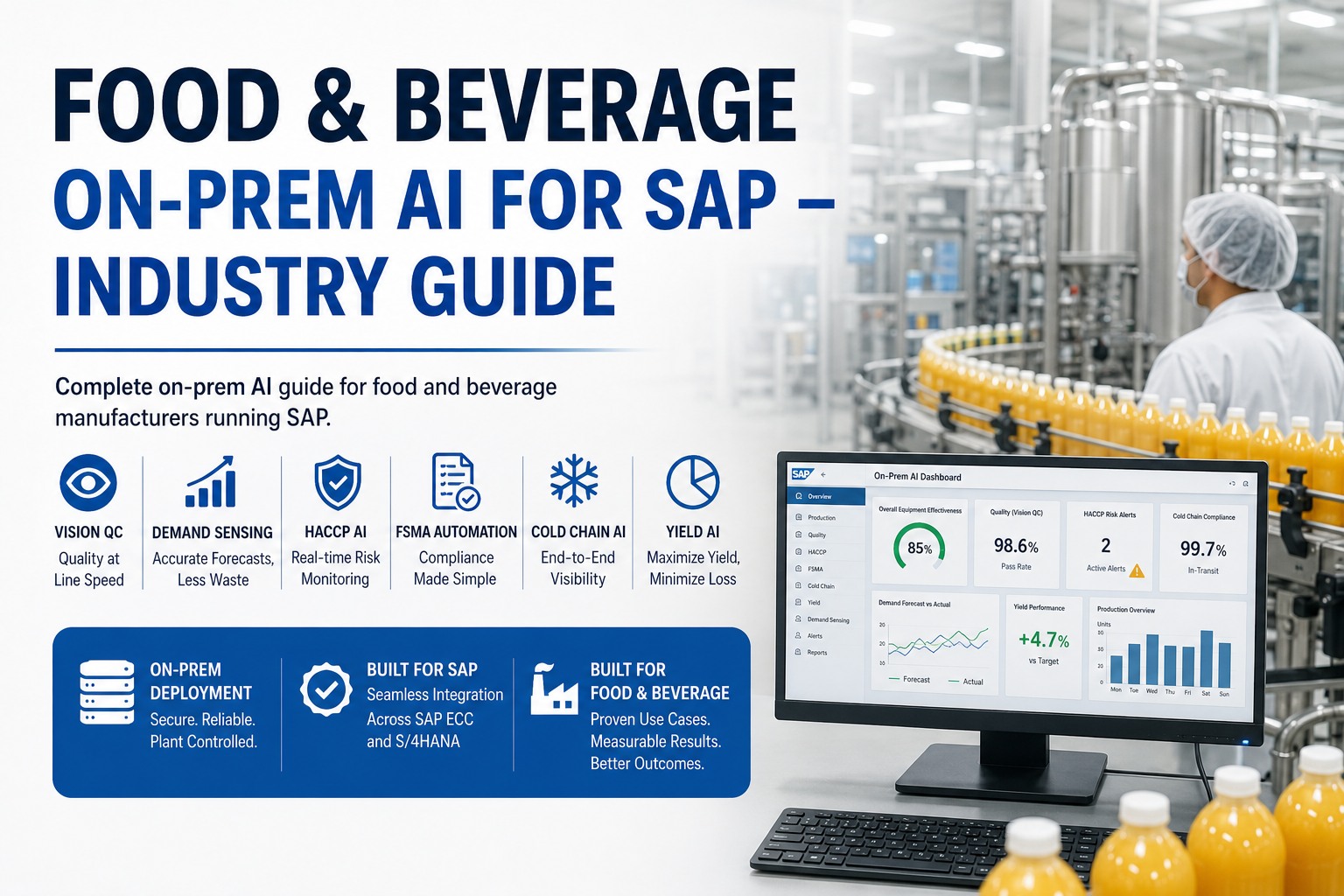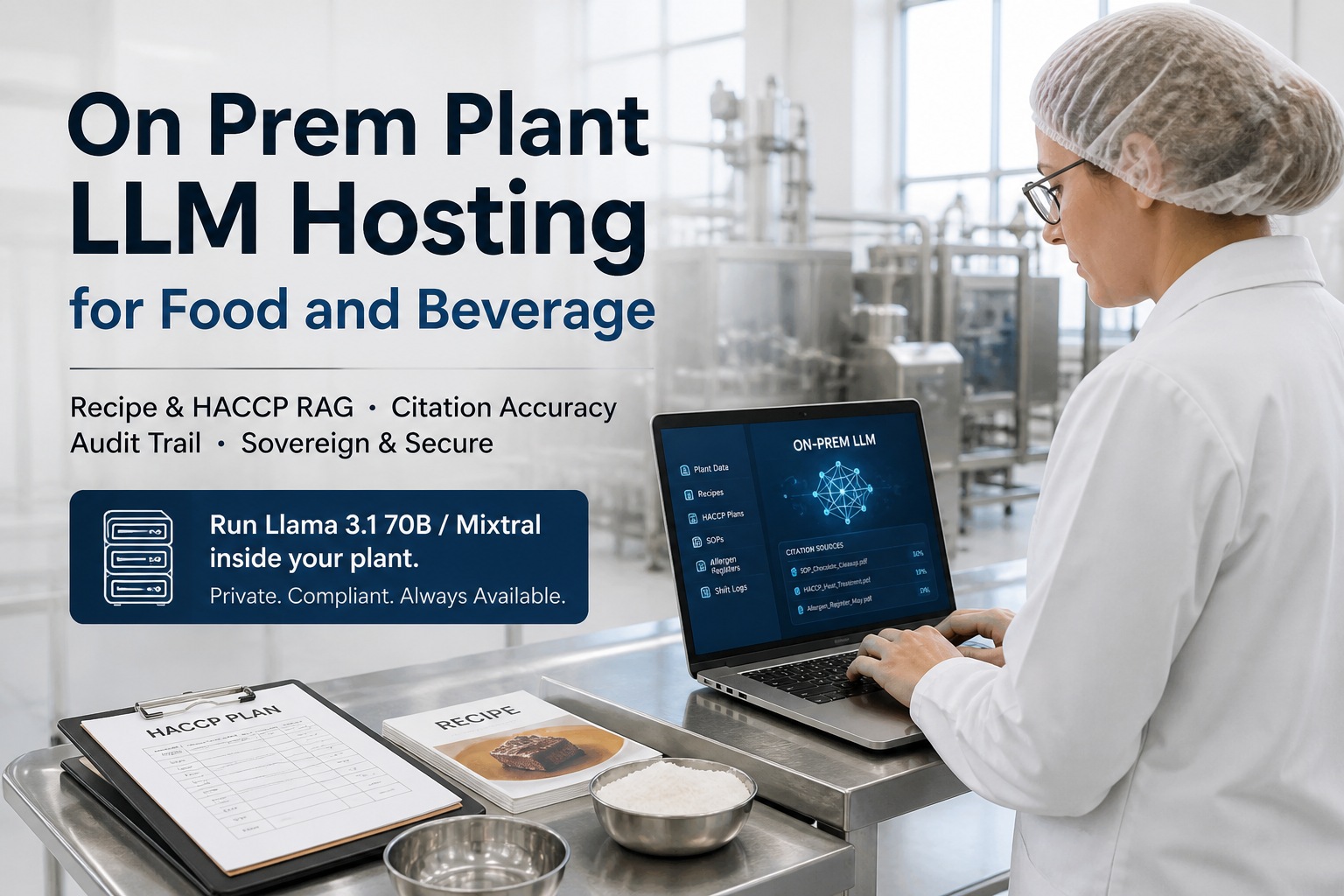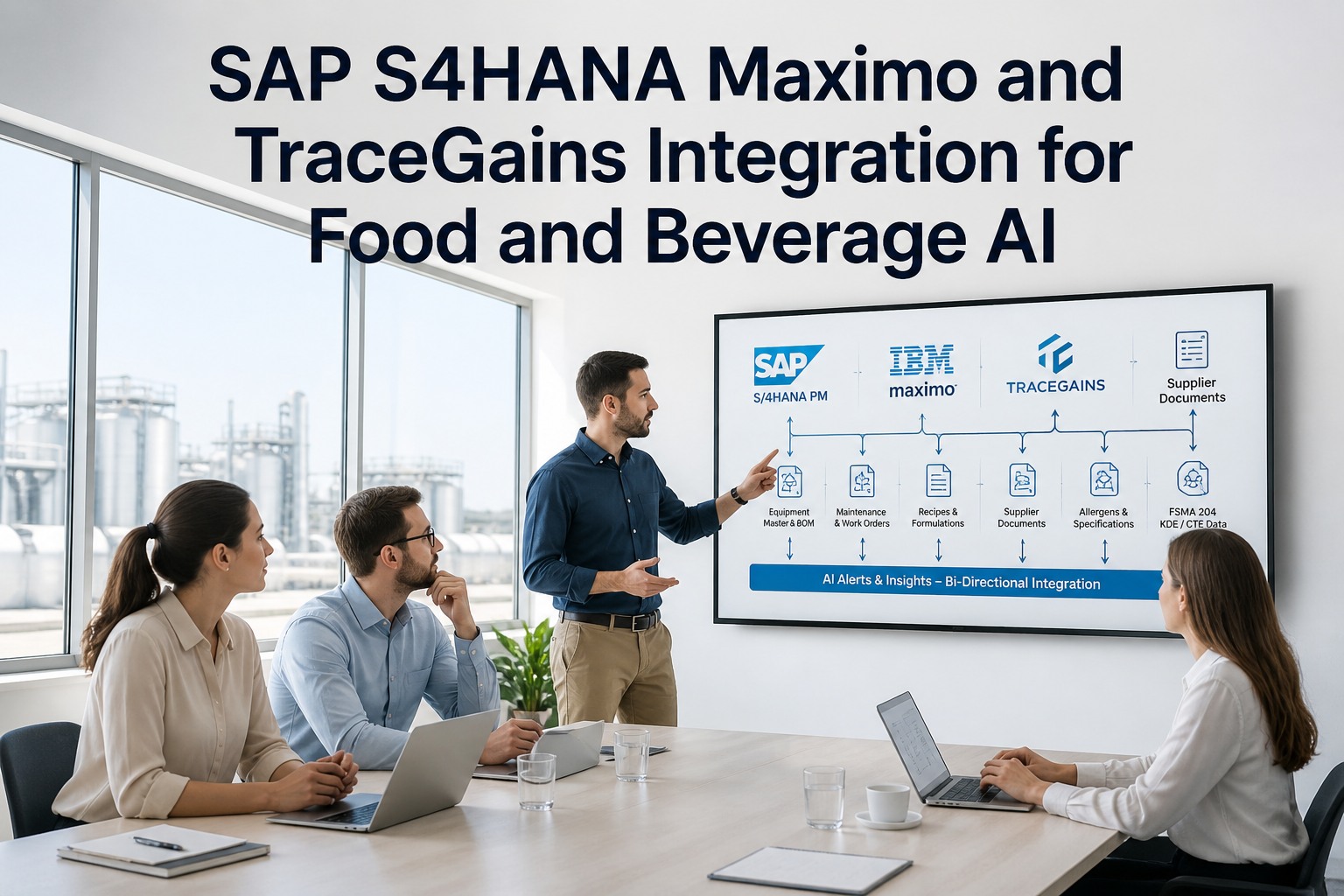
Food and beverage manufacturers don't get to choose between SAP, Maximo, and TraceGains—they live inside all three. Equipment master and work orders sit in S/4HANA PM. Asset health and CMMS workflows live in IBM Maximo. Supplier docs, allergen declarations, and FSMA 204 traceability data flow through TraceGains. The AI layer that ties them together has to read from all three, write back to all three, and produce auditable, regulator-ready records on demand. With FSMA 204 compliance now in effect, the cost of NOT bridging these systems with AI-grade automation is non-conformances, missed CAPAs, and recall investigations that take weeks instead of days. This guide walks through what that bridge looks like, how KDE/CTE data flows, and how an LLM drafts non-conformance and CAPA narratives directly into the systems your QA and operations teams already use.
SAP, Maximo & TraceGains Integration for F&B AI
Join the iFactory team for a live walkthrough of bidirectional integration between SAP S/4HANA PM, IBM Maximo, and TraceGains for food and beverage plants. Cover equipment master sync, recipe and allergen flow, FSMA 204 KDE/CTE bridge, and LLM-drafted CAPA narratives—built on 1,000+ enterprise implementations.
SAP S/4HANA, Maximo & TraceGains — What Each One Owns
Every F&B plant runs at least two of these three systems, and most run all three. The AI integration layer doesn't try to replace any of them—it makes them act like one. Book a 30-minute call with our integration engineers to map your exact data flows.
The system of record for equipment master, work orders, recipe headers, batch management, and allergen flags. Manages co-products, by-products, and process orders for F&B-specific manufacturing.
Where the maintenance team actually works. Asset hierarchy, condition monitoring, predictive maintenance triggers, and the work-order execution layer used by reliability engineers and field technicians on the plant floor.
The supplier network and compliance backbone. Supplier docs, COAs, FSMA 204 readiness data, allergen declarations, and the FTL/CTE/KDE pipeline. Spans 100,000+ supplier locations globally.
How the Bidirectional Bridge Actually Works
The integration node is the small, opinionated middleware that owns translation between systems—a Master Data Hub, an Event Router, and an LLM Narrator. None of them try to be the system of record. They just keep the three systems honest with each other.
Single source of truth for equipment ↔ asset ↔ supplier mapping. Resolves IDs across SAP equipment numbers, Maximo asset tags, and TraceGains supplier codes.
Routes events between systems with idempotent retries, audit logging, and conflict resolution. Webhooks in, webhooks out—every payload signed and versioned.
Drafts non-conformance and CAPA narratives in TraceGains and SAP QM tone. Uses event context, recipe, and supplier history—never makes up facts.
How a Lot Travels Through CTEs — From Receiving to Shipping
FSMA 204 enforcement at the FDA level continues, with companies expected to maintain Critical Tracking Event records and provide them within 24 hours of an FDA request. Whether you're already compliant or accelerating to meet a customer demand earlier than the FDA deadline, the KDE/CTE flow looks the same. Schedule a KDE/CTE flow review for your specific FTL products.
Inbound shipment of FTL ingredient hits the dock. Supplier ASN arrives via TraceGains; SAP creates inbound delivery; Maximo logs receiving asset usage.
Ingredient enters a process order. New TLC assigned for the output batch. SAP captures input/output lot link, Maximo logs equipment used, TraceGains updates allergen genealogy.
Optional CTE for temperature-sensitive product. Cold-chain sensor data flows from the floor into Maximo; deviations trigger automatic non-conformance creation.
Outbound to next supply-chain partner. SAP generates ASN; TraceGains transmits FSMA 204-compliant electronic record to receiver before the truck leaves the dock.
Tracking Allergens Across Three Systems Without Losing the Chain
Allergen declarations don't live in one system—they're scattered across SAP recipe master, supplier COAs in TraceGains, and equipment changeover records in Maximo. A clean genealogy stitches them into one chain that auditors can follow without ten clicks per question.
How the LLM Drafts Non-Conformance & CAPA Narratives
The most painful integration tax in F&B is not data—it's the narrative. QA writes the same incident in three different systems with three different formats. The LLM Narrator drafts once, files three times, and never invents facts it didn't observe.
Maximo flags a vibration anomaly on Filler Line 3. SAP QM creates an inspection lot. TraceGains receives a supplier deviation notification. The integration node correlates all three within seconds.
The model pulls the equipment history from Maximo, the affected lot from SAP, the supplier COA from TraceGains, and the relevant SOP. It does not invent context. It reads only what it is given.
One narrative is rewritten into three: the SAP QM notification format, the Maximo work-order log format, and the TraceGains non-conformance/CAPA format. Each respects the field structure of its target system.
QA gets a single review screen with the three drafts side-by-side. They edit anything they don't like, then a single approval pushes all three records into all three systems with full audit trail.
What Syncs Where — The Bidirectional Reference Map
Bidirectional integration is not "everything everywhere." It's "the right data, in the right direction, at the right time." Here's the field-level reference map for a typical F&B plant.
| Data Object | System of Record | Syncs To | Direction | Frequency |
|---|---|---|---|---|
| Equipment Master | SAP S/4HANA PM | Maximo | One-way | Real-time |
| Asset Health Status | IBM Maximo | SAP PM (notif.) | One-way | Real-time |
| Work Order | Maximo (exec) ↔ SAP (financial) | Both | Bidirectional | Real-time |
| Recipe Master | SAP S/4HANA | TraceGains (allergen view) | One-way | Daily |
| Supplier Docs / COAs | TraceGains | SAP QM (lot data) | One-way | On receipt |
| FSMA 204 KDE/CTE | TraceGains | SAP (inbound/outbound) | Bidirectional | Real-time |
| Non-Conformance / CAPA | TraceGains | SAP QM + Maximo WO | Bidirectional | Real-time |
| Allergen Genealogy | Integration Node | All three | Bidirectional | Per batch |
| Batch Genealogy | SAP S/4HANA | TraceGains (TLC) | One-way | Per batch |
Where the Integration Pays Back — Five Concrete Wins
An integration project survives the budget review when each work-stream has a measurable payback. These are the five plant operators ask us about most.
The FSMA 204 24-hour electronic record requirement collapses from a frantic three-system spreadsheet hunt into a single Master Data Hub query. Auditable, sortable, ready in minutes.
FSMA 204 was designed to compress investigation time from 5–6 weeks to 5–6 days. Bridged systems make it possible. Without the bridge, the data exists but cannot be assembled fast enough.
QA stops writing the same non-conformance into SAP, Maximo, and TraceGains. The LLM Narrator drafts once; one approval files three. Saves 2–4 hours per QA per shift.
The supplier-to-label allergen chain is queryable end-to-end. Customer audits and BRC/SQF assessors get one report instead of three system tours.
Maximo asset health flags propagate into SAP QM. A vibration anomaly on a filler is no longer just a maintenance ticket—it's a quality risk on every batch produced after the threshold.
New supplier docs in TraceGains automatically create vendor master entries and quality info records in SAP. Onboarding cycle drops from 2–3 weeks to 2–3 days.
The 10-Week Integration Cycle
A working SAP ↔ Maximo ↔ TraceGains bridge with the LLM Narrator typically goes from kickoff to production in 10 weeks. Most of that time is spec-and-mapping work, not code.
What F&B Plant Teams Ask Before Bridging Systems
These come up in every integration scoping call. Reach out to our support team for tailored answers on your stack.
No. The LLM Narrator is constrained to a structured retrieval pipeline. It can only write what it has read from SAP, Maximo, or TraceGains. Every drafted narrative is reviewed and approved by QA before being filed. Hallucination protection is built in.
That's normal. Most plants run two of the three. The integration node is modular—pick the lanes you need. SAP-only and SAP+TraceGains deployments are common starting points before adding Maximo later.
Every KDE/CTE event is captured at source, normalized in the Master Data Hub, and indexed by TLC. An FDA request becomes a single sortable query against the hub—usually answered in minutes instead of hours.
Yes—and you should. TraceGains is the network supplier interface; SAP is the manufacturer system of record. The bridge lets your suppliers keep using TraceGains exactly as they do today, while your QA team works in SAP without copy-paste.
Why F&B Plants Choose iFactory for SAP/Maximo/TraceGains Integration
Most integrators can connect APIs. Few have shipped production bridges that survive a real recall, a real FDA inquiry, and a real customer audit. Book a bridge-readiness review and we'll model your integration before you sign a PO.
Get a Bridge Plan for Your SAP, Maximo & TraceGains Stack
Thirty minutes with our integration engineers. Bring your SAP version, Maximo footprint, and TraceGains supplier count. We'll map your data flows, identify the highest-payback lanes, and give you a concrete 10-week bridge plan—before you commit a single dollar to integration spend.