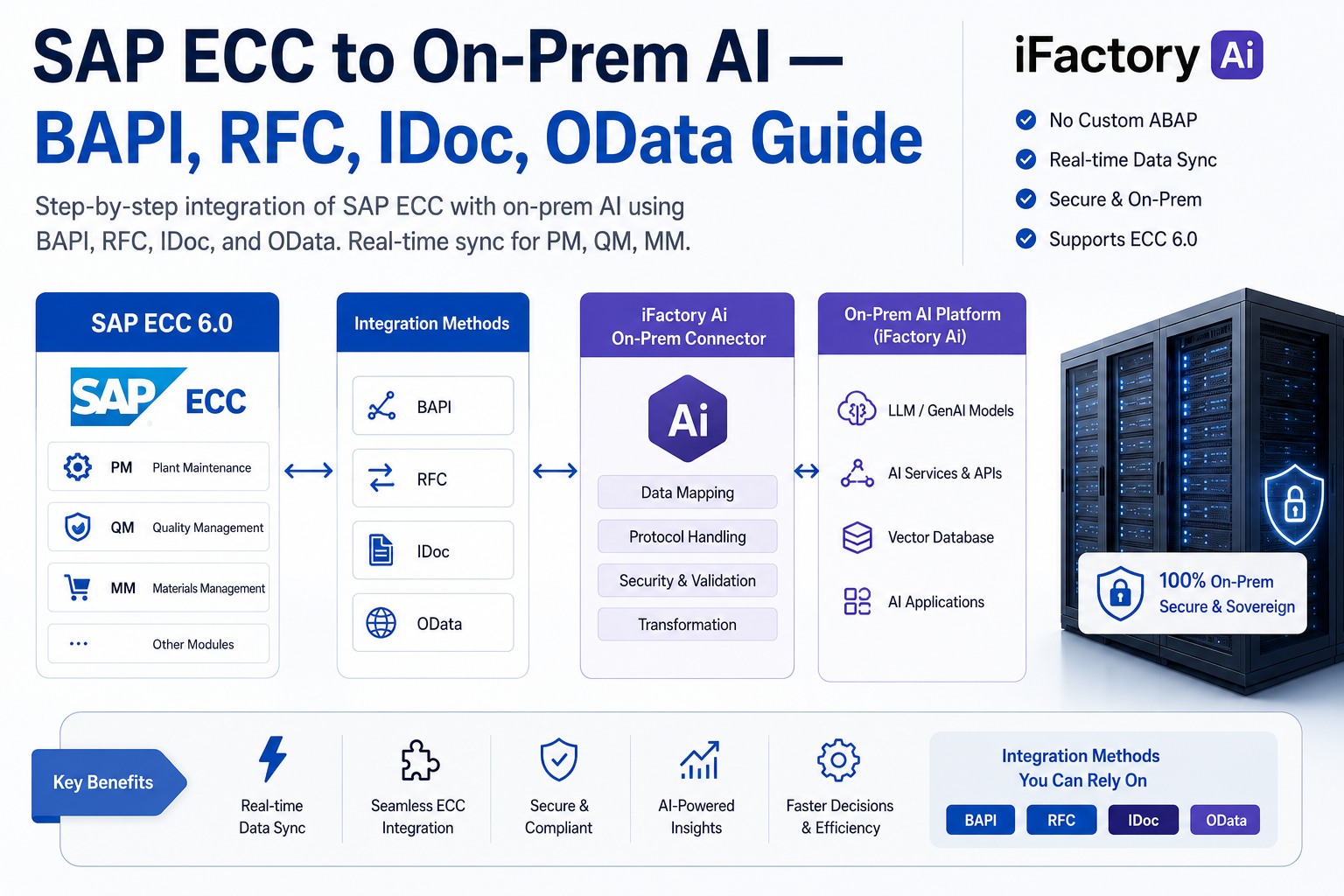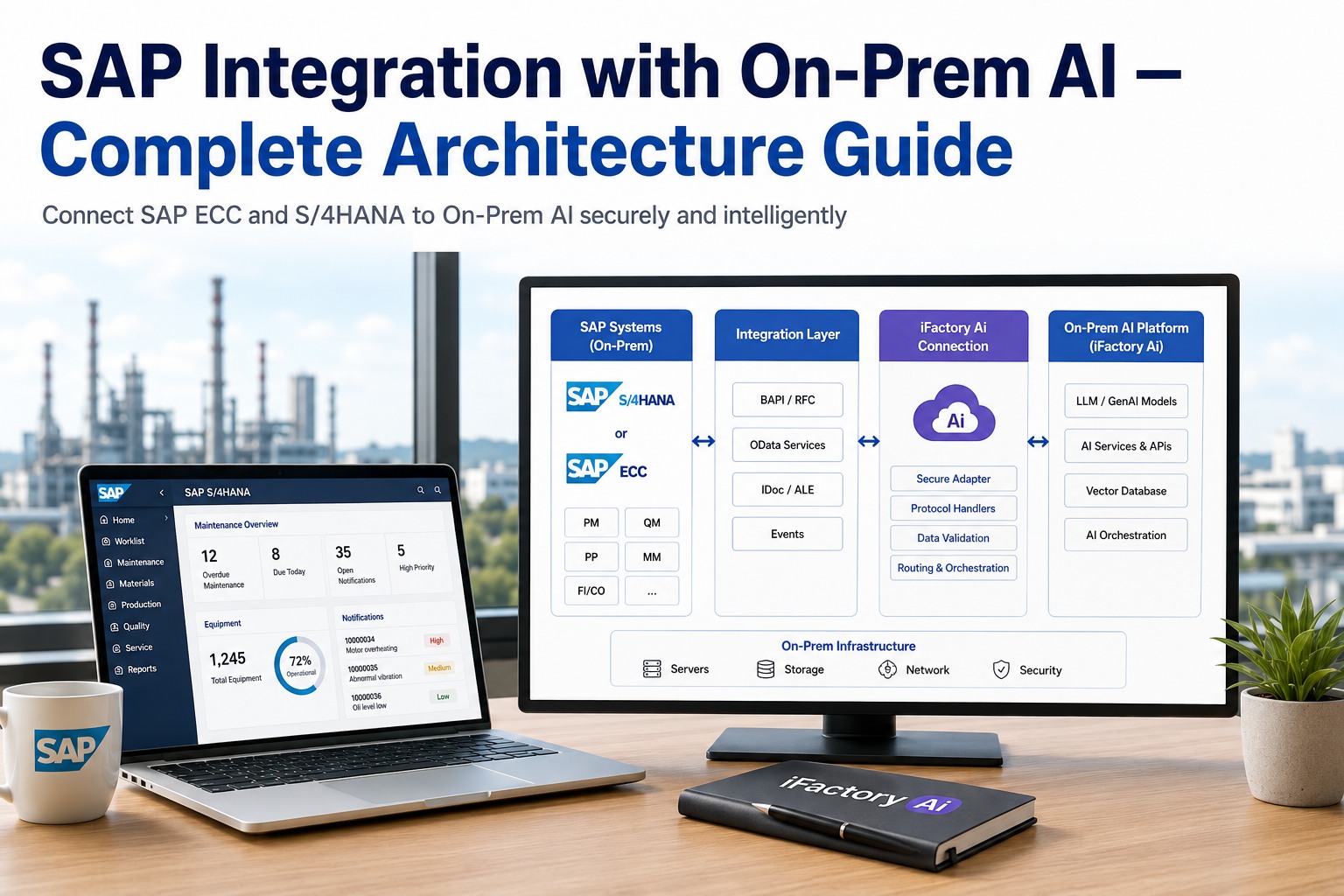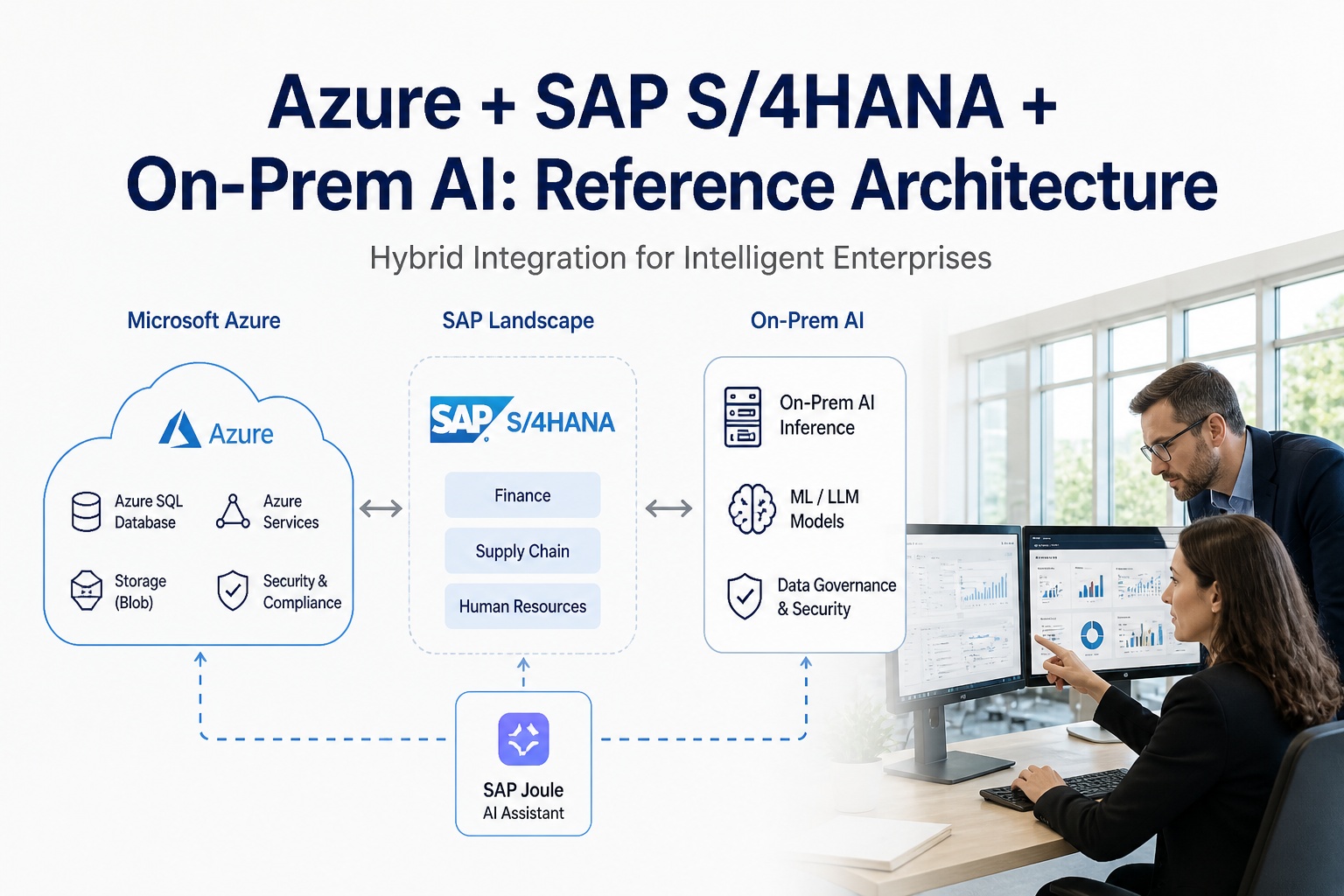
BAPI, IDoc, and OData calls are only the transport — what plants actually want from a SAP S/4HANA connector is module-specific intelligence on top. This guide covers iFactory's pre-built connectors for the three SAP modules that drive the most plant value: Plant Maintenance (PM), Quality Management (QM), and Materials Management (MM). For each, you will see the data objects, the AI use cases, the typical RFC and BAPI calls, and the outcomes that justify the integration. Production-tested on S/4HANA on-prem and S/4HANA Private Cloud through release 2023 and 2024.
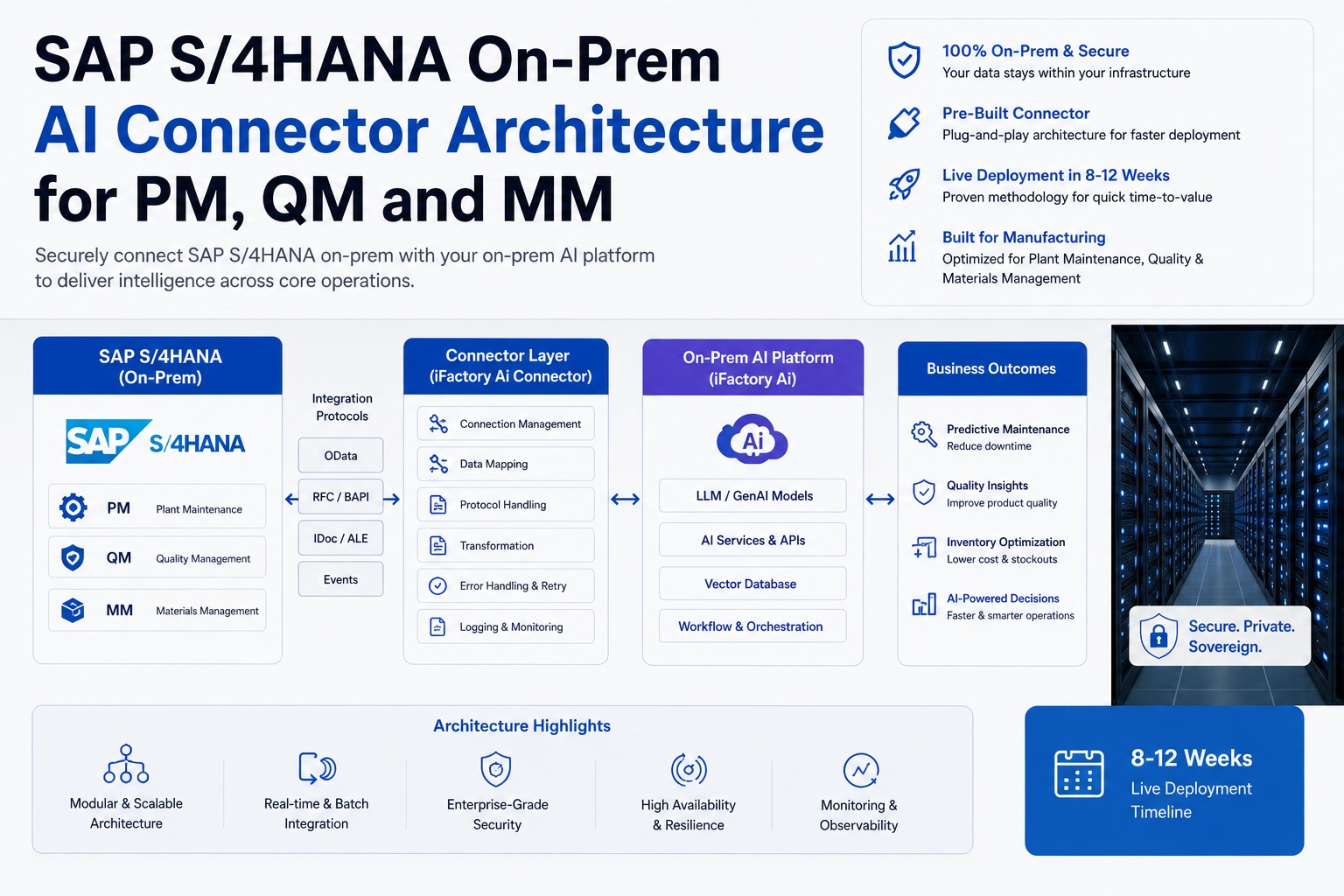
SAP S/4HANA On-Prem AI Connector Architecture for PM, QM and MM
Three SAP modules. One connector layer. Pre-configured for S/4HANA on-prem and S/4HANA Private Cloud. Each module ships with module-specific BAPIs, IDocs, OData services, and AI playbooks — production-tested, upgrade-safe, and live in 8–12 weeks.
Plant Maintenance
Equipment master · Functional locations · Work orders · Notifications · Maintenance plans
Quality Management
Inspection plans · Master inspection characteristics · Lots · Usage decisions · Q-notifications
Materials Management
Material master · BOMs · Purchase orders · Goods movements · aATP · Source lists
What You Get — Turnkey S/4HANA Module Connectors
Pre-built. Pre-tested. Pre-loaded on NVIDIA DGX. Three modules, one ship, one go-live. No middleware tax.
Hardware
NVIDIA DGX, pre-racked, pre-cabled, ships ready to plug in.
Module Connectors
PM, QM, MM connectors with all BAPIs and OData services pre-wired.
Training
Module-specific playbooks for Basis, operators, and supervisors.
Support
24×7 monitoring, S/4HANA release compatibility, SLA-backed uptime.
Work Order #4500001847
Plant Maintenance Connector
Every iFactory plant connector for SAP PM ships with the same goal — predictive maintenance signals trigger SAP-side work orders, with notifications, technician assignment, spares confirmation, and audit trail all happening through standard PM transactions. No custom Z-tables. No parallel maintenance system.
What the connector does
Reads equipment master, functional locations, maintenance plans, and PM notifications in real time. Writes notifications, work orders, confirmations, and measurement documents from AI predictions.
Key BAPIs & objects
BAPI_ALM_ORDER_MAINTAIN, BAPI_EQUI_GETLIST, BAPI_ALM_NOTIF_CREATE, BAPI_MEASUREM_CREATE — plus CDS view I_MaintenanceOrder for fast OData reads.
AI use cases
Predictive maintenance from sensor data, vibration anomaly detection, energy-driven scheduling, technician skill matching, and spares pre-staging from forecasted failure dates.
Typical outcome
45% reduction in unplanned downtime · 30% drop in emergency PM work orders · 2× faster MTTR via auto-assigned technicians and pre-confirmed spares.
Quality Management Connector
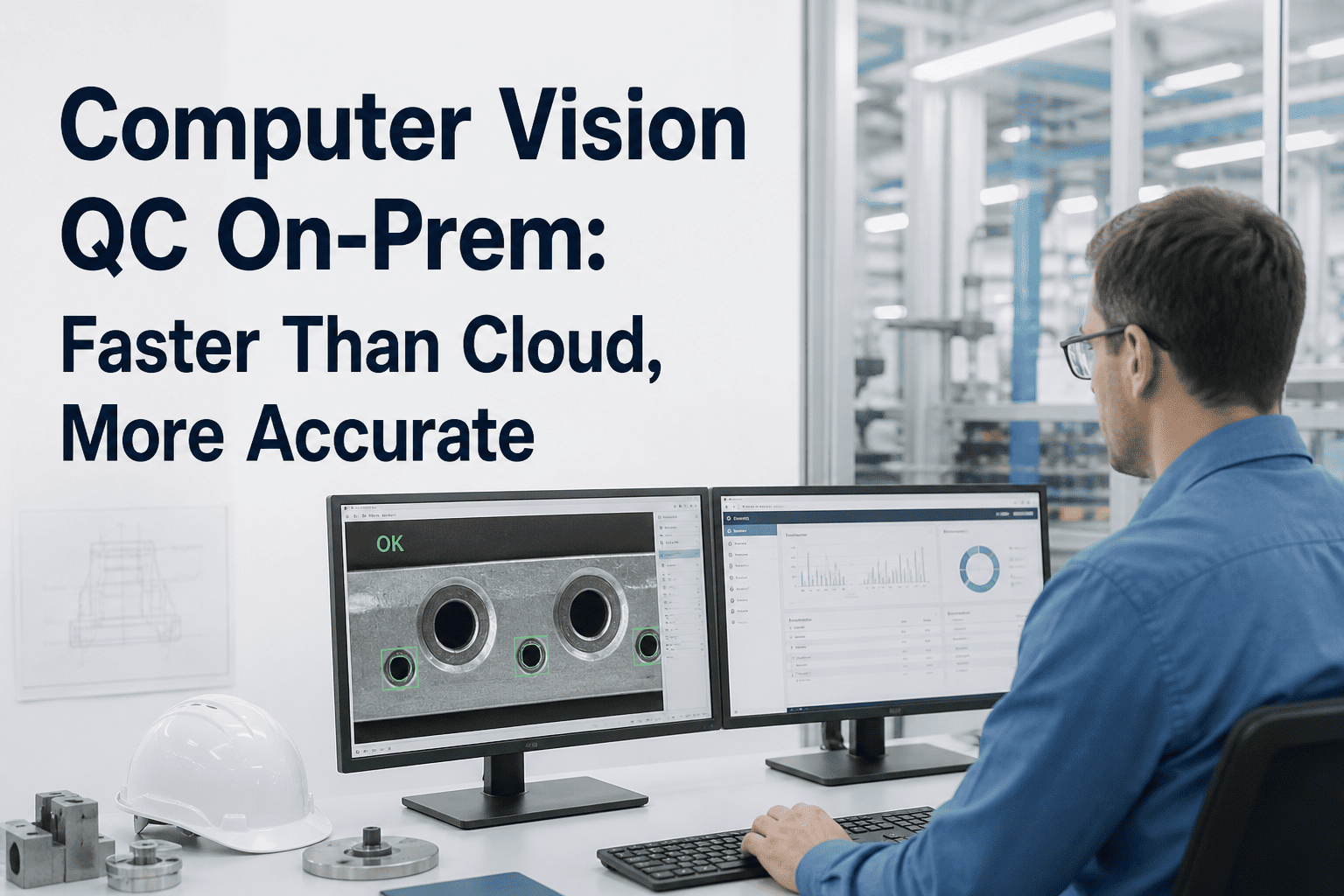
QM is where AI vision and SAP intersect most powerfully. iFactory's QM connector turns every camera-detected defect into a properly-coded inspection result with usage decision, q-notification, and full traceability — all inside SAP QM, not a parallel quality system that nobody trusts at audit time.
What the connector does
Reads inspection plans, master inspection characteristics (MICs), and inspection lots. Writes inspection results, usage decisions (UD), quality notifications, and defect catalog entries — with annotated AI vision images attached as DMS documents.
Key BAPIs & objects
BAPI_INSPLOT_GETLIST, BAPI_INSPLOT_USAGEDECISION, BAPI_QNOTIF_CREATEFROMDATA, BAPI_INSPOPER_RECORDRESULTS — plus IDoc QPGR05 for inspection result transfer.
AI use cases
Vision-based defect detection on lines, automatic UD with confidence scoring, audit-grade defect classification, GxP-compliant evidence packaging for regulated industries.
Typical outcome
30% defect reduction · 90% less manual inspection time · 100% audit-grade traceability with vision evidence attached to every q-notification.
Inspection Lot 100087421
Purchase Order 4500009127
Materials Management Connector
MM is the connector that pays for the whole project. AI sees the consumption trends the planners miss, predicts the stockouts they will not catch in time, and triggers source-list-compliant POs before production ever pauses. Every transaction goes through SAP's aATP and procurement governance — no shadow purchasing.
What the connector does
Reads material master, BOMs, source lists, info records, vendor master, and live stock levels via aATP. Writes purchase orders, goods movements, reservations, and STOs — always honoring source list policy and approval hierarchies.
Key BAPIs & objects
BAPI_PO_CREATE1, BAPI_GOODSMVT_CREATE, BAPI_MATERIAL_AVAILABILITY, BAPI_RESERVATION_CREATE1 — plus aATP service API_PRODUCT_AVAILABILITY_SRV.
AI use cases
Demand sensing from POS or shop-floor consumption, predictive stockout alerts, dynamic safety stock, supplier risk scoring, and goods movement auto-posting from sensor-confirmed throughput.
Typical outcome
$2.3M average 3-year inventory cost reduction per plant · 80% drop in emergency POs · 25% improvement in fill rate without raising safety stock.
How Data Flows — Top to Bottom, Both Directions
One pipeline. Bidirectional. Every transaction observable at every layer. The vertical view below is exactly how the connector sits between your S/4HANA system and the iFactory AI brain.
SAP S/4HANA
System of record. Source of truth for PM equipment, QM lots, MM materials. Reads via OData CDS views; writes via BAPI through bgRFC destination.
iFactory Connector Layer
Module-specific adapters for PM, QM, MM. Handles authentication, transactional commits, retries, and protocol selection. Replaces SAP xMII for the on-prem AI use case.
Data Fabric
Time-series store, vector database, knowledge graph. Caches SAP master data for sub-second copilot queries. Buffers SAP writes if S/4HANA is briefly unavailable.
AI Brain — NVIDIA DGX
Best-in-class models — vision for QM, time-series for PM, foundation LLM for the copilot. Generates predictions, recommendations, and actions back into SAP.
Sync vs Async — Per Module Defaults
Each module has a default protocol pairing that reflects how plants actually use the data. These defaults are what ships out of the box — they are overridable but rarely need to be.
Real-time work order creation and notification posting. Operator expects an immediate SAP order number back. Latency budget — under 3 seconds.
Bulk measurement document uploads, shift-end equipment reading transfers. Eventual consistency is fine; throughput matters more than latency.
Usage decision posting must complete before the next pallet leaves the line. Latency budget — under 2 seconds, blocking on the conveyor signal.
Inspection result bulk transfers at shift end. ALE-filtered to send only lots with results that need master data sync to other systems.
Material availability checks during operator copilot queries. CDS view via OData hits S/4HANA in-memory column store. Latency budget — under 1 second.
Goods movement bulk postings from auto-counted production. Throughput-optimized parallel queues prevent dialog work process exhaustion.
One Query, All Three Modules
The dialogue below shows a single operator question routing through PM, QM, and MM connectors in parallel — every fact grounded in live SAP transactions, every action written back through standard BAPIs.
· SAP PM — Mixer #2 vibration trending high since 06:00; auto-created WO #4500001847 with priority 1, technician Ramesh assigned for 09:30
· SAP QM — Last 4 inspection lots show viscosity drift toward upper limit; AI vision confidence 94% on imminent spec breach within 2 lots
· SAP MM — Closure cap stock down to 9 hours at current run rate; auto-PO created via BAPI_PO_CREATE1, supplier 100847, lead time confirmed
The 8–12 Week Module Rollout Track
Reads first. Writes second. All three modules running concurrently — no waterfall, no waiting on one module to clear before the next begins.
Provision & Read Paths
SAP service users, authorization objects, RFC destinations. PM equipment master + QM inspection plans + MM material master read paths live.
Model Train & Pilot Reads
PdM models train on PM history. Vision models train on QM lots. Demand models train on MM consumption. Pilot copilot live on one line.
Write Paths & Pilot Acts
BAPI write paths validated in sandbox. WOs, UDs, POs created in pilot scope. SM20 audit traces verified end-to-end.
Plant Go-Live
Transport request promoted to production. All three modules live plant-wide. 24×7 monitoring active on all bgRFC queues and IDoc inboxes.
What Plants Measure After Module Go-Live
Aggregated from production deployments running the three-module connector on S/4HANA on-prem.
See PM, QM, MM live at SAP Sapphire 2026
Live demo of the three-module connector running against S/4HANA — operator chat, auto-WO, AI-vision UD, predictive auto-PO. Book a 20-minute walkthrough.
Frequently Asked Questions
Do I need to buy NVIDIA servers separately?
No. Fully-loaded NVIDIA DGX AI servers are supplied and installed as part of the iFactory package. They ship pre-racked, pre-cabled, with all NeMo, RAPIDS, NIM, and Agent Toolkit components pre-installed alongside the PM, QM, and MM connector library. You provide power and Ethernet. We provide the rest.
Which S/4HANA releases are supported?
S/4HANA 1809 through 2024, both on-premise and Private Cloud editions. The connectors handle the extended material number (40 chars), Universal Journal, and embedded analytics CDS views automatically. S/4HANA Cloud public edition is not the target — that environment requires SAP's own integration suite.
Can I deploy only one module instead of all three?
Yes. The most common starting point is PM-only — predictive maintenance gives the fastest payback. QM and MM are layered in during weeks 5–10 of the same deployment, but each is opt-in. The connector library is modular; you license what you use.
How does the connector handle S/4HANA Fiori & OData services?
Fiori UIs and iFactory copilots can coexist. The connector reads via the same OData services Fiori uses (CDS views on HANA's column store), so the data is consistent across both. AI predictions surface in the iFactory copilot; SAP transactions remain manageable via Fiori for users who prefer the standard UI.
What happens to an AI-created work order if a planner edits it in SAP?
SAP wins. The AI creates the WO with the data it had at creation time. Any subsequent planner edit in IW31 or Fiori takes precedence — the AI never overwrites a human-edited field unless the AI is explicitly granted update authority on that field. Audit log shows both the AI creation and the planner edit.
Can AI auto-post goods movements without operator approval?
Configurable per material group and per movement type. By default — automatic posting for sensor-confirmed movements with high AI confidence and low transaction value. Manual approval is required for high-value materials, regulated batches, or movements above a threshold. The threshold is set during the architecture review.
How is the connector audited?
Three audit layers. SAP-side — SM20 logs every service-user transaction. iFactory side — every AI prediction and resulting BAPI call is logged with timestamp, user, and confidence score. Combined — a single audit view joins both and is exportable for regulatory inspections.
Is the connector compatible with SAP DMC (Digital Manufacturing Cloud)?
Yes. iFactory can coexist with SAP DMC where DMC handles MES execution and iFactory handles AI. The two systems integrate at the SAP layer — DMC writes to S/4HANA via RFC, iFactory reads the resulting transactions via OData and writes its AI-driven outcomes via BAPI. No direct DMC-to-iFactory coupling needed.
Three Modules. One Connector. Live in 8–12 Weeks.
Plant Maintenance, Quality Management, and Materials Management — all wired to your S/4HANA system, all governed by your SAP authorization, all running on-prem on NVIDIA DGX. Pick one module to start or roll all three at once.