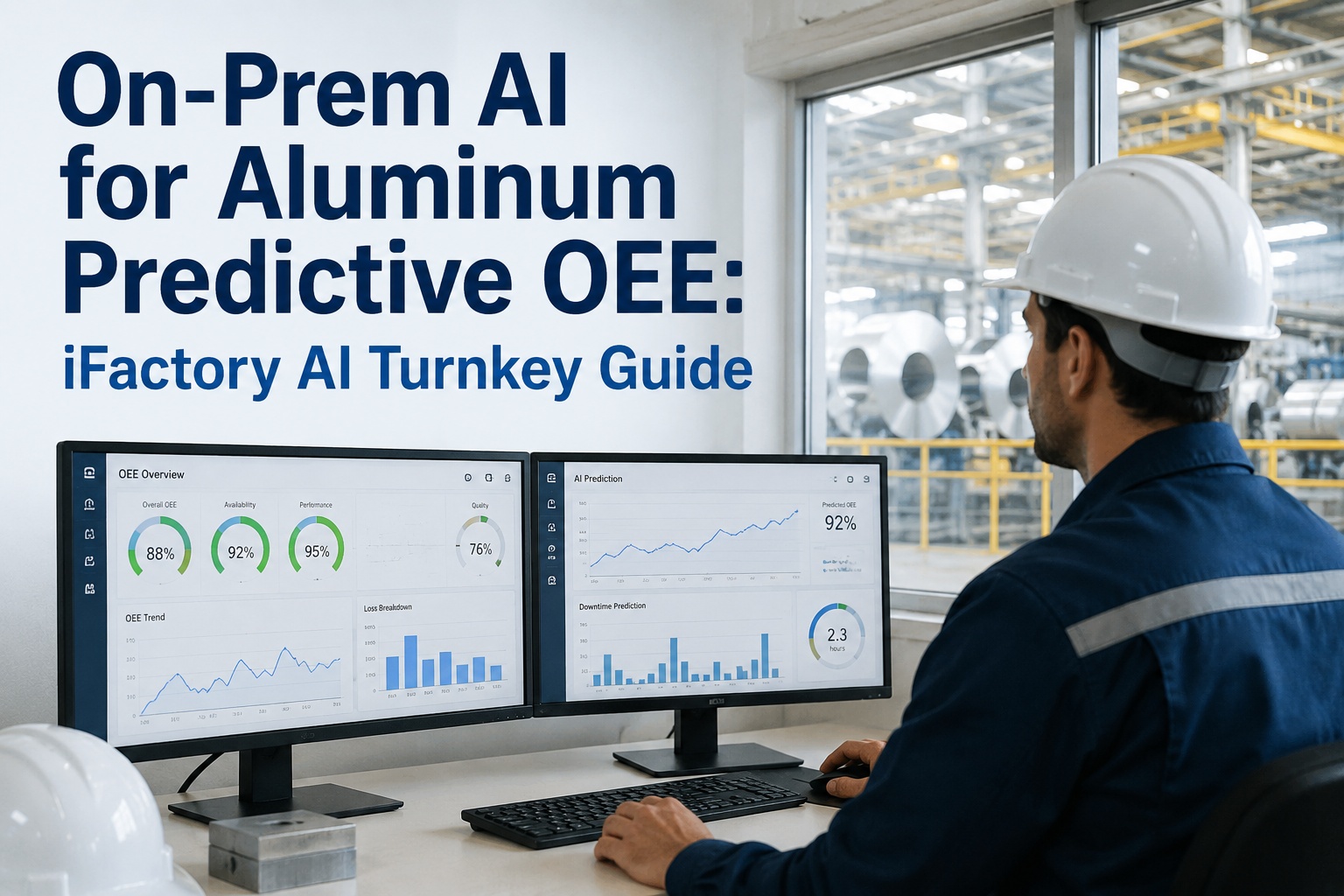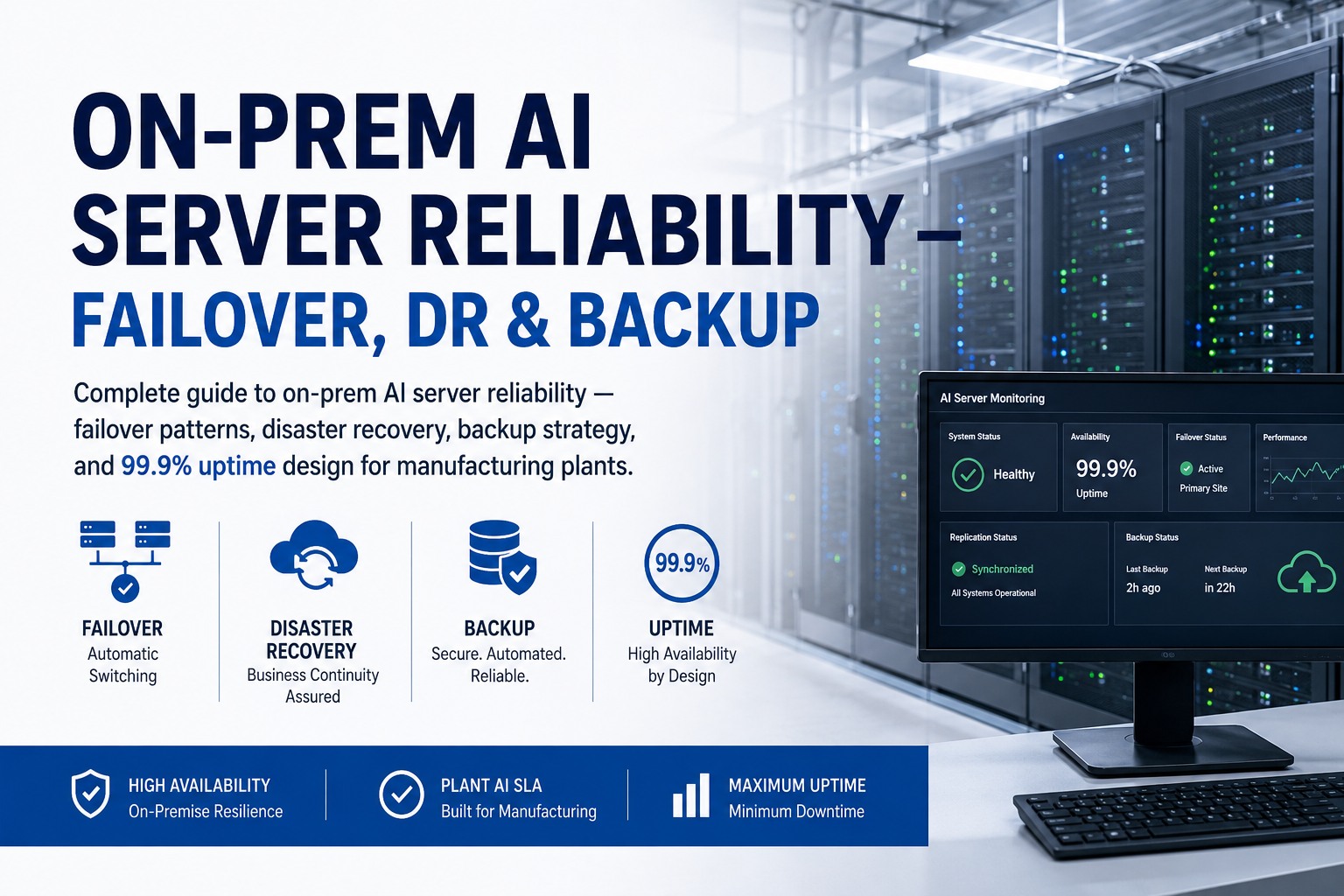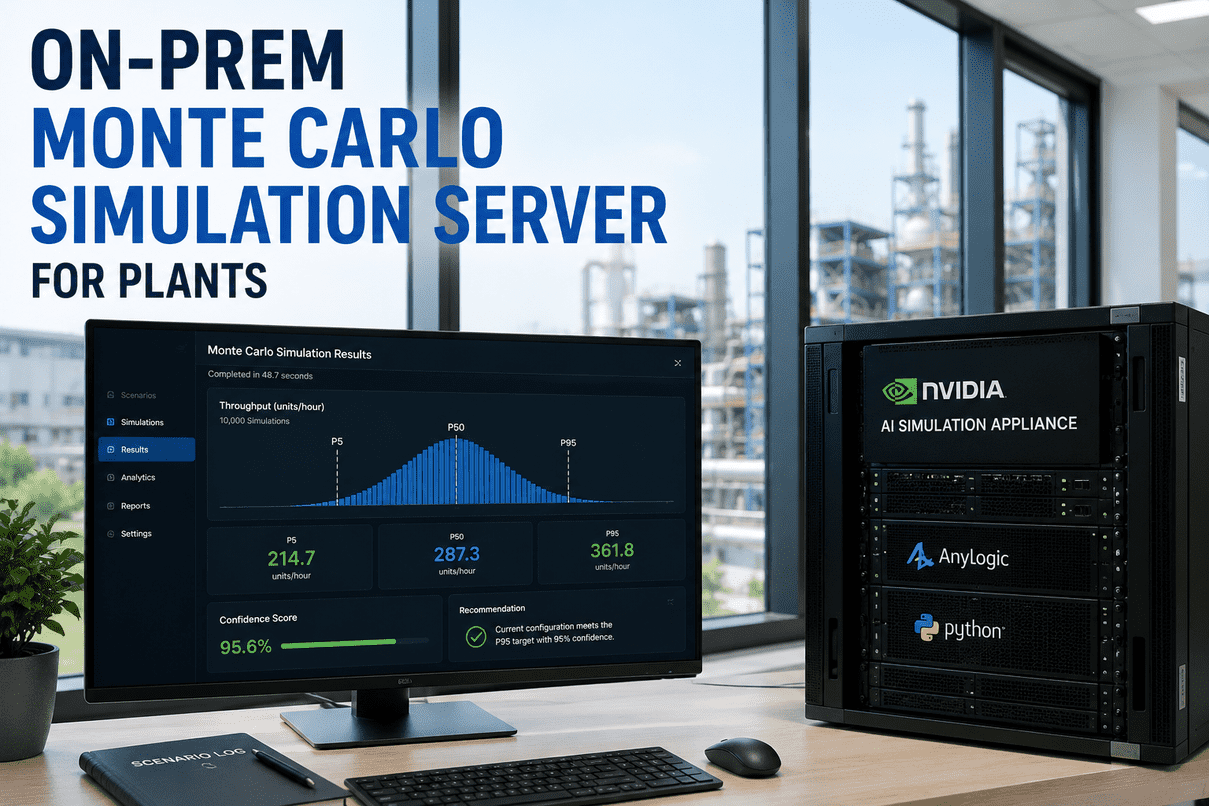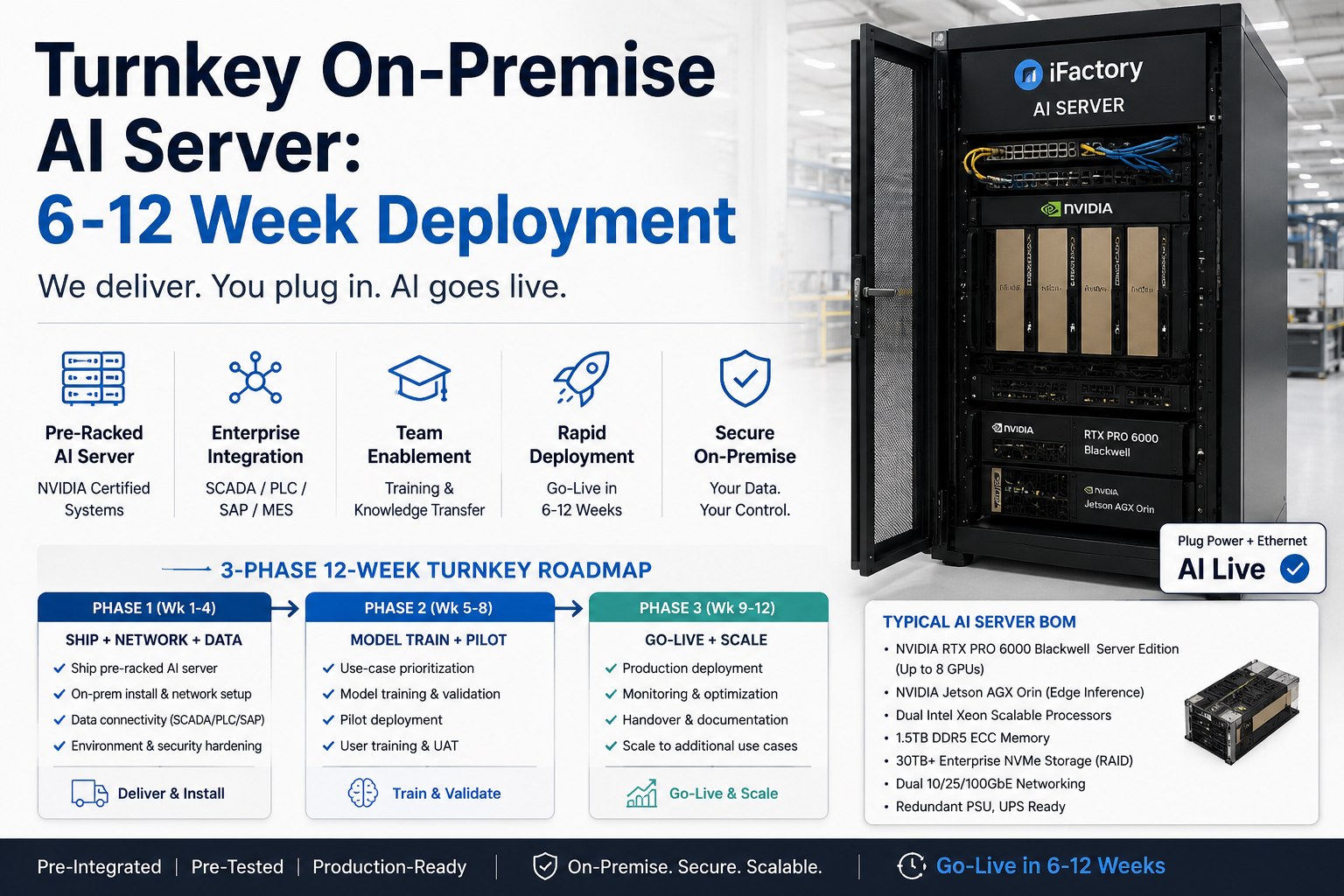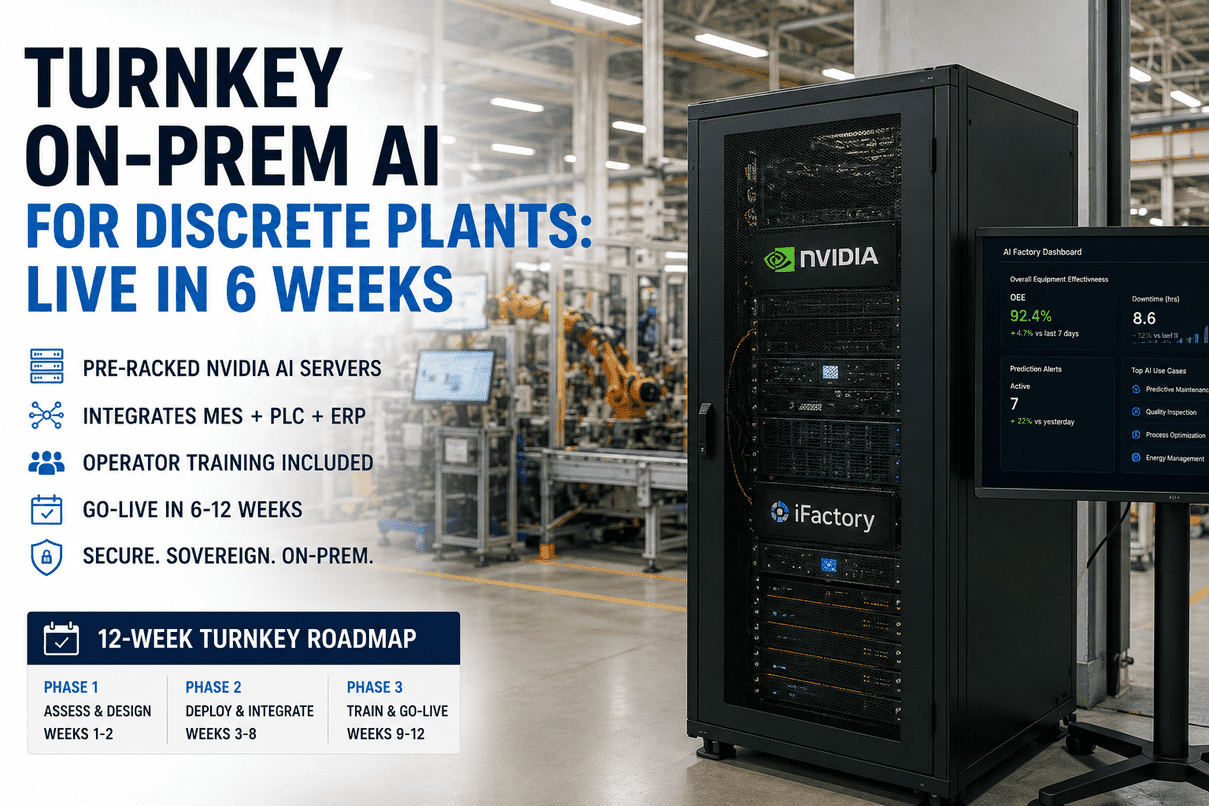
A plant manager evaluates an AI vendor on a Tuesday. The pitch deck is impressive. By the third meeting they discover the "AI platform" needs a GPU cluster they don't own, an MLOps team they haven't hired, six months of cloud data egress, an MES integration project they don't have budget for, and a security review their CISO hasn't started. The pilot slips from Q2 to Q4. The deployment gets re-scoped twice. Eighteen months later there's a slide deck full of dashboards but the line operators are still using the same Excel sheets they used in 2023. According to research published in the Proceedings of the IEEE, over 60% of manufacturers cite data integration as the primary barrier to smart factory implementation, and survey data on agentic ERP rollouts shows only 14% pilot success rates revealing implementation discipline gaps. iFactory is built around the opposite arc. The hardware ships racked, pre-loaded, and configured. Plug power and Ethernet — AI is live. The integration to your MES, ERP, PLCs, SCADA, and historian is part of scope, not a separate professional services contract. Operators are trained in the same window. Total elapsed time from PO to your floor running production AI: 6 to 12 weeks.
Turnkey On-Premise AI For Discrete Manufacturing —
Live On Your Floor In 6 To 12 Weeks
Pre-racked NVIDIA AI server. Pre-loaded software stack. MES, ERP, PLC, SCADA, and historian integrations in scope. Operator training included. CapEx purchase, you own the appliance, data stays inside your perimeter. The decision you're evaluating isn't "will AI work in our plant" — it's "do we want a vendor who arrives with a finished system or one who arrives with a six-month implementation project."
Why Most Discrete Manufacturing AI Projects Stall — And What Actually Ships
The gap between AI announcements and AI on the plant floor is widening, not closing. The numbers below are not opinions — they're what the analysts and deployment teams have been writing for the past twelve months. Read them as a checklist of what your turnkey vendor needs to absorb so you don't have to.
The pattern: the AI model isn't the problem. The integration is. The hardware procurement is. The change management is. Deloitte found manufacturers including all infrastructure costs in their business case achieve 85% of projected ROI, while those who underestimate achieve only 45%. A turnkey scope is the structural answer to a structural failure mode.
DIY AI Stack Vs. Turnkey Appliance — Honest Side-By-Side
Both paths can work. The honest comparison is about who absorbs which problems. The DIY path means your team owns hardware procurement, software stack assembly, integration, security review, and operator change management. The turnkey path means a single vendor absorbs all five and ships you a working system with a defined go-live date.
Three Phases — From PO To Live AI On Your Floor
A turnkey deployment isn't a magic trick — it's a sequenced project where the vendor owns the critical path. Below is the 12-week Gantt iFactory walks weekly with every customer. Each phase has a defined exit criterion. The schedule is conservative; many deployments land at 6–8 weeks when CAD and PI mappings are clean.
The "rip the bandaid" point: the reason this works is that hardware ships ready, integrations are pre-built, and the model fine-tunes inside your perimeter. The schedule is realistic precisely because no part of it is being invented during the project. Walk through your Gantt with our deployment lead.
The Three-Node Appliance Every iFactory Plant Runs On
The hardware below is what arrives on a pallet at your plant. One AI server, two edge nodes. The NVIDIA RTX PRO 6000 Blackwell Server Edition delivers a multifold increase in performance for enterprise AI applications including LLM inference for agentic AI, data analytics, engineering simulation, and visual computing — and ships with 96 GB of GDDR7 memory because plant-scale workloads outgrow smaller GPUs in month three.
Pre-Built Connectors For The Stack You Already Run
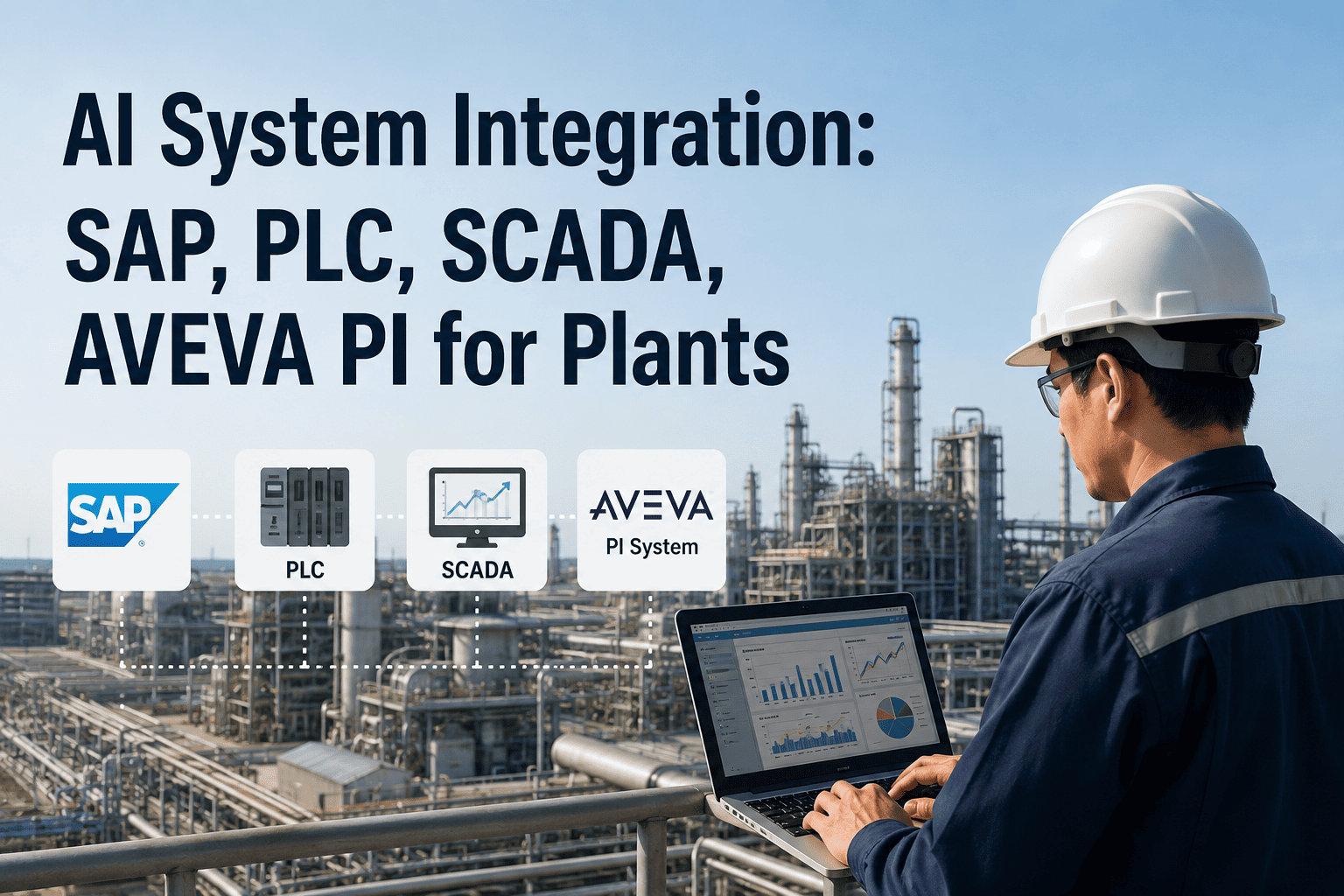
A turnkey appliance is only "turnkey" if the integrations are part of scope. iFactory ships with pre-built, production-tested connectors to the platforms that run discrete manufacturing in 2026. No new SI engagement, no greenfield API work, no months of OPC-UA debugging. Bring your tag list and your ERP credentials; we do the rest.
2:14 PM — Operator Asks The AI Why Cell 4 Just Slowed Down
An illustrative scenario showing the appliance in routine use. Numbers are representative. The point isn't the specific recommendation — it's that the line operator gets a useful answer in seconds, on the same screen, in plain language, without escalating to engineering.
— Hydraulic temperature on Press-04 climbed 8°C above the 90-day baseline starting 12:42 PM.
— Material lot changed at 12:55 PM (Lot K-2208 to K-2210); new lot has 0.3mm thicker stock per incoming QC.
Most likely cause: thicker stock + hotter hydraulics is increasing dwell time per stroke. Suggested next step: check coolant flow on Press-04 and confirm Lot K-2210 spec with receiving.
What just happened: the operator got an answer that pulled from the historian (hydraulic temp), the MES (cycle time), the ERP (incoming QC lot data), and pattern history (prior occurrences). Three systems, one query, six seconds. That conversation didn't need an engineer, didn't need a dashboard, didn't need an escalation. It needed the data to be in one place and the AI to be allowed to read all of it. Which is what the appliance is.
What Discrete Manufacturers Run On The Appliance In Year 1
Most plants pick one anchor use case in the first 12 weeks, prove ROI, then expand to 3–5 cases on the same appliance over the following year. Across hundreds of US deployments, four AI use cases consistently produce measurable operational impact: predictive maintenance, quality anomaly detection, energy optimisation, and operator-assist conversational AI. The matrix below maps the most common starting points.
Surface defects, dimensional drift, assembly errors flagged in <100 ms. Reuses the cameras you already own. Typical pilot: one line, 4 weeks. Typical year-1: 20–40% reduction in escapes to customer.
Vibration, current, temperature, acoustic signatures fused with maintenance history. Continental AG achieved 37% downtime reduction across 4 tire manufacturing plants with annual savings exceeding EUR 8 million. Typical anchor for plants with high-cost downtime.
Auto-attributes downtime, slow-cycle, scrap to root cause. Replaces the morning huddle spreadsheet. Operators see "why" in their language, not in BI dashboards.
The chat from the prior section. Pulls from MES, ERP, historian, maintenance log to answer operator questions without escalation. Reduces engineering pulls 30–50%.
Sub-meter data fused with production schedule. Identifies idle-state waste, peak-tariff exposure, equipment-level outliers. Pays back fastest in energy-intensive discrete (heat treatment, casting, drying).
Recommends sequence, predicts dwell, flags missing tooling. Codifies tribal knowledge from senior operators so newer crews hit the same numbers.
Why Turnkey + CapEx Beats Cloud AI Subscription Maths On A 5-Year Horizon
The economics for plant-scale AI are different from the economics for chatbot AI. Plant data is high-volume, latency-sensitive, sovereignty-bound, and runs continuously. Cloud subscription pricing scales linearly with all four. On-prem CapEx pays back fastest exactly where cloud pricing is most punishing — which is most discrete manufacturing plants.
Honest caveat: if your AI workload is small, intermittent, and not latency-sensitive, cloud subscriptions can win on Year 1 cash. Plants don't usually fit that profile. By year 3, the appliance has typically paid back twice over and the data has never left your zone.
What Plant Managers, COOs & IT Directors Ask Before Signing
Hardware ships pre-racked and pre-loaded — your IT team doesn't build the AI server, install CUDA, or assemble the inference stack. Network, MES/ERP, PLC, and historian connectors are part of scope. Your IT team provides credentials, network drops, and security review. The vendor brings everything else and walks the Gantt weekly.
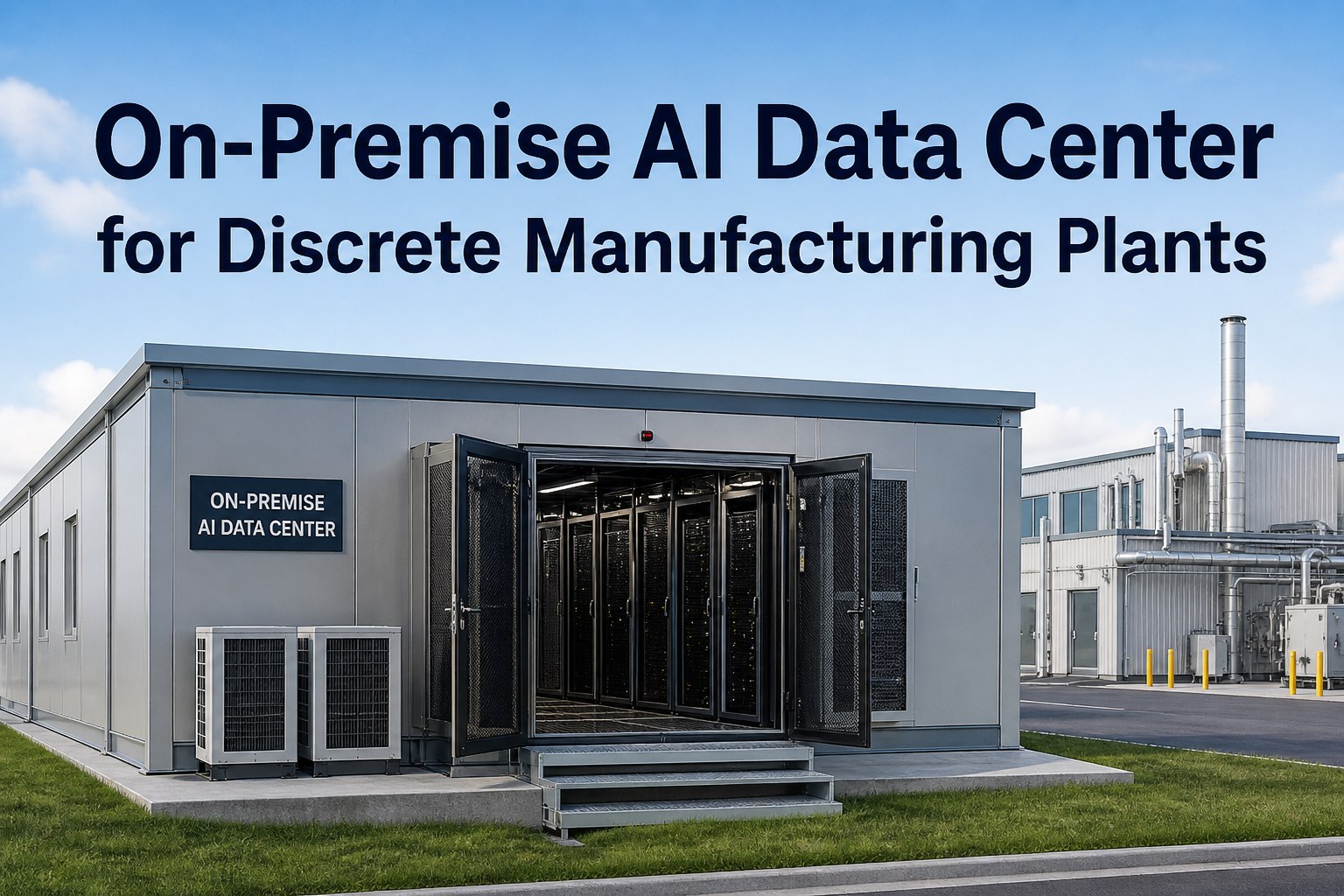
Stays inside your perimeter. The appliance lives in your control building or IT room. PI tags, MES records, ERP data, video feeds, model weights — none of it leaves your zone. Air-gapped from public internet by default. The fine-tuning happens locally on your data; nothing is shared with other customers.
The honest answer: most slips trace to one of three things — late security review, MES credentials not granted in time, or operator-side change management. We Gantt these dependencies on day 1, surface them weekly, and own the parts the vendor controls. If the schedule slips because of a vendor-controlled item, the day-rate runs at our cost, not yours. That's contractual.
By default, no. The appliance reads from PLC, SCADA, MES, ERP, and historian. It surfaces recommendations to operators and engineers. Write-back is an opt-in capability, scoped per-tag, requires a separate change-control process, and never bypasses your DCS interlocks. Most plants run advisory-only for the first 12 months and consider write-back later.
Appliance keeps running. You own the hardware, the trained models, the data, the integrations, the runbooks. Renew annually for software updates, model refresh, and 24/7 remote monitoring — or run it in-house with our handover docs. NVIDIA AI Enterprise license stays with the appliance. No vendor lock-in beyond the connectors you keep using.
Yes. The first deployment establishes the integration patterns, model library, and operator workflow. Subsequent lines on the same site reuse the same appliance — typically 4–8 weeks per additional line. Multi-site rollouts use the same pattern; year 2 onwards we Gantt the fleet expansion against your capital and shutdown cycles.
Yes. The AGX Orin edge node speaks OPC-UA, Modbus TCP, EtherNet/IP, MQTT, and the major DCS protocols. Modern brownfield-ready systems use IIoT gateways and edge computing to extract data from legacy PLCs without requiring expensive hardware upgrades. We've connected to ControlLogix from 2008 and SIMATIC S7-300s in production for 18 years. If your PLC has any digital interface, we'll bridge it.
Honest range, not a marketing number: predictive maintenance pilots typically show 20–40% downtime reduction on the equipment in scope. Defect detection typically shows 15–35% reduction in escape rate. Operator copilot typically reduces engineering escalations 30–50%. Variability is high because plant baselines vary; we share specific numbers from comparable plants under NDA at the scoping meeting.
Two Ways To See The Turnkey Stack Running On A Real Plant Model
First: a 30-minute working session with our deployment lead. Bring one line's worth of context — equipment list, MES platform, top KPI you want to move. We'll walk through what week 1 to week 12 would look like for your plant. Second: walk the iFactory. The full appliance is rendering live, with MES sync, PLC tag streaming, operator copilot answering questions in real time. Bring your toughest "but our plant is different" question.