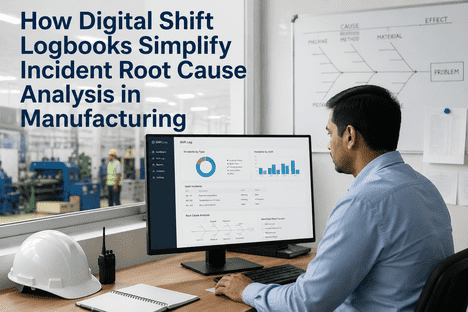
Shift handover documentation in 24/7 industrial operations carries an outsized risk profile: it consumes less than 5% of operational time yet is implicated in 40% of all plant incidents and unstructured handover communication costs industrial manufacturers an estimated $50 billion annually in duplicated troubleshooting, missed alerts, delayed interventions, and compliance gaps. Paper logbooks and free-text digital entries compound the problem — they are illegible, unsearchable, inconsistent across shifts, and impossible to audit at scale. AI-powered text analysis transforms shift logbook entries from passive records into structured operational intelligence: extracting critical events, flagging compliance gaps, summarizing handover priorities, and surfacing recurring patterns that human review cycles consistently miss. Book a Demo to see how iFactory AI deploys structured logbook intelligence across manufacturing, energy, and process operations in under two weeks.
40%
Of plant incidents occur during or immediately after shift handover
$50B
Annual cost of poor handover communication in industrial manufacturing
76%
Reduction in shift handover time with AI-powered logbook summaries
99.2%
Information accuracy with AI-structured logbook entries vs paper logs
What AI Text Analysis Actually Does in a Shift Logbook
Shift logbook entries are dense with operational meaning — but most of that meaning is locked inside unstructured free-text written under time pressure at end of shift. An operator writes "C-3 compressor running hot, watch on next shift" and the next supervisor has to decide whether that means a routine observation, a developing fault, or an unreported safety condition. Research from oil and gas operations indicates 80% of logbooks are unstructured and fail to capture key information consistently, while verbal handovers lose 40–60% of actionable detail before the incoming crew even reaches the floor.
AI text analysis closes this interpretation gap. Natural language processing models parse every logbook entry as it is written, extracting entities (equipment IDs, work orders, personnel, materials), classifying severity (routine, monitor, critical), linking observations to active CMMS alerts and SCADA trends, and generating a prioritized handover summary the incoming crew can review in under two minutes. The result is not just faster handovers — it is a structured operational record that supports compliance audits, root cause analysis, and cross-shift pattern detection that paper logs simply cannot produce.
Automated Entity Extraction
NLP models identify equipment IDs, work order numbers, materials, personnel, and timestamps from free-text entries — converting messy operator notes into structured fields without forcing operators to fill out rigid forms.
AI-Generated Handover Summaries
Top issues, equipment flags, and open actions are surfaced automatically so incoming crews review a clear, prioritized brief — eliminating verbal handovers that lose 40–60% of actionable information.
Severity and Intent Classification
Machine learning models classify each entry as routine, monitor, or critical based on language patterns, equipment context, and historical correlation — escalating safety and integrity concerns automatically.
Completeness and Compliance Checks
AI validates that every shift entry covers mandatory categories — equipment status, safety events, production, quality, open tasks — flagging gaps before handover acknowledgment so nothing falls through.
NLP Work Order Auto-Generation
When an operator logs "agitator 3A making noise," AI extracts the asset, classifies the fault category, and generates a draft CMMS work order — closing the gap between observation and maintenance action.
Cross-Shift Pattern Detection
Text analysis across weeks and months identifies recurring fault language, repeat equipment mentions, and emerging trends invisible to single-shift review — supporting root cause analysis and continuous improvement.
Why Paper and Free-Text Digital Logs Are Failing Modern Operations
Most facilities have already moved past handwritten paper logs, but many are stuck in a middle state: digital text fields that capture entries without structuring them. The result is a searchable archive that still requires human reading to interpret, with the same review backlogs, the same compliance gaps, and the same missed signals. The comparison below shows what operators continue to lose with conventional logbook approaches versus what AI-powered text analysis delivers.
| Handover Parameter |
Paper or Free-Text Digital Logs |
iFactory AI Text Analysis Logbook |
| Entry Completeness |
Operators write under time pressure; mandatory information often skipped. No automated check that equipment, safety, quality, and open tasks are all covered. |
AI scans every entry against required categories before handover. Missing sections flagged immediately so the outgoing operator completes the record before sign-off. |
| Handover Briefing Time |
Verbal handover meetings run 30–45 minutes. Incoming crew reads through dozens of entries to build context, losing first hour of shift to interpretation. |
AI-generated summary surfaces top 3–5 priorities, open actions, and critical alerts in under two minutes. Handover time reduced 76%. |
| Information Accuracy |
Verbal handovers lose 40–60% of actionable detail. Handwritten notes illegible or ambiguous. Free-text fields lack structure for downstream use. |
Structured entry extraction with AI-validated entity recognition achieves 99.2% information accuracy across handover records. |
| Pattern and Trend Detection |
Recurring issues invisible — same machine jams every Tuesday but no one connects the dots because data is trapped across dozens of pages or unstructured fields. |
NLP pattern recognition across weeks of entries surfaces repeat fault language, problem clusters, and emerging trends — supporting RCA and reliability programs. |
| Compliance and Audit Readiness |
Manual filing, paper retrieval, and inconsistent entries create days of audit preparation. FDA Form 483 observations frequent for documentation gaps. |
Immutable timestamped audit trail with e-signatures, role attribution, and version history — aligned with FDA 21 CFR Part 11, OSHA PSM, and ISO requirements out of the box. |
| Integration with CMMS and SCADA |
Logbook entries disconnected from work order systems and process data. Operator observations rarely linked to predictive alerts or condition monitoring trends. |
AI links observations directly to active CMMS alerts, SCADA trends, and asset condition timelines — operator knowledge corroborates predictive analytics in real time. |
Every Unstructured Handover Is a Compliance Risk and a Production Loss Waiting to Surface.
iFactory's AI-powered shift logbook delivers structured logging, automated text analysis, AI-generated handover summaries, and a complete audit trail — deployed across your operations in days, not months.
Book a Demo to see how AI text analysis applies to your current logbook workflow.
How iFactory Deploys AI Text Analysis Across Shift Logbook Workflows
iFactory follows a structured deployment process that delivers live shift logbook intelligence within the first two weeks and full AI text analysis with cross-shift pattern detection by week four. Each stage produces measurable operational change — not months of consulting without floor impact.
Week 1
Logbook Audit and Template Configuration
Existing paper and digital logs reviewed. Shift patterns, handover sequences, areas, and asset groups mapped. Structured templates configured per area covering equipment status, safety events, production metrics, quality notes, and handover checklists — enforcing completeness without overloading operators.
Week 2
Mobile Rollout and System Integration
iFactory mobile and tablet apps deployed to the plant floor. Integration with CMMS, MES, SCADA, and ERP completed so logbook entries link automatically to work orders, condition monitoring alerts, and production data. Operators, supervisors, and managers trained on entry workflows.
Week 3
AI Text Analysis and Handover Summaries Activated
NLP models begin parsing every entry — extracting equipment IDs, classifying severity, validating completeness, and generating prioritized handover summaries. Incoming crews receive AI-curated briefs covering critical items, developing trends, and open actions. Mandatory digital acknowledgment enforced.
Week 4
Pattern Detection and Compliance Reporting Live
Cross-shift pattern recognition activated to surface recurring fault language, repeat equipment mentions, and emerging issues. Compliance dashboards generate automatically for FDA 21 CFR Part 11, OSHA PSM, and ISO audits. Adoption metrics monitored with 90-day support included.
MEASURABLE OUTCOMES FROM WEEK 2: HANDOVER TIME AND INCIDENT RISK DROP IMMEDIATELY
Operators completing iFactory's 4-week deployment report handover time reduced 76%, information accuracy improved to 99.2%, and shift-transition incidents reduced by more than two-thirds in the first quarter — recovering $840K+ annually in duplicated troubleshooting at a single line and unlocking continuous compliance for FDA, OSHA, and ISO audits.
76%
Reduction in shift handover time with AI summaries
$840K
Annual duplicated troubleshooting cost recovered per facility
30%
Unplanned downtime reduction reported using cross-shift intelligence
AI Logbook Text Analysis: Use Cases from Live iFactory Deployments
The following outcomes are drawn from iFactory deployments across manufacturing plants, process industry sites, and power generation facilities. Each use case reflects post-deployment performance data over the first 6–12 months.
A multi-line automotive assembly plant was losing an estimated $840,000 annually in duplicated troubleshooting alone — the incoming shift kept rediscovering problems the previous shift had already diagnosed because verbal handovers and free-text notes failed to transfer root-cause context. iFactory deployed structured templates across all three shifts and activated NLP text analysis that linked operator observations to active CMMS work orders and SCADA condition alerts. Within 90 days, AI-generated handover summaries reduced average handover time from 42 minutes to 10 minutes, repeat fault investigations dropped 68%, and the plant recovered the full $840K duplicated-troubleshooting baseline.
Book a Demo to see how this applies to your production lines.
$840K
Annual duplicated troubleshooting cost recovered
10 min
Handover briefing time, down from 42 minutes pre-deployment
68%
Reduction in repeat fault investigations across shifts
A regulated pharmaceutical manufacturing site was preparing for an FDA inspection with a paper-based shift logbook program that had previously generated Form 483 observations for incomplete documentation and missing handover acknowledgments. iFactory replaced paper with structured digital templates, activated AI text analysis to enforce mandatory category completion, and enabled 21 CFR Part 11-compliant e-signatures with immutable audit trail. AI completeness checks blocked any handover sign-off where equipment status, safety events, or open deviations were not documented. The site completed its next FDA inspection with zero documentation-related observations and reduced audit preparation time from four days to under four hours.
Zero
FDA Form 483 documentation observations post-deployment
4 hrs
Audit prep time, down from 4 days with paper logs
100%
Handover acknowledgment compliance enforced by AI completeness checks
A combined-cycle power plant operated three condition monitoring platforms but had no systematic way to correlate operator field observations with vibration, temperature, and pressure analytics alerts. Operators frequently noted equipment concerns in shift logs — "Pump P-7 sounds louder than usual," "Compressor C-3 vibration feels off" — but those notes never reached the reliability engineering team. iFactory deployed NLP text analysis that automatically tagged every entry mentioning an asset ID, classified the fault language, and corroborated observations with active predictive alerts in real time. Within six months, mean time to fault detection improved 41%, and three major rotating equipment failures were prevented through early operator-corroborated alerts that would previously have been buried in paper logs.
41%
Improvement in mean time to fault detection
3
Major rotating equipment failures prevented in 6 months
100%
Operator observations now linked to predictive analytics in real time
Expert Perspective: Why Structured Text Analysis Beats Better Forms
Industry Perspective — Operations Excellence Lead, Process Manufacturing
"Most facilities that try to fix shift handover do it by adding more required fields. The result is operators clicking through forms at end of shift just to log off, and the entries become formulaic and useless. The breakthrough is not more structure imposed on operators — it is letting them write naturally, then using AI to extract structure from what they wrote. Now we get rich, contextual entries and a structured database underneath them. The handover summary the day shift gets at 6 a.m. is genuinely the top three things they need to know — not a checklist of green ticks."
Operations Excellence Lead — Global Process Manufacturer (provided via iFactory deployment reference)
This perspective matches what iFactory consistently observes across deployments: the most durable improvements come not from forcing operators into rigid forms, but from letting AI do the structuring work behind the scenes. The logbook stays operator-friendly, and the data underneath becomes audit-grade, searchable, and analytically useful. Book a Demo to speak with iFactory's operations team about applying this to your current shift workflow.
Conclusion: AI Text Analysis Is Now the Baseline for Shift Logbook Documentation
The economics of shift handover have shifted decisively. With handover time reductions of 76%, information accuracy reaching 99.2%, and FDA's 2026 QMS regulation making electronic documentation mandatory for pharmaceutical and life science manufacturers, operators continuing to rely on paper logs or unstructured digital text fields are accepting financial, operational, and regulatory risk that AI-powered logbook intelligence eliminates. The same is increasingly true in non-regulated sectors — OSHA Process Safety Management requirements, ISO documentation standards, and insurance audit expectations all assume traceable, searchable shift records.
iFactory's digital shift logbook delivers the specific capabilities that modern operations require: structured templates that enforce completeness, NLP text analysis that extracts entities and classifies severity, AI-generated handover summaries that compress 40-minute briefings into 2-minute reads, automatic CMMS and SCADA integration, and audit-ready documentation aligned with FDA 21 CFR Part 11, OSHA PSM, and ISO frameworks. Deployments typically go live in days — not the multi-month implementation timelines that have historically made digital logbook programs hard to justify. Book a Demo to receive a shift logbook assessment specific to your operations.
Frequently Asked Questions About AI Text Analysis in Shift Logbooks
How is AI text analysis different from a digital form-based logbook?
Form-based logbooks require operators to fill rigid fields, which leads to formulaic, low-context entries. AI text analysis lets operators write naturally — by typing or voice dictation — and extracts structured data automatically behind the scenes. The result is richer entries plus structured data the system can analyze, summarize, and audit.
Does AI replace operator judgment in handover decisions?
No. The AI summarizes and prioritizes entries, flags completeness gaps, and links observations to existing CMMS and SCADA alerts. Incoming supervisors still review and acknowledge handovers and apply professional judgment — the AI removes the rediscovery and search burden, not the decision-making.
Will AI-generated logbook records satisfy FDA, OSHA, and ISO audit requirements?
Yes. iFactory logbook records include immutable timestamps, e-signatures aligned with FDA 21 CFR Part 11, role-based attribution, version history, and full audit trails. These records support FDA inspections, OSHA Process Safety Management documentation, and ISO 9001/14001 certification audits.
How does the logbook integrate with our existing CMMS, MES, and SCADA systems?
iFactory connects with major CMMS, MES, ERP, and SCADA platforms. Logbook entries can auto-generate maintenance work orders, link to active condition monitoring alerts, and pull production targets directly from MES — so operators see one consolidated view rather than switching between systems.
How long does deployment take and how much operator training is required?
Typical deployment is completed in under four weeks, with live AI handover summaries active by week 3. Operator training is brief — usually under 30 minutes — because entries can be made in natural language via mobile or tablet, with offline sync where connectivity is limited.
Stop Losing Critical Operational Context Every 8 Hours. Deploy AI-Powered Shift Logbook Intelligence in Weeks.
iFactory gives industrial operators structured shift logging, NLP text analysis, AI-generated handover summaries, automatic CMMS and SCADA integration, and audit-ready compliance documentation — deployed across your facility in days, not months.
76% reduction in shift handover briefing time
99.2% information accuracy with AI-structured entries
$840K+ annual recovery from eliminated duplicated troubleshooting
Audit-ready for FDA 21 CFR Part 11, OSHA PSM, and ISO standards