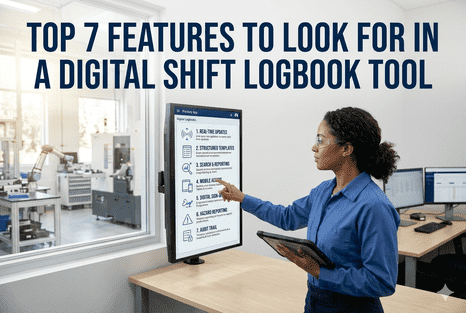
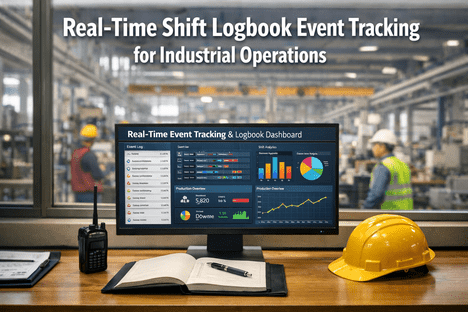
Industrial operations have relied on paper shift logbooks for decades — handwritten shift notes, clipboard checklists, and three-ring binders passed from one shift team to the next. Despite their familiarity, paper logbooks introduce systemic inefficiencies: incomplete entries, illegible handwriting, lost pages, delayed handoffs, and zero searchability. A single missing logbook page during an audit can trigger a regulatory finding, and the average operator spends 20–30 minutes per shift on manual logbook documentation — time that could be directed toward production oversight and equipment observation. iFactory's Digital Shift Logbook replaces paper binders with a mobile-first, searchable, audit-ready platform that connects shift records directly to work orders, compliance documentation, and predictive maintenance intelligence. Book a Demo to see how iFactory's Digital Shift Logbook transforms handover documentation from a compliance burden into an operational intelligence tool.
Digital Shift Logbook vs Paper Logbook · ROI 2026
Digital Shift Logbook vs Paper Logbook: ROI & Efficiency Comparison
Mobile-first shift handovers · Audit-ready digital records · Real-time visibility · CMMS & ERP integration · Eliminates transcription errors, lost logbooks, and 30-min-per-shift documentation overhead.
30 min
Per-shift documentation time saved per operator
100%
Searchable, audit-ready records vs paper binder searches
3×
Faster shift handovers with structured digital handover forms
85%
Reduction in logbook-related audit findings documented
Why Paper Logbooks Persist — and Why They Fail Modern Operations
Paper shift logbooks are deeply embedded in industrial culture — operators have used them for generations, they require no power or training, and they feel reliable. But in practice, paper logbooks fail on nearly every dimension that matters in a modern manufacturing or processing plant. Entries are inconsistent: one operator writes a paragraph about a minor adjustment while another records nothing about a near-miss. Illegible handwriting forces follow-up calls between shifts. Logbook pages are lost, coffee-stained, or simply not filled in during high-throughput periods. When an auditor or regulator requests a specific date range, someone must physically locate the binder and flip through every page — a process that takes hours across a multi-month window. These aren't edge cases; they are the daily reality of paper-based shift documentation in plants across every industrial sector.
Paper Logbook Pain Points vs Digital Shift Logbook Solutions
Handover
Shift Handoff
Paper: verbal + illegible notes · Digital: structured forms with mandatory fields
3× faster handovers
Records
Audit Retrieval
Paper: binder searches · Digital: seconds via keyword, date, asset
100% searchable
Errors
Data Integrity
Paper: illegible, incomplete · Digital: mandatory fields, photo capture, timestamps
Zero transcription
Visibility
Real-Time Access
Paper: one location, one reader · Digital: mobile app, any shift, any location
Plant-wide visibility
Integration
CMMS / ERP Link
Paper: manual re-entry · Digital: auto work orders, linked records
Zero manual entry
Five Areas Where Digital Shift Logbooks Deliver Measurable ROI Over Paper
01
Operator Documentation Time: 30 Minutes Saved Per Shift
Paper logbook entries require operators to locate the binder, hand-write shift notes, describe equipment status in free text, and hope the next shift can read the result. iFactory's Digital Shift Logbook replaces this with structured mobile forms — dropdown selections for equipment status, photo capture for visual observations, voice-to-text for hands-free entry, and auto-populated timestamps and operator IDs. Average documentation time drops from 30 minutes per shift to under 5 minutes across documented deployments. For a plant running three shifts with 10 operators per shift, that represents 12.5 hours of operator time recovered per day — redirected toward production oversight and equipment observation rather than paperwork.
5 min vs 30 minMobile structured formsPhoto + voice capture
02
Audit Preparation: From Hours to Seconds
An auditor walks in and requests all shift log entries for a specific machine over the past six months. With paper binders, the plant manager must locate every relevant binder, flip through hundreds of pages, and hope nothing was misfiled or lost — typically a 2–4 hour search. With iFactory's Digital Shift Logbook, the same request is fulfilled in seconds: filter by asset, date range, and entry type, and the complete record set is displayed or exported. Every entry carries an immutable timestamp, operator ID, and any attached photos or supporting documents. This single capability — instant audit-ready retrieval — is consistently cited as the highest-ROI feature by iFactory customers undergoing regulatory audits.
Seconds vs hoursImmutable timestampsBulk export
03
Shift Handover Quality: Structured, Complete, Actionable
Paper shift handovers depend entirely on the quality of the verbal conversation and the legibility of handwritten notes. Critical details — equipment alarms overnight, corrective actions taken, spare parts consumed — are frequently omitted or miscommunicated. iFactory's Digital Shift Logbook enforces structured handover forms with mandatory fields for equipment status, open work orders, safety observations, and pending actions. The out-going shift completes the form; the in-coming shift acknowledges receipt digitally, creating a closed-loop handover record. Shift managers gain a dashboard showing handover completion rates, unresolved issues, and trend data across all shifts — enabling data-driven shift performance management rather than trust-based handover assessment.
Mandatory handover fieldsDigital acknowledgmentShift completion dashboard
04
Data Integrity & Compliance: Electronic Signatures That Hold Up in Court
Paper logbooks can be altered after the fact — pages removed, entries rewritten, dates changed — with no forensic trace. For FDA-regulated, USDA, or ISO 9001 operations, this creates a compliance liability. iFactory's Digital Shift Logbook captures every entry with an immutable audit trail: who entered what, when, from which device, and whether the entry was edited after submission. Edits are tracked as version history, not overwrites — preserving the original entry alongside the correction with rationale. Electronic signatures meet FDA 21 CFR Part 11 requirements for closed systems. For plants operating under continuous USDA FSIS inspector presence, the ability to produce unalterable shift records on demand transforms audit risk posture.
Immutable audit trail21 CFR Part 11Version history
05
CMMS & ERP Integration: Eliminating Dual Data Entry
With paper logbooks, equipment observations noted by operators during a shift must be manually re-entered into the CMMS by the maintenance planner — introducing transcription errors and delays. iFactory's Digital Shift Logbook links directly to the CMMS and ERP. An operator flags abnormal vibration in the shift log; the platform auto-generates a work order in the CMMS with the operator's observation, asset ID, and timestamp. Spare parts consumed during the shift are logged in the shift log and automatically synced to the ERP inventory module. This closed-loop integration eliminates the 15–20 minutes per event that planners spend transcribing paper log entries into digital systems, while ensuring that no operator observation is lost between the logbook and the maintenance execution system.
Auto work order creationERP inventory syncZero transcription
Digital vs Paper Logbook: Head-to-Head Comparison
Documentation time
25–35 min per shift
3–5 min per shift
12.5 hrs/day recovered in 30-operator plant
Audit record retrieval
2–4 hours per request
Under 30 seconds
Audit prep reduced from weeks to minutes
Handover quality
Inconsistent, verbal-dependent
Structured forms, mandatory fields, digital acknowledgment
Eliminates information loss between shifts
Data integrity
Alterable, no audit trail
Immutable, versioned, 21 CFR Part 11 compliant
Defensible records for regulatory and legal use
CMMS integration
Manual re-entry required
Auto work orders from shift log entries
Eliminates transcription time and errors
Remote visibility
Physical binder, one location
Mobile app, web dashboard, any device
Plant and fleet-wide visibility from any location
Photo & media capture
Not available
Photo, video, voice, document attachment
Visual evidence attached to every shift entry
Digital Shift Logbook Use Cases: Real-World Applications
In a three-shift automotive parts plant operating 24/5, each shift transition previously relied on a 15-minute verbal handover and handwritten notes in a shared binder. Critical details about a spindle vibration or coolant leak were frequently lost between shifts, leading to repeated equipment damage and quality escapes. iFactory's Digital Shift Logbook replaced the binder with structured handover forms accessible on tablets at each production cell. The out-going shift completes equipment status, safety observations, open issues, and pending actions. The in-coming shift acknowledges receipt. Shift supervisors monitor handover completion rates on a live dashboard. Within 60 days, handover-related quality incidents dropped by 40% and average handover time decreased from 15 minutes to 5 minutes per shift pair.
Handover time15 min → 5 min per shift pair
Quality incidents40% reduction in handover-related escapes
Book a Demo
A USDA-inspected meat processing facility faced recurring audit findings because paper shift logs could not be produced within the inspector's requested timeframe. The facility converted to iFactory's Digital Shift Logbook with mandatory fields for HACCP CCP readings, SSOP execution sign-offs, and pathogen monitoring results per shift. When an FSIS inspector requested six months of records for a specific cooler, the quality manager filtered by asset, date range, and entry type in under 30 seconds — producing a complete, timestamped, and immutable record set. The facility received zero logbook-related findings in the subsequent two audits. iFactory's Shift Logbook integrates with the platform's broader HACCP automation and environmental monitoring modules for a complete compliance documentation system.
Retrieval time30 seconds vs 2–4 hours paper
Audit findingsZero logbook-related findings post-deployment
Book a Demo
When an operator notices abnormal vibration, a temperature spike, or an unusual noise during a shift, the fastest path to maintenance action is critical. With paper logbooks, the operator writes a note, the shift supervisor reads it during handover, the maintenance planner transcribes it into the CMMS the next morning, and the work order is released 8–16 hours after the initial observation. iFactory's Digital Shift Logbook collapses this timeline: the operator flags the observation using a configurable severity matrix directly in the shift log interface, and the platform auto-generates a work order in the connected CMMS with the asset ID, operator notes, timestamp, and attached photo or audio recording. The maintenance planner receives the work order in real time — not the next morning. For critical assets, the same observation can trigger a predictive maintenance alert if sensor data confirms the degradation pattern.
Work order lagFrom 8–16 hrs to real time
Data capturedAsset · severity · notes · photo · audio
What iFactory's Digital Shift Logbook Delivers
30 min
Per-shift documentation time saved per operator
Structured forms, photo capture, voice-to-text
100%
Searchable, audit-ready records with immutable audit trail
Keyword, date, asset filter — seconds retrieval
3×
Faster shift handover with structured digital handover forms
Mandatory fields, digital acknowledgment, completion dashboard
85%
Reduction in logbook-related audit findings
Immutable timestamps, version history, 21 CFR Part 11 signatures
FAQ: Digital Shift Logbook vs Paper Logbook
Replace Paper Logbooks With iFactory's Digital Shift Logbook
Mobile-first shift logbook with structured handover forms, photo and voice capture, immutable audit trail, FDA 21 CFR Part 11 compliance, and direct CMMS/ERP integration. 1–2 week deployment, under 30-minute operator training, positive ROI within 2–3 months.
Digital Handover
Audit-Ready Records
Mobile-First
CMMS Integration
21 CFR Part 11