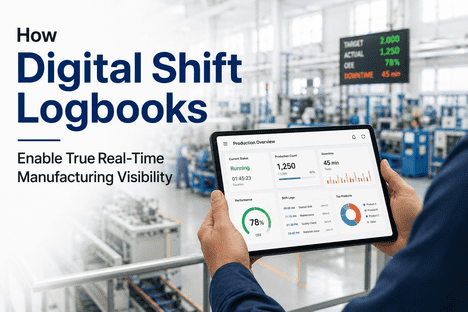
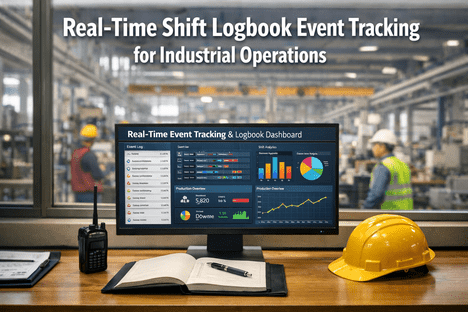
Somewhere in your plant right now, there is a logbook sitting on a shelf. Its pages are filled with handwriting that only two people can decipher. Three entries from last Tuesday are missing entirely. A critical equipment warning from the night shift was recorded in the wrong section. And when the auditor arrives next month, someone will spend three days trying to reconstruct what actually happened. This is not a rare scenario — it is the daily reality for the 80% of manufacturing facilities still running paper-based logbooks in 2026. The question is no longer whether to switch to digital. The question is how much longer you can afford not to.
Paper Logbook vs. Digital Shift Logbook: A Complete Breakdown
Human error is unavoidable with handwritten entries. Illegible writing, missing fields, incorrect readings, and inconsistent formats create unreliable records that nobody trusts and auditors flag.
Mandatory fields prevent incomplete entries. Configurable min/max limits flag out-of-range readings instantly. Data is consistent, legible, and structurally enforced — every time, every shift.
Finding a specific entry from six months ago means physically retrieving an offsite logbook and manually scanning every page. Audit preparation can take days or weeks. Critical information stays hidden in ink.
Find any entry by keyword, date, equipment ID, or operator in seconds. Pull a complete history of any asset across any time range from any device. Audit preparation drops from days to minutes.
The FDA regularly issues Form 483 observations and warning letters for missing records, uncontrolled documents, and poor documentation from paper logbooks. Paper cannot meet ALCOA+ data integrity requirements.
E-signatures, timestamps, access controls, and immutable records satisfy FDA 21 CFR Part 11, GMP, OSHA PSM, and ALCOA+ standards. Every entry is attributed, legible, contemporaneous, and permanently stored.
Data is trapped in ink. You cannot search, graph, or analyze patterns across paper logs. Equipment failure trends, recurring shift issues, and quality patterns remain invisible until they become catastrophic.
AI identifies recurring failures on specific machines, tracks cleaning cycle durations, links environmental conditions to quality outcomes, and surfaces patterns across shifts — before they become problems.
Still logging manually on your shop floor? Book a demo to see how iFactory replaces paper chaos with structured digital intelligence — deployed in days.
6 Critical Problems Paper Logbooks Create Every Day
Unreadable and Incomplete Entries
Human Error Built-InPaper logbooks guarantee human error. Supervisors decipher messy handwriting. Missing fields go undetected until an audit surfaces them. There is no mechanism to catch out-of-range readings, enforce mandatory entries, or flag inconsistencies in real time. One study confirmed that 80% of all logbooks still being paper-based is directly creating data integrity risks that FDA inspectors specifically target. A digital logbook flags the incomplete entry before the operator can move on.
Knowledge Lost Between Shifts
$840K Annual LossCritical context — what the previous shift diagnosed, what temporary fix is in place, what the machine was doing before it tripped — evaporates when it lives only in paper notes or someone's memory. One automotive plant calculated $840,000 in annual losses from duplicated troubleshooting caused purely by information gaps at shift change. Digital logbooks carry open issues forward automatically with full context intact until they are resolved and closed.
No Search, No Patterns, No Intelligence
Data Trapped in InkPaper logbooks are permanent data silos. You cannot graph the frequency of equipment jams. You cannot see that Line 3 trips every Tuesday at 2 AM. You cannot link environmental readings to product defects three weeks later. Every entry is information that could prevent the next failure — but on paper, it is inaccessible intelligence. Digital logbooks transform raw entries into searchable, analyzable operational history that surfaces patterns automatically.
Compliance and Audit Exposure
FDA 483 RiskThe FDA regularly issues Form 483 observations and warning letters for missing records, uncontrolled documents, and poor documentation practices from paper logbooks. For pharmaceutical and life science manufacturers, the FDA's 2026 QMS regulation makes electronic documentation mandatory — paper is no longer compliant. Even for non-regulated industries, paper cannot support OSHA PSM requirements for traceable shift handover records in process safety environments.
Hours Wasted on Manual Retrieval
Days to Prepare AuditsStaff spend hundreds of hours generating, reviewing, and approving paper logs. Because paper logbooks are typically stored offsite, retrieval for audits or investigations requires physically locating the right binder among warehouses of documentation. A single audit response that takes three days on paper takes three minutes on a digital platform. One pharmaceutical CDMO achieved an 85% reduction in log entry time after switching to a GMP-compliant digital logbook system.
No Integration With Your Other Systems
Permanent Data SilosPaper logbooks cannot connect to SCADA, CMMS, MES, or ERP systems. A machine alarm fires in SCADA — the paper log knows nothing about it. A work order is completed in the CMMS — the logbook has no record. Every system operates in isolation, and critical operational context never reaches the people who need it. Digital logbooks integrate with existing systems to create a unified operational record where every event, work order, and sensor reading is linked.
Your Paper Logbook Is Actively Costing You Money
iFactory replaces manual logs with structured digital entries, AI-generated shift summaries, real-time equipment visibility, and compliance-ready audit trails — all accessible from any device, even offline.
Real Results From Facilities That Made the Switch
See iFactory's Digital Shift Logbook in Action
Structured templates, real-time event logging, AI summaries, equipment status boards, compliance audit trails — all deployed in days. Join the facilities already running digital shift intelligence.
Industry Perspective on the Paper-to-Digital Shift
"While 100% of companies in regulated environments use some form of logbook, an astounding 80% still rely on paper-based systems. This dependence on manual processes creates significant challenges in data integrity and regulatory compliance. Pharma manufacturing can no longer afford these inefficiencies. Digital logbooks deliver the compliance, efficiency, and data integrity that modern operations demand — while providing a foundation for continuous improvement and innovation. The adoption of these digital tools is no longer a question of if, but when."
The 5-Step Roadmap to Replacing Paper Logbooks With Digital
Audit Your Current Paper Logbooks
Start by identifying every paper logbook in use — shift logs, equipment logs, maintenance logs, safety logs, cleaning records, calibration records. Map who fills them out, how often, and who reviews them. This audit reveals where information gaps, compliance risks, and retrieval bottlenecks are hiding. Focus your digital rollout on the highest-impact logs first: shift handover and equipment status boards account for the majority of critical information loss.
Mirror Your Existing Templates Digitally
Replicate your current paper forms in digital format first — do not redesign your entire process on day one. A no-code form builder lets you customize fields to match what operators already know, minimizing change resistance and training time. Add mandatory fields, range validations, and conditional logic progressively. The goal in phase two is to eliminate paper, not reorganize everything at once. Adoption happens fastest when the digital form feels familiar.
Enable Offline Mobile Access for the Shop Floor
Operators cannot log in real time if they need to walk to a connected terminal. Deploy on tablets and mobile devices with offline capability — entries log locally and sync automatically when connectivity returns. This is the step that drives actual behavior change: when logging is as easy as reaching into a pocket, entries happen at the moment of the event instead of at end-of-shift from memory. Real-time logging is where paper's biggest weakness is permanently eliminated.
Connect to CMMS, SCADA, and MES Systems
A digital logbook that exists in isolation creates a new data silo — just a cleaner version of paper. Integration with your CMMS means work orders created from log entries appear automatically in maintenance workflows. SCADA alarms write directly into the logbook timeline. MES production data enriches shift summaries without manual entry. This connected layer is what transforms a logbook from a record into an operational intelligence platform.
Activate AI Analytics and Compliance Reporting
Once structured data accumulates, AI can identify recurring equipment issues, link environmental readings to quality outcomes, and surface patterns invisible in paper records. Automated compliance reports pull any date range, any area, any operator in seconds — turning audit preparation from a multi-day project into a 3-minute task. A global pharmaceutical CDMO cut log entry time by 85% at this stage. This is where the 4–6 month ROI begins paying back and compounding.
Ready to replace paper logbooks at your facility? Contact our support team and go live in days — not months.
Digital Logbook Adoption: Where Manufacturing Stands in 2026
Want to see exactly how iFactory compares to your current paper process? Book a demo and get a facility-specific walkthrough.
Every Day on Paper Is a Day of Data You Will Never Get Back
iFactory's digital shift logbook gives your teams structured logging, AI-powered shift summaries, live equipment status boards, real-time CMMS integration, and compliance-ready audit trails — deployed in days, not months. The shift to digital starts with one conversation.