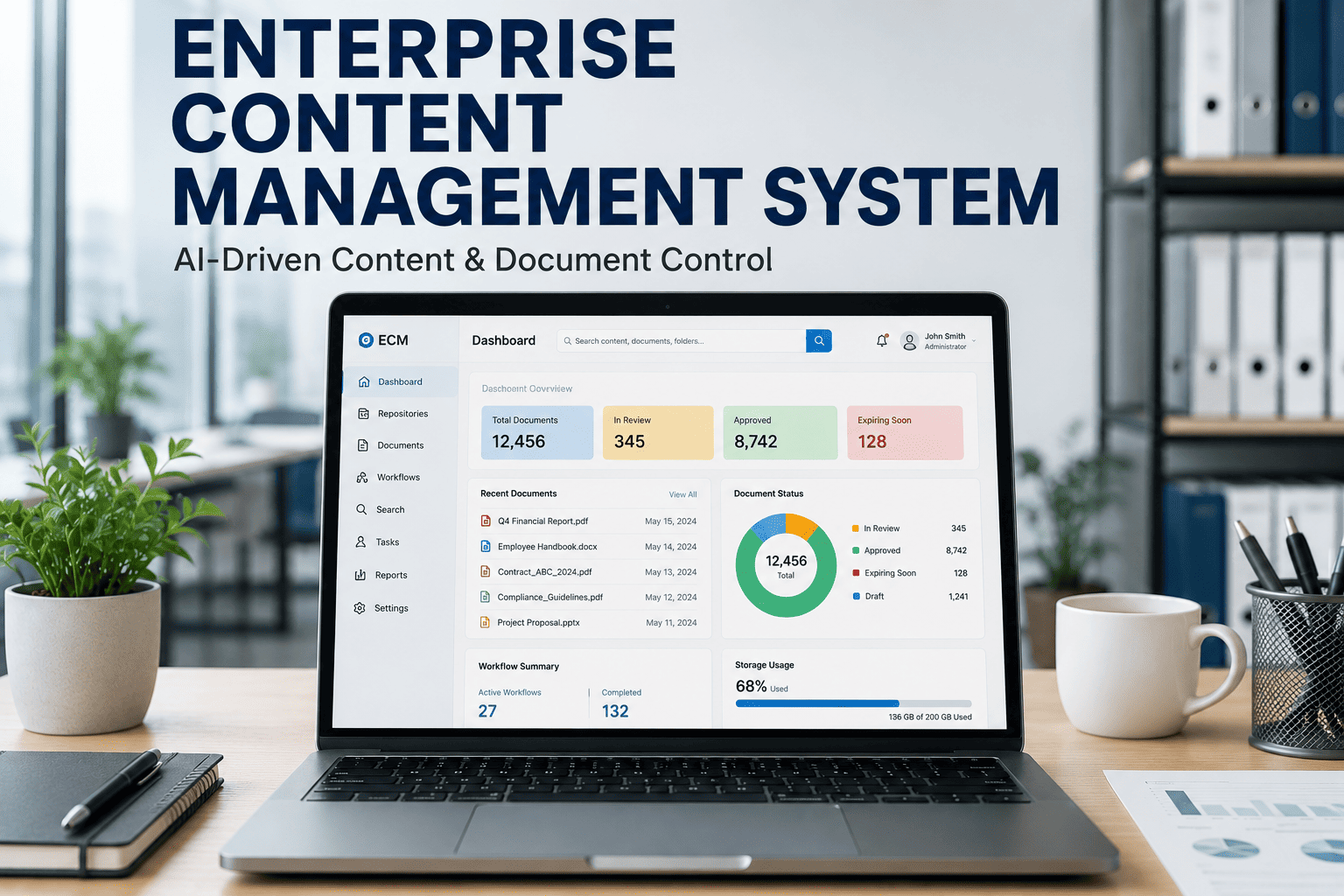
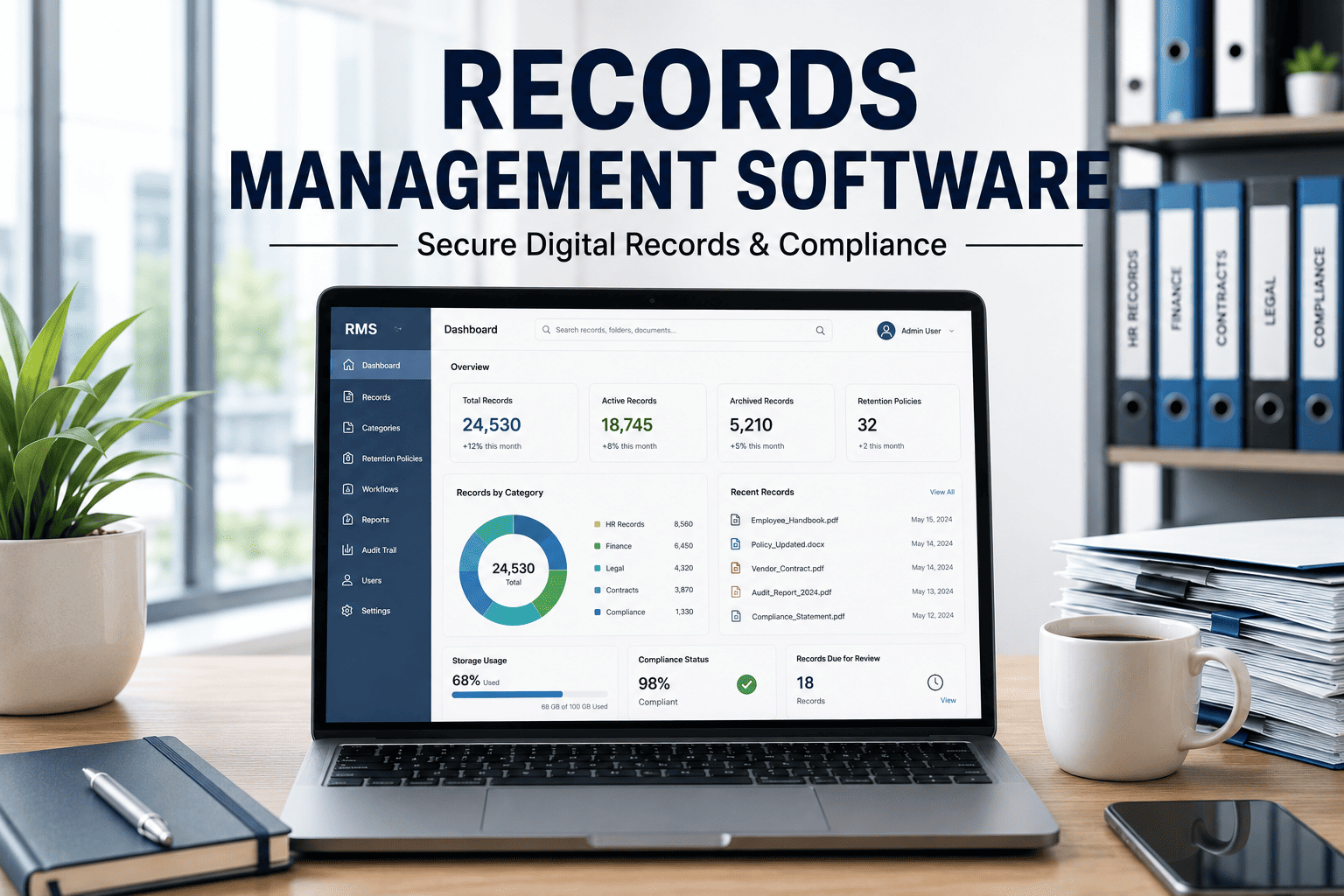
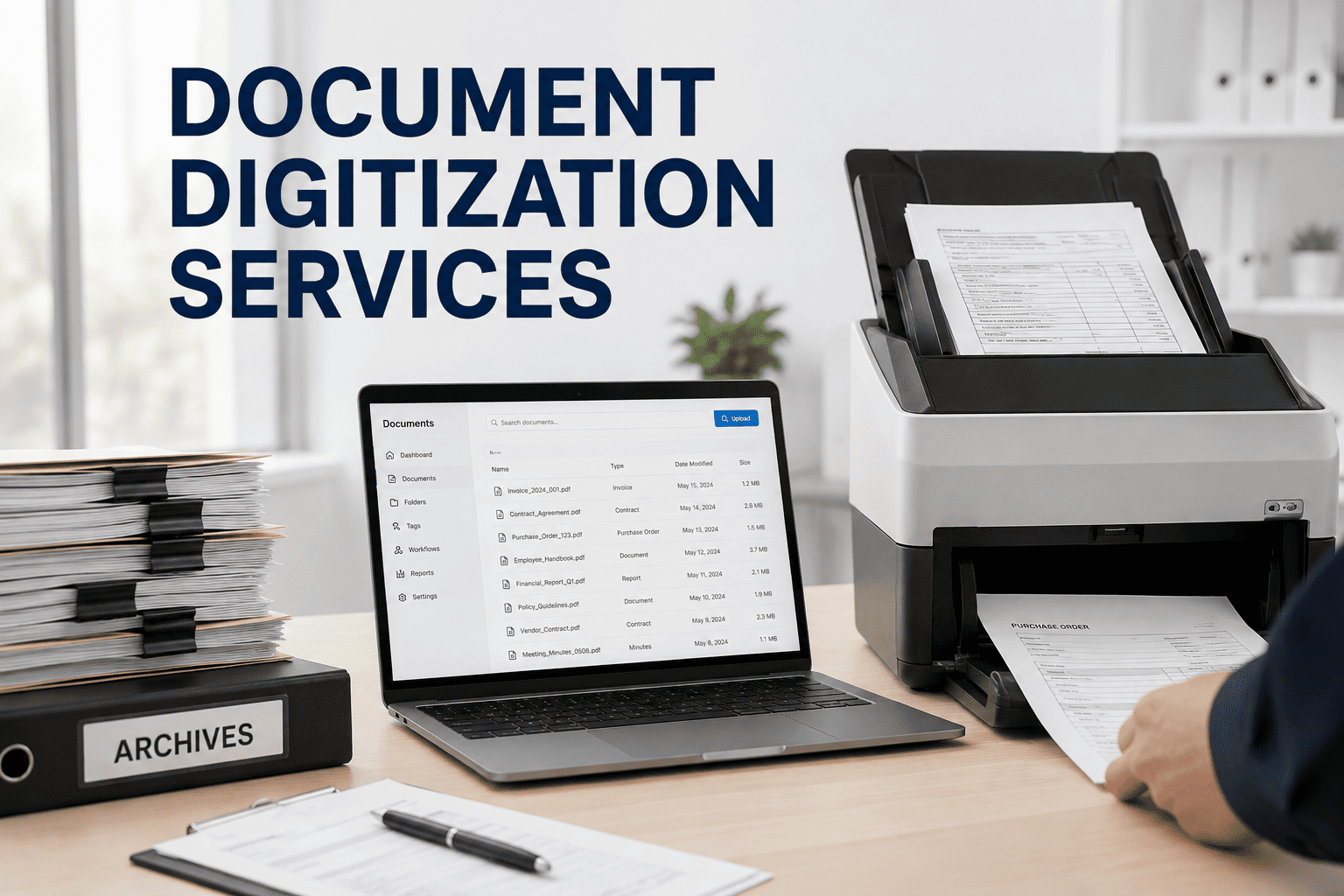
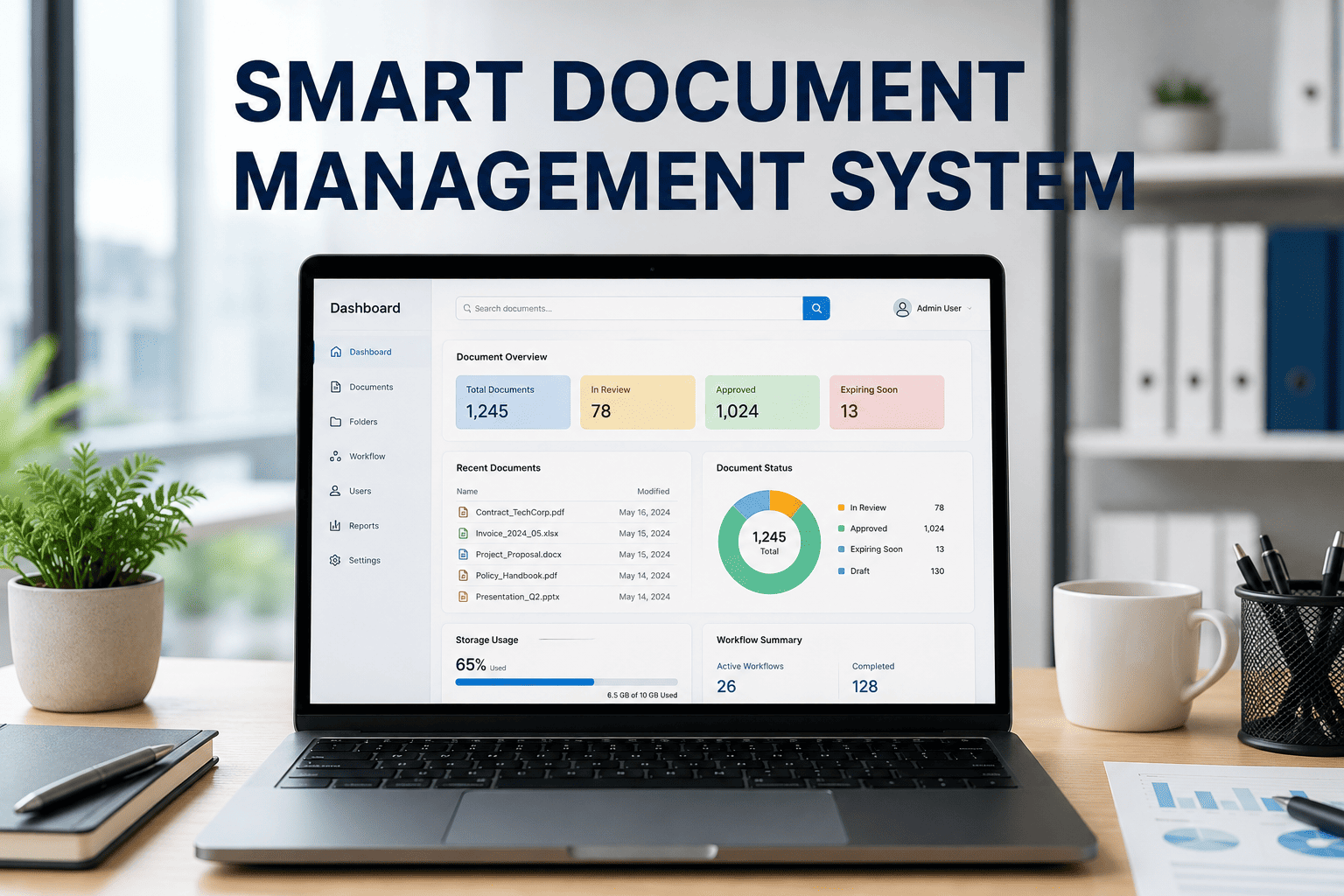
Roughly 80% of all enterprise data is unstructured — contracts, emails, invoices, images, video, chat transcripts, presentation decks, engineering drawings, HR files, marketing collateral. The average organization sprawls this content across around 50 terabytes of file shares, plus SharePoint sites, Google Drives, personal cloud folders, email archives, and departmental applications nobody remembers who owns anymore. The global enterprise content management market is projected to reach $133.7 billion by 2030 for a simple reason: every large organization has this problem, and the cost of leaving it unsolved compounds every year. Modern ECM — what Gartner has been calling Content Services Platforms since 2017 — is what happens when you stop treating content as a storage problem and start treating it as an intelligence problem. AI-driven auto-classification hits 98% accuracy on multi-language documents. Intelligent capture pipelines process 10,000 pages per hour. Automated governance and low-code workflows cut storage costs by up to 30% and accelerate document-heavy processes by up to 50%. The organizations that unify their content ecosystems reduce compliance risk, cut storage cost, and unlock workforce productivity — all at the same time. An enterprise content management platform is built to run exactly that — every content type, every department, every workflow, one intelligence layer.
Enterprise Content Management System
Turn 80% Unstructured Content Into Governed, Actionable Intelligence
One platform across every content type, every repository, every department — with AI-driven classification, automated governance, and native integration into SAP, Microsoft 365, and Salesforce.
80%
of enterprise data is unstructured
$133.7B
ECM market by 2030
50%
faster document processes
The Content Universe an Enterprise Actually Runs On
ECM is not "document management with a bigger logo." It handles every category of content the organization produces or consumes — structured records, unstructured knowledge work, rich media, external correspondence, and the operational documents that keep the business moving. This is the full scope.
Business Documents
Contracts & agreements
Invoices & purchase orders
Policies & procedures
Reports & presentations
People & HR
Employee records
Onboarding docs
Performance reviews
Training materials
Correspondence
Email archives
Chat & collaboration logs
Customer support tickets
Meeting transcripts
Rich Media
Marketing images & video
Engineering drawings
Product photography
Brand assets
Compliance & Legal
Regulatory filings
Audit evidence
Certifications & licenses
Litigation records
Operational
SOPs & work instructions
Quality records
Supplier documentation
Field service reports
Repository Sprawl vs Unified Content Services
The problem ECM solves is not "we don't have a place to put files." It's "we have too many places, none of them talk to each other, and half of them are outside IT's control." A modern content services platform collapses that mess into one governed layer without ripping out what works.
TODAY: REPOSITORY SPRAWL
SharePoint
Network drives
Google Drive
Email attachments
Personal Dropbox
Legacy ECM
Dept apps
Paper archives
50 TB of file shares — average enterprise
Nobody knows what lives where
Access controls inconsistent, permissions rot
Compliance evidence scattered
Same file in six versions in five places
UNIFIED CONTENT SERVICES
One governed layer
Federation over existing repositories
Federation via CMIS across existing systems
One search, one access model, one audit log
Retention and compliance applied uniformly
AI classification runs across all sources
Legacy stays put where migration doesn't pay
The AI Layer That Makes ECM "Intelligent"
Modern ECM leans on transformer-based language models, computer vision, and process mining to turn a passive repository into an active intelligence layer. These are the specific AI capabilities that separate a content services platform from a shared drive.
01
Auto-Classification
98% accuracy
Transformer models like BERT classify documents by content, language, and context — no manual tagging, no rigid folder hierarchy.
02
Intelligent Capture
10,000 pages/hour
Documents ingested from email, scanners, mobile, and APIs — extracted, classified, and routed at industrial scale.
03
Entity Extraction
50+ entities per doc
NLP identifies dates, amounts, parties, addresses, contract clauses, and 50+ other structured entities from unstructured text.
04
Semantic Search
Natural language
"The Q3 supplier agreements we amended after the Frankfurt visit" returns the right documents — meaning, not keyword matching.
05
Predictive Routing
Historical pattern-based
Learns from past workflow decisions to route new documents automatically, with escalation on stall and audit trail intact.
06
Agentic Workflows
Execute complex tasks
AI agents chain classification, extraction, validation, and routing — humans only touch the exceptions.
Want to see the AI layer applied to your own content? Book a demo — bring one department's real content and we'll process it live.
The Four Pillars of a Modern ECM
Regardless of which vendor logo is on the platform, every modern ECM stands on four pillars. If any one is weak, the whole system leaks value — either in compliance risk, user adoption, integration cost, or governance failure.
I
Repository & Federation
Native storage plus federation over existing sources via CMIS. Cloud, on-prem, or hybrid — 40% of enterprises stay hybrid through 2026 per IDC.
II
Intelligence & Automation
Auto-classification, entity extraction, semantic search, and predictive workflow routing — the layer that turns storage into intelligence.
III
Governance & Compliance
Retention schedules, access controls, immutable audit trails, and regulatory templates applied consistently across every source.
IV
Integration & APIs
Native connectors to SAP, Microsoft 365, Salesforce, SuccessFactors, and Google Workspace — content available where work actually happens.
Where the Value Actually Lands — By Department
ECM's ROI is horizontal, but the concentration of value is not. Certain departments generate outsized returns because document volume, compliance stakes, and workflow complexity stack together.
| Department |
Primary content types |
Typical ECM impact |
| Finance / AP |
Invoices, POs, receipts, contracts |
50% cycle-time cut on invoice processing |
| HR |
Employee files, onboarding, reviews, right-to-work |
Onboarding time cut, retention compliance automated |
| Legal |
Contracts, litigation records, IP filings |
Clause extraction, renewal tracking, e-signature integrated |
| Compliance |
Policies, SOPs, audit evidence, certifications |
Continuous audit-ready evidence, expiry tracking |
| Sales / CX |
Proposals, contracts, customer records, support cases |
Unified customer view, CRM-integrated retrieval |
| Marketing |
Brand assets, campaign content, rich media |
DAM integration, version-locked brand governance |
| Engineering / Ops |
Drawings, specifications, quality records |
Version control on drawings, ISO evidence built in |
| Records / IG |
Retention across everything above |
Unified retention policy, defensible destruction |
How Enterprise ECM Deploys — Without the 2-Year Project
Gartner research finds 70% of ECM failures trace to people and process gaps, not technology. The deployment approach that works is phased, department-by-department, with the intelligence layer proving value before the migration layer even starts.
01
Inventory & Prioritize
Map current repositories (average 50 TB sprawl), rank departments by ROI potential — usually AP, HR, or legal first.
02
Federate, Don't Migrate
Connect existing sources via CMIS. AI classification and search run across all of them from day one — no forced migration.
03
Launch AI Layer
Auto-classification, entity extraction, and semantic search go live on federated content. Users feel the change immediately.
04
Configure Governance
Retention, access, and audit rules built no-code. Regulatory templates for GDPR, HIPAA, SOX applied across all repositories.
05
Roll Out & Optimize
First department live in 4-6 weeks. Full enterprise 12-24 weeks. AI models improve with usage; sprawl consolidates over time.
What Enterprise ECM Delivers
The ECM value case is not soft. Storage cost, cycle time, and compliance risk are all measurable — and every one moves. These are the outcomes documented across recent Hyland, OpenText, and analyst benchmarks.
30%
Storage cost cut
from dedup, tiering, defensible destruction
50%
Faster processes
on document-heavy workflows
98%
Classification accuracy
multi-language, transformer-based
Zero
Rip-and-replace
federation over existing repositories
Curious what unified content services would look like across your sources? Talk to a specialist — we'll benchmark the ROI.
Frequently Asked Questions
Isn't SharePoint already our ECM?
SharePoint is a repository — a very capable one. What it isn't, on its own, is a content services platform with enterprise-wide auto-classification, cross-source federation, agentic workflow, and unified governance. Modern ECM either sits on top of SharePoint and other repositories via federation (CMIS), or replaces the parts of the SharePoint estate where governance and intelligence gaps have accumulated. The right answer is usually a hybrid — keep SharePoint where it's working, add the intelligence and governance layer across everything.
Do we have to migrate everything to a new repository?
No. Modern ECM is built around federation — the AI classification, semantic search, workflow routing, and governance run across your existing SharePoint, network drives, cloud storage, and legacy ECM through CMIS and native connectors. Migration happens only where it pays back (usually consolidating end-of-life systems). IDC finds 40% of enterprises remain in hybrid configurations through 2026 by design, not by delay.
How accurate is the AI classification really?
On structured business documents (invoices, POs, forms, contracts), transformer-based models consistently hit 98%+ classification accuracy across multiple languages. On unstructured content (emails, chat, free-form documents), accuracy runs 90-95% with confidence scoring — low-confidence items go to human review, so effective end-to-end accuracy stays near 100% at the workflow level. Every correction feeds the model.
How does this reduce compliance risk in practice?
Three ways at once. Retention schedules are enforced uniformly across every source — so end-of-life content gets defensibly destroyed on time. Access controls apply consistently — no more permissions rot on abandoned SharePoint sites. And every view, edit, and share is logged in a single audit trail, so audit evidence for GDPR, HIPAA, SOX, or ISO 27001 comes out of one query instead of six manual searches. The controls stop being aspirational and become automatic.
Why do so many ECM projects fail?
Gartner research puts 70% of failures on people and process, not technology — over-scoping the initial rollout, forcing migration when federation would have worked, insufficient change management, and building policies that ignore how work actually happens. The playbook that works: start with one high-ROI department, federate rather than migrate, prove the AI layer in weeks, and let adoption pull governance out from there. Skip the two-year monolithic project.
Can we see it on our own content estate first?
Yes. Bring one department's content — one SharePoint site, one file share, one legacy repository, whatever you have — and we'll federate it in a demo environment, run the AI classification and semantic search live, and show you what the intelligence layer looks like against real content. Book a demo and we'll walk it through on your data.
Stop paying to store what you can't find.
See Content Services Running Across Your Own Sources
Bring one department's content estate — SharePoint, file shares, cloud drives, legacy ECM, whatever mix you have. We'll federate it in a demo environment, run AI classification and semantic search live, show governance applied across all sources, and quantify the storage and cycle-time recovery.
Federation
no rip-and-replace
AI layer
across all sources