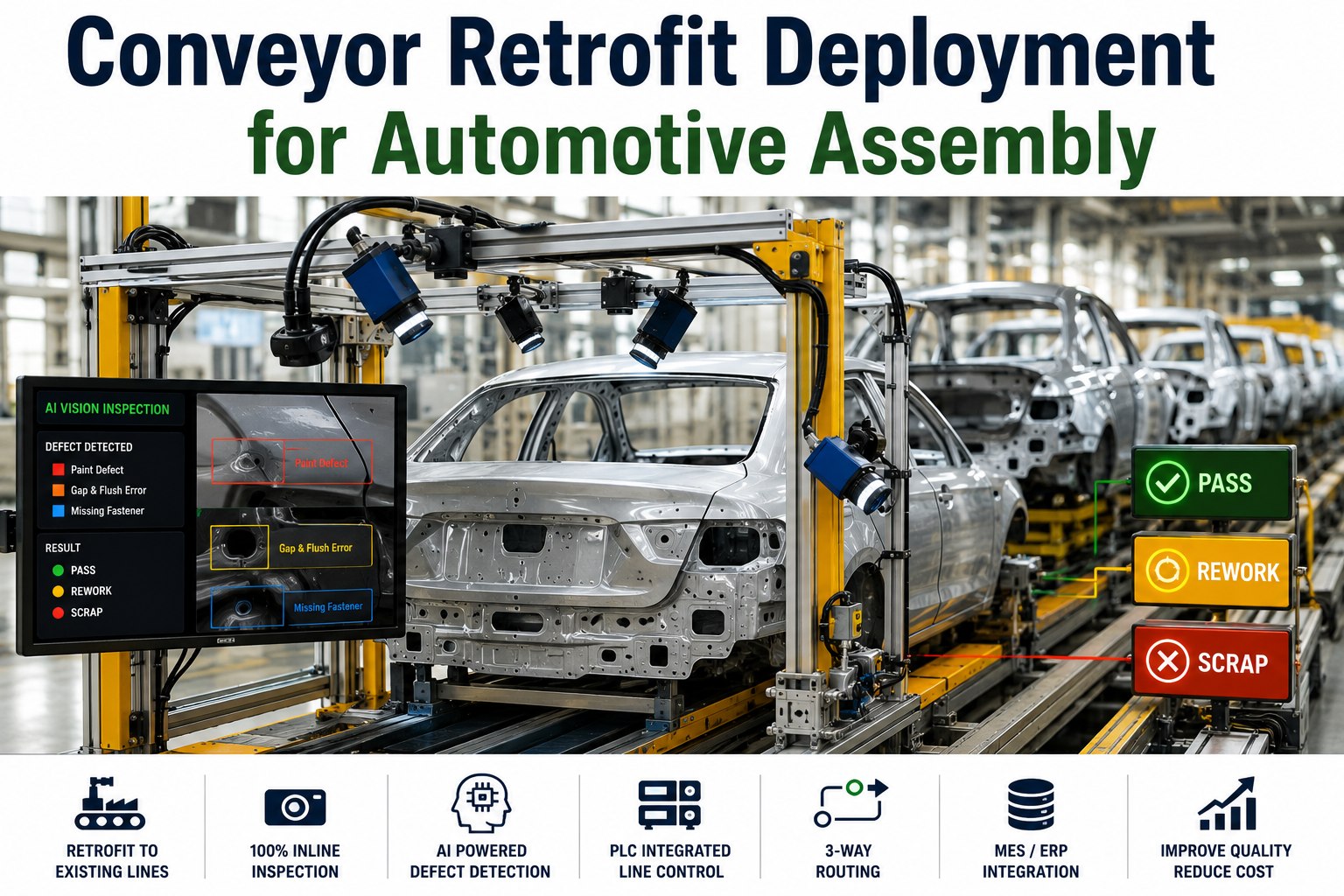
Your trim conveyor is running at 18 meters per minute, and somewhere between station 14 and station 15 a door gap drifted out of spec by 1.2 millimeters. The operator at the end of the line won't catch it — they are checking twelve other things. By the time the gap-and-flush gauge finds it at audit, you've built forty more bodies with the same fault and your first-time-through rate just dropped below target. This is the daily reality that drives automotive assembly plants to retrofit conveyor inspection with AI vision — a deployment that inspects 100% of items in motion on existing body, paint, and trim conveyors without slowing the line or ripping out infrastructure.
Why Retrofit Beats Rip-and-Replace on Existing Assembly Lines
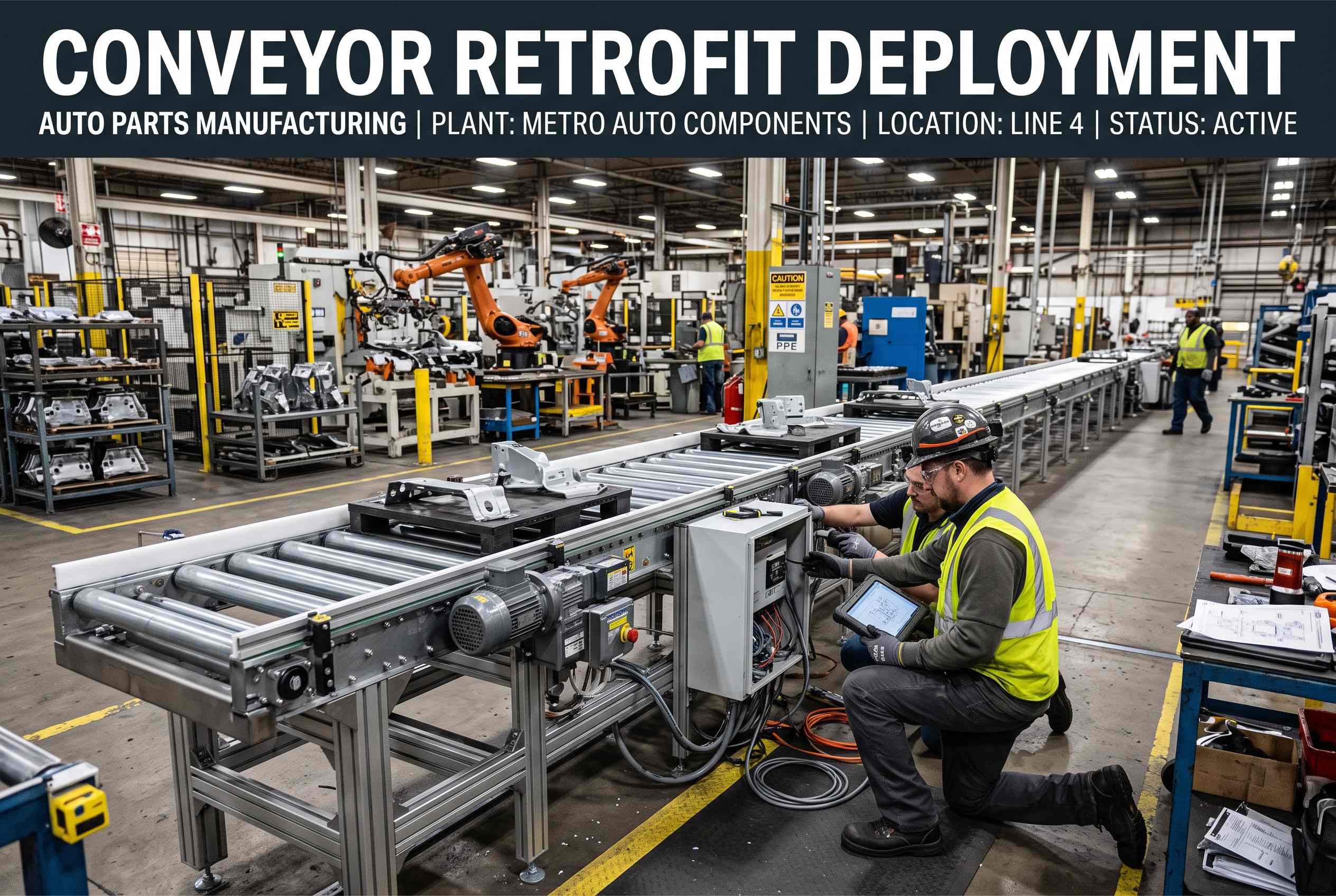
Most body-in-white and trim lines running today were built between 2005 and 2018. They're mechanically sound, PLC-controlled, and running at cycle times the plant depends on. Tearing them out to install a new conveyor with integrated vision is a 14-month, multi-million-dollar capital project that forces a shutdown. Retrofitting AI vision onto the existing line — cameras, lighting enclosures, on-prem GPU inference cabinets, and PLC tag integration — takes eight weeks per line, runs during scheduled maintenance windows, and doesn't touch the conveyor mechanics. Book a single-line retrofit scoping session to see how your current conveyor layout maps to camera placement and inference coverage.
What AI Vision Catches on a Moving Assembly Conveyor
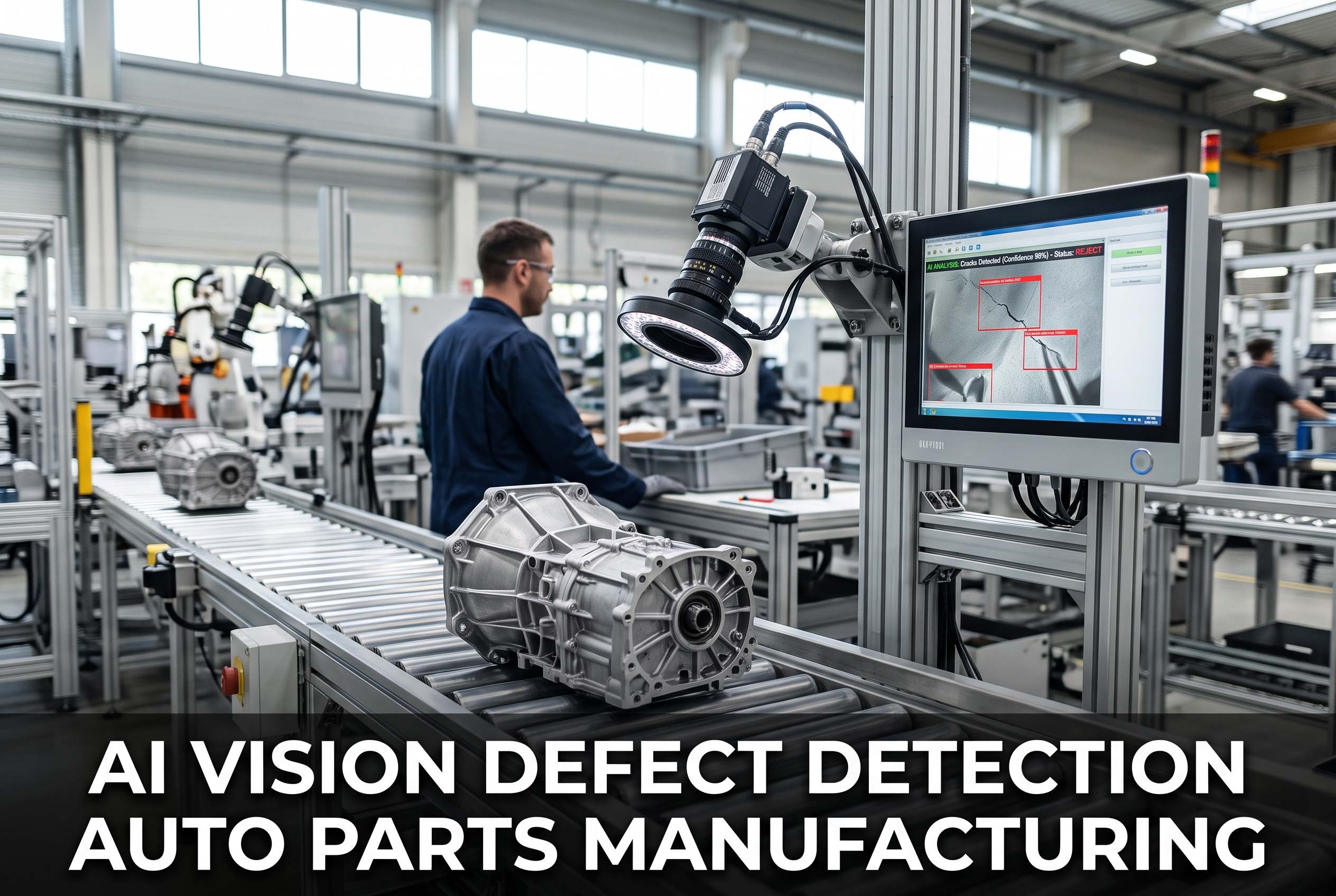
The defects that kill first-time-through on automotive lines aren't exotic — they're the same categories that slip past manual inspection every shift. The difference with retrofitted AI vision is that every unit gets checked, every time, at line speed, with results written back to the MES batch record in under 200 milliseconds. Here are the defect categories the system is trained to catch on body, paint, and trim conveyors.
Gap & Flush Errors
Door-to-body gaps, hood-to-fender alignment, liftgate flushness, panel misalignment beyond ±0.5mm tolerance
Paint & Surface Defects
Orange peel, runs, sags, dirt inclusions, fisheyes, solvent pop, scratches from transfer contact
Missing & Loose Fasteners
Missing bolts on subframes, incomplete torque marks, unseated clips, missing rivets on body panels
Component Presence & Orientation
Missing brackets, misaligned harness clips, wrong-side mirrors, incomplete trim bezels, badge placement
Sealer & Adhesive Bead
Bead continuity, bead width variance, skips, overflow, missing hem flange sealer on closure panels
Label & VIN Verification
VIN readability, tire pressure label presence, regulatory compliance labels, emission sticker placement
Three-Way Routing: Pass, Rework, Scrap — Automatically
Detection without routing is just a dashboard. The real value of a retrofitted AI vision system is that it talks directly to your Level 2 PLC and DCS, triggering automated divergence at decision points on the conveyor. When a defect is classified, the system sends a routing instruction to the PLC in real time — the body, skid, or pallet is diverted to the rework loop, flagged for scrap, or passed forward to the next station. No operator lookup, no paper traveler, no manual tag. The routing decision is logged against the unit's MES identity and becomes part of the permanent build record.
Pass
Conveyor carries unit forward to next station. MES record updated with pass status and all inspection data points.
Rework
Diverter sends unit to rework loop. Defect type, location, and images pushed to rework station touchscreen.
Scrap
Unit diverted to scrap bay. Scrap code, root cause, and cost logged to ERP for real-time yield reporting.
Want to see how three-way routing maps onto your existing conveyor layout and PLC logic? Book a routing architecture walkthrough with iFactory's automotive integration team.
Measured Impact on First-Time-Through and Scrap Cost
The numbers that matter to an Operations Director are first-time-through (FTT) rate, scrap cost per unit, and rework hours per shift. Retrofitted AI vision moves all three — not over years, but within the first 90 days of deployment. The improvement comes from catching defects at the station where they're created, not thirty stations downstream where the root cause is buried under forty good units of additional assembly work.
inspection coverage vs. 2–5% manual audit sampling on typical body and trim conveyors
reduction in scrap cost per unit within first 90 days of deployment on retrofitted lines
inference latency per unit — fast enough for 18m/min conveyor speeds with no line slowdown
fixed-price single-line pilot timeline from site survey to production-ready deployment
Manual Inspection & End-of-Line Audit
- FTT rate: 82–87% — defects discovered late, root cause obscured
- Inspection rate: 2–5% sample audit at end of line, rest unverified
- Defect discovery: 30+ stations downstream from where fault originated
- Rework loop: Manual tag, paper traveler, operator lookup at rework bay
- Scrap cost: Full embedded cost — labor, parts, paint — absorbed per scrapped unit
- Root cause: Shift-end review, manual data correlation, 24–48 hour lag
AI Vision with Automated Routing
- FTT rate: 94–97% — defects caught at source, corrective action immediate
- Inspection rate: 100% of units, every station, in motion at line speed
- Defect discovery: At the station where it occurs — 1 cycle, not 30
- Rework loop: Auto-diverted, defect images and instructions on rework screen
- Scrap cost: 18–24% reduction — fewer units reach scrap, earlier intervention
- Root cause: Automated RCA via PLC tag correlation, minutes not days
Run a Fixed-Price 8-Week Pilot on Your Hardest Line
iFactory's automotive retrofit team deploys on-prem NVIDIA GPU inference, multi-station camera arrays, and PLC tag integration onto your existing conveyor — fixed price, fixed timeline, with an ROI worksheet built from your actual scrap cost and FTT baseline.
MES, ERP, and PLC Integration: How the Data Chain Works
The reason most vision systems stall at "nice dashboard" is that they sit outside the plant's data backbone. iFactory's retrofit architecture is designed to plug into your existing stack — MES, ERP, QMS, and the Level 2 PLC/DCS that controls the conveyor — so every inspection result, routing decision, and defect image becomes part of the permanent production record. Here's how the integration chain works, from camera to boardroom report.
PLC Tag Capture
Conveyor position, cycle count, skid ID, and station status tags read directly from the Level 2 PLC/DCS. No new sensors required on existing conveyor infrastructure.
On-Prem GPU Inference
NVIDIA edge GPU cabinet processes camera streams, classifies defects, and sends routing decisions back to the PLC in under 200 milliseconds — all on-prem, no cloud dependency.
MES Identity Mapping
Each inspection result is mapped to the body ID, VIN, and work order in the MES. Defects, passes, and rework events become part of the electronic build record.
ERP & QMS Feed
Scrap codes, rework hours, and yield data flow to ERP for real-time cost visibility. Quality events trigger CAPA workflows in the QMS automatically.
Automated RCA
PLC tag correlation links defect events to upstream process parameters — torque values, clamp force, robot position — pinpointing root cause in minutes.
Need to validate integration against your specific MES and PLC environment before committing? Talk to an integration specialist about your stack — we support OPC UA, EtherNet/IP, and direct SAP/Oracle adapters.
The 8-Week Retrofit Deployment Timeline
A single-line AI vision retrofit is a fixed-price, fixed-scope project. No open-ended consulting, no change-order drift. The timeline below is what a typical body or trim conveyor retrofit looks like from site survey to production-ready handoff. Every phase runs during scheduled maintenance windows or off-shifts — your line never stops producing.
Site Survey & Line Mapping
Engineering team walks the conveyor, maps camera positions, identifies PLC tag points, and documents MES identity capture method (barcode, RFID, or existing skid ID). Deliverable: camera placement drawing and integration spec.
Defect Library & Model Training
Historical defect images, manual audit logs, and known failure modes from your line are used to train the initial inference model. Client QA team reviews and validates the defect classification library before deployment.
Hardware Install (Off-Shift)
Camera enclosures, lighting, and on-prem NVIDIA GPU cabinet installed during weekend maintenance windows. Cabling run alongside existing conveyor infrastructure. Line runs normally through the week.
PLC Tag Integration & Routing Logic
Level 2 PLC/DCS integration tested — tag capture for skid ID and station status, routing commands for pass/rework/scrap divergence. Dry-run testing with empty skids before live production.
MES & ERP API Integration
Inspection results mapped to MES body ID and work order. Scrap codes and rework events flowing to ERP. QMS CAPA triggers configured for critical defect categories.
Shadow Mode Validation
System runs live on production units in shadow mode — inspecting, classifying, and logging but not routing. QA team compares AI results against manual audit to validate accuracy and false-positive rate.
Go-Live & Handoff
Routing automation activated. Production team trained on rework station interface. ROI baseline established from Week 8 data. Ongoing model retraining and support transition to iFactory managed services.
Ready to scope your single-line pilot? Book a pilot scoping session and we'll bring the ROI worksheet to the first meeting.
What the ROI Worksheet Actually Measures
The fixed-price pilot includes an ROI worksheet built from your plant's actual numbers — not industry averages. Before deployment begins, iFactory's engineering team works with your Operations and Quality leads to establish baselines across five measurable dimensions. The worksheet is updated weekly during the pilot and presented as a go/no-go decision tool at the Week 8 handoff.
Scrap Cost Per Unit
Baseline scrap cost from ERP — material, labor, and overhead absorbed per scrapped body. Tracked weekly post-deployment to quantify reduction from earlier defect detection.
First-Time-Through Rate
Percentage of units that pass all stations without rework. Measured per station and per line. FTT improvement directly correlates to throughput gain and labor cost reduction.
Rework Hours Per Shift
Direct labor hours spent in rework loops. Automated routing and defect-image delivery to rework stations cut diagnosis time and reduce average rework cycle duration.
Defect Escape Rate
Defects that pass through the line and are caught at final audit or — worse — at dealer delivery. Retrofitted vision targets zero escapes on inspected defect categories.
Root Cause Cycle Time
Time from defect detection to identified root cause and corrective action. Automated PLC tag correlation reduces this from 24–48 hours to minutes for most defect categories.
Throughput Impact
Units per hour at line speed. Because the vision system runs at conveyor speed with no slowdown, throughput is preserved — and improved indirectly via FTT gains and fewer rework interruptions.
Expert Perspective
We were running 2% manual audit at end of trim and thinking we had a quality problem. After the vision retrofit, we found out we had a detection problem. The first week in shadow mode, the system caught 340 defects our manual audit had missed — same line, same units, same shift. The thing that surprised me was the routing. We'd been tagging rework units with paper travelers and hoping the operator at the rework bay could figure out what was wrong. Now the unit diverts itself and the defect images are on the screen before the operator touches it. My rework hours per shift dropped 30% in the first month, and that was before the model finished training.
— David Kowalski, Trim Line Production Manager, Tier 1 automotive body & assembly plant (NAICS 336110)
defects caught in first week of shadow mode that manual audit had missed
reduction in rework hours per shift within first 30 days of go-live
conveyor speed reduction — full line speed maintained throughout deployment
Deploy AI Vision on Your Existing Conveyor — No Rip-and-Replace
Fixed-price 8-week single-line pilot. On-prem NVIDIA GPU inference. PLC tag integration for automated pass/rework/scrap routing. MES and ERP connected from day one. ROI worksheet built from your actual scrap cost and FTT baseline. Your conveyor never stops running.
Frequently Asked Questions
Can AI vision really inspect 100% of units on an existing conveyor without slowing the line?
Yes. The on-prem NVIDIA GPU inference cabinet processes 8–16 camera streams per station in under 200 milliseconds, which is fast enough for conveyor speeds up to 18 meters per minute and beyond. The cameras capture images of units in motion — no stop-and-scan, no line pause. The system is retrofitted onto your existing conveyor infrastructure during scheduled maintenance windows, so production continues normally throughout deployment.
How does the three-way pass/rework/scrap routing actually work with my existing PLC?
The vision system communicates with your Level 2 PLC/DCS via OPC UA or EtherNet/IP. When a defect is classified, the inference engine sends a routing command — ROUTE_FORWARD, ROUTE_REWORK, or ROUTE_SCRAP — to the PLC, which triggers the existing diverter mechanism at the appropriate conveyor decision point. The skid or pallet is diverted automatically. No operator intervention is required for the routing decision, and the result is logged against the unit's MES identity in real time.
What does the fixed-price 8-week pilot include, and what happens after week 8?
The pilot includes site survey, defect library development, camera and GPU hardware installation on a single line, PLC tag integration, MES and ERP API connections, shadow-mode validation, go-live, and an ROI worksheet built from your plant's actual baseline data. After week 8, the line is in production with full inspection and routing automation. Ongoing model retraining, system monitoring, and support transition to iFactory managed services. Book a pilot scoping session to get a fixed-price quote for your specific line.
Can the system integrate with our existing MES and ERP, or does it require a new software stack?
The system is designed to integrate with your existing stack. iFactory supports REST API and WebSocket connections to major MES platforms, direct adapters for SAP, Oracle, and QAD ERP systems, and OPC UA or EtherNet/IP for PLC communication. If your line already captures skid ID, body ID, or VIN via barcode or RFID, the vision system maps inspection results to that identity — no new identity infrastructure required. Talk to a specialist about your specific MES and PLC environment.
What types of automotive assembly lines are best suited for a vision retrofit?
Body-in-white assembly conveyors, trim lines, paint inspection lines, skillet lines, and final assembly conveyors are all strong candidates. The key requirement is that the line has a consistent conveyor path where cameras can be mounted above or beside the unit, and that the PLC controls diverter points where routing decisions can be executed. Lines with high SKU variation, frequent model changeovers, or known defect categories like gap-and-flush, missing fasteners, or paint defects see the fastest ROI — typically within the first 90 days of deployment.
Key Takeaways: Retrofit AI Vision on Your Assembly Conveyor
The plants winning the quality battle in automotive assembly aren't the ones with the newest conveyors — they're the ones inspecting 100% of units in motion and routing defects automatically at the station where they occur. A retrofitted AI vision deployment on your existing body or trim conveyor delivers that capability in 8 weeks, at a fixed price, without stopping production. The impact shows up where it matters: first-time-through rate climbs, scrap cost per unit drops, rework hours shrink, and root cause cycle time collapses from days to minutes. If you're still relying on 2% manual audit sampling and paper rework travelers, the gap between your line and a vision-equipped line is widening every shift. Book a pilot scoping session and bring the ROI worksheet to your next operations review.