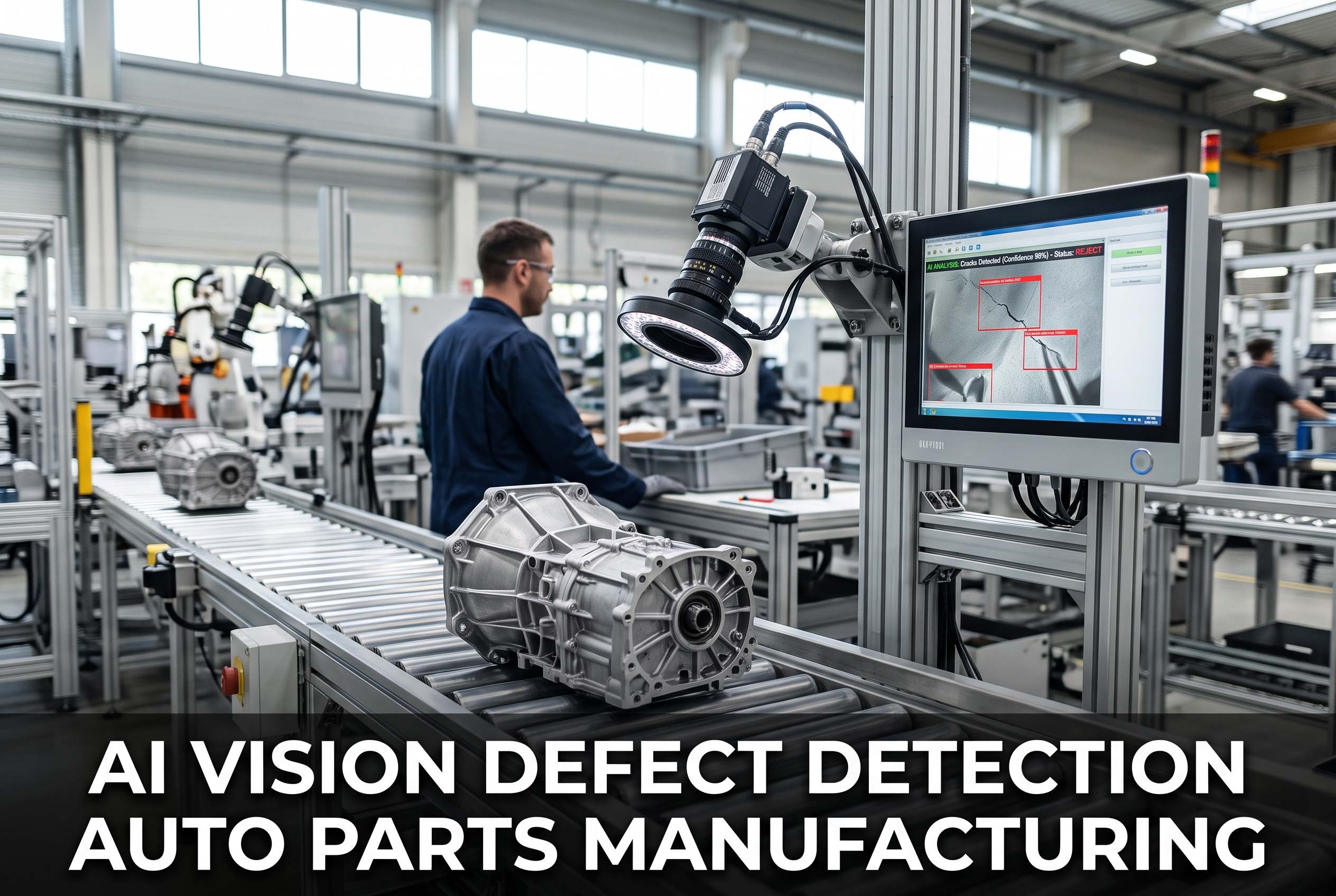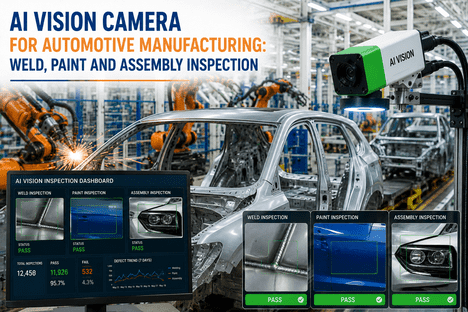
Your paint shop runs a flawless robotic basecoat on Monday, and by Thursday the trim line is logging a spike in orange peel on the same BIW skin panel — but nobody can tell you exactly when the drift started, which skillets carried the affected units, or whether the root cause was booth humidity, bell voltage, or a dirty shaping air nozzle. The line keeps moving at 40 jobs per hour, and by the time a manual auditor catches the defect at the end-of-line audit station, you've already shipped 60 painted bodies into final assembly with embedded rework cost. AI vision surface inspection on automotive assembly lines changes that math — inspecting 100% of bodies in motion on the conveyor, routing every defect to pass, rework, or scrap in real time, and writing the defect image, body ID and process parameters straight into your MES and ERP so the root-cause analysis takes minutes instead of a cross-functional war room.
What AI Vision Actually Catches on a Moving Body-in-White
The defect spectrum on an automotive body and trim line is wider than any single camera station can handle — but a properly designed AI vision system covers all of it at conveyor speed. Here's what the system sees, classifies, and routes on every single unit, with no sampling and no operator judgment in the loop.
Paint & Coating Defects
- Orange peel, mottling, and texture drift
- Runs, sags, and solvent pop
- Dirt inclusions and gel particles
- Color mismatch and undertone shift (ΔE tracking)
- Pinholes, craters, and fisheyes
- Under-coverage on edges and jambs
Gap & Flush Variations
- Door-to-fender and hood-to-fascia gaps
- Liftgate and tailgate alignment
- Flushness step between panels (±0.3mm)
- Asymmetric gaps left-to-right
- Hinge bind and striker misalignment
- Seal compression gaps on closures
Fasteners & Hardware
- Missing studs, clips, and retaining pins
- Cross-threaded or partially seated bolts
- Missing weldnuts and studs on sub-assemblies
- Incorrect fastener grade or finish
- Sealant bead presence and continuity
- Adhesive application coverage
Running a mixed-model line with frequent model changeovers? Book a defect spectrum mapping session to see exactly which defects AI vision will catch on your body and trim conveyors.
Three-Way Pass, Rework, and Scrap Routing at Line Speed
Manual audit stations operate after the fact — a body gets flagged, an auditor walks over, and a decision gets made 20 minutes and 15 jobs later. AI vision moves that decision to the exact moment the body passes the inspection arch, and pushes the routing instruction directly to your Level 2 PLC and conveyor control system before the body reaches the next diverter.
PASS
Defect-free or within spec. Body continues to the next station. MES records green status, body ID, and timestamp.
REWORK
Repairable defect detected — polish, respray, or adjustment. Body diverts to rework bay with defect map and work instructions pushed to the operator screen.
SCRAP
Defect beyond economic repair — substrate damage, severe contamination, structural compromise. Body quarantined, QMS notified, root-cause investigation triggered automatically.
Want to see how three-way routing integrates with your existing PLC and conveyor logic? Schedule a routing architecture walkthrough with iFactory's automotive integration team.
The Cost of Catching Defects Too Late
The economics of surface inspection in automotive assembly are brutal. A paint defect caught at the booth costs roughly $4 to fix in-process. The same defect caught at end-of-line audit costs $45. Caught at the dealer? $400-plus in warranty and goodwill, assuming it's not a visible cosmetic complaint that hits your J.D. Power IQ score. Here's what the data looks like across North American assembly plants.
cost multiplier when a paint defect reaches the dealer vs. catching it at the booth — the classic automotive rework ladder
manual audit sampling rate on a typical body line — meaning 98% of units pass uninspected for cosmetic quality
of end-of-line paint defects trace back to upstream process drift that real-time vision would catch within the first affected batch
inference time per body on NVIDIA on-prem GPU — fast enough for conveyor speeds up to 60 jobs per hour with no line slowdown
Manual Audit Station vs. AI Vision on the Conveyor
If you're still relying on end-of-line manual audit stations for surface and cosmetic inspection, you're operating on a 2008 quality model. Here's what changes when AI vision moves inspection upstream onto the conveyor itself — and why plants that make the switch don't go back.
Still running end-of-line manual audits on a high-volume body line? Book an inspection gap analysis or talk to an automotive vision specialist about retrofitting AI vision onto your existing conveyor.
Retrofit AI Vision Onto Your Existing Body Line in 8 Weeks
iFactory delivers on-prem NVIDIA GPU inference, PLC tag capture, and full MES/ERP/QMS integration — retrofitted to your existing conveyors and skillets with no line stoppage. Fixed-price single-line pilot, ROI worksheet included, and routing logic that talks to your Level 2 control system from day one.
MES, ERP, and QMS Identity Mapping — Not Just Pictures
A camera that takes pictures of defects is a toy. A vision system that maps every defect image to a body ID, a VIN, a skillet number, a paint booth parameter set, and a supplier lot — and pushes that into your MES, ERP, and QMS in real time — is a manufacturing intelligence platform. That's the difference between "we saw a defect" and "we know exactly what caused it."
Body ID & VIN Capture
Camera triggers sync to the conveyor tracking system — every image is stamped with body ID, VIN, model variant, and build sequence position before inference runs. No orphan images, no manual lookup.
PLC Tag Capture
At the moment of inspection, the system pulls live PLC tags — booth temperature, humidity, bell voltage, conveyor speed, robot program number — and attaches them to the defect record. Root-cause analysis starts with the data, not a guess.
MES Batch & Shift Mapping
Every defect maps to the MES shift record, operator crew, and batch genealogy. When a defect cluster appears, you see the shift, the crew, and the material lot in one view — not three spreadsheets and a war room.
ERP Cost Attribution
Rework and scrap costs flow into the ERP by body ID, model, and defect type. Finance sees the true cost of quality in real time, not in a month-end variance report that nobody acts on.
QMS Nonconformance Auto-Log
Scrap and repeat rework events auto-generate nonconformance records in the QMS with attached images, PLC context, and MES batch ID. No manual data entry, no transcription errors, no missing context.
API-First Integration
REST and OPC UA endpoints connect to whatever stack you run — SAP, Siemens Opcenter, Rockwell FactoryTalk, Dassault Apriso, or a legacy homegrown MES. No rip-and-replace, no custom middleware project.
The 8-Week Single-Line Pilot: What Actually Happens
iFactory's fixed-price pilot isn't a feasibility study that ends in a slide deck. It's a working AI vision station on your line, routing defects through your PLC, and writing data into your MES — delivered in eight weeks with a clear ROI worksheet built from your actual defect and rework costs. Here's the week-by-week breakdown.
Line Survey & Defect Mapping
iFactory engineers walk your line, catalog the defect spectrum from the last 90 days of audit and warranty data, and map camera positions, lighting, and PLC integration points. You get a defect catch matrix before any hardware ships.
Hardware Install & PLC Integration
Inspection arch, NVIDIA GPU inference cabinet, and lighting installed over a scheduled maintenance window — no line stoppage. PLC tags captured, conveyor tracking synced, and body ID mapping validated against your MES.
Model Training & Tuning
Deep learning models trained on your actual defect images — not a generic library. False reject rate tuned to under 3%, defect classification validated against your audit team's reference calls, and three-way routing logic tested against your diverters.
Go-Live & ROI Validation
System runs live on your line. Pass/rework/scrap routing active through your PLC. MES and QMS integration verified. ROI worksheet delivered with your actual rework cost reduction, scrap avoidance, and first-time-through improvement — measured, not projected.
Ready to put a fixed-price pilot on your highest-defect-cost line? Book an 8-week pilot scoping call with iFactory's automotive team, or talk to a specialist about your specific line configuration.
Expert Perspective
Before we put vision on the conveyor, I had two auditors catching maybe 30 units a shift at end-of-line — and by then the damage was done. The first week the AI station went live, it caught a dirt inclusion pattern on the right rear quarter that tracked back to a single shaping air nozzle in booth 3. We'd been chasing that defect for six months with audit sheets and shift huddles. The vision system found it in four days because it had the booth parameters and the body IDs tied to every image. That's when I stopped thinking of it as a camera and started thinking of it as a diagnostic tool.
— Marco Velasquez, Paint Shop Quality Manager, Tier 1 automotive body & paint facility (NAICS 336110)
to root-cause a six-month recurring defect when PLC tags attach to every defect image
annual scrap and rework avoidance on a single high-volume body line after AI vision go-live
line stoppages required during retrofit — inspection arch installed over a maintenance window
Stop Catching Defects 60 Jobs Too Late
AI vision surface inspection on your automotive assembly line means 100% inspection at conveyor speed, three-way pass/rework/scrap routing through your existing PLC, and every defect image mapped to a body ID, booth parameters, and MES batch record. Fixed-price 8-week pilot, on-prem NVIDIA GPU inference, and an ROI worksheet built from your actual rework and scrap costs.
Frequently Asked Questions
Can AI vision be retrofitted onto an existing automotive body or trim conveyor without stopping the line?
Yes. iFactory designs the inspection arch, GPU inference cabinet, and lighting to install over a scheduled maintenance window — typically 8 to 12 hours. The system connects to your existing conveyor tracking and PLC via OPC UA or direct tag capture, so there's no need to modify the conveyor structure or interrupt production. Most single-line retrofits are fully operational before the next shift starts.
How does the three-way pass, rework, and scrap routing actually work with my PLC?
The AI vision system classifies each defect by type and severity, then writes a routing command to your Level 2 PLC or DCS via a tag write or REST API call. The PLC controls the diverter at the next conveyor gate — pass units continue straight, rework units divert to the rework bay with a defect map and work instructions on the operator screen, and scrap units quarantine with a QMS nonconformance auto-generated. The entire routing decision happens within 200ms of the body passing the inspection arch.
What defect types can the AI vision system detect on painted automotive bodies?
The system detects the full paint and body defect spectrum: orange peel, runs, sags, solvent pop, dirt inclusions, craters, fisheyes, color mismatch with Delta-E tracking, pinholes, and under-coverage on edges and jambs. It also measures gap and flush variations to ±0.15mm on every body panel, and detects missing fasteners, clips, studs, and incomplete sealant or adhesive beads. Models are trained on your actual defect images, not a generic library, so they reflect your specific paint chemistry, booth conditions, and body geometry.
How does the system map defects to MES, ERP, and QMS records?
Every defect image is timestamped and stamped with the body ID and VIN captured from your conveyor tracking system at the moment of inspection. Simultaneously, the system pulls live PLC tags — booth temperature, humidity, bell voltage, robot program — and attaches them to the defect record. This combined record is pushed via API to your MES (shift, crew, batch), ERP (cost attribution by body and defect type), and QMS (auto-generated nonconformance with image and process context). The integration works with SAP, Siemens Opcenter, Rockwell FactoryTalk, Dassault Apriso, and legacy homegrown MES systems.
What does the fixed-price 8-week pilot include and how is ROI measured?
The pilot includes a full line survey and defect mapping, hardware installation (inspection arch, NVIDIA GPU inference cabinet, lighting), PLC and conveyor integration, deep learning model training on your defect images, three-way routing go-live, and MES/QMS integration. At week 8 you receive an ROI worksheet built from your actual rework cost per defect, scrap cost per body, and first-time-through improvement — measured against your pre-pilot baseline, not projected. Most plants see the system pay for itself within the first production cycle. Book a pilot scoping call to map it against your highest-defect-cost line.