AI Vision Cameras paired with edge computing represent the most significant architectural shift in manufacturing quality control of the past decade — and the reason is latency. Cloud-dependent vision systems that route inspection images off the production floor for remote processing introduce delays measured in hundreds of milliseconds to several seconds between image capture and rejection signal. On a production line running at 120 units per minute, a 500-millisecond processing delay means eight units have passed the rejection point before the signal fires. Edge computing eliminates this problem entirely by processing every AI vision inspection decision locally, at the inspection point, within milliseconds of image capture — making real-time, every-unit inspection at full line speed a deployable reality rather than a theoretical capability. iFactory's AI Vision Camera platform is built on an edge-first architecture that delivers this local processing performance without sacrificing the centralized data aggregation and fleet-wide analytics that cloud connectivity provides.
Edge AI Vision · Real-Time Inspection · On-Device Processing · iFactory Platform
Real-Time AI Vision Inspection at Full Line Speed — No Cloud Dependency Required
iFactory's edge-deployed AI Vision Camera system processes every inspection decision locally in under 20 milliseconds — delivering the rejection signal accuracy and throughput performance that cloud-routed vision systems structurally cannot match on fast production lines.
Why Edge Computing Is the Correct Architecture for AI Vision in Manufacturing
The core argument for cloud-processed AI vision — centralized model management, lower on-site hardware cost, simplified IT footprint — is real at low inspection volumes and low line speeds. It breaks down at production throughput rates because the physics of data transmission create a latency floor that no amount of cloud processing optimization can eliminate. The round-trip time for a high-resolution inspection image to travel from the production floor to a cloud inference server and return a rejection signal is bounded below by network propagation delay, compression-decompression time, and inference queue latency. In a managed enterprise network environment with optimized cloud endpoints, this floor sits at 150 to 400 milliseconds under normal conditions — and rises sharply during network congestion events that production environments generate routinely. Edge computing removes this floor entirely. The inference engine runs on hardware collocated with the camera, the image never leaves the inspection point during processing, and the rejection signal latency is governed only by the edge processor's inference time — which iFactory's platform executes in 8 to 22 milliseconds depending on model complexity and resolution.
Cloud-Processed AI Vision — Limitations
- Rejection signal latency of 150–400ms minimum — structurally unbounded under congestion
- Inspection halted by network outages — no local fallback processing capability
- High-bandwidth image upload requirement stresses facility network infrastructure
- Per-image cloud inference cost scales directly with production volume
- Data sovereignty constraints complicate regulatory compliance in food and pharma
- Real-time defect feedback loop to rejection hardware requires persistent low-latency connection
iFactory Edge AI Vision — Advantages
- Rejection signal in 8–22ms — consistent at any line speed, any network condition
- Full inspection capability maintained during cloud connectivity loss — zero coverage gap
- Only compressed inspection summaries and alerts sent to cloud — minimal bandwidth
- Fixed edge hardware cost — inspection cost per unit does not increase with volume
- Inspection data processed and stored locally — full data sovereignty compliance
- Rejection signal wired directly to PLC — no network dependency in the rejection path
The Edge Computing Architecture Behind iFactory's AI Vision System
iFactory's AI Vision Camera deployment uses a three-tier edge architecture that separates local inference from facility-level aggregation and enterprise-level analytics — each tier optimized for its specific function. Understanding this architecture is important for production engineers evaluating AI vision deployment because the architecture determines not just inspection performance but also network requirements, IT integration complexity, and the scope of analytics accessible at each level of the organization. Engineers who want to map this architecture against their facility's existing IT infrastructure can Book a Demo with iFactory's technical team for a site-specific integration review.
Tier 1 — Camera Node
On-Device Image Capture and Pre-Processing
Industrial AI vision camera with integrated ISP (Image Signal Processor) performs hardware-accelerated image pre-processing at the point of capture — noise reduction, exposure normalization, and trigger synchronization — before passing the conditioned image to the Tier 2 edge inference unit. Camera-level pre-processing reduces the computational load on the inference hardware and ensures consistent input image quality regardless of ambient lighting variation.
Tier 2 — Edge Inference Unit
Local AI Model Execution and Rejection Signal Generation
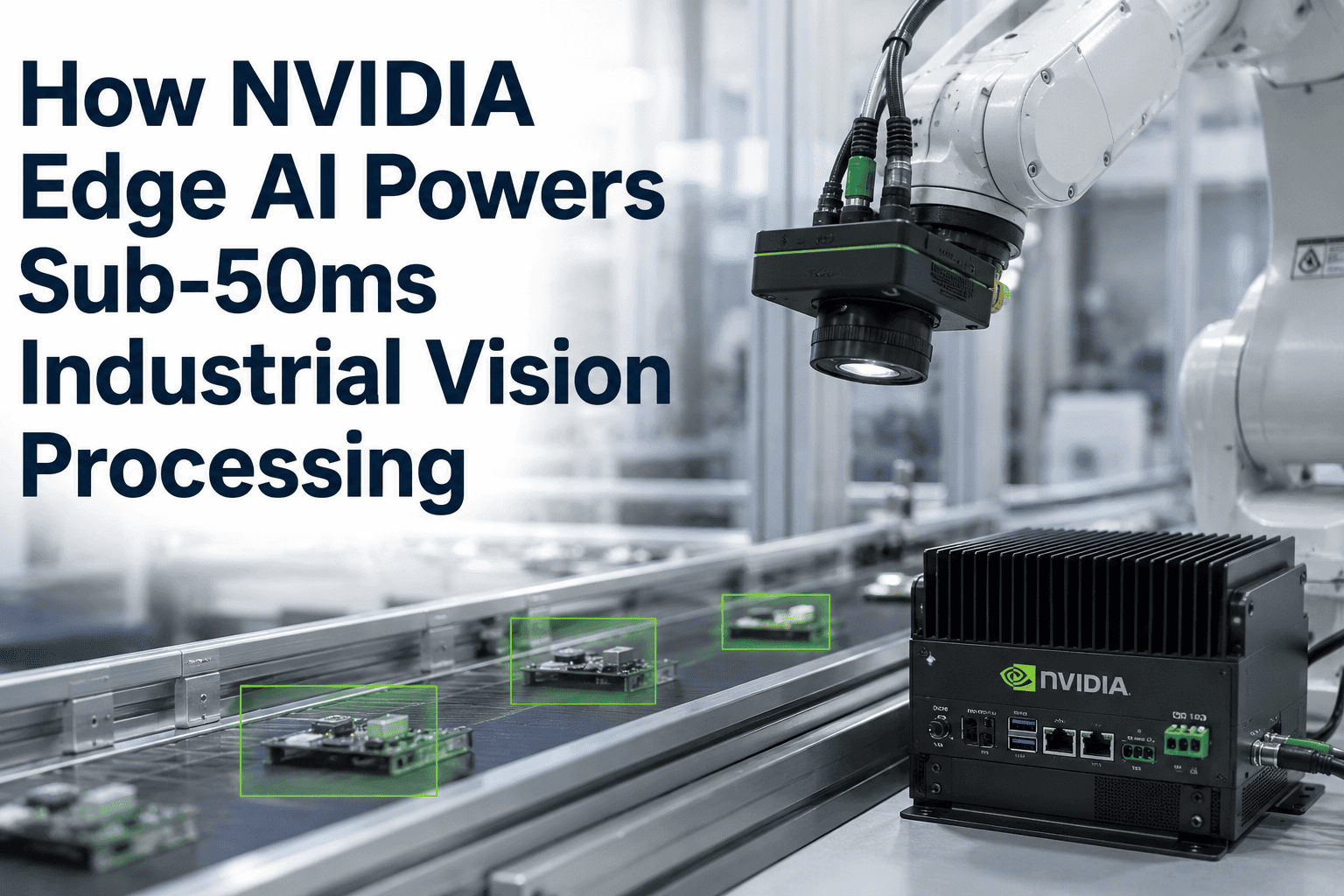
DIN-rail mounted edge computing hardware — equipped with GPU or NPU acceleration — runs iFactory's AI vision model entirely on-site, with no external network dependency in the inference path. The inference result — pass, reject, and defect classification — is generated in 8 to 22 milliseconds and transmitted directly to the line PLC via hardwired I/O for rejection actuation. Simultaneously, the inspection record is written to local storage and queued for aggregation to Tier 3. The edge inference unit continues full-capability operation during cloud connectivity interruptions.
Tier 3 — Facility Aggregation Layer
Multi-Line Data Consolidation and Dashboard Delivery
An on-premise facility server (or virtual machine on existing facility infrastructure) aggregates inspection records from all active edge inference units, generates facility-level quality dashboards, and manages model deployment to edge units. This layer hosts the iFactory web interface accessible to quality engineers and line supervisors on the facility network — providing real-time defect trend visualization, per-line performance comparison, and shift reporting without cloud connectivity requirement for local dashboard access.
Tier 4 — Cloud Analytics Layer (Optional)
Enterprise Analytics, Multi-Site Benchmarking, and Remote Model Management
Compressed inspection summaries — not raw images — are transmitted from the facility aggregation layer to iFactory's cloud analytics platform on a scheduled or event-triggered basis. This layer provides enterprise-level quality benchmarking across multiple facilities, remote model performance monitoring, and centralized model retraining management. Cloud connectivity is not required for any local inspection or rejection function — its loss affects only the enterprise analytics and remote management capabilities, not production-floor performance.
Edge AI Processing Performance: What the Numbers Mean for Production
The performance specifications of an edge-deployed AI vision system have direct, calculable implications for inspection coverage at different line speeds. A system that processes an inspection in 20 milliseconds can theoretically inspect 50 items per second — 3,000 items per minute — with no missed items if the triggering and image transfer pipeline is optimized. A cloud-routed system with a 300-millisecond round-trip time is limited to approximately 3.3 inspections per second before queuing begins to create missed inspection windows. At a production rate of 100 units per minute — common in food, beverage, and consumer goods manufacturing — the cloud-routed system operates within its performance envelope only if every inspection completes before the next unit arrives. The moment a network event pushes latency above the inter-unit interval, units begin passing uninspected. Edge processing eliminates this failure mode entirely.
8–22ms
Local edge inference time — consistent at any production rate or network condition
100%
Inspection coverage maintained during cloud connectivity loss — zero coverage gap
3,000+
Units per minute inspectable at edge with full AI model inference — no sampling required
95%
Reduction in facility network bandwidth consumption versus cloud-routed image upload approach
Five Manufacturing Scenarios Where Edge AI Vision Outperforms Cloud Alternatives
The performance advantage of edge-deployed AI vision over cloud-routed alternatives is universal, but its business impact is most concentrated in specific production scenarios. The following five scenarios represent the manufacturing contexts where edge processing is not merely preferable but operationally necessary — and where iFactory's edge architecture delivers inspection performance that cloud-dependent systems structurally cannot match. Quality engineers evaluating deployment options in these scenarios can Book a Demo to see latency and coverage performance data from production deployments in comparable environments.
High-Speed Packaging and Labeling Lines
Consumer goods packaging lines running at 400 to 800 units per minute require rejection signal latency below 15 milliseconds to maintain physical rejection accuracy. At these speeds, a 200-millisecond cloud processing delay creates a rejection window offset of 2.5 to 5 meters of conveyor travel — making precise unit rejection mechanically impossible without a buffer accumulation system that itself introduces production complications. Edge inference at 8 to 12 milliseconds eliminates the offset and enables direct, precise unit rejection at any packaging line speed.
Remote or Network-Constrained Production Facilities
Food processing, agricultural processing, and resource extraction facilities located in remote areas with limited or unreliable internet connectivity cannot sustain cloud-dependent inspection systems without accepting significant inspection coverage gaps during connectivity interruptions. iFactory's edge architecture operates at full inspection capability on a local area network with no external connectivity requirement — providing the same AI vision performance in a remote facility with a satellite internet connection as in an urban facility with fiber backbone connectivity.
Regulated Industries with Data Sovereignty Requirements
Pharmaceutical, medical device, and certain food manufacturing operations are subject to regulatory requirements governing where production and quality data can be stored and processed. Cloud routing of inspection images may violate these requirements depending on cloud provider geography and data residency commitments. Edge processing eliminates the regulatory complexity by ensuring that inspection data is processed and stored locally — with cloud transmission limited to compressed analytics summaries that do not contain the product images subject to data residency controls.
Multi-Camera High-Resolution Inspection Systems
Complex inspection systems using four to twelve cameras simultaneously — for all-surface inspection of three-dimensional products, or for inspection at multiple stages of a single production line — generate image data volumes that would require enterprise-grade wide area network connections if cloud-routed. Edge processing handles this data volume locally, with each camera's inference running on dedicated processing channels that scale linearly without network bandwidth constraints. iFactory's multi-camera edge configurations support simultaneous inference on up to eight camera streams per edge unit.
Continuous Process Manufacturing with Zero Stop Tolerance
Continuous process manufacturing environments — web printing, film extrusion, continuous casting, paper and board production — operate without the ability to stop and restart for inspection system recovery. A cloud-dependent inspection system that loses connectivity for 30 seconds creates a 30-second uninspected production window in a continuous process, which at typical process speeds represents tens of meters of material with unverified quality status. Edge processing with local storage buffering ensures that every meter of continuous production is inspected and recorded regardless of connectivity events.
Just-in-Time Manufacturing with Zero Rework Tolerance
Automotive components, precision assemblies, and other JIT-supplied manufactured goods enter customer production lines directly from inbound delivery with no rework opportunity. A defect that escapes inspection in a JIT supply context causes a line stop at the customer — a consequence measured in thousands of dollars per minute. The zero-latency rejection accuracy of edge AI vision provides the detection confidence required in JIT supply contexts, where the cost of a single escaped defect far exceeds the cost of the entire inspection system deployment.
Edge Architecture · Sub-20ms Inference · Multi-Camera Support · iFactory AI Vision
Every Inspection. Every Unit. No Network Dependency. No Latency Compromise.
iFactory's edge-deployed AI Vision Camera platform delivers consistent sub-22-millisecond inspection at any production throughput rate — with full coverage maintained during connectivity events and direct PLC integration for precise unit rejection at any line speed.
Edge Hardware Specifications and Selection for AI Vision Deployment
Selecting the correct edge computing hardware for an AI vision deployment requires matching processor architecture to the computational demands of the AI model, the number of simultaneous camera streams, and the environmental requirements of the installation location. Underpowered edge hardware produces inference latency that defeats the purpose of local processing — overpowered hardware creates unnecessary capital cost. iFactory's hardware specification process evaluates these parameters for each inspection point before procurement to ensure that the edge unit selected delivers the required inference performance at the required environmental rating without margin excess that inflates deployment cost. Facilities evaluating their edge hardware requirements can Book a Demo for a hardware specification review as part of the iFactory deployment scoping process.
| Deployment Scenario |
Camera Count |
Required Inference Time |
Recommended Processor |
Environmental Rating |
| Single-Camera Label / Cap Inspection |
1–2 cameras |
<15ms per frame |
GPU-accelerated ARM SoC or entry NPU module |
IP54 DIN-rail enclosure |
| Multi-Camera All-Surface Inspection |
4–8 cameras |
<20ms per stream |
Multi-core GPU with dedicated inference accelerator |
IP54 panel PC enclosure |
| High-Resolution Defect Detection (Food / Pharma) |
2–4 cameras |
<12ms per frame |
Industrial GPU compute module with ECC memory |
IP65 stainless enclosure |
| Continuous Web Inspection (Print / Film) |
Line scan 1–4 heads |
<8ms per scan line |
FPGA + NPU hybrid processor for pipeline throughput |
IP54 DIN-rail enclosure |
| Washdown Environment Inspection |
1–4 cameras |
<20ms per frame |
Fanless industrial PC with sealed GPU module |
IP69K sealed enclosure |
| Remote / Low-Power Site Deployment |
1–2 cameras |
<25ms per frame |
Low-power ARM NPU with hardware video decoder |
IP54 with passive cooling |
Model Management at the Edge: Deployment, Updating, and Version Control
Edge-deployed AI vision systems introduce a model management challenge that cloud-hosted systems avoid: when the inference model lives on hardware distributed across a production floor — or across multiple facilities — updating that model requires a deployment mechanism that propagates changes to every edge unit without creating coverage gaps during the transition. iFactory's model management architecture addresses this through a centralized model registry that pushes validated model versions to edge units on a scheduled or triggered basis, with rollback capability that automatically reverts to the prior model version if deployment validation on the edge unit fails. This mechanism ensures that model updates — whether triggered by product variant changes, defect mode evolution, or performance improvement cycles — reach every edge unit reliably without requiring manual intervention at each inspection point.
iFactory Edge Model Deployment Workflow
1
Model Trained & Validated
New or retrained model validated against held-out test dataset in cloud environment. Performance benchmarks recorded.
→
2
Staged Rollout Authorized
Quality engineer authorizes deployment to target edge units. Shadow mode deployment runs new model in parallel with current for validation.
→
3
Edge Unit Validation
New model runs on edge hardware in shadow mode during live production. Performance metrics compared against current model before cutover is authorized.
→
4
Live Cutover & Monitoring
Model promoted to live inference. Automated monitoring tracks post-cutover performance. Prior model version retained for instant rollback if metrics degrade.
Frequently Asked Questions: AI Vision Cameras and Edge Computing
1. What happens to inspection coverage if the edge computing unit loses power or fails during production?
iFactory's edge units are configured with UPS (Uninterruptible Power Supply) integration that provides 10 to 30 minutes of continued operation through a power interruption — sufficient to cover most transient events. For hardware failures, the platform's coverage monitoring system immediately alerts the quality team and documents the uninspected production window with start and end timestamps, enabling appropriate disposition of production manufactured during the inspection gap. Redundant edge unit configurations are available for inspection points where coverage continuity is a regulatory requirement.
2. How does iFactory's edge architecture handle AI model updates across multiple facilities without disrupting production?
Model updates are deployed through iFactory's centralized model registry using a staged rollout process: new models run in shadow mode on the target edge unit before cutover, performance metrics are compared against the current model during the shadow period, and cutover is authorized only when shadow mode performance confirms the new model meets or exceeds current performance thresholds. This process is managed through the iFactory dashboard without requiring on-site technical presence at each edge unit — a single quality engineer can manage model updates across all facilities from a central interface.
3. Can iFactory's edge AI vision system integrate with existing PLCs and SCADA systems already installed on the production line?
Yes. iFactory's edge inference units output rejection signals via discrete I/O that connects directly to existing PLC input cards without requiring PLC programming changes for basic rejection functionality. For deeper integration — quality data writing to SCADA historian, production order management, or MES traceability linking — iFactory supports OPC-UA, Modbus TCP, and standard industrial Ethernet protocols that connect to the facility's existing automation network. A specific integration architecture review is conducted during the pre-deployment scoping process to confirm compatibility with the specific PLC and SCADA platform in use at the facility.
4. What network infrastructure does iFactory's edge deployment require within the facility?
The critical network path in iFactory's edge architecture is the local area network connection between the edge inference unit and the facility aggregation server — which carries compressed inspection records rather than raw images. A standard 100 Mbps industrial Ethernet connection is sufficient for this path, even for multi-camera deployments. The camera-to-edge-unit connection uses GigE Vision or USB3 Vision direct cable — not the facility network. External internet connectivity is required only for the cloud analytics tier and is not in the critical path for any local inspection or rejection function.
5. How does edge processing affect the total cost of ownership compared to cloud-routed AI vision systems?
Edge hardware represents a higher upfront capital cost than cloud-subscription-only alternatives — but this calculation inverts when production volume is factored in. Cloud-routed systems charge per-inference or per-image fees that scale directly with production volume, while edge hardware cost is fixed regardless of throughput. At production rates above approximately 50 units per minute on a single camera stream, edge processing typically reaches cost parity with cloud alternatives within 12 to 18 months and provides lower total cost of ownership across a standard 5-year deployment lifecycle. iFactory provides a facility-specific TCO comparison as part of the deployment scoping process.
6. Can iFactory's edge AI vision platform support multiple simultaneous AI models for different inspection tasks on the same production line?
Yes. iFactory's edge inference platform supports multi-model deployment on a single edge unit, enabling simultaneous inference for different inspection tasks — for example, label defect detection, fill level verification, and cap placement inspection — using separate model instances running concurrently on the same hardware. Model instances are allocated dedicated processor resources to prevent inference latency cross-contamination between tasks. Multi-model configurations are validated during the hardware specification process to confirm that the selected edge unit provides sufficient compute capacity for all concurrent inference tasks within the required latency budget.
Sub-22ms Inference · Zero Cloud Dependency · Full Line Coverage · iFactory AI Vision
Deploy AI Vision Cameras with an Edge Architecture Built for Real Manufacturing Conditions
iFactory's edge-first AI Vision Camera platform delivers consistent, full-coverage inspection at any line speed — with no cloud latency risk, no network dependency in the rejection path, and no per-unit inference cost that scales with your production volume. See the architecture in a live deployment walkthrough.