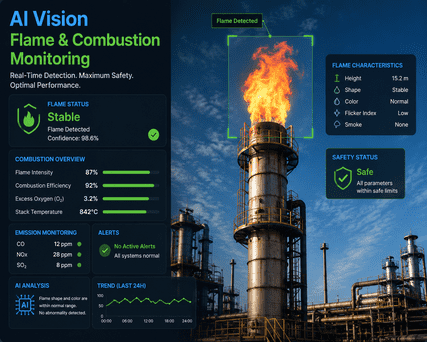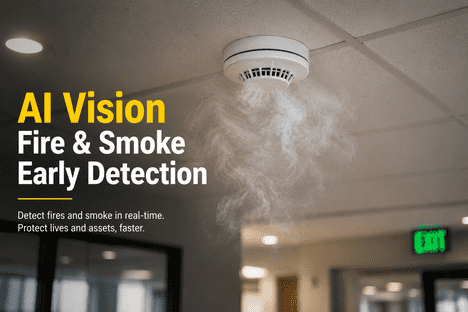
AI vision fire and smoke early detection represents a fundamental shift in how facilities protect assets, operations, and people from ignition events that conventional point sensors consistently miss until flames are already established. Traditional smoke detectors and heat sensors depend on physical particles or thermal thresholds reaching the sensor itself — a detection mechanism that works well in small enclosed spaces but fails in the large, high-bay, and open-plan environments where industrial fires cause the most catastrophic damage. iFactory's AI vision anomaly detection platform continuously analyzes live camera feeds across facility environments to identify the earliest visual signatures of fire and smoke — rising vapor wisps, thermal shimmer, visible flame flicker, and hotspot glow — within seconds of ignition, triggering automated alerts and safety system responses before sprinklers, traditional smoke detectors, or manual observation would register any signal at all. In large warehouses, manufacturing floors, data centers, logistics hubs, and outdoor storage yards, AI vision detection provides the spatial coverage and response speed that point sensor grids simply cannot match at practical installation densities.
Why Conventional Fire Detection Fails in Large Industrial Spaces
Point-based smoke and heat detectors are engineered around a core assumption: that combustion byproducts will travel by convection to a sensor positioned above the fire origin. In small rooms with low ceilings and limited air movement, this assumption holds reliably. In the environments where industrial fires cause the greatest losses — high-bay warehouses, manufacturing floors with overhead ventilation, outdoor storage yards, and large open-plan distribution centers — convection paths are unpredictable, ceiling heights dilute smoke to undetectable concentrations before particles reach sensor arrays, and the horizontal distances between point sensors create detection gaps measured in tens of meters. The consequence is a detection delay that converts a containable ignition event into a facility-destroying fire. Insurance data from large industrial fire losses consistently shows that the window between ignition and the point at which suppression becomes ineffective is measured in minutes, not hours — and that detection delay is the single largest factor determining whether a fire is controlled or catastrophic. AI vision fire detection addresses this failure mode directly by eliminating the dependence on physical particle transport to a sensor. iFactory's AI vision camera platform processes live video across the entire monitored field of view simultaneously — detecting the visual anomalies that characterize early ignition events at the moment they become visible, regardless of ceiling height, ventilation patterns, or distance from the nearest point sensor. Facilities that want to evaluate this detection architecture against their specific environment can Book a Demo with iFactory's fire safety engineering team.
What iFactory's AI Vision System Detects in Fire and Smoke Events
iFactory's vision anomaly detection engine is trained on a comprehensive library of fire and smoke visual signatures across diverse facility environments, lighting conditions, and background complexity levels. The detection model identifies multiple early-stage fire indicators simultaneously rather than relying on a single signal threshold — a multi-signal approach that achieves both the sensitivity needed for early detection and the specificity needed to avoid the false alarm rates that cause facilities to disable or ignore traditional detection systems.
Fire and Smoke Detection Capabilities Across Hazard Types
The platform's detection capability covers the full spectrum of fire development stages — from the earliest pre-flame thermal anomalies and smoke wisps through established flame and structural fire conditions — enabling graduated alert responses matched to the severity and confidence level of each detection event.
| Detection Type | Visual Signal Detected | Typical Environment | Automated Response |
|---|---|---|---|
| Early Smoke Detection | Rising vapor wisps, translucent smoke plumes, visual haze accumulation | Warehousing, manufacturing, data centers | Immediate safety alert, suppression system pre-arm signal |
| Flame Detection | Visible flame flicker, light intensity anomalies, combustion glow patterns | Outdoor storage, loading docks, production lines | Emergency alert dispatch, evacuation system trigger |
| Thermal Hotspot Detection | Infrared surface temperature anomalies, heat shimmer, pre-ignition glow | Electrical rooms, battery storage, process equipment | Maintenance alert, equipment isolation work order |
| Smoldering Detection | Low-visibility smoke accumulation, slow-burn visual signatures | Storage areas, recycling facilities, packaging zones | Escalating alert sequence, area monitoring intensification |
Each detection category uses independent model confidence scoring, and alert responses are configurable by hazard type and facility zone — allowing high-sensitivity smoke detection in critical server and electrical rooms while applying appropriately different thresholds in outdoor areas with ambient environmental smoke sources.
How AI Vision Detection Outperforms Point Sensor Networks
The performance gap between AI vision fire detection and conventional point sensor arrays is most pronounced in the environments where fire losses are most severe. Understanding the specific mechanisms behind this gap is essential for safety engineers and facility managers evaluating detection system upgrades.
Detection Independent of Particle Transport
Conventional smoke detectors require combustion particles to travel from the fire origin to the sensor location — a process that depends on convection currents, facility airflow patterns, and ceiling geometry. In high-bay facilities with overhead HVAC systems, smoke can be dispersed horizontally and diluted below detectable concentrations before reaching ceiling sensors. AI vision detection identifies smoke at the source the moment it becomes visually distinguishable from the background — regardless of air movement, ceiling height, or distance from any sensor position. This detection independence eliminates the physics-based delay that makes point sensors unreliable in large spaces.
Simultaneous Multi-Zone Coverage from Single Camera Positions
A single AI vision camera with a wide field of view monitors a detection area that would require dozens of point sensors to cover at equivalent spatial resolution. In warehouse environments with racking systems, cameras positioned at aisle intersections provide line-of-sight detection across multiple rack bays simultaneously. Point sensor grids installed above racking provide ceiling-level coverage but miss smoldering events within rack structures that are shielded from convection by stored inventory above. AI vision cameras positioned to see into rack faces detect ignition events within the storage structure itself — closing the coverage gap that racking geometry creates in sensor-only detection systems.
Graduated Alert Confidence Reduces False Alarm Rate
False alarms are the primary driver of detection system complacency — when staff experience repeated false activations from cooking odors, steam, or dust, the behavioral response to subsequent alarms deteriorates. iFactory's AI vision system assigns confidence scores to every detection event and applies graduated alert protocols: low-confidence detections trigger investigative alerts that prompt human verification before suppression systems are activated, while high-confidence multi-signal detections trigger immediate automated response. This confidence-graded approach maintains the sensitivity needed for early detection while substantially reducing the nuisance alarm rate that causes facilities to reduce system sensitivity or disable automatic suppression links.
Visual Context for Emergency Responders
When a fire alert triggers, emergency responders need to know exactly where in the facility the event is occurring, what the fire conditions look like, and whether evacuation routes are affected — information that a point sensor alarm provides only as a zone identifier. iFactory's AI vision system transmits the live camera image from the detection zone to the safety management console and the responding team's mobile devices simultaneously, showing the exact location, apparent severity, and smoke propagation direction at the moment of alert. This visual situational awareness enables faster and safer emergency response by eliminating the reconnaissance time responders spend locating the fire origin within a large alarmed zone.
Integration with Suppression, Access Control, and Evacuation Systems
iFactory's platform connects to fire suppression systems, access control infrastructure, PA and evacuation signaling systems, and safety management platforms through OPC-UA and REST API integration — enabling the AI vision detection event to trigger a coordinated facility response rather than a single alarm signal. When smoke is detected in a specific zone, the system can simultaneously alert safety personnel, pre-arm zone suppression, lock access control points to prevent entry into the affected area, activate directional PA instructions for the nearest exit routes, and create an incident record in the safety management system with the detection image and timestamp attached. This integrated response architecture converts early detection into early containment — the combination that determines whether a fire event becomes a manageable incident or a catastrophic loss.
Deployment Environments and Industry Applications
AI vision fire and smoke detection provides its most significant performance advantage over conventional systems in the environments where point sensor physics are most constrained — large spaces, complex geometries, outdoor areas, and facilities with high-value assets that justify the earliest possible detection. iFactory's platform is deployed across the following high-priority environments where fire detection performance directly determines loss severity outcomes. Facilities in any of these categories can Book a Demo with iFactory's fire safety engineering team to review camera placement strategies and detection architecture for their specific layout.
Distribution Centers and Logistics Facilities
Warehouses with ceiling heights above 10 meters present the most severe point sensor limitation scenario. AI vision cameras positioned at strategic aisle and perimeter locations provide ground-level and mid-bay smoke detection that ceiling sensors cannot achieve. Rack storage creates fire development geometries — rapid vertical flame propagation through rack flues — that require the earliest possible ignition detection to enable suppression before vertical fire spread puts entire rack bays at risk.
Production and Assembly Environments
Manufacturing environments combine high ignition risk from electrical equipment, cutting and welding operations, and flammable material handling with complex spatial geometries that create detection shadows for ceiling-mounted sensors. AI vision cameras monitor equipment surfaces, material handling areas, and process zones simultaneously — detecting thermal anomalies and early smoke at the source rather than waiting for convection to carry signals to overhead detectors.
Server Rooms and Critical Infrastructure
Data centers require the highest possible detection sensitivity and the lowest possible false alarm rate — suppression activation in an operational server environment carries its own significant damage risk. AI vision detection provides early warning of electrical smoldering and rack-level thermal anomalies with the graduated confidence scoring that prevents false suppression activations, while still providing faster detection than aspirating smoke detection systems when visible smoke is present.
Yards, Parking Structures, and Open Storage
Outdoor fire detection is a category where conventional point sensors provide essentially no practical coverage — there is no enclosed space to concentrate smoke toward a sensor, and weather conditions create constant false signal noise for heat detectors. AI vision cameras with outdoor-rated enclosures and models trained on outdoor fire visual signatures provide the only practical automated early detection option for vehicle fires, outdoor material storage ignition events, and perimeter security fire threats.
Energy Storage and EV Charging Infrastructure
Lithium battery thermal runaway events produce thermal hotspot signatures minutes before visible smoke or flame develops — a detection window that thermal vision cameras can capture and that conventional smoke detectors miss entirely. iFactory's platform deploys thermal anomaly detection alongside visible smoke and flame detection for battery storage environments, providing the earliest possible warning of a developing thermal runaway event before it transitions to active fire.
Cleanroom and Precision Manufacturing
Semiconductor manufacturing environments combine extremely high asset values with cleanroom requirements that constrain conventional detection system installation and maintenance. AI vision fire detection integrates with existing cleanroom camera infrastructure without additional penetrations or sensor installations, providing fire monitoring that does not compromise cleanroom integrity while delivering detection performance that protects high-value equipment and in-process inventory from even minor ignition events.
Integration Architecture: From Detection to Coordinated Safety Response
The strategic value of AI vision fire detection is fully realized when detection events automatically trigger a coordinated facility safety response — not when they generate alerts that wait for human acknowledgment before any action is taken. iFactory's platform is built around an open integration architecture that connects detection events to the safety systems, communication tools, and management platforms that facilities already operate.
When iFactory's AI vision anomaly detection engine classifies a fire or smoke event above the configured confidence threshold for a given zone, the platform initiates the response workflow mapped to that zone's risk profile and event type. A high-confidence flame detection event in a warehouse aisle triggers simultaneous actions: safety supervisors and emergency response teams receive mobile alerts with the live camera image and zone location; the facility's fire suppression system receives a zone pre-arm or activation signal through the OPC-UA integration; access control systems lock entry points to the affected zone; PA systems activate with zone-specific evacuation instructions; and an incident record is created in the safety management system with detection timestamp, camera image, confidence score, and zone identification attached. The entire sequence executes in under 60 seconds from the moment the AI model classifies the detection event — without requiring a human to acknowledge an alarm, locate the fire on a floor plan, and manually trigger each downstream system. This response speed, relative to the minutes-long detection and human-dispatch cycle of conventional systems, is the primary determinant of whether AI vision fire detection changes outcomes in real fire events. Organizations that want to see this integration architecture demonstrated with their specific safety system configuration can Book a Demo with iFactory's integration engineering team.
Frequently Asked Questions: AI Vision Fire and Smoke Detection
How does iFactory's AI vision system detect fire faster than conventional smoke detectors?
Conventional smoke detectors require combustion particles to physically travel from the fire source to the sensor — a process that takes minutes in large spaces with high ceilings or active ventilation. iFactory's AI vision system identifies the visual signatures of smoke, flame, and thermal anomalies at the moment they appear in the camera's field of view, independent of any particle transport requirement. In high-bay environments, this difference in detection physics translates to a detection advantage measured in minutes — the window that separates a contained ignition event from an established fire that exceeds suppression system capacity. The platform's deep learning models are trained specifically to distinguish genuine early-stage fire and smoke visual signatures from common background conditions including steam, dust, and reflections that generate false alarms in conventional optical systems.
Can iFactory's platform work with our existing camera infrastructure?
In most facility deployments, iFactory's edge AI processing units connect to existing IP camera networks without requiring camera replacement — provided the existing cameras meet minimum resolution and frame rate specifications for the detection models being deployed. The assessment of existing camera suitability is part of the deployment scoping process: iFactory's team reviews camera specifications, placement geometry, and field-of-view coverage against the detection requirements for each monitored zone, and identifies any positions where additional cameras or repositioning would meaningfully improve detection coverage. Facilities with large installed camera bases often achieve significant deployment cost reductions by leveraging existing infrastructure for fire monitoring alongside the security and operational monitoring those cameras already perform.
What is the false alarm rate of AI vision fire detection compared to conventional detectors?
AI vision fire detection systems with well-calibrated environment-specific models achieve substantially lower false alarm rates than conventional ionization and optical smoke detectors in industrial environments — where cooking, steam, welding fumes, and dust routinely trigger nuisance alarms that erode staff response to genuine alerts. iFactory's platform applies multi-signal confidence scoring that requires concurrent detection of multiple fire visual indicators before triggering high-priority alerts, and uses zone-specific calibration during deployment to establish baseline visual conditions that distinguish genuine anomalies from normal operational visual variability. The result is a false alarm rate that supports the high-sensitivity detection thresholds needed for early fire warning without generating the nuisance alarm frequency that causes facilities to reduce system sensitivity as a workaround.
Which safety and suppression systems does iFactory's platform integrate with?
iFactory's platform integrates with fire suppression systems, building management systems, access control infrastructure, PA and mass notification systems, and safety management platforms through OPC-UA and REST API connections. Specific suppression system integration supports pre-arm and zone activation signals to wet pipe, dry pipe, and gaseous suppression systems — with the integration configured to match the facility's suppression zoning and the confidence threshold levels at which automatic activation is appropriate. Safety management platform integration creates incident records with detection images and timestamps for every alert event, supporting post-incident investigation, insurance documentation, and regulatory compliance reporting. iFactory's engineering team manages integration configuration during deployment and provides documentation for the safety system interfaces required by local authority having jurisdiction for system approval.
How long does deployment of AI vision fire detection take in a large facility?
Deployment timelines depend on facility size, camera infrastructure status, integration complexity, and the extent of environment-specific model calibration required. For facilities with suitable existing IP camera coverage, edge AI unit installation and initial software configuration can be completed in one to three weeks. For facilities requiring new camera installation, timelines extend to four to eight weeks including camera placement design, installation, and cabling. Environment-specific model calibration — the period during which the AI establishes baseline visual conditions for each monitored zone — typically requires two to four weeks of live observation before detection thresholds are finalized for production use. iFactory's engineering team manages the full deployment process and provides commissioning support, including coordination with local fire authorities where AI vision detection is being integrated into the facility's official fire detection system documentation.