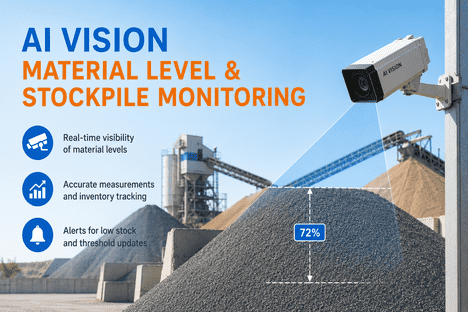
AI vision material level and stockpile monitoring gives operations and inventory teams a continuous, accurate picture of silo levels, bin status, and outdoor stockpile volumes without sending personnel to climb silos, walk yards, or estimate quantities by eye. Material inventory visibility has historically depended on manual rounds, ultrasonic or radar point sensors that struggle with dust, foam, and irregular material surfaces, or periodic survey-based volume estimates that are already stale by the time they reach the planning system. Every one of these methods introduces a lag between the true state of material inventory and what the planning, procurement, and production scheduling systems believe to be true — a lag that drives the two most expensive inventory failure modes in industrial operations: unplanned stockouts that halt production, and overstocking that ties up working capital and yard space unnecessarily. iFactory's AI vision measurement platform replaces this lag with continuous, camera-based volumetric monitoring of silos, hoppers, bins, and open stockpiles, converting visual data into accurate level and volume readings that feed directly into inventory systems and flow control logic in real time.
Why Conventional Level Monitoring Methods Fall Short
Point-based level sensors — ultrasonic, radar, and capacitive probes — were designed for tanks holding uniform liquids in clean, predictable conditions. Applied to bulk solid materials, they encounter a fundamentally different measurement problem. Bulk materials form irregular surfaces with cones, voids, and bridging that a single point measurement cannot characterize. Dust generated during filling and discharge interferes with ultrasonic and optical sensors. Material build-up on sensor faces causes drift that requires regular manual cleaning and recalibration. Outdoor stockpiles present an even more fundamental limitation: there is no practical way to mount a point sensor that captures the volume of an irregularly shaped pile that changes footprint and height with every load added or removed. The result across both silo and stockpile environments is the same operational pattern — inventory teams either trust sensor readings that drift silently out of calibration, or they fall back on manual measurement rounds that are accurate at the moment they are taken but already outdated by the next shift. iFactory's AI vision measurement platform addresses this gap directly by using camera-based volumetric analysis rather than point contact or single-axis distance measurement, capturing the full surface geometry of the material and converting it into an accurate volume calculation continuously, without the dust sensitivity, build-up drift, or surface irregularity problems that limit conventional point sensors. Operations teams evaluating this approach for their specific material handling environment can Book a Demo with iFactory's engineering team.
What iFactory's AI Vision Measurement Platform Monitors
iFactory's vision measurement technology is deployed across the full range of bulk material storage and handling infrastructure found in industrial and processing facilities — from enclosed silos and hoppers to open yard stockpiles spanning thousands of square meters. Each application uses a tailored camera and analysis configuration suited to the specific geometry and material handling pattern of the storage type.
Measurement Applications Across Storage Types
The specific measurement challenge differs significantly between an enclosed silo, an open hopper, and an outdoor stockpile — and iFactory's platform applies the camera placement and analysis methodology suited to each.
Enclosed Silo and Vertical Bin Level Monitoring
For enclosed silos, iFactory deploys downward-facing cameras at the silo crown that capture the full material surface and apply depth-mapping algorithms to calculate fill level and remaining capacity continuously. This approach accounts for the cone and void geometry that forms naturally as material is added and discharged — geometry that a single ultrasonic point reading at the silo center cannot capture accurately when the surface is uneven. The system tracks fill level trends over time, flags abnormal discharge patterns that indicate bridging or rat-holing inside the silo, and integrates with inventory management systems to maintain accurate stock position without requiring personnel to access the silo top for visual or physical checks.
Hopper and Bin Status Monitoring on Production Lines
Feed hoppers and process bins on production lines require frequent level checks to prevent the line stoppages that occur when a feed source runs empty mid-production. iFactory's vision sensors monitor hopper fill level continuously and generate low-level alerts with sufficient lead time for material replenishment to occur before the hopper empties — directly preventing the unplanned production stops that occur when manual checks miss a fast-depleting feed source between scheduled rounds. For multi-hopper production lines, the platform provides a unified dashboard view across every monitored bin, replacing the operator walk-rounds that previously consumed significant shift time on large production floors.
Outdoor Stockpile Volume Estimation
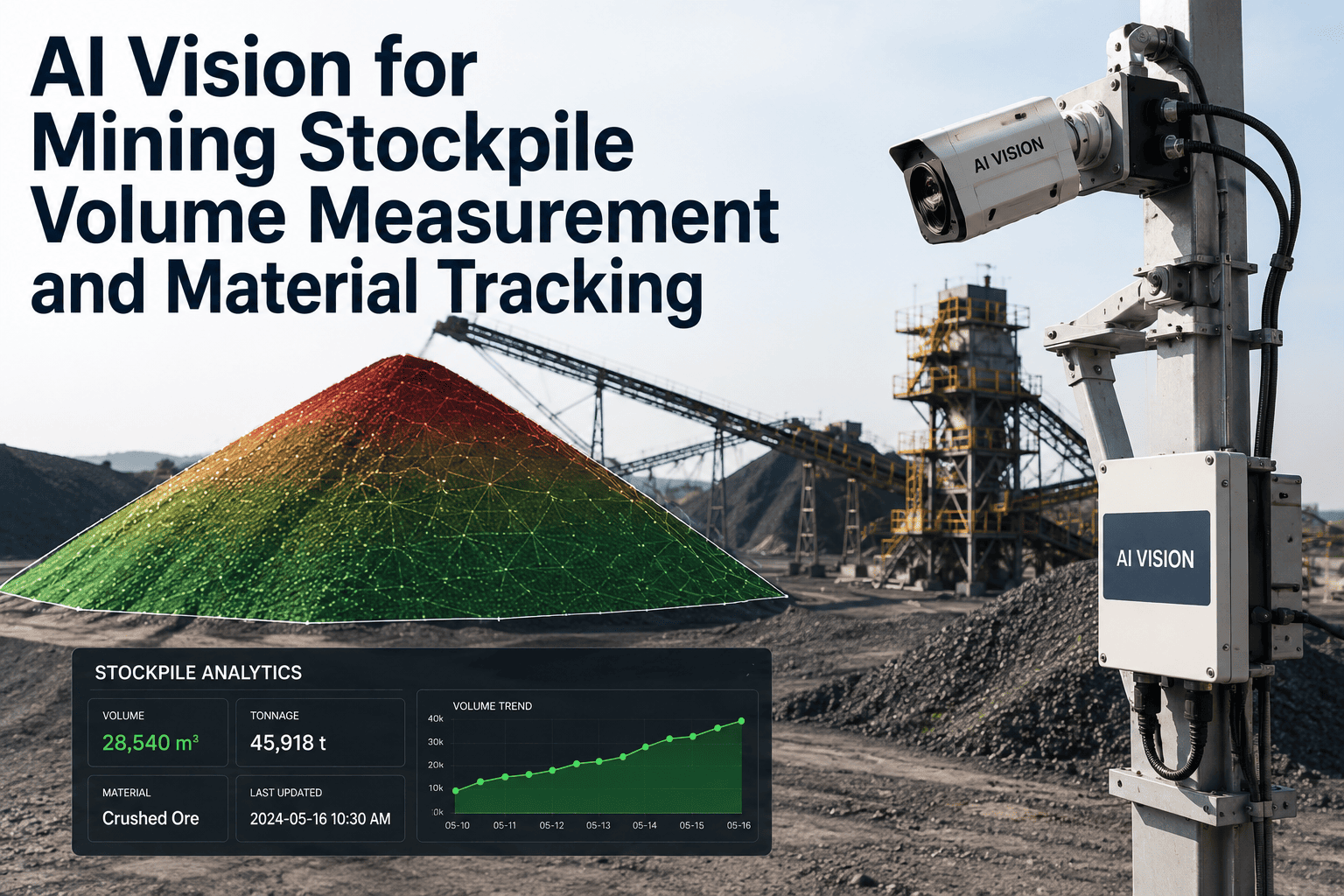
Outdoor stockpiles of aggregate, ore, coal, biomass, and other bulk commodities present the most significant measurement challenge for conventional methods, since there is no enclosed structure to mount a point sensor against. iFactory deploys elevated or drone-assisted camera positions that capture the full stockpile geometry from multiple angles, applying photogrammetric volume calculation to generate accurate tonnage estimates without requiring a surveyor with laser scanning equipment to walk the yard. This continuous stockpile monitoring supports inventory reconciliation, throughput tracking against incoming and outgoing material flows, and the financial reporting accuracy that bulk commodity operations depend on for inventory valuation.
Flow and Discharge Anomaly Detection
Beyond static level measurement, iFactory's platform monitors the rate of change in material level during filling and discharge cycles, identifying anomalies such as slower-than-expected discharge that indicates flow obstruction, bridging, or arching within a silo or hopper. Early detection of these flow anomalies allows maintenance and operations teams to intervene before a complete blockage halts production — converting what would otherwise be a reactive emergency response into a planned corrective action with the material flow data needed to diagnose the specific cause before a technician is dispatched.
From Visual Measurement to Inventory and Flow Control Action
Accurate level and volume measurement only delivers operational value when it connects to the systems that act on inventory data — procurement triggers, production scheduling, and flow control logic. iFactory's platform is built around this connection from the start, ensuring that every measurement becomes usable inventory intelligence rather than a number that still requires manual transcription into a planning spreadsheet.
Real-Time Inventory System Integration
Level and volume readings from every monitored silo, bin, and stockpile feed directly into ERP and inventory management systems via REST API, keeping the system of record continuously synchronized with actual physical inventory rather than relying on the last manual count entered by a warehouse or yard team. This continuous synchronization eliminates the inventory discrepancies that accumulate between periodic physical counts and that typically surface only during scheduled reconciliation, by which point procurement and production decisions have already been made on inaccurate data.
Low-Level and Reorder Point Alerting
iFactory's platform generates automated alerts when monitored material levels cross configured reorder thresholds, routing the alert to procurement and logistics teams with sufficient lead time to schedule replenishment before a stockout occurs. For materials with variable lead times or seasonal supply constraints, alert thresholds can be configured with wider margins, while fast-turnover production line feed sources can be configured with tighter, more responsive thresholds matched to actual consumption rate trends tracked by the system over time.
CMMS Work Order Generation for Flow Issues
When the platform detects a flow anomaly — bridging, rat-holing, or discharge rate deviation — it automatically generates a maintenance work order in the connected CMMS, attaching the level trend data and anomaly classification that gives the responding technician immediate diagnostic context. This closes the loop between material flow monitoring and the maintenance response required to resolve the underlying mechanical or material condition causing the flow disruption, without requiring a separate inspection step to first confirm that a problem exists.
Historical Trend Analytics for Demand Planning
Continuous level and volume data accumulated over weeks and months provides the consumption rate history that demand planning and procurement teams need to optimize reorder quantities and timing against actual usage patterns rather than estimated averages. This historical trend visibility supports more accurate safety stock calculations, identifies seasonal or production-cycle-driven consumption variability that flat reorder rules miss, and provides the audit trail needed for inventory valuation and financial reporting in bulk commodity operations.
When iFactory's AI vision measurement platform is connected to inventory, procurement, and CMMS systems, the result is a closed-loop architecture where every silo, bin, and stockpile measurement automatically informs the systems that depend on accurate material data — without manual transcription, periodic survey lag, or sensor drift. Reorder alerts trigger before stockouts occur. Flow anomalies generate maintenance work orders before they cause a production stoppage. Inventory valuation reflects actual measured volumes rather than estimated counts carried forward from the last physical survey. Organizations operating this closed-loop architecture consistently reduce both unplanned stockout events and excess safety stock carrying costs, since accurate continuous measurement removes the uncertainty that previously forced planners to maintain wider buffers in both directions. To explore how this integration applies to your specific storage infrastructure, Book a Demo with iFactory's platform team.
AI Vision Measurement Compared to Traditional Level Sensing Methods
Selecting the right measurement technology for a given material and storage configuration requires understanding where each approach performs well and where it consistently falls short under real operating conditions.
| Measurement Method | Dust & Surface Irregularity Tolerance | Volumetric Accuracy on Bulk Solids | Maintenance Burden |
|---|---|---|---|
| Ultrasonic Point Sensors | Poor — signal loss in dusty environments | Low — single point, assumes flat surface | Regular cleaning and recalibration required |
| Radar Level Sensors | Moderate — better than ultrasonic in dust | Low — single point, surface cone errors | Periodic calibration and antenna cleaning |
| Manual Survey / Dip Stick | N/A — direct physical measurement | Moderate — accurate at moment taken, immediately stale | High labor cost, safety access requirements |
| iFactory AI Vision Measurement | High — full-surface optical and depth analysis | High — captures complete surface geometry continuously | Minimal — periodic lens cleaning only |
Industries and Applications
Material level and stockpile monitoring delivers measurable value across every industry that manages bulk material inventory as a core part of its operations. In cement and aggregates, silo-level monitoring of raw material and clinker storage prevents the kiln feed interruptions that are costly to recover from once a production line stops. In mining and metals, stockpile volume tracking of ore, concentrate, and waste rock supports both production planning and the regulatory reporting that mine sites must maintain for resource accounting. In agriculture and food processing, grain and ingredient silo monitoring protects against the spoilage and quality risk that comes from extended storage beyond planned turnover, while also supporting the inventory accuracy needed for commodity trading and contract fulfillment. In power generation, coal and biomass fuel stockpile monitoring supports fuel procurement planning and the inventory valuation required for regulatory and financial reporting. In chemical and bulk materials manufacturing, hopper and silo monitoring across multi-ingredient batching operations prevents the production stoppages and quality deviations that occur when a feed material runs low without adequate warning to the operations team.
Frequently Asked Questions: AI Vision Material Level and Stockpile Monitoring
How accurate is AI vision measurement compared to traditional level sensors for irregular bulk materials?
iFactory's AI vision measurement platform achieves volumetric accuracy above 95% on most bulk material applications by capturing the complete surface geometry of the material rather than relying on a single point measurement. This full-surface approach directly addresses the largest source of error in conventional ultrasonic and radar sensors — the assumption of a flat material surface, which is rarely accurate for bulk solids that naturally form cones, slopes, and voids during filling and discharge. Accuracy is further improved through calibration against known material density and angle-of-repose characteristics specific to each monitored material type during deployment.
Can iFactory's platform monitor outdoor stockpiles that change shape and footprint over time?
Yes — outdoor stockpile monitoring is one of the primary applications for iFactory's vision measurement technology. Elevated or drone-assisted camera positions capture the stockpile from multiple angles, and photogrammetric volume calculation algorithms generate an accurate volume estimate regardless of how the pile's footprint and height change as material is added or removed. This approach eliminates the need for a surveyor with laser scanning equipment to physically walk the yard for each measurement, while providing measurement frequency that periodic survey methods cannot match.
How does iFactory's level monitoring integrate with existing inventory and ERP systems?
iFactory's platform pushes level and volume data to inventory management and ERP systems via REST API integration, keeping the system of record continuously synchronized with actual measured inventory. The integration is configured during deployment to match the inventory item structure and units of measure used in the facility's existing system, and supports automated reorder point alerting that routes directly to procurement workflows. For facilities without a formal inventory system, iFactory's own dashboard provides level tracking, historical trends, and alert management directly within the platform.
What is required to deploy AI vision level monitoring on an existing silo or stockpile?
Deployment requirements depend on the storage type. Enclosed silos require a camera mounting position at the crown with appropriate environmental protection for the operating conditions, typically installed without requiring a full shutdown of the silo. Outdoor stockpiles require either elevated fixed camera positions with line of sight to the full pile area, or periodic drone-based capture for sites where fixed camera coverage is impractical due to pile size or layout changes. iFactory's engineering team conducts a site assessment during the scoping process to determine the optimal camera configuration, and most single-asset deployments are completed within two to four weeks from site survey to live monitoring.
Can the platform distinguish between a slow material flow issue and an empty or near-empty silo?
Yes — iFactory's platform tracks both the absolute level reading and the rate of change in level over time, allowing it to distinguish between a silo that is genuinely depleting toward empty at an expected consumption rate and one where the discharge rate has slowed or stopped due to bridging, rat-holing, or mechanical obstruction while material remains in the silo. This distinction is critical for accurate alerting, since a flow obstruction with material still present requires a maintenance response rather than a replenishment order, and treating it as a simple low-level event would delay the correct corrective action.