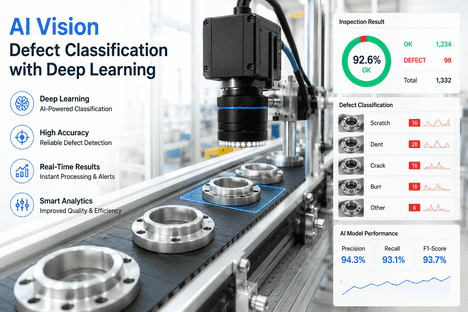
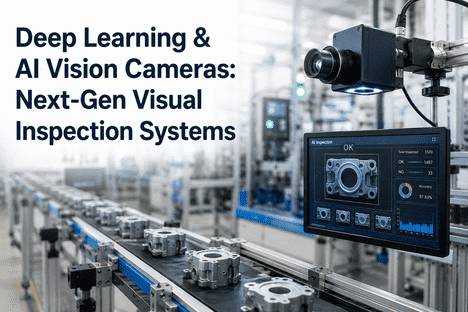
Electronics manufacturers running high-density SMT lines face a quality control reality that traditional Automated Optical Inspection was never designed for: rule-based AOI systems depend on rigid geometry templates and pixel thresholds that perform well on ideal samples and fail the moment real-world variation appears — board warp, lighting shifts, micro-changes in pad alignment, stencil spread, and component height that shift lot to lot. The result is a familiar trade-off that has plagued SMT quality teams for years — tighten the inspection thresholds and false rejects flood the rework line, loosen them and genuine solder bridges, tombstones, and missing components slip through to functional test or, worse, to the customer. AI vision inspection trained on real production variation resolves this trade-off directly, learning to distinguish a legitimate solder fillet from a bridge caused by excess paste or reflow shadowing, and to recognize component placement defects with the fine-grained accuracy that rigid rule libraries cannot match. iFactory's AI Vision Camera platform brings exactly this capability to PCB and electronics assembly lines, detecting solder defects, missing components, misalignment, and tombstoning at production speed while continuously improving detection accuracy from every board inspected. Electronics manufacturers ready to see first-pass yield improvement on their own SMT line can Book a Demo of iFactory's Vision Defect Detection platform today.
Why Rule-Based AOI Misses the Defects That Matter Most on Modern SMT Lines
Conventional AOI systems work by comparing a live board image against a fixed geometry template — a method that performs reliably only when every board, every lighting condition, and every component placement matches the reference exactly. In practice, no production line operates under those ideal conditions. Slight board flex changes reflected edges and produces both false rejects and missed solder bridges. Every new lot introduces micro-shifts in pad alignment, stencil spread, and component height that break rigid inspection rules built for a previous lot. Reflow process variation introduces solder behaviors — head-in-pillow joints, micro-bridges from inconsistent paste deposition — that static rule libraries were never programmed to anticipate. The consequence is an inspection system that requires constant manual reprogramming for every new board revision, and that still allows genuine defects to escape to functional test or final assembly when real-world variation falls outside the rules it was given.
AI vision inspection changes the underlying detection method rather than simply tightening thresholds on the same rigid approach. Deep learning models trained on real production imagery recognize spatial and texture patterns rather than relying purely on geometric template matching — learning to distinguish a legitimate solder fillet from a bridge caused by excess paste, even under mixed or inconsistent lighting. Because the models learn across rotations, board flex, and lighting variation, detection accuracy remains stable as fixture tolerances loosen and board lots shift, eliminating the constant rule-rewriting cycle that consumes process engineering time on conventional AOI deployments.
The Defect Categories iFactory's AI Vision AOI Detects Across the SMT Assembly Process
PCB defects are not a single uniform category — they occur at distinct stages of the SMT assembly process, each with its own visual signature and its own optimal detection point. Catching a defect at solder paste inspection before reflow is dramatically cheaper than catching the same underlying issue after reflow has already produced a defective joint. iFactory's AI vision platform is designed to detect the full range of defect types across every stage of board assembly where visual inspection adds value. Teams evaluating where AI vision fits into their current SPI-AOI-X-ray inspection stack can Book a Demo to walk through deployment options for their specific line configuration.
Solder Joint Defects — Bridges, Insufficient Solder, and Cold Joints
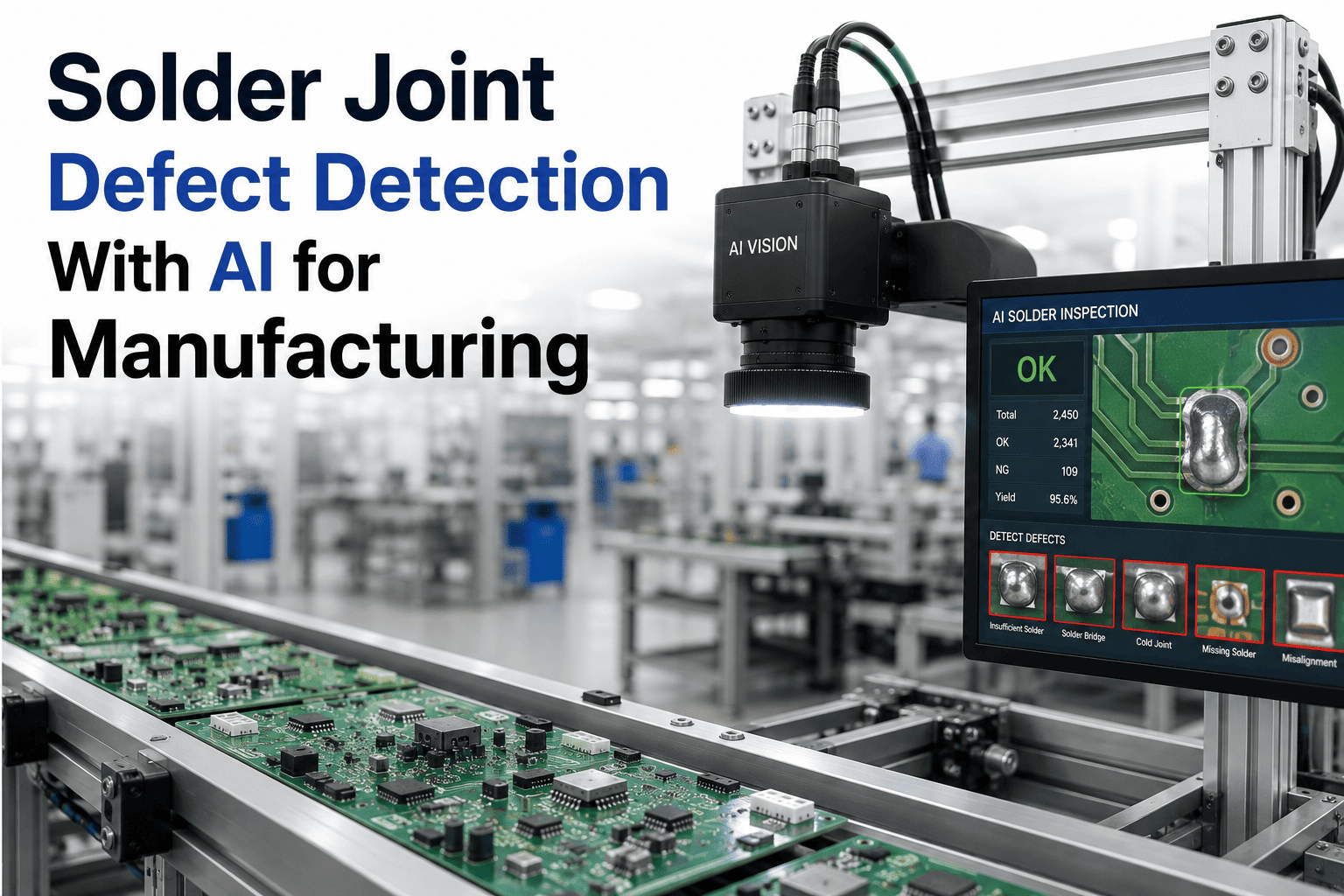
Solder bridges form unintended conductive paths between adjacent pads, often invisible to rule-based AOI when excess paste creates reflow shadowing that mimics normal fillet geometry. Insufficient solder produces concave or absent fillets that compromise joint integrity, while cold solder joints show dull, irregular surfaces that indicate incomplete wetting. iFactory's AI vision models learn the difference between legitimate fillet variation and genuine defect signatures across lighting conditions and board angles, catching solder joint defects that pixel-threshold AOI systems consistently misclassify in either direction.
Missing and Wrong-Value Components
A component not placed during pick-and-place, or lost during reflow, leaves a board with an open circuit that will fail functional test downstream — but catching it at the optical inspection stage avoids the cost and time of a failed test cycle. iFactory's AI vision system verifies component presence against the bill of materials at every position on the board, and where component markings are legible, cross-references value and package against the BOM to catch wrong-value substitutions that pass simple presence checks but fail electrically.
Component Misalignment and Rotation Errors
Components placed outside acceptable tolerance — shifted, rotated, or skewed relative to their intended footprint — can still pass through reflow without producing an obvious open or short, but create marginal solder joints with elevated long-term reliability risk. iFactory's AI vision detection measures component position and orientation against design placement data with sub-pixel precision, flagging misalignment before it becomes an intermittent field failure rather than a clear manufacturing defect.
Tombstoning Detection
Tombstoning occurs when one end of a passive component lifts during reflow due to unbalanced surface tension between its two solder pads — a defect that produces a visually distinctive standing component but whose boundary with simple misalignment can be difficult to resolve in early-stage post-reflow images. iFactory's fine-grained classification models are trained specifically to distinguish tombstoning from misalignment and other placement defects, providing the defect-specific classification that downstream rework and root cause analysis teams need rather than a generic placement-error flag.
Polarity Errors and Bare Board Surface Defects
Polarity errors on diodes, electrolytic capacitors, and ICs are among the most functionally critical defects an AOI system must catch, since a reversed polarized component frequently destroys the board or adjacent components when power is applied. iFactory's AI vision platform also covers bare board inspection prior to component placement — detecting scratches, contamination, delamination, and trace defects that compromise board integrity before any component value is added to the build, preventing defective bare boards from consuming downstream assembly cost.
AI Vision AOI Maturity: From Static Rule-Based Inspection to Continuously Learning Detection
Not every AOI deployment delivers the same inspection accuracy or process value. The gap between a basic rule-based inspection station and a fully AI-optimized, continuously learning vision system is substantial, and understanding where a production line currently sits on this maturity spectrum is the starting point for identifying the highest-value upgrade path.
| Maturity Level | Inspection Method | Defect Coverage | Reprogramming Burden | Typical False-Call Rate |
|---|---|---|---|---|
| Level 1 — Manual Visual Inspection | Human inspector under magnification | Narrow, fatigue-limited | N/A — fully manual | Highly variable, inspector-dependent |
| Level 2 — Rule-Based AOI | Fixed geometry templates, pixel thresholds | Moderate, brittle to variation | High — every new board revision | 15–30% false calls common |
| Level 3 — AOI + Manual Overlay Review | Rule-based flags reviewed by operator | Improved via human judgment | Moderate — rules plus manual tuning | 10–20% false calls common |
| Level 4 — Deep Learning Classification Overlay | AI classifier added atop existing AOI hardware | Broad — fine-grained defect classes | Low — model retraining vs. rule rewriting | Reduced up to 40% vs. rule-based |
| Level 5 — Full AI Vision Inspection | End-to-end deep learning across SPI, AOI, post-reflow | Comprehensive, continuously improving | Minimal — models adapt from production data | 95%+ detection accuracy |
How iFactory AI Vision Camera Strengthens First-Pass Yield on SMT Production Lines
First-pass yield is the single metric that determines whether an SMT line's inspection program is actually working. Every board that passes inspection but fails functional test represents an inspection miss; every board flagged as defective but found acceptable on manual review represents a false call that consumed rework labor and slowed throughput for no quality benefit. iFactory's AI vision platform is built to move both numbers in the right direction simultaneously — catching genuine defects earlier in the process while reducing the false-call rate that drives unnecessary rework station traffic.
Real-Time Multi-Angle Solder Joint Inspection
iFactory's AI vision camera captures solder joint geometry from multiple inspection-relevant angles simultaneously, handling the reflective, highly variable appearance of solder under different lighting conditions that is a known weakness of single-angle, rule-based AOI hardware. Detected solder defects are classified by type — bridge, insufficient, cold joint, excess — with annotated image evidence attached to each flagged board position.
BOM Cross-Reference for Component Verification
Where component markings are legible, iFactory's vision system reads them via integrated OCR and cross-references the result against the bill of materials, catching wrong-value or wrong-package substitutions that pass simple visual presence checks but fail electrically once the board reaches functional test — a defect category that pure geometric AOI cannot detect at all.
Continuous Model Improvement From Production Data
Every board inspected by iFactory's AI vision platform feeds back into the detection models — comparing what the camera flagged against what technicians confirmed at rework, refining defect classification accuracy and reducing false-call rates over time without requiring process engineers to manually rewrite inspection rules for every new board revision or component change.
Inline Integration With Existing SMT Line Infrastructure
iFactory's AI vision platform integrates with SMT line controllers, conveyor systems, and manufacturing execution systems already in place — exporting inspection results in standard formats compatible with SPI, AOI, and X-ray data management systems, so existing process control and yield analytics infrastructure continues to function without disruption.
When iFactory's AI vision camera is deployed alongside or in place of existing rule-based AOI hardware, the result is a closed-loop quality system where every defect detection improves the accuracy of the next inspection. The platform correlates visual findings with line data — yield trends, defect rates by board position, recurring defect patterns by component or supplier — giving process engineers the root cause visibility needed to fix the underlying process issue rather than simply catching its symptom at the inspection station, board after board. Electronics manufacturers running this closed-loop architecture consistently report meaningful first-pass yield improvement alongside reduced false-call rework traffic. To explore how this integration deploys against your current SPI-AOI-X-ray inspection stack, Book a Demo with our platform team.
Key Benefits of AI Vision Inspection for Electronics Manufacturing
The business case for upgrading PCB inspection from rule-based AOI to AI vision detection is well-supported by documented outcomes across consumer electronics, automotive, and industrial assembly lines. The performance improvements below reflect measured results from manufacturers that have progressed beyond static template-matching AOI to deep learning-based inspection.
"We had reached the point where our quality engineers spent more time tuning AOI rule thresholds than actually improving the process. Every new board revision meant another round of reprogramming, and we were still missing tombstoning cases that looked like simple misalignment in the early post-reflow image. Moving to AI vision inspection changed that completely — the system learned to tell the two defect types apart with a precision our rule-based thresholds never achieved, and our false-call rate dropped enough that the rework station stopped being our line's bottleneck. First-pass yield moved in a direction we had not seen in years of incremental rule tuning."
— Quality Engineering Manager, Contract Electronics Manufacturing, SMT Line Operations
Frequently Asked Questions: AI Vision PCB and Electronics Inspection
Conventional AOI compares a live board image against a fixed geometry template, which performs well only when board conditions match the reference closely and requires manual reprogramming for every new board revision or component change. iFactory's AI vision system uses deep learning models trained on real production variation — board flex, lighting shifts, lot-to-lot component differences — to classify defects by their actual visual characteristics rather than rigid template matching, reducing both missed defects and false calls without constant rule rewriting. The platform can overlay onto existing AOI hardware or deploy as a standalone inspection station depending on the production line's current infrastructure.
Yes — this is one of the specific use cases where fine-grained AI classification provides clear value over rule-based detection. Tombstoning and misalignment can share a similar visual signature in early-stage post-reflow images, since both involve a component positioned outside its intended footprint. iFactory's models are trained specifically to resolve this distinction, classifying each defect by its actual failure mechanism rather than flagging both as a generic placement error, which gives rework and root cause analysis teams the precise defect data needed to target the correct corrective action.
iFactory's AI vision platform supports inspection at every stage where visual defects can be caught — bare board inspection before component placement, post-placement verification before reflow, and post-reflow solder joint and component inspection. Catching a defect earlier in the process is always less costly than catching the same underlying issue further downstream, so most manufacturers prioritize deployment at post-reflow inspection first, where solder joint and tombstoning defects are most visually distinct, before extending coverage to earlier process stages.
No — iFactory's platform is designed to integrate with SMT line controllers, conveyor systems, and manufacturing execution systems already in place, and can overlay onto existing AOI camera infrastructure where compatible, or deploy as an additional inspection station at the point in the line where it adds the most value. Inspection results export in standard formats compatible with existing SPI, AOI, and X-ray data management systems, so current yield analytics and process control infrastructure continues to function without disruption. Book a Demo to review the integration approach for your specific line configuration.
A turnkey pilot covers imaging environment assessment at the selected inspection point, camera and lighting configuration for the specific board types and component mix being run, model development and validation against representative defect samples drawn from current scrap and rework data, shadow-mode validation alongside existing AOI for direct comparison, and live defect-alert commissioning. Pilots are typically scoped to the board family or production line generating the highest current defect escape rate or false-call volume. Book a Demo to discuss the pilot scope appropriate for your SMT line.