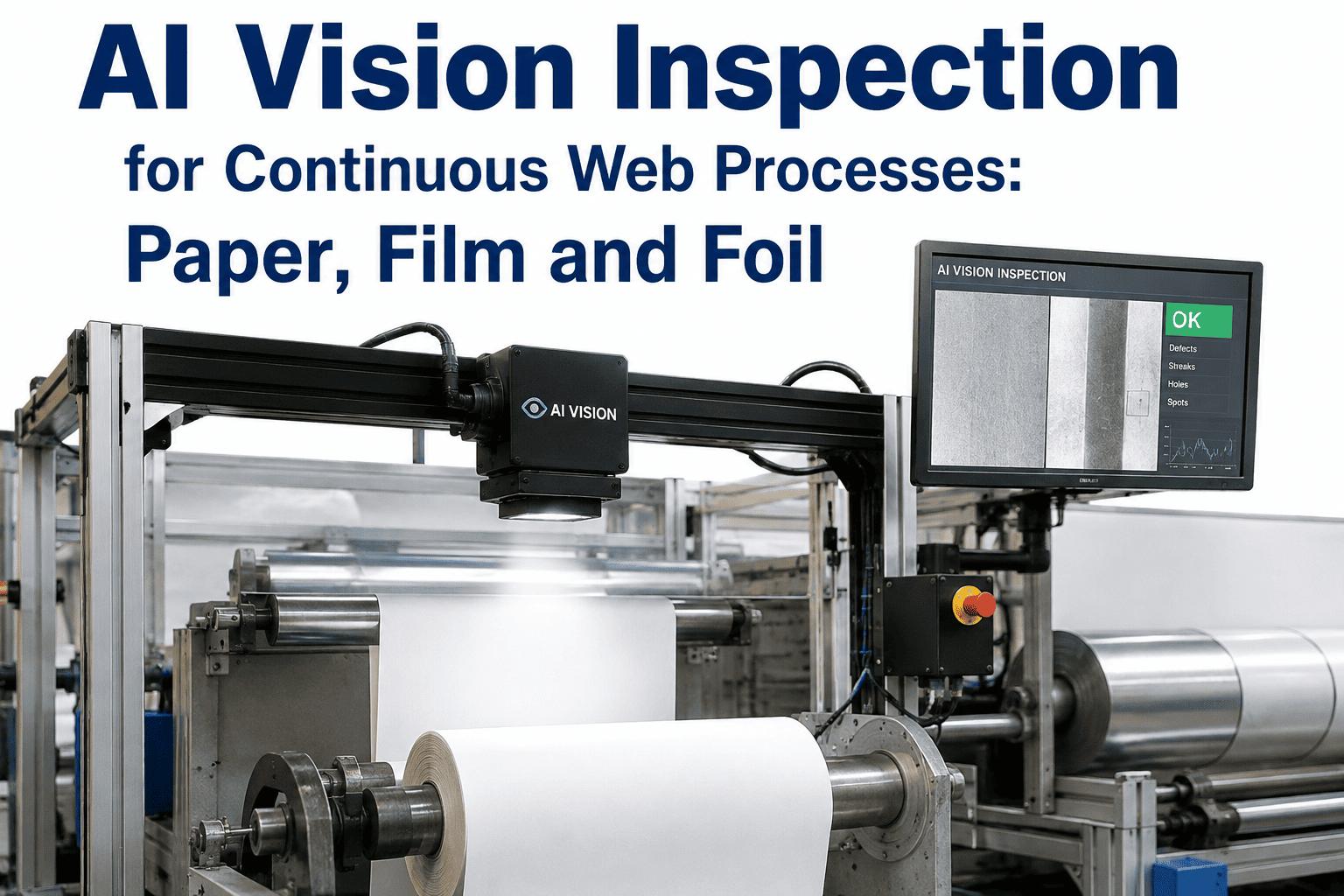
[0High-speed paper, film, and nonwoven web production runs at line speeds that frequently exceed 1,000 to 2,000 meters per minute — a throughput rate at which a single undetected hole, streak, wrinkle, or contamination event can propagate through tens of thousands of meters of product before the next manual quality check has any chance of catching it. The economic consequence of this detection lag is twofold and severe: web breaks caused by undetected defects halt the entire production line for the time required to re-thread and restart, often consuming thirty minutes to several hours of lost production per break event, while defective material that does not break the web but fails downstream customer specifications generates costly claims, returns, and converting waste once it reaches packaging, printing, or laminating operations. Manual web inspection — operators visually scanning a moving web or reviewing periodic samples pulled from the line — was never capable of providing reliable full-width, full-length coverage at these speeds, and the gap has only widened as production lines have accelerated while inspection staffing has not scaled proportionally. iFactory's AI vision camera platform closes this gap with continuous, full-width web inspection at full line speed — detecting holes, streaks, wrinkles, contamination, and surface defects in real time and triggering immediate operator alerts and automated defect marking before a developing problem propagates into a web break or a roll of out-of-specification material. Paper, film, and packaging manufacturers evaluating their current web inspection architecture regularly choose to Book a Demo with iFactory's engineering team to see full-speed defect detection demonstrated on their specific web material and defect catalogue, with a turnkey AI vision quote available after the initial assessment.
Why Web Break Prevention Is the Highest-Value Inspection Outcome in Paper and Film Production
Web breaks are the single most expensive recurring production event in high-speed paper, film, and nonwoven manufacturing — not because any individual break is catastrophic, but because the frequency and cumulative cost across a production year is substantial even at facilities that consider their break rate well-controlled. A typical web break on a high-speed paper or film line consumes the production time required to clear the break, re-thread the web through the process, and ramp the line back to full speed — a sequence that commonly takes thirty minutes to two hours depending on line complexity, with the lost production value compounding at the line's full-speed output rate for the entire downtime duration. Because the majority of web breaks originate from a detectable defect precursor — a hole that propagates under tension, a streak that indicates a coating or forming irregularity, a wrinkle that creates a stress concentration point — the opportunity to prevent the break exists in the window between defect formation and defect-induced failure. iFactory's AI vision camera platform is positioned specifically to exploit this window, providing continuous full-width inspection that identifies defect precursors in real time and alerts operators to intervene — adjusting tension, correcting a coating head, or scheduling a controlled stop — before the defect reaches the failure point that an uncontrolled break represents.
Defect Classes Detected on Paper, Film, and Nonwoven Webs
Effective web inspection requires detection coverage across a defect taxonomy that spans structural defects capable of causing a web break, surface defects that affect converting and print quality, and contamination defects that affect end-product performance. iFactory's AI vision models are trained on defect imagery specific to each web material class — paper and paperboard, plastic film, foil, and nonwoven textile substrates each present distinct optical and structural defect signatures that require matched detection approaches.
Holes, Tears, and Pinholes
Holes and pinholes are the most direct precursor to a web break — a hole under tension propagates into a tear that frequently runs across the full web width and stops the line. AI vision detection of holes ranging from sub-millimeter pinholes to larger tears uses transmitted and reflected illumination configurations matched to the web material's opacity, with detection thresholds calibrated to flag pinhole formation rates that indicate developing forming, coating, or converting process issues well before a single hole grows large enough to fail under line tension.
Streaks, Bands, and Coating Non-Uniformity
Streaks and bands running in the machine direction typically indicate a coating head, doctor blade, or wire/felt condition issue, while cross-direction bands often correlate with a calendering, drying, or forming process parameter cycling at a frequency tied to a specific roll or section of the process line. AI vision detects both orientations of streak and band defects with classification that distinguishes the specific visual signature of each — enabling process engineers to correlate the defect pattern back to its likely originating process zone rather than only knowing that a streak defect occurred somewhere on the line.
Wrinkles, Creases, and Web Handling Defects
Wrinkles and creases create stress concentration points that significantly increase break probability under normal line tension, and they typically originate from roller misalignment, uneven tension across the web width, or moisture/temperature gradients in paper and nonwoven webs. AI vision detection of wrinkle and crease patterns uses surface topology imaging — structured light or shadow-based illumination that reveals the three-dimensional surface deformation that distinguishes a wrinkle from a flat surface defect — providing the early detection that allows tension and alignment correction before the wrinkle frequency or severity reaches break-inducing levels.
Contamination — Dirt Specks, Foreign Fiber, and Gel Particles
Contamination defects including dirt specks, foreign fiber inclusion, and gel or contaminant particles affect product appearance and downstream performance — particularly critical for packaging webs destined for food contact, pharmaceutical, or printed graphic applications where visual and functional contamination standards are strict. AI vision contamination detection identifies particle size, density, and distribution pattern across the web, distinguishing genuine contamination from normal substrate texture variation using models trained on the specific visual characteristics of the contamination types relevant to each customer's quality specification.
Thickness Variation, Bubbles, and Optical Defects
Thickness variation, bubble inclusion in extruded film, and optical defects such as haze patches or gauge bands affect both structural integrity and end-use performance, particularly in barrier film and laminate applications where thickness uniformity is a specified quality parameter. AI vision detection of these defect classes uses optical density and gauge profile imaging alongside conventional surface defect detection, providing a combined structural and optical quality assessment in the same inspection pass rather than requiring separate gauging and visual inspection systems.
From Defect Detection to Roll Mapping and Converting Waste Reduction
The value of web inspection extends beyond break prevention into the downstream converting and packaging operations that consume the finished roll. A defect that does not cause a web break still represents a quality risk if it reaches the converting operation undetected — generating waste, customer claims, or production stoppages at the printing, laminating, or bag-making stage where the defective section is finally discovered. iFactory's AI vision camera platform generates a complete defect map for every roll produced, recording the position, classification, and severity of every detected defect along the roll length and across its width — creating a digital roll quality record that travels with the physical roll to the converting operation.
When a converting operation receives a roll with an accompanying defect map, the converting line can automatically skip or flag the mapped defect locations during unwind — avoiding the production of defective finished product without requiring the converting operator to visually re-inspect material that has already been fully inspected at the web production stage. This roll mapping capability eliminates the redundant inspection effort that occurs when converting operations run their own visual checks on material that should already carry complete quality documentation, and it reduces converting waste by allowing precise removal of only the defective web section rather than discarding entire roll segments out of uncertainty about where defects are located. For multi-site operations where web production and converting occur at different facilities, the defect map travels with the roll's digital record through the facility's MES or ERP system, ensuring the quality data generated at the production line remains available and actionable at the point of converting regardless of geographic separation between the two operations. Manufacturers running both web production and converting operations can Book a Demo to see how iFactory's roll mapping data integrates with converting line control systems to automate defect avoidance.
| Inspection Approach | Coverage | Break Detection Lead Time | Converting Waste Impact |
|---|---|---|---|
| Manual Visual Inspection | Sampled — operator attention limited | None — breaks detected only at failure | High — undetected defects reach converting |
| Periodic Sample Testing | Sampled — lab testing on cut samples | None — lagged, off-line results | High — full roll quality unknown between samples |
| Basic Optical Sensors (Single-Point) | Partial — limited width coverage | Minimal — narrow detection zone | Moderate — defects outside sensor zone missed |
| iFactory AI Vision Full-Width Inspection | 100% — full width, every meter, full speed | Real-time — early intervention window | Minimized — complete defect map per roll |
Deployment on High-Speed Production Lines — Camera Architecture and Line Integration
Web inspection systems must be engineered for the specific line speed, web width, and material characteristics of each production line — there is no universal camera configuration that performs equally well on a 10-meter-wide paper machine and a 1.5-meter-wide film extrusion line. iFactory's deployment engineering process specifies camera count, resolution, and illumination configuration based on the web width requiring coverage, the minimum defect size requiring detection, and the line speed determining the required image capture rate. Line-scan camera arrays positioned across the full web width capture continuous imagery as the web passes beneath, with the edge compute architecture processing each image frame within the time available before the next frame arrives — a processing budget that shrinks as line speed increases, making the edge compute hardware specification as critical to system performance as the camera and optics selection. Integration with the line's existing control system uses standard industrial protocols to receive line speed data for image capture rate synchronization and to publish detection alerts and roll-level summary data back to the line HMI and the facility's quality and production systems — ensuring the AI vision system operates as an integrated part of the production line's control architecture rather than a standalone monitoring tool disconnected from operator workflow.
Frequently Asked Questions: AI Vision Web and Roll Defect Inspection
Can AI vision web inspection keep up with line speeds above 1,500 meters per minute without missing defects?
Yes — iFactory's web inspection configurations are engineered specifically for high-speed production, with camera and edge compute hardware specified to match the image capture rate and processing throughput required at the target line speed. At line speeds exceeding 1,500 to 2,000 meters per minute, the camera resolution and line rate are matched to the minimum defect size requiring detection, ensuring that even fast-moving small defects such as pinholes receive adequate image sampling for reliable classification. The edge compute architecture processes each captured frame within the available time budget before the next frame arrives, maintaining real-time detection and alert generation without any backlog or processing delay that would compromise the system's ability to provide actionable, real-time defect alerts at full production speed.
Does the system work across different web materials — paper, plastic film, foil, and nonwoven textiles — on the same production facility?
Yes — iFactory's AI vision platform supports multiple web material types through material-specific inspection models and illumination configurations selected for each material's optical properties. Paper and paperboard webs typically use reflected illumination optimized for surface texture and opacity characteristics; plastic film often benefits from transmitted illumination that reveals internal defects such as bubbles and gels; foil and metallized substrates require illumination configurations that manage specular reflection; nonwoven textiles require detection models trained to distinguish genuine defects from the inherent fiber texture variation of the nonwoven structure. For facilities running multiple web materials on the same or different production lines, the appropriate model and illumination configuration is selected and validated during the deployment engineering phase for each material type in scope.
How does the system distinguish a defect that will cause a web break from a cosmetic defect that does not affect structural integrity?
Defect classification includes both the defect type and a severity assessment based on size, location, and the defect's known relationship to structural failure risk for that specific web material and process. Holes and tears above a configurable size threshold, and wrinkles or creases exceeding a severity threshold correlated with break risk, are flagged with high-priority alerts that prompt immediate operator attention or automated line response. Cosmetic surface defects, minor contamination, and lower-severity streak or band defects are logged and mapped for roll-level quality documentation and converting waste avoidance without necessarily triggering an immediate line intervention alert. This tiered alerting approach — calibrated during deployment using the facility's own historical break and defect data — ensures operators receive actionable, prioritized alerts rather than an undifferentiated stream of every minor defect detected across the web.
What does the turnkey deployment process look like, and how long does installation take?
A turnkey deployment begins with a line and material assessment to specify the camera array, illumination, and edge compute configuration matched to the web width, line speed, and defect detection requirements of the facility. Physical installation of the camera array and lighting on the production line is typically completed in 2–5 days depending on line accessibility and the number of inspection zones required, with installation scheduled to minimize production interruption. Following installation, the inspection models are calibrated using imagery captured from the actual production line and material, with a validation period running the system in monitoring mode alongside existing quality processes before live alerting and roll mapping are activated. Full operational deployment, including HMI integration and roll mapping data routing to MES or ERP systems, is typically complete within 4–8 weeks of the initial assessment, with a turnkey quote provided after the line and material assessment confirms the specific configuration required.
How does the platform integrate with existing line control systems and downstream converting operations?
Integration with the production line control system uses OPC-UA to receive line speed and production order data for synchronized image capture and to publish real-time defect alerts to the operator HMI. Roll-level defect map data is generated automatically at roll changeover and routed via REST API to the facility's MES or ERP system, attaching the digital quality record to the roll's production lot identifier. For facilities with downstream converting operations — whether on the same site or at a separate facility — the roll defect map is structured for consumption by converting line control systems, enabling automated defect-zone skip or flag functionality during unwind without requiring the converting operation to perform redundant visual inspection. Manufacturers wanting to review the specific integration architecture for their line control and MES environment can Book a Demo with iFactory's integration engineering team.