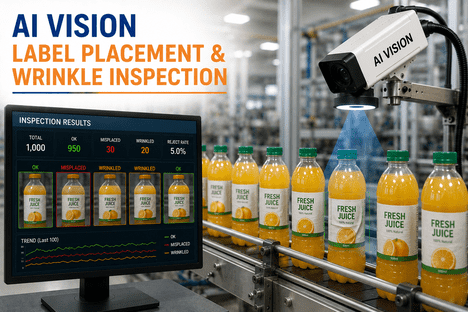
A label that is skewed by a few degrees, lifted at one corner, or creased across the printed text looks like a minor cosmetic flaw — until it reaches a retail shelf, fails a customer's barcode scan, or draws a regulatory flag for an obscured allergen statement. Label placement and surface defects are among the most visually obvious quality failures a product can carry, yet they are also among the most commonly missed on high-speed lines, because a human inspector sampling one pack in fifty simply cannot catch a wrinkle that appears intermittently on one labeler head out of four. AI vision label placement and wrinkle inspection checks every label on every unit — position, skew angle, surface condition, and presence — at full line speed, so a defect that would have shipped gets caught and routed to maintenance before it becomes a pattern.
Why Label Placement and Wrinkle Defects Are So Easy to Miss — and So Costly to Let Through
Label application looks like a simple mechanical step, but it depends on a chain of variables that drift constantly: web tension on the labeler, applicator pad alignment, container surface curvature, adhesive temperature, and line speed all interact to determine whether a label lands straight and flat or skewed and creased. A label that goes on a few degrees off-angle might still scan and might still read correctly, but it signals an inconsistency that compounds into bigger problems — a label that is rotated far enough can overlap a barcode, fold over a tamper seam, or obscure a regulatory statement that is required to stay visible. A wrinkle or air bubble trapped under a label during application is often invisible from a top-down camera angle but plainly visible from the side, which is exactly why single-camera rule-based systems and manual spot checks miss it so often. None of these defects affect what is inside the package, which is precisely what makes them dangerous from a quality perspective — a customer who receives a crooked or wrinkled label questions the integrity of the whole product, even though nothing about the contents has changed.
What iFactory's AI Vision Camera Checks on Every Label
iFactory's AI vision camera platform applies trained deep learning models to the labeling zone of the line, inspecting the attributes that determine whether a label will hold its position and appearance from application through final delivery. The system verifies label presence, confirming that a label is actually applied to every container rather than relying on a downstream count discrepancy to flag a labeler skip. It measures label position and skew angle against the container's reference features, flagging labels that are rotated, off-center, or applied at the wrong height before they pass the inspection point. It identifies surface defects including wrinkles, creases, air bubbles, and folded edges that occur when adhesive temperature or applicator pressure varies during application. It also detects peeling, lifting corners, and torn labels that indicate adhesion failure, which often appears only after a few minutes of handling rather than at the moment of application. Because the inspection runs on every unit at full line speed rather than on a sample, a labeler head that begins drifting out of alignment shows up as a defect trend within minutes rather than after a full shift of mislabeled product has already been cased and shipped.
Four Categories of Label Defects and How AI Vision Detects Each
Label quality failures generally fall into four recognizable categories, each with its own root cause and its own visual signature. Mapping detection coverage to these categories helps quality and packaging teams understand exactly what an AI vision deployment is protecting against, rather than treating label inspection as one undifferentiated check.
| Defect Category | Typical Root Cause | Downstream Risk | AI Vision Detection Method |
|---|---|---|---|
| Missing Label | Labeler feed jam, web break, sensor miss | Unlabeled product shipped, traceability gap | Presence detection on every unit |
| Skewed or Misaligned Label | Applicator pad misalignment, container rotation drift | Barcode overlap, obscured statements, brand inconsistency | Angle and position measurement against reference points |
| Wrinkles, Bubbles & Creases | Adhesive temperature variance, applicator pressure drift | Poor shelf appearance, perceived quality issue | Surface texture analysis across multiple camera angles |
| Peeling or Lifting Edges | Adhesion failure, container surface contamination | Label loss in transit, unreadable product at point of sale | Edge-contour classification and adhesion-pattern detection |
Each category requires a slightly different inspection approach to catch reliably. Skew and position errors are measured against fixed reference points on the container, while wrinkles and bubbles are surface-texture defects that are easiest to see from an angled or side-mounted camera rather than a single top-down view. iFactory configures multi-camera coverage around the labeling station so that both placement geometry and surface condition are checked on the same pass, rather than requiring separate inspection stations for each defect type.
From Defect Detection to Automated Work Order: How the Closed Loop Works
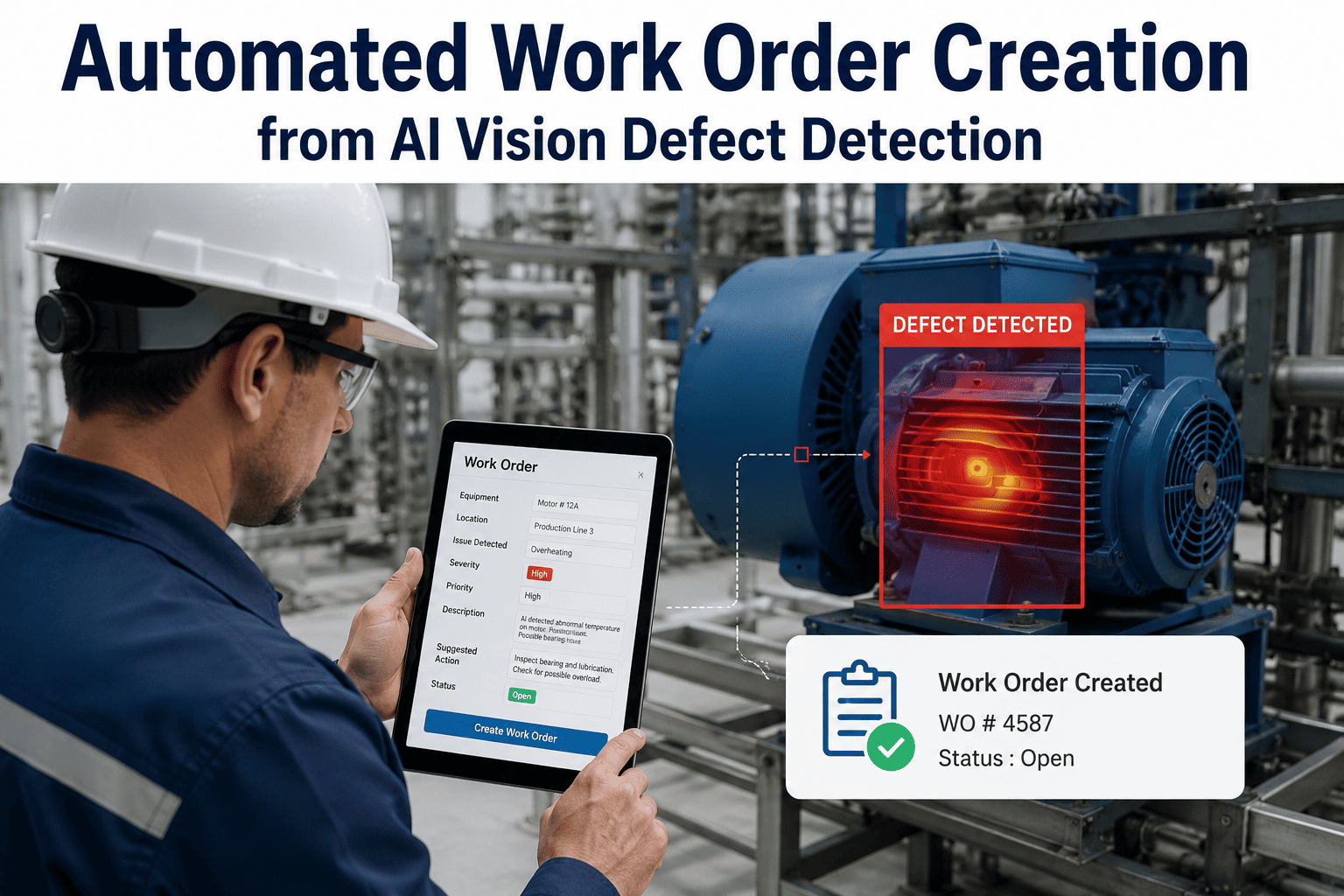
Catching a label defect only creates value if it reaches the right person fast enough to fix the root cause. iFactory's AI vision camera runs on-premise edge AI, processing every frame locally with sub-50ms inference so a defect is classified before the next unit reaches the labeling station. When a label defect is detected, the platform automatically raises a work order with the annotated image attached, showing exactly which unit failed and which defect category triggered the flag. That work order routes to the assigned technician through SAP PM, OPC-UA, MQTT, or REST API, depending on how the facility's CMMS is configured, eliminating the manual review and paperwork that normally separates a defect sighting from a maintenance response. When defects trace back to a mechanical cause — a labeler applicator pad that needs realignment, an adhesive heater that is drifting out of its temperature range — the system tags the underlying asset, so repeated defects on the same labeling head surface as a clear pattern in the maintenance history instead of a string of disconnected rejects. Teams that want to see this detection-to-work-order flow running on their own label types and container shapes can Book a Demo with iFactory's engineering team.
Where Label Placement Inspection Matters Most
Label quality stakes differ by what is printed on the label, but the underlying inspection need is consistent everywhere a product carries a label that has to land straight, stay flat, and stay attached. Food and beverage packaging depends on accurate label placement to keep allergen statements, nutrition panels, and date codes fully visible and unobscured by a folded edge. Pharmaceutical and nutraceutical labeling carries regulatory weight where a wrinkled or skewed label that obscures a lot code or dosage instruction is a compliance issue as much as a cosmetic one. Cosmetics and personal care lines run high SKU variety with labels in many shapes and finishes, where a skewed label on a glass or curved container is especially visible to the end consumer and especially hard for rule-based vision systems to handle consistently. Household and industrial product packaging depends on label durability through handling and transit, where a peeling or lifting label found at the distribution center is far more expensive to address than one caught at the point of application. Across all of these, the inspection logic — verify presence, position, skew, and surface condition on every unit — stays the same, while the specific tolerances and camera setup are tuned to the label material, container shape, and line speed in use.
iFactory's AI vision camera platform does not require replacing existing line cameras to add label inspection. The system works with existing IP cameras over ONVIF and RTSP, and on-premise NVIDIA GPU hardware runs the detection models locally so no inspection data or video leaves the facility. Models reach high accuracy within the first week of active learning on your specific label stock, container geometry, and applicator setup, and the configuration scales from a single labeling station to multiple lines across a plant as confidence in the results builds. Most teams evaluating label inspection for the first time start with the labeling and capping zone together, since both stations sit close together on most packaging lines and both benefit from the same camera coverage.
Frequently Asked Questions About AI Vision Label Placement and Wrinkle Inspection
How is AI vision label inspection different from a barcode scanner or label sensor?
A barcode scanner or photoelectric label sensor confirms that a label exists and that a code is readable, but neither one evaluates how the label looks or whether it is positioned correctly. A label can be present, scannable, and still be wrinkled, skewed several degrees off-angle, or peeling at one corner — defects that a presence sensor has no way to detect. AI vision inspection adds the visual layer that sensors cannot provide: position measurement against reference points, surface texture analysis for wrinkles and bubbles, and edge-condition classification for peeling or lifting labels, all checked on every unit rather than relying on the binary present-or-absent signal a sensor returns.
What typically causes labels to wrinkle or bubble during application?
Wrinkles and air bubbles under a label are usually traced to a small set of mechanical causes: adhesive that is applied too cold or too hot for the line speed, an applicator pad pressure setting that is uneven across the label width, or a container surface with residual moisture or contamination that prevents a clean bond. Web tension on the labeler itself can also introduce wrinkling if it fluctuates during the application stroke. AI vision inspection helps identify which of these causes is active by correlating defect timing and pattern with the specific labeling head and time window in which the wrinkles appeared, rather than only flagging that a defect happened.
Can the system tell the difference between a minor cosmetic wrinkle and a label that will fail in transit?
Yes. The detection models are trained to classify defect severity, not just defect presence, which matters because not every surface irregularity affects whether a label will hold. A faint crease near a corner gets classified differently than a wrinkle that runs across printed text or a lifted edge that indicates adhesion has already started to fail. This distinction keeps false reject rates low, since the system does not need to reject every unit with a minor cosmetic variation — only the units where the defect pattern correlates with an actual placement, readability, or adhesion failure risk.
How quickly can a label inspection system be deployed on an existing labeling line?
Most facilities go live within one to two weeks starting with cameras positioned around the labeling station. Setup involves mounting cameras to capture the label from multiple angles, connecting them via Ethernet, WiFi, or cellular using standard ONVIF and RTSP protocols, and then training the detection models on the specific label stock, container shapes, and skew tolerances running on that line. Because the platform runs on-premise edge AI rather than depending on a cloud connection, there is no dependency on external network bandwidth once the system is configured, and accuracy typically reaches a stable, high level within the first week as the model adapts through active learning on live production data. Facilities ready to map out a deployment plan for their own line can Book a Demo to walk through camera placement and timeline.