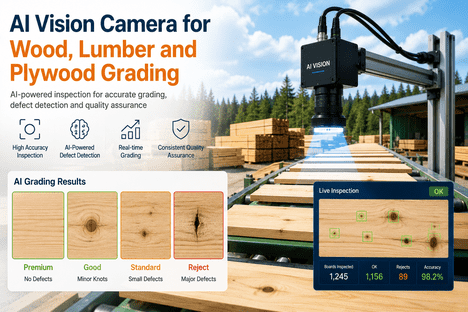
Traditional lumber grading relies on human visual inspection at high-speed production lines — a process where fatigue, lighting variation, and subjective judgment lead to inconsistent grade assignments and missed value recovery opportunities. An AI Vision Lumber & Wood Defect Grading system replaces manual inspection with deep learning models trained on millions of board images, enabling real-time detection of knots, splits, wane, checks, stain, and dimensional deviations at line speeds exceeding 400 feet per minute. iFactory's Vision Classification platform — powered by our AI vision camera technology — mounts directly over grading chains and planer mills to capture high-resolution surface imagery across four faces of every board, classifying defects with accuracy above 95% and triggering real-time sort gate commands without production interruption. Unlike competitive systems that require weeks of camera calibration and model retraining for each species shift, iFactory's edge AI architecture adapts to species changes, moisture content variation, and sawtooth wear patterns through continuous online learning — maintaining grading precision across mixed hardwood runs, softwood batches, and specialty cuts without operator intervention.
Grade Every Board with AI Precision
Replace subjective manual grading with real-time AI defect detection at line speed. Start recovering value you are leaving on the mill floor.
How AI Vision Transforms Lumber Grading Operations
Every board that passes through a planer mill or grading chain represents a value decision — which grade it earns, which sort bin it enters, and what price it commands. Manual grading introduces variability between shifts, between graders, and across species runs, costing mills 3–8% of potential revenue in mis-graded boards and missed high-grade recovery. AI vision lumber grading eliminates that variability by applying the same consistent defect classification model to every board, every shift, every day. iFactory's Vision Classification engine analyzes each board surface for 20+ defect categories — including sound knots, loose knots, bark pockets, pitch pockets, wane, skip, wormholes, and machine burn — and produces a real-time grade assignment that aligns with NHLA, CLS, and custom mill grade rules. The system outputs sort commands directly to downstream diverters, ink-jet markers, and trim saws, closing the loop from detection to decision within milliseconds. Book a Demo to see how iFactory maps to your specific grading configuration.
The Cost of Inconsistent Wood Defect Detection
A 2024 industry study of North American sawmills found that manual grading accuracy averages 82–87% across a production shift, dropping to 72% during the final two hours before shift change — a period when high-value clears and selects are most frequently mis-graded into lower lumber grades. Each percentage point of grading error on a mill producing 200 million board feet annually represents approximately $180,000 in lost value recovery. AI vision wood defect detection systems from iFactory maintain consistent detection accuracy above 95% across full production runs regardless of shift timing, species changeovers, or line speed variation. The financial impact compounds across every grade boundary — when a FAS board is sold as No. 1 Common, or when a No. 1 Common board containing wane beyond allowable limits ships to a customer who rejects it, the mill absorbs both the downgrade cost and the chargeback penalty.
95%+
AI defect detection accuracy maintained across all shifts and species changeovers
3–8%
Revenue recovered from eliminating mis-graded boards and improving grade yield
400+
Feet per minute line speed supported with real-time classification and sort output
Core Capabilities of iFactory AI Vision Lumber Grading
Real-Time Defect Classification
Deep learning models detect knots, splits, wane, checks, stain, skip, pitch pockets, wormholes, and machine burn across 20+ defect categories — assigning NHLA or custom grades at line speed without deceleration.
Four-Face Board Surface Imaging
iFactory's
AI vision camera arrays capture top, bottom, and both edge surfaces simultaneously — illuminating each board face with structured lighting to eliminate shadow artifacts and surface glare that degrade classification accuracy.
Continuous Online Learning
Edge AI models adapt to species changes, moisture content shifts, knife wear patterns, and lighting drift through online retraining — maintaining grading precision across mixed-species runs without operator intervention or camera recalibration.
Sort Gate & Trim Optimization
AI classification outputs feed directly to downstream diverters, ink-jet markers, and trim saw controllers — enabling real-time sort assignment, grade marking, and optimal trim decision to maximize recovery from each defective board.
Defect Mapping & Yield Analytics
Every board generates a pixel-level defect map showing type, location, and severity of each defect — feeding yield dashboards that identify species-specific downgrade patterns, mill configuration drift, and value recovery trends over time.
Production Data Integration
API-native architecture connects classification data to existing mill MES, ERP, and tally systems — enriching production dashboards with per-board grade, defect counts, and recovery metrics without custom middleware development.
Manual Grading vs. AI Vision Lumber Grading
| Performance Area |
Manual Grader Operations |
iFactory AI Vision Grading |
Measurable Impact |
| Defect Detection Accuracy |
82–87% average; drops to 72% at end of shift |
95%+ consistent across all shifts and species |
13–23% accuracy improvement |
| Value Recovery |
3–8% revenue loss from mis-graded boards |
Real-time grade optimization captures lost revenue |
3–8% direct revenue gain |
| Species Changeover |
Grader retraining required; accuracy drops for 30–60 minutes |
Online model adapts within seconds to species shift |
Zero transition loss |
| Defect Documentation |
Paper tally sheets — no traceability per board |
Digital defect map and grade record for every board |
Full audit trail |
| Line Speed Support |
Graders miss defects above 250–300 fpm |
Full classification at 400+ fpm with sub-millisecond inference |
30–60% speed increase |
Ready to Automate Your Lumber Grading?
iFactory's Vision Classification platform deploys over your existing grading chain and begins delivering real-time grade assignments within a 6-week pilot program.
Frequently Asked Questions: AI Vision Lumber & Wood Defect Grading
What defect types can AI vision detect on lumber?
iFactory's Vision Classification engine detects 20+ defect categories including sound knots, loose knots, bark pockets, pitch pockets, wane, skip, checks, splits, wormholes, stain, machine burn, and dimensional deviations. The deep learning model is trained on mill-specific defect presentations and continuously improves through online retraining.
Book a Demo to see defect classification samples from your own species and grade mix.
Does the system handle different wood species without reconfiguration?
Yes. iFactory's edge AI architecture supports mixed-species runs — including hardwoods (oak, maple, cherry, walnut) and softwoods (pine, spruce, fir, hemlock) — with automatic adaptation to species-specific defect appearance, grain patterns, and color variation. The continuous learning model adjusts to moisture content shifts and sawtooth wear patterns without camera recalibration or manual model retraining.
How long does it take to deploy an AI vision grading system?
iFactory's 6-week pilot program includes camera installation over the grading chain, model calibration with your species mix, and integration with existing sort gate controllers and tally systems. Full deployment following a successful pilot typically completes within an additional 4–6 weeks — significantly faster than competitive systems that require 4–6 months of integration engineering.
Can AI lumber grading integrate with existing mill control systems?
Yes. iFactory integrates with Allen-Bradley, Siemens, and Mitsubishi PLCs, major MES platforms, and standard sort gate controllers via OPC-UA, Modbus TCP, and REST APIs. Classification outputs are delivered as standard digital signals for gate actuation and as structured data payloads for ERP and tally system ingestion. Schedule a consultation to review integration requirements for your specific mill configuration.
What is the typical ROI for AI vision lumber grading?
Customers typically achieve positive ROI within 6–9 months, driven by 3–8% revenue recovery from improved grade yield, elimination of chargebacks from mis-graded shipments, and 30–60% line speed increases enabled by reliable AI classification. Mills producing 100+ million board feet annually commonly see annual value recovery exceeding $750,000.
Detect. Grade. Recover.
iFactory's AI vision lumber grading platform gives your mill the ability to classify every board at line speed, eliminate grading subjectivity, and capture the full value of every log — from a single integrated vision system.